
Temu: from $0 to $3 billion in 10 months
...while pressuring staff, merchants and logistics partners.


Table of Contents
Things that caught our attention
Things that caught our attention
"Spending on Temu … was 20% higher than more established fast-fashion retailer Shein in the US in May, according to Bloomberg Second Measure, which analyzes billions of credit and debit card transactions." (Source)
Latepost reported that Douyin has given up this year's target of RMB 100 billion GTV in food delivery because of disappointing progress in the first half of 2023. Q1 GTV was only about RMB 250 million. It is now teaming up with more 3rd party delivery providers. (Source, link in Chinese) Techplanet reports Douyin still has added a dedicated section for (self-operated) food delivery in its app. It is still taking takeaway seriously. (Source, link in Chinese) We wrote about Douyin's local services business in general and food delivery specifically in March.
Daniel Zhang is stepping down as CEO of Alibaba Group to lead the Alibaba Cloud company and ready it for its IPO. (Source) We wrote about Alibaba Cloud in March.
There’s lots of buzz about Alibaba’s Michael Evans saying that Tmall will come to Europe and is running a pilot in Spain. (Source) Evans is actually referring to Miravia (miravia.es), which was launched in December 2022. We tweeted about the platform in April and Techbuzz China team member Ed wrote about it on ChinaTalk.nl in January.
Key takeaways
Since its U.S. launch in September 2022, Temu has expanded to around 20 countries. Its estimated GMV in the first half of 2023 exploded to $3 billion, helped by aggressive social media campaigns and expensive Super Bowl advertising. Its gamification has been showing mixed results.
When Temu shifted its focus from clothing to standardized household and personal care products, it substantially increased its average order value.
In the early months, about half of Temu’s suppliers were manufacturers (who can create products cheaply), the other half were traders (often trying to get rid of excess inventory). 20% of the manufacturers were also operating on Pinduoduo. The others were companies that had previously already been trading cross-border, selling goods on Amazon and Shopee. Temu will use the cheapest supplier.
Temu uses a ‘fully managed’ marketplace approach. Merchants agree on a selling price to Temu and ship goods to its warehouse. Temu sets the consumer price and handles all shipments to the consumer, as well as marketing and customer service. Since the model comes with advantages for Temu, merchants and consumers alike, other cross-border e-commerce players have started copying it.
Temu is putting pressure on staff, logistics partners and merchants. It is shifting more costs to merchants and increasing the pressure to lower prices through a bidding system. Staff works under a merciless horse-racing culture.
Temu has been using the logistical services of J&T Express. J&T is accepting this loss-making business because it is building market share because of an upcoming IPO.
Even though Temu has significant gross margins, it will still lose money since it sees 20-30% logistical costs and 30% marketing costs (incl. customer acquisition), plus taxes, custom duties and storage costs. In total, Temu’s current loss rate is 60%.
AliExpress is no longer focusing on the U.S. and its market share seems to have been taken by Temu. Most of Temu’s other business is coming at the expense of Shein and from small offline shops. Amazon remains a very suitable sales channel for white-label products and native Chinese e-commerce brands like Anker. Therefore the target audience of Amazon highly overlaps with that of Temu. Temu’s product category structure now largely resembles that of Amazon and Shein.
For details on these key takeaways, please subscribe to get full access to the article.
Free subscribers can read part of the full article.
Introduction
Since it launched in the U.S. in September, Temu, Pinduoduo’s cross-border e-commerce platform has taken the internet by storm. Marketplace Pulse recently reported that either Temu or its fellow Chinese webshop Shein was the number one downloaded app in half of the fifty largest economies in the world. Temu was the most downloaded app in all countries it had formally launched in, driven by aggressive promotional campaigns on social media like Facebook, YouTube and Instagram.
In December we published the Techbuzz China Insider article Temu - Pinduoduo's Cross-Border E-commerce Platform. The article gathered all information from expert interviews in the Six Degrees database available at the time.
A lot has happened since. Temu already went through several changes and more information about its business model, operations, successes and challenges has become available. In this article, we’re giving you an update and new proprietary knowledge from the Six Degrees database and Chinese language media.
Freya Zhang, Ed Sander & Rui Ma

(click on the images above for information on the Tech Buzz China team)
The early months
Since launching in the U.S. in September 2022, Temu has made remarkably strong and fast progress. In the first month after its launch, it spent RMB 1 billion (~$140 million) on marketing. According to data analysis firm Apptopia, Temu has also paid for more than 900 app store search terms to get to the top of listings. The investments paid off: in 2 months, it surpassed the popular Chinese webshop Shein in the shopping app charts. Temu would stay at the top of the app charts until OpenAI launched its mobile ChatGPT app in mid-May.
Pinduoduo initially downplayed the fact that Temu was their product. But in November, the importance of Temu became clear when Pinduoduo upgraded its corporate identity to ‘Pinduoduo Holdings’: ‘a multinational commerce group that owns and operates a portfolio of businesses, including Temu, an e-commerce marketplace for North American consumers, and Pinduoduo, a leading social commerce platform.’
According to Sensor Tower, Temu had 41 million unique visitors between November and December 2022. On this metric, it had also overtaken Shein, which had 36.6 million in the U.S. in the same period. And that’s all within 4 months of Temu’s launch …
Enter gamification
By the end of 2022, Temu had started rolling out gamification in its app. By January, it was continuously adding new games. Among these were Daily Gift Box, Earn Credits, Free Gift, Cash Rewards, Redeem Cash, Lucky Flip, Fishland and Farmland.


These games followed the same pattern as those in Pinduoduo. Users can earn free products, discounts and even cash payouts. Initial progress in the game is easy but to actually claim a reward users will need to recruit friends to the app, watch product feeds or log in multiple times a day. All of this is meant to bring down acquisition and retention costs for Temu.
Users can get cheaper products by inviting friends. In one game, users can buy a product for a very low price after inviting two friends to download the app. In another game, users get a 30% discount coupon, to be used on any product, after inviting one user.
But the most important game in this stage is without a doubt the ‘price cut’ tactic also used in sister-app Pinduoduo (as 砍一刀). A user picks a free gift and asks friends to help reduce the price of an item. The more friends join (and download the app if they are not yet using it) the lower the price. But the invited users do not benefit. At the end of 2022, quantitative data showed that the effect of Temu’s ‘price cut’ was poor. Less than 1% of sales came from these products and the conclusion was that Western consumers were not willing to inform others that they wanted to buy cheap products.

By February, the Temu games had been promoted to the app’s home screen. Interestingly enough, two of the three Techbuzz China team members have seen the games disappear from the app, while a third could still access them through the profile menu.
As in Pinduoduo, there is also the option to earn free cash. When this gamification started, a user could get $20 and $80 in coupons when recruiting 7 new users, a threshold that was later lowered to 5 users. Chinese users in the U.S. could even get $20 paid directly to their WeChat account. On Facebook and Instagram, users would exchange invitation codes to receive this cash.
The approach of investing heavily in discounts and subsidies on products to attract new users and then having these users recruit friends and family through gamification is basically copying the successful model Pinduoduo used when it launched some 7 years ago.
This is a smart strategy to grow the user base at relatively low acquisition costs. In the U.S., the normal customer acquisition cost for webshops is $30-$35. According to 36Kr, the cost of acquiring a single user through Facebook in the US was $35 in the first half of 2022.
In the early months, Temu’s customer acquisition costs, which consist of advertising, product subsidies and coupon discounts, were as high as $42. But now, Temu gets people to download the app for $5 and spends a total of $10-$25 to complete a first order. By comparison, Shein’s acquisition costs are estimated to be $25-30, with subsidized logistics costs being 20%.
The large discounts and viral campaigns resulted in a conversion rate of 10%, far higher than the industry average of 2%.
In 2022, the 30-day repurchase rate on Temu was 10%, which is relatively low in the sector (Shein’s is more than 30%). More recently it has climbed to 20% and according to some sources even 35%. But some of these sales were generated by promotional leaflets in shipping packages and coupons for repurchases. Thus, sustainability of these metrics is in question.
Apps like Temu, which use recommendation algorithms to make personalised product feeds based on purchased and browsed products, need to gather a large user base quickly. That’s another reason for the heavy investments in customer acquisition. As such, it follows the same strategy of heavy advertising on popular social media we've seen before with TikTok.
Into 2023
In January 2023, Sensor Tower reported the following figures:
20 million total worldwide downloads
16 million Monthly Active Users (MAU)
10 million transacting customers, 90% of which came from the U.S.
The Temu app's 7-day retention rate increased from 14% in November to 22%
Average order value had increased from $20-$25 in November (with 3-4 items per order on average) to $35 (Temu was aiming to further increase this to $50)
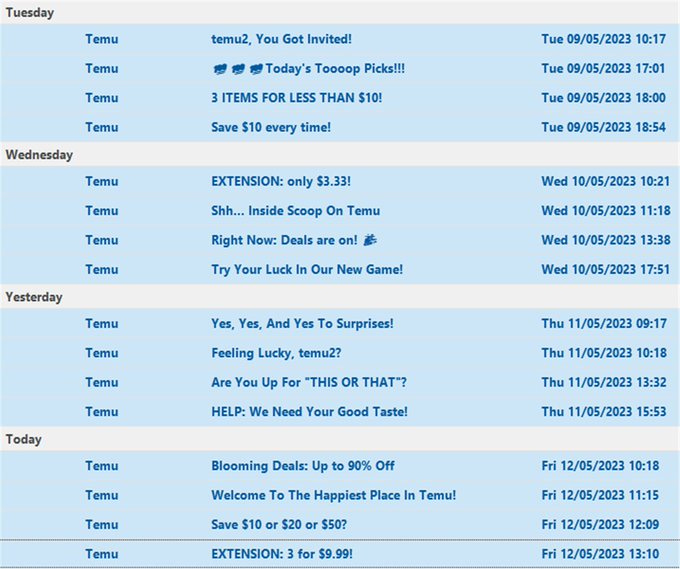
By this time, the Temu staff had been told to shift focus from customer acquisition to increase the spending of consumers. In January it became obvious that Temu was trying to activate its inactive users and wanted customers to spend more. After several months of silence, Temu started an aggressive emailing campaign. Five months later, one of the Techbuzz China team members is still receiving up to four emails over the span of a few hours on a test account.
In the third week of January, Temu’s GMV exceeded $50 million, and its monthly GMV was approaching $200 million, which was roughly the same as the total GMV of the four months it had been active in 2022. This positive progress made Temu decide to raise its GMV target for 2023 from $3 billion to $5 billion.
Meanwhile, the marketing budget for September 2023 – August 2023 was nearly doubled from the original RMB 7 billion (~$1 billion). In January Temu placed almost 9,000 ads across Meta’s platforms, promoting deeply discounted items like $5 necklaces, $4 shirts and $13 shoes.
According to a16z, Temu was seriously outperforming Wish, AliExpress and Shein customer retention in the first four months.
The Super Bowl
By early February, Temu had 5 million Daily Active Users (DAU), according to Sensor Tower. In the first five months since its launch, Temu had achieved a total $500 million GMV, and in January alone, GMV was about $200 million. While most Chinese merchants were only selling a few orders per day, by this time, several Chinese merchants claimed to see 20,000 to 30,000 daily orders through Temu.
On the 12th of February, during the Super Bowl broadcast, Temu broke two records when its ‘Shopping like a billionaire’ advert aired in the first and third quarter of the game. It became the youngest brand to ever advertise during the Super Bowl (Temu had only been 5.5 months old) and paid the highest fee per second ever (allegedly $14 million for two 30-second ads).
With its choice for one of the most viewed U.S. TV broadcasts, Temu took another page from the history of its sister app Pinduoduo, which had previously advertised during China’s New Year’s Gala, the country’s most-watched TV program, to recruit new users.
Accompanying the Super Bowl commercials was a game called ‘Shake & Cheer’, in which $10 million was given away. While it followed games that have been quite common in China during Chinese New Year’s Gala broadcasts, it must have seemed strange and unnecessarily complicated to U.S. consumers.
A few days prior to the Super Bowl, Temu had launched in its second market, Canada. Perfect timing since many people in Canada also watch the game.
Prior to the Super Bowl, Temu had advised merchants to increase their stock at the Temu warehouse. This proved to have been good advice. After the Super Bowl commercials, app downloads surged by 45% and Daily Active Users (DAU) by 20%. The number of packages shipped to the U.S. surpassed those of Shein, and the number of orders overwhelmed Temu’s Guangzhou warehouse.
The rapid increase of orders caught Temu by surprise. When it found its warehouse capacity overwhelmed, it issued a notice to merchants saying the warehouse needed to be ‘upgraded’ and receipt of goods (including JIT, Just in Time, receipts), the launch of new products, and first-order approvals were all temporarily suspended.
According to Intelligence Insider, Temu saw more than 70 million unique U.S. visitors in February.

Expansion into new markets
On March 13th, Temu launched its webshop in two more new English-speaking countries: Australia and New Zealand. On that same day, news broke that it would enter the UK by March 25th. It would actually take a month longer, possibly because of the warehouse capacity issues back in China.
In March Temu had 13.4 million MAU, surpassing U.S. retailer Target, while it reached 2 million daily orders and an average daily GMV of $10 million. Impressive, but still only 1/6th of Shein’s daily GMV in 2022. According to Sensor Tower, it now had 50 million total downloads and 20 million active users.
In April, Temu’s U.S. GMV was approaching $400 million. Meanwhile, the Temu team had grown to about 1,500 people strong.
At the end of April, Temu launched in several European countries: the U.K., Italy, Spain, France, Germany and The Netherlands. So far, it has only offered an English website in these countries, something that might hamper its growth potential. At the time of writing, Temu has added even more European countries and is available in 18 markets. It was also said to be preparing launches in Africa, Latin America, and Southeast Asia (a region it previously shunned) and will launch in Japan before the end of June. Temu has already purchased a large amount of Japanese air freight capacity.
Like Shein, Temu set up an office in Dublin, Ireland, serving as the legal registration for PDD Holding’s overseas business while the headquarters remain in Shanghai. Like Meta and Google, it can enjoy a friendly 12.5% corporate tax rate in Ireland. An organisational change in which PDD Holding’s CEO Chen Lei became responsible for Temu further pointed towards the priority that Temu was receiving within the organisation.
Temu wants to sell to the whole world from one store. When a store on Temu meets a minimal rating, it will automatically be synced to other countries without any work required from the merchant.
Repositioning
When Temu first launched in the U.S. in September last year, it initially tried to be an ‘overseas Taobao’, focussing on women’s clothing. But the acquisition costs for this category proved very high, and the production capacity was limited since a large portion of it had already been claimed by Shein. Shein also had many loyal users and a 90-day repurchase rate of 60%.
Temu shifted direction. It researched Amazon’s popular products and started benchmarking itself against it. Temu’s product category structure now largely resembles that of Amazon.
Comparing the homepage of Temu when it launched in September to its current homepage shows how Temu has abandoned the idea of becoming a ‘Shein clone’. Its social media ads have also shifted away from largely apparel-related content to (cute) household items.

Temu U.S. homepage September 2022

Temu U.S. homepage June 2023
When Temu shifted its focus to standardized household and personal care products it increased its average order value to $40. Meanwhile, Temu’s development focussed on the app, which brought in 80% of GMV, with only 20% of GMV coming from the desktop website.
Temu has also launched an affiliate program in which KOLs/influencers can earn money for promoting the Temu app.

Customers
Temu primarily targets users with less than $30K annual income. It sees three dominant (and overlapping) types of users in the U.S.:
(Note: the section below is only available to paid Tech Buzz China subscribers)
The first to join were the price-sensitive consumers (e.g. college students and low-end service staff)
Housewives
Ethnic minorities
Among the ethnic minorities are 30 million Chinese, 30% of which like to buy low-priced items and many items with Chinese elements. There are also 30 million low-income Hispanics and African Americans.
The core customers of Temu are young people with low to middle income, a segment estimated to be 60 million large in the U.S. Some Temu users used to purchase on Wish, AliExpress and offline retailers. Meanwhile, Temu's customer profile differs significantly from that of Amazon, which more often consists of the middle-class looking for brands and quality. Therefore the impact of Temu on Amazon seems to have been limited so far. Or has it? More on that later.
Inflation has made US consumers more interested in inexpensive goods. Temu hopes this will be a success factor in other markets as well. But while PDD has a good understanding of consumer needs in China, Temu needs to build up that knowledge for many international markets that can have widely different consumer behaviours.
Merchants
Merchants that want to sell on Temu need to meet a series of requirements:
Hold a business licence.
Have the ability to develop designs, manufacture and provide high-quality product photo shooting.
Have sufficient and stable production capacity and inventory (merchants determine how much they deliver to Temu).
Have experience in e-commerce.
Have experience in the North American market. They must understand popular styles but also sizes and standards for products in foreign markets. They (often) can’t just copy what they sell on Pinduoduo.
After applying in the backend system, a merchant needs to provide a business licence, photos of the business’ actual operation (e.g. company facade or warehouse pictures), product pictures and quotations. A review normally takes 1-2 weeks. The higher the mentioned turnover, the higher the chance of admittance.
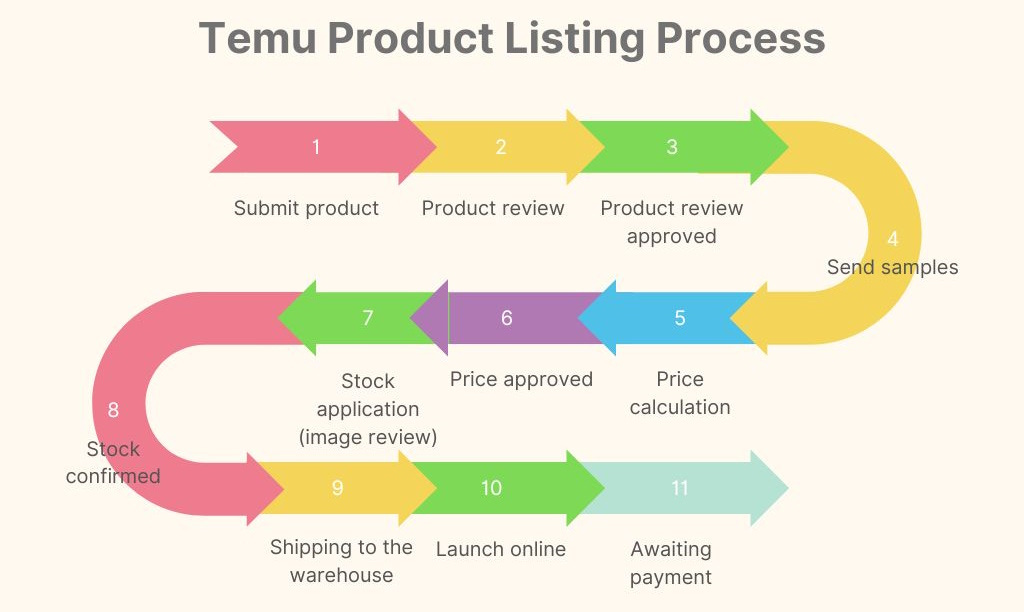
Temu screens a factory's prior working background and later even conducts real-time checks during the ordering process. It will ask for photographs of the products and if merchants pass all checks - including a check if the product price is 20% lower than the one on Alibaba’s 1688 wholesale platform - they are normally asked to provide samples. Temu will determine if the product will be popular and what the normal production cost could be.
Besides goods, the merchants also supply the descriptions and visuals of the product. In order to radiate the right quality, pictures on the website should be of high (definition) quality. Temu assists merchants in making necessary product adjustments, picture improvements, etc. Where needed, Temu can refer factory-type suppliers to service providers for photography and copywriting.
Merchants must use English names for their store, cannot use meaningless pinyin and may not infringe on the IP of existing logos.
On October 16th Temu opened the merchant back-end app. Merchants that are already active on Pinduoduo and are accepted can open a Temu store with ‘one click’ in the backend system, according to a PDD staff member.
Most of the businesses selling on Temu fall into two categories: merchants/factories that have done cross-border commerce on Wish, Amazon or Shein and brands, possibly without their own factories, with certain brand awareness in cross-border channels.
In November, about half of Temu’s suppliers were manufacturers, who can create products cheaply. The other half were trade merchants, most of which could offer a low price because they were trying to get rid of excess inventory. At the end of the day, Temu will use the cheapest supplier.
Temu actually favours factory-type sellers that can provide extremely low-priced products. China’s state of overcapacity gives Temu a strong bargaining position with manufacturers. Where possible, it will try to reduce the more traditional chain of ‘factory - seller - platform - consumer’ to ‘factory - platform - consumer’. Anecdotal evidence shows manufacturers receive preferential treatment compared to traders that have bought goods from factories.
In November, 20% of the manufacturers supplying Temu were also operating on Pinduoduo. The other 80% were manufacturers that had previously already been trading cross-border, selling goods on Amazon and Shopee.
While Temu’s website and app information boasts about the 11 million merchants that PDD works with, in the first quarter Temu only had 60,000 merchants (double the number in October).
Products
There are two categories of apparel that sell on Temu: low-to-medium priced multi-scenario products and products that are also popular on Amazon and Shein but cheaper than on those platforms. But while about 75% of Shein’s sales are apparel, only 20% of Temu’s sales consist of clothing categories.
Another 30% of Temu’s sales consist of 3C (electronics & accessories) including Chinese brands like Xiaomi, Huawei and Lenovo. While Temu used to sell a lot of chargers and wires, it now also sells earphones and mobile phones, driving up the average order value. The share of male buyers has also increased because of the 3C category.
Another 25% of sales concerns home decoration/improvement and gardening (mostly products below $20), a category Wish used to dominate. Household items are normally at least 40% cheaper than on Amazon.
Apparel and household items are growing faster in order volume. They are two categories that tend to be bought by the same customers.
While some Temu customers might beg to differ, the company aims to select high-quality products because it targets the mid-end user. Temu has a higher barrier for entry than Wish, which has a very low threshold in order to attract enough sellers from China. This led to quality problems and many customers abandoning the platform, which in turn made the order volumes smaller.
For clothing, Temu and Shein both do shrinkage tests, but unlike Walmart, which has one of the strictest quality control standards in the market, they do not do clothing reliability tests (fading of fabric, staining, damaging of fabric due to human activities or external strains). At the end of the day, Temu’s product quality is considered to be less than that of Shein.
At the end of 2022, Temu had a return rate of 10%. Goods that are returned to China are disinfected, repackaged and resold. Considering the return costs, Temu will however encourage users to keep the product at a discount.
Pricing
Many merchants that used to sell on Amazon have opened shops on Temu, or have opened Temu as an additional sales channel. The margin pressure on Amazon can be serious. One merchant explained that on Amazon he charges 60% margin, but this margin evaporates because of:
20% logistical costs
12% Amazon commission
10-15% advertising on Amazon
10% taxes
The end result is still a bit higher than Shein or Temu, but the merchant has to invest heavily in capital and human resources to sell through Amazon. As such, Amazon is only interesting for merchants that sell high-margin products.
Anecdotal examples show that the price difference between merchant price, Temu price, Shein price and Amazon price is 1 : 1.5 : 2-3 : 3. It is expected that the price difference with Shein will eventually level out.
Most of Temu’s products are sold with a 50% markup (for Temu). But even at such a gross margin, Temu will still be losing money since it sees 20-30% logistical costs and 30% marketing costs (incl. customer acquisition), plus taxes, custom duties and storage costs.
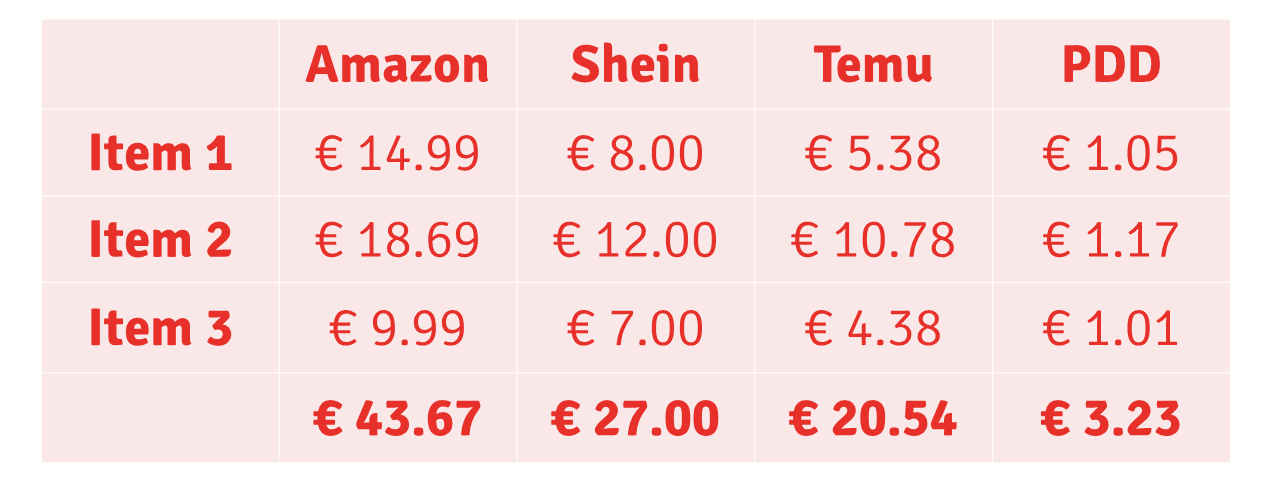
After we placed a test order on Temu, we compared the prices on Amazon, Shein (which has also started a marketplace) and Temu. We also looked up the product on Pinduoduo to get an idea of Temu's purchase price.
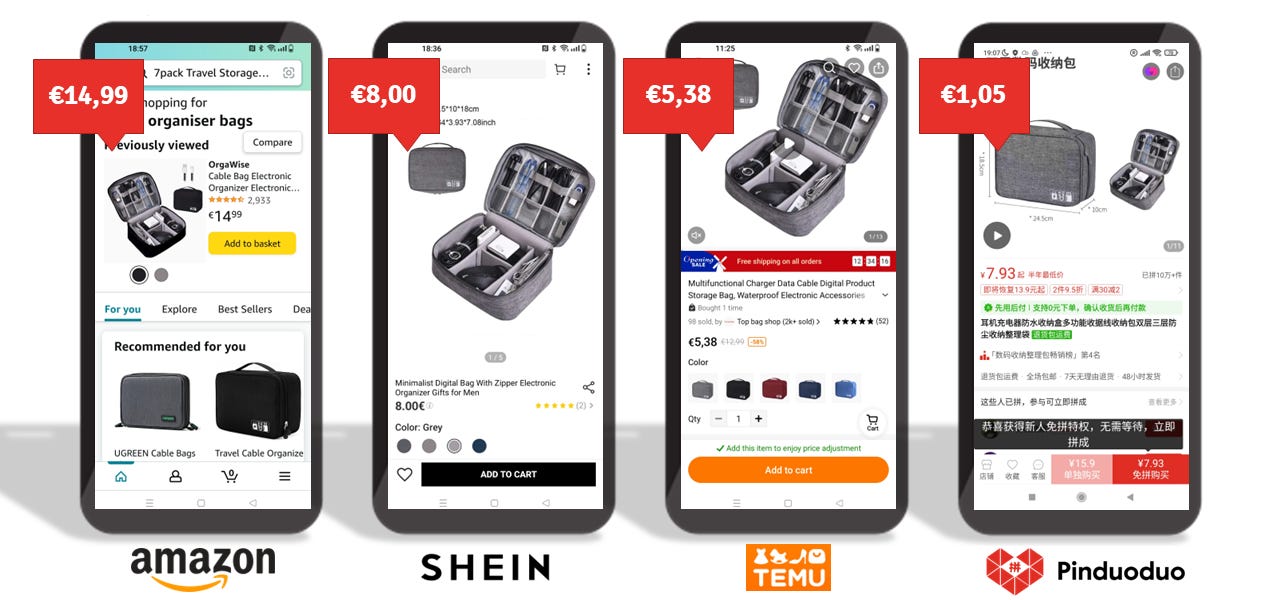
We repeated this for all prices of the three products in the order, none of which were promoted ‘loss leader’ products.
Logistics
The full chain of Temu's logistics can be broken down into three parts:
From the factory to a Temu warehouse in Guangdong: RMB 3.5 yuan per order (~$0.50, paid by the merchant)
From the Temu warehouse to the U.S.: on average $10 per order
Delivery in the US by courier: on average $10 per order
Temu has warehouses in Qingyuan, Foshan, Zhaoqing and Guangzhou in Guangdong. Merchants in Guangdong can use the JIT delivery mode and can deliver to the Zhaoqing transit warehouse within 48 hours of receiving orders.
Temu provides volume, but this comes at a price. Its contracts with logistical partners do not offer an exit mechanism, and if a partner wants out, it would be difficult to receive final payment. At the same time, the contract transferred all operational risks to the merchants.
In China, Pinduoudo has been using the logistical services of J&T Express. Through aggressive pricing, J&T conquered the fifth position in the Chinese courier industry, three years after launching in 2019. But growth has stagnated and its share of the PDD business got stuck at 20% when the company started seeking out other logistics partners.
J&T has turned its attention to foreign markets for growth. In China, it subsidized Pinduoduo merchants with profits from the Southeast Asian market to build its Chinese network and buy market share. It's now doing the same for the Temu shipments. Shipping a package from Guangzhou to the U.S. costs about $14. J&T bears $4-$5 of these costs and Temu $9-$10. J&T is accepting this loss-making business because it is building market share because of an upcoming IPO (J&T Express submitted its prospectus to the Hong Kong stock exchange).
J&T having entered the U.S. and Australia will be of great help to Temu’s deliveries. It is expected that when J&T expands, Temu will bring down its logistical costs by shifting more business from traditional local couriers to J&T.
A first test order that a European Techbuzz China team member placed in May was delivered in 6 days. In June, several people reported that packages ordered from China arrived in as fast as 4 days. A team member in Germany has experienced 8-11 days delivery time.
To further speed up delivery to American customers, Temu is building warehouses in the east and west of the U.S.
Organisation
For Temu, PDD Holdings has copied the same approach it has previously used for Duoduo Maicai, Pinduoduo’s community group buying platform: ‘subsidize aggressively in the first stage, cutting operational and customer acquisition costs in the later stage, eventually achieving profitability’. PDD even transferred a lot of staff from Duoduo Maicai to Temu.
Horse-racing
Like other units in PDD Holdings, Temu only has three management layers and few internal meetings. But despite the flat organisation, the culture is extremely hierarchical and authoritarian, with no questions asked about orders from above.
As with other Chinese (internet) companies, PDD uses a corporate culture of ‘horse racing’, in which several teams fiercely compete for the same goal. The team that is the most successful gets upgraded, while the others get downgraded. The worst-performing teams are even disbanded and merged into better-performing teams, while their managers are demoted to other businesses. Only when these managers perform well in their new business unit can they be promoted again. Meanwhile, the disbanded team is replaced by a new team so the horse race can continue.
Engineers that get moved to other teams need to delete their own source code, and staff internally use nicknames to maintain a level of anonymity, with people not really knowing who works on what within the company.
There is also strong competition within teams and a 7-2-1 policy is maintained: 70% can stay, 20% can stay but won’t get a (full) bonus, and 10% will be eliminated. PDD also found that young people from rural areas are more eager to be successful in this culture than residents from first-tier cities. They recruit accordingly. And because the salaries at PDD are 2-3 times the industry average, people get trapped in a golden cage and stay despite the many complaints about its work culture. Meanwhile, well-performing executives get enormous bonuses in the form of company stock issued over several years, which also stimulate staff retention.
The consignment model
Pinduoduo studied Shein before entering the international market with Temu. While it did not copy Shein’s model, it did learn from Shein’s strong control over supply chains and product quality.
PDD also identified a series of challenges for merchants that wanted to go overseas:
Lack of market knowledge: merchants don’t know what products will sell, how promotional tactics work, etc.
Warehousing and overseas logistics.
Payment settlement and unstable conversion rates between RMB and foreign currencies.
PDD relieves the merchants of these pain points. They select the right products, do the overseas marketing, logistics, and after-sales and pay in RMB for domestic supply. Merchants do not have to invest in customer service staff that speak English.
Temu is not a regular marketplace like Amazon, and neither is it a drop-shipping platform like Wish. Both Pinduoduo and Temu use an approach called ‘fully managed’ (全托管, quan tuoguan). Merchants agree on a selling price to Temu and ship goods to Temu’s warehouse. Temu then takes over and handles all shipments to the consumer, marketing and customer service while it also determines the selling price to the consumer. Temu’s own gross margin is the difference between the merchant’s and its own selling price.
Behind fully managed stores on Temu there is a ‘selection team’, ‘buyer team’ and ‘strategy team’. The selection team has studied popular products in the U.S. and Europe. When a product becomes popular, Temu can quickly mobilize the right resources for low price, good quality and rapid delivery.
Temu recruited merchants with the promise of 5 no’s: no merchant operations, no traffic fee, no storage or slow-moving fees, no warehousing and shipping costs, no exchange rate risks and no payment handling costs.
Momentum Works calls this the ‘consignment model’ and recently summed up its advantages:
Compared to other channels like Amazon, merchants do not have to manage the complexities of marketing, fulfilment, and customer service. That would encourage more suppliers to join the platform.
Consumers will get a consistent experience (e.g. when they order six items from different merchants, they all arrive at the same time in one package) and customer service.
The platform can maximise operational efficiency without worrying about working capital requirements or inventory risk.
Logistics providers will only need to interface with the platform instead of a large number of individual sellers – a boost in productivity.
In recent months, other cross-border e-commerce companies like Lazada, Shopee, AliExpress and TikTok have all started copying the same model. AliExpress, for instance, started operating the consignment model at the end of 2022 and it's been quite successful. It attracted many new merchants, and some existing merchants saw their orders double. In March 2023, AliExpress’ sales had increased 50% year-on-year, which can at least be partially ascribed to the implementation of the consignment model.
Pressure on merchants
While the consignment model sounds like all benefits and no pain for merchants, the reality is a bit harsher. Temu’s model is often described as ‘lowering supplier prices + large subsidies + crazy advertising’. The pain for the merchants is in the first part of that equation.
In the early months of Temu, PDD would use stories of merchants quickly getting rich on Temu to attract more merchants to the new platform. Merchants that had trouble selling on Amazon or were even facing a possible ban on Bezos’ marketplace started flocking to Temu. Many of them quickly cleared out old stock. So far, so good.
By March, however, merchants in China had started to complain about Temu on Chinese social media. Mismanagement, inconsistent and unfriendly policies, and mounting pressures were the main grievances. Some merchants even considered leaving the platform.
No, being a Temu supplier isn’t quite a walk in the park. The platform gives merchants a capacity planning schedule, telling them how much to deliver every day. After delivery, it applies three-month payment terms. In November, Temu also launched a JIT (Just in Time) delivery model for merchants, who could supply goods to Temu’s warehouse within 24 hours after receipt of orders. This saved Temu from having to expand its own warehouse capacity. Timeliness is key for merchants though: delivering too late could result in out-of-stock and products being removed from the platform, while early delivery could result in additional storage fees.
In December, Temu asked merchants to start paying for half of the shipping costs from factories to its Guangzhou warehouses.
In April Temu updated the merchant agreement and added a text saying the platform has the right to charge the merchants service-related fees. No actual fees were mentioned yet, but in China, Pinduoduo charges 0.6%. Recent merchant agreements also state that Temu holds the right to unilaterally change the agreement.
Merchants also claim to be facing above-average return rates on Temu. While on Amazon, the average is 5-15% depending on the product category, return rates on Temu have been reported to be as high as 30%.
As mentioned, Temu’s warehouse reached maximum capacity after the Super Bowl commercials. On March 15th, Temu stopped receiving goods at its warehouse without prior notice. Merchants couldn’t store their goods or have Temu ship them to the U.S. The closure lasted at least two weeks. As a result, many products were removed from the webshop because of insufficient stock (a standard Temu policy). Not only did merchants miss sales, but they were also fined by Temu for not having sufficient stock while being unable to replenish that same stock.
Pricing policies
Merchants are also complaining about Temu’s aggressive pricing policy. As mentioned, unlike most marketplaces, Temu determines the sales price on the platform, selling products at a multiple of the merchants’ price. It’s not uncommon for Temu to pay merchants RMB 10-15 ($1.30 – $2.00) while selling the goods to foreign customers for $8-$9. Our own price comparison confirmed this. But it simultaneously also asks merchants to provide the lowest possible prices. The idea of Temu is that merchants have small margins but quick turnover.
The whole logic of Temu is to further decrease its own purchase price from merchants while slowly increasing the sales price to consumers and thus increasing its gross margin. When it gradually reduces investments in advertising and controls operational costs this should eventually result in a profitable operation.
Temu will constantly compare merchants’ prices to those on Alibaba’s 1688 wholesale platform. When it is higher, a merchant has the chance to propose a lower price. Anecdotal evidence shows that when accepted, gross margins end up in the single digits.
When products prove popular, Temu asks merchants to further lower their prices. If prices are too high for Temu’s liking, it will not put the products online. Again, here Temu is following the example of Duoduo Maicai. For products that don’t show much quality difference, like cucumbers, Duoduo Maicai will simply use the supplier with the lowest price.
In March 2023, Temu launched a comparable bidding system. The message being that only by lowering prices could merchants get traffic and sales. Bids for specific products are held once a week on Monday. For standardized products with multiple suppliers, Temu selects the supplier with the lowest bid. Losings bidders will be restricted from stocking and updating information on the platform. They can try again next week.
Temu can even unilaterally reduce prices to what it considers ‘reasonable’. A supplier can object within 24 hours after being sent a price reduction notification in the backend system. During Chinese New Year, Temu reduced the prices of many products by 20%. Many suppliers that failed to check the backend system because of the public holiday suffered substantial losses.
Many merchants claim Temu’s policies have evaporated their margins while there is a growing danger of diminishing product quality.
Quality & storage policies
To improve customer satisfaction, Temu has implemented logistics fees and fines for merchants that violate product quality rules. Every time a customer complains about a product, the merchant will be fined five times the purchase price. At the same time, items can be removed from the webshop if the customer gives a low product rating while actually having grievances about the delivery time, over which the merchant has no control.
As with Pinduoduo, to retain customers, Temu often assumes that a complaining consumer is right and their complaints are justified, and merchants are forced to pay the refunds and even receive additional fines. Some merchants have seen more than half their revenues evaporate in such fines.
Meanwhile, quality standards are often unclear to merchants as they differ between Temu warehouses and inspection staff.
There’s more bad news for merchants: Temu will start charging them fees for storage in its warehouse (in itself not uncommon among e-commerce platforms). Every extra day that goods stay in Temu’s warehouse will cost a merchant RMB 500 ($70). After 7 days, Temu can dispose of the goods (by sale or disposal) and charge any costs involved to the merchant, while keeping any potential profits.
When products are not popular (anymore), Temu returns the goods, making merchants pay for the logistics. A product will be removed from the website if it doesn’t sell in 15 days or if sales are less than 30 pieces or $90 over 30 days. Again, the merchant will bear the costs of removal from the warehouse.
Combined with the pricing pressure and potential fines, it is very hard to make money on Temu.
Competition
Since 2017 cross-border e-commerce from China has been steadily growing, helped by favourable government policies in China. The March 2021’s 14th Five-Year Plan set a clear goal to accelerate the development of cross-border e-commerce, encourage the construction of overseas warehouses, and ensure the operation of the supply chain of foreign trade. These policies and the help that was given to cross-border companies have been beneficial to Temu and other cross-border platforms.
Chinese webshops tend to focus on product categories with lower penetration that platforms like Amazon are not leading in. Unlike offline retailers like Walmart and Costco, U.S. e-commerce firms like Amazon focus on ‘good + fast’, not on inexpensive.
Research agency Neilsen has named Shein, Temu, AliExpress and TikTok as capable of participating in global competition and even challenging giants like Amazon. All four are using the ‘consignment model’ to different extents. The fight for the Western consumer has been firing up among these competitors…
In December, Shein filed a lawsuit against Temu in the Northern District of Illinois, USA, claiming it was using fake social media accounts to convince people to download their app and had asked influencers to badmouth Shein. As is to be expected, Shein and Temu are not the best of friends. In May 2022, Pinduoduo set up an office in Panyu, Guangdong, across from Shein, to poach Shein staff and suppliers to come work for Temu. Suppliers were offered twice the normal commissions, and staff three times their current wages. In the end, the poached Shein staff proved a mismatch as most of them were lower-level staff that couldn’t share strategic insights.
After analysing data from credit and debit card transactions, Bloomberg Second Measure found that in May, Americans spent 20% more on Temu than on Shein. Shein has recently received $2 billion in funding, but 36Kr reported that the pressure that Temu is putting on the company is now resulting in an acceleration of Shein’s IPO plans.
Meanwhile, an old player is polishing up. AliExpress never really lived up to its potential because Alibaba has more urgent priorities in the domestic market. But Alibaba reorganised its international e-commerce business in 2022, and AliExpress has been aggressively expanding its product offerings and improving customer service. In March, Alibaba announced that it would split up into six different companies, international e-commerce being one. This should release AliExpress from being a lower-priority business unit. AliExpress is no longer focusing on the U.S. and its market share seems to have been taken by Temu. Most of Temu’s other business is coming at the expense of Shein and from small offline shops.
Amazon remains a very suitable sales channel for white-label products and native e-commerce brands like Anker. Therefore the target audience of Amazon highly overlaps with that of Temu. Anecdotal evidence shows that less goods are being sent from China to Amazon warehouses, which could point to the impact Temu is already having.
Earlier this month, Chinese merchants on Amazon noticed how some of their products, as well as Amazon’s own products, are being offered with 20% discount. This discount is being subsidized by Amazon, just like Pinduoduo has its ‘ten billion subsidies’ program in China. This program pays for discounts of brands that PDD wants to have on its platform (often goods one would normally buy on JD.com like 3C products). The program has brought Pinduoduo many new customers from beyond their original ‘sinking market’ target audience.
Merchants, who were not priorly informed by Amazon, speculate that this is a defensive move by Amazon against Temu. The discounts, which will end on September 1st, will not affect merchants’ margins.
Amazon uses a monitoring system that will suspend a merchant’s product sales or even fully close their Amazon store if products are found to be sold cheaper on other platforms. If it concerns a product that Amazon sells itself, the monitoring system will automatically adjust the Amazon price according to the competitor’s platform. But Amazon had to remove Temu from this monitoring system because it would penalize large numbers of merchants or drop its own prices to unprofitable levels. At present 63% of Amazon’s marketplace merchants are from China.
The future
Temu has seen several waves of growth after its September launch: during Halloween, Christmas and the Super Bowl.
There are three stages to Temu’s development.
September - December 2022: the targeted loss should be less than RMB 20 million (~$2.8 million), which is close to the loss of the whole Pinduoduo organisation in 2021 (23.6 billion yuan). Temu should have 3 million sellers and 2 million buying customers.
2023 & 2024: product optimization to reach break-even.
2025 and beyond: full profitability in all segments.
Once GMV reaches $3 billion, it also plans to allow merchants to operate on their own and advertise on the platform, becoming more like a regular marketplace.
In the U.S., Temu has shifted its goal three times since launching in September, from user recruitment (a normal launching strategy) to increasing average order value (by convincing customers to buy more items) to increasing the conversion rate.
About 7 months after its launch, Temu set up a special department to recruit ‘Key Account Merchants’. This team invited large Chinese brands and brands selling on Amazon and independent websites to join the platform. Some Chinese brands like Xiaomi, Lenovo, Anker and Huawei have already started selling on Temu.
After Temu reaches a certain scale, it plans to also recruit local Western brands to sell on its platform, while also attracting more Chinese brands to go overseas. It remains to be seen if this will be successful as AliExpress before it, found this difficult because brands want to control their own pricing and don’t want to be associated with a discount platform.
Impressive results, ambitious targets
This positive progress in its first few months made Temu raise its GMV target for 2023 from $3 billion to $5 billion. 36Kr recently confirmed that Temu’s GMV in the first quarter of 2023 was about $2 billion before discounts and close to $1 billion after discounts. This shows that Temu is still subsidizing 50% of sales.
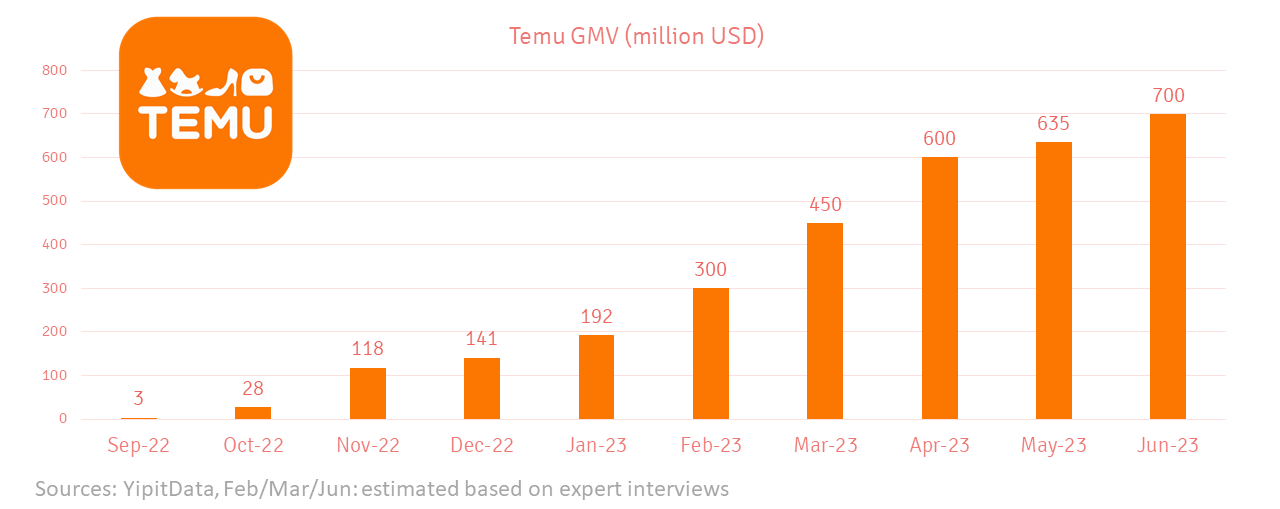
Based on the results of Q2 2023 so far, Temu’s GMV is expected to reach $3 billion for the first half of the year and $10 billion for the whole of 2023.
Temu is aiming to reach $30 billion GMV within 5 years, which is comparable to Shein’s GMV in 2022. It hopes Americans will place no less than 30 orders per year, with an average value of $50 each. It still has a long way to go. While the average order value is said to be $25, Temu is losing, on average, $30 per U.S. order because of its heavy subsidizing of logistics, pricing, etc. The company also plans to spend $1.4 billion on advertising this year and $4.3 billion in 2024.
Temu has been reported to expect an estimated RMB 5 billion (~$0.72 billion) loss in its first year of operation (September 2022 – August 2023). Meanwhile, Credit Suisse calculated that Temu could sell $3.6 billion at a $1.7 billion loss in 2023.
PDD Holding recently announced its 2023 Q1 results. Marketing costs had risen by 45% to RMB 16.26 billion (~$2.37 billion). Considering how Temu was not yet operational in the first quarter of 2022, this clearly shows the impact of Temu on PDD Holding’s spending. 36Kr reported that Temu’s current loss rate is 60%.
Can Temu keep up such enormous investments? It sure can! Pinduoduo has been profitable for a while and generated $7 billion cash flow in 2022 and net income of $1.2 billion in the first quarter of 2023. With PDD Holding's RMB 150 billion (~$21 billion) in cash reserves, Temu can continue on its current path for a while.
Success is far from guaranteed though. Singapore-based Shopee previously launched and eventually withdrew from France, Mexico, Poland and Spain. But there is more at stake for Pinduoduo and we can expect it to have a much longer breath.
Mounting criticism
Not everybody is happy with Temu. While many consumers praise its value for money, others have complained about delivery times, product quality and customer service. And then there is organised resistance…
On April 14th, The US-China Economic and Security Review Commission released a report on ‘data risks, sourcing violations and trade loopholes’ related to Shein and Temu. The document largely consists of a collection of (sometimes dubious) facts from various media reports on both companies. It identified issues with labour, raw material procurement, the impact of chemical substances in products on human health, the impact of product production on the environment, product design infringement, and import tax avoidance.
Temu and Shein are both using the so-called ‘minimis rule’ which exempts imports valued at $800 or less from import taxes if they are shipped to individual consumers. Ironically, the amount was raised from $200 in 2016. Bulk shipments from China are unpacked when they arrive in the U.S. and enter customs as small packages. A bipartisan group plans to introduce a bill in June that would immediately ban such shipments. Federal brief claimed that “exploit” de minimis to avoid duties and import illegal items. If the bill passes, it which would have a serious impact on both platforms.
While there is no current legislation that could easily ban Temu, the proposed RESTRICT Act of March 23rd 2023, which seems to have been designed as a possible way to ban TikTok, could open a door if it is passed. The Act would allow for blocking information and communications technologies, products or services (including e-commerce platforms) of “foreign adversaries” of the U.S. (such as China) when they pose an “undue and unacceptable risk” to the national security of the U.S. or its citizens.
Anticipating potential problems, Temu has already started to separate its information management systems from Pinduoduo.
There are more challenges on the horizon. In April 2023, the European Parliament approved revised rules on the product safety of non-food consumer products. Besides rules on how to inform customers that have bought unsafe products, sellers have an entity located in the EU that is responsible for product safety. Since it would be unlikely individual merchants would set up such a local entity, it will be interesting to see how Temu tackles this.
With grumbling merchants, critical consumers, unsustainably loss-making logistics and governments that are launching new legislation to level the playing fields, it remains to be seen if Temu can turn its massive investments into building a customer base in a profitable business.
Sources:
Six Degrees, a leading global expert network/quantitative research firm that operates in China. Augmented with information from:
Marketplace Pulse 2023-05-24, 白鲸出海 2023-05-17, 白鲸出海 2023-05-19, Pingwest 2023-05-27, Tech Planet 2023-05-17, 暗涌Waves 2023-02-22, LatePost 2023-02-20, 36Kr 2023-02-14, Bloomberg 2023-03-05, 36Kr 2023-02-10, Pingwest 2023-05-04, Pingwest 2023-03-06, 跨通社 2023-03-13, 白鲸出海 2023-03-17, Momentum Works 2023-05-30, 白鲸出海 2023-04-07, Jiemian 2023-03-13, Wired 2023-05-26, Momentum Works 2023, Pingwest 2023-03-10, KrAsia 2023-04-13, Latepost 2023-05-18, Pandaily 2023-03-17, Pingwest 2023-04-11, 黑夜之睛滚雪球Weibo account 2023-02-26, 出海必读 2023-05-16, Pandaily 2023-04-13, Reuters 2023-06-14, Momentum Works 2023-06-09, 36Kr 2023-06-07, 36Kr 2023-06-07, 36Kr 2023-06-09. 36Kr 2023-05-25, 36Kr 2023-05-12, 36Kr 2023-04-26, 36Kr 2023-04-24, 36Kr 2023-04-21, 36Kr 2023-06-15, Latepost 2023-06-15
Images from a keynote by Techbuzz China’s Ed Sander unless stated otherwise. Stills taken from Temu commercial ‘Shopping like a billionaire’.