Food Fight! Douyin’s local services business
How Douyin charged into Meituan's group-buying territory, teamed up with an unlikely partner and takes aim at food delivery.
Table of Contents
Things that caught our attention
Introduction
Key takeaways
Chapter 1: Douyin’s history in local services
Chapter 2: Behind the scenes: details of Douyin’s local services business
Chapter 3: Recent developments in Douyin’s local services
Please note that chapters 2 and 3 are only available to paying subscribers.
Things that caught our attention
36Kr recently reported (link in Chinese) that Douyin’s overall GMV target for 2023 is no less than 2 trillion yuan, which is roughly a quarter of GMV in Alibaba’s ecosystem in the past 2 years. Douyin is increasing its focus on search-based ‘shelf-commerce’ and wants it to account for 50% of e-commerce GMV within 3 years. Currently, it is almost 30%. To learn more about the app’s initiatives in ‘shelf-commerce’, read our November article ‘Douyin's E-Commerce Efforts & Increasing Taobao-fication’.
Xiaohongshu is upgrading its livestreaming business to a separate first-level department, moving it out from under the community department and hoping to boost the platform’s commercialization (source: LatePost). In our Xiaohongshu article of last month, we described the conflicts between the commercialization (revenue) and community (user experience) departmental goals that drove this decision.
After launching in Canada in February, Pinduoduo’s cross-border e-commerce platform Temu has also launched in Australia and New Zealand this week and is expanding to the UK by the end of the month. Last month Ed was interviewed about Temu by Bloomberg and TechinAsia. The TechinAsia article can be read here for TiA Premium subscribers. A recording of the Bloomberg interview with added visuals can be found here as a series of 8 short videos.
Introduction
This week, we are taking a deep dive into Douyin’s local services and food delivery ventures. After adding e-commerce to its platform and invading Alibaba’s turf (about which we wrote in November), Bytedance has now also encroached on Meituan’s territory.
Chapter 1 is based on an article Ed wrote about Douyin’s ventures in local services last summer and is available to all subscribers Chapter 2 contains exclusive information we gathered from expert interviews in the Six Degrees Intelligence database. Chapter 3 summarizes relevant recent developments taken from Chinese tech media. Chapters 2 and 3 are only available to paying subscribers.
Key takeaways
Since launching local services in early 2021, Douyin has actually conquered a large market share in the group-buying market (Meituan’s initial business). It has also made several attempts at the much larger market of food delivery, including a highly touted partnership with Ele.me.
Douyin is aggressively chasing this market not just because of the potential GMV but because onboarding these merchants will lead to more advertising revenue. In addition, Douyin has always been very conscious about evolving into more than just a “time wasting” app but one that brings its users real practical benefits.
It’s clear that Douyin management believes travel to be a high potential growth vertical based on the headcount they’ve poured into the business, and the strategy also emphasizes the “sinking market” (3rd tier cities and below).
Douyin previously had a sizeable staff in local services, but seems to be moving to a lighter model where it is relying more on third party service providers.
Key disadvantages of Douyin include: being far removed from the point of actual transactions, limited search functionality, high operational costs, low ROI, and short-lived content popularity.
The key advantage of Douyin is its strength in livestreaming, which gives merchants branding opportunities and the ability to promote new products, whereas group-buying is primarily about deep discounts.
The ability to brand and promote and the hurdle of creating content also means that Douyin attracts a large number of top-tier customers ie larger chains.
While Meituan leads (by far) in transactions, Douyin’s importance as an advertising platform is not to be dismissed, as many merchants who are active on both platforms spend a majority of their advertising budget on Douyin.
Chapter 1: Douyin’s history in local services
In early 2021, Bytedance took a remarkable next step in monetizing its (at the time) 600 million daily active users by adding links to local services to Douyin. In China, the ‘local services’ market includes all kinds of intra-city services like meal delivery, cinema ticketing, bike rental, and more. Previously, this sector was often referred to as O2O (online-to-offline) because consumers place orders online in an app and have products or services delivered offline. In the past decade, local services were a territory of companies like Meituan and Alibaba’s Ele.me.
Bytedance entered local services by offering group-buying discounts at restaurants and accommodations in Beijing and Shanghai through an early version of a channel for location-based recommendations in Douyin. It tried to lure in users by offering even better deals than Meituan, the company that had won the group-buying battle among thousands of Chinese Groupon clones in the early 2010s (check out this Tech Buzz podcast episode for this story).
For this new functionality to become popular, Bytedance needed to recruit lots of merchants interested in offering their products and services on Douyin. Quite a challenge since Meituan is known for having a strong foothold with a powerful offline sales team. But Bytedance made merchants an ‘offer they couldn’t refuse’ by initially charging them only a 600 yuan registration fee and no sales commission (compared to Meituan’s 10-26%). Douyin also allocated 10.000 employees to build the local services business.
Traveling with Douyin
As early as July 2020 (link in Chinese), Douyin started allowing merchants to add options for ticket booking and hotel reservations to their personal pages. By April 2021, Douyin users could buy deals on meals and book hotels in more than 300 cities in China. At the same time, Douyin users would see restaurants promoting themselves on livestreams or advertising in short videos. Douyin even worked on a test with the mapping platform AutoNavi, making merchants visible on a map. All this is to get Douyin users interested in actually visiting these establishments.
In May 2021, Douyin entered another Meituan territory by starting tests with a travel agent mini program called ‘Mangosteen Travel’ (Shanzhu Lüxing, 山竹旅行), offering ticket booking and hotel reservations. Mini-programs are small mini-apps that run inside another app and were first made popular by WeChat in 2017 (check out this Tech Buzz China podcast episode for more details). Since then, they have become an industry-standard in China and have been copied by most Chinese internet companies. Douyin's interest in the travel business comes as no surprise, given the platform's enormous popularity for travel-related content.
Example of accommodation booking from the ‘same city’ menu in Douyin.
Finding food on Douyin
After first generating restaurant traffic through group-buying deals, Bytedance took another page from Meituan’s playbook and entered the food delivery market … sort of. In June 2021, it added a mini-program called ‘Heartbeat Takeout’ (心动外卖, Xindong Waimai), providing food delivery services in China’s first and second-tier cities. The app followed an earlier Douyin functionality from September 2020 called ‘Heartbeat Restaurant’ (心动餐厅, Xindong Canting), in which users could post videos with reviews of restaurants.
While food delivery functionality was new to Douyin, it wasn’t the first time Bytedance offered it. In early 2020, Jinri Toutiao, Bytedance’s news aggregation app, had already added functionality to order meals from restaurants, grocery stores, and pharmacies through third-party platforms.
Douyin invited food and beverage businesses that were already active on the app to join this new Heartbeat Takeout mini-program platform. There was an important difference with Meituan though: restaurants had to arrange their own delivery.
Douyin’s Heartbeat Takeout food delivery portal could be found through its livestream channels, where hosts could also recommend specific delivery services. Users would pick a restaurant, select products, fill in their delivery address, and pay within Douyin Pay, an in-app payment option.
Left: Douyin Pay, 0.09 RMB discount per payment. Middle: Alternative payment options. Right: Link a bank card to Douyin Pay
Despite Douyin allocating a lot of staff to push the service to merchants, it wasn’t a success. After 5 months, Heartbeat was suspended and related mini-programs were removed from Douyin. Instead, the app started to focus on dine-in group-buying. Linkshop would later report (link in Chinese) that difficulties in setting up a distribution system were the likely reason for the failure of Heartbeat Takeout.
While September 2020’s Heartbeat Restaurant and June 2021’s Heartbeat Takeout remained in a testing phase, Douyin opened yet another food delivery ordering functionality to the public in the summer of 2021. Users could order food delivery through external connections to meal delivery platforms Meituan and Ele.me. As such, this looked a lot like the paid traffic Douyin previously generated for third-party e-commerce platforms.
Time to monetize
In May 2022, SCMP reported that Douyin had started charging hotels and restaurants that were promoting their businesses through group-buying discounts. The fees ranged from 2.5% for restaurant orders to 4.5% for hotel bookings and 8% for wedding services, all of which were still lower than the average industry standard. Meituan’s usual charge was roughly 20%, but remember that with Meituan, that fee also includes delivery. New merchants would also still get 60 days of commission-free access to Douyin.
In July 2022, TechPlanet reported (link in Chinese) that Douyin users could order combo meal delivery from restaurants through group-buying features in the app. Users can place an order by clicking on a product link in a short video. Restaurants arranged their own delivery drivers or used existing delivery platforms like Dada. The process ran directly on Douyin instead of a mini-program built by the merchant or other third-party mini-programs.
It was clear by now that whatever the business model, Bytedance wanted to take a bite out of China’s food delivery industry dominated by Meituan and Alibaba’s Ele.me, who had 67% and 27% market share respectively in the first quarter of 2022. According to the National Bureau of Statistics, the food delivery market was worth over 934Bn yuan ($134Bn) in 2021. Before 2022’s problems with COVID lockdowns across China, the penetration for food delivery had increased from 16.9% of online Chinese in 2020 to 19.9% in 2021. That still leaves a lot of room for growth.
Douyin had reached 22Bn yuan in local services GMV in the first half of 2022 and had raised the target for 2022 even further to 55Bn yuan. It also expanded the categories of local services: massage, supermarkets, flowers, parent-child, travel, sports, leisure & entertainment, etc.
While the Mangosteen Travel mini-program no longer seems to be operational and its official account hasn’t posted new content since August 2021, the local services ecosystem in Douyin has greatly expanded. Douyin has a channel called ‘same city’ (同城, tong cheng) in its top menu. Clicking on it brings you to a new screen that offers a menu showing lists of service providers in food, leisure and entertainment, attractions, beauty & hairdressing, accommodation, sports, and more. Douyin has allowed almost any local business to promote itself through this portal.
Early 2022, Bytedance acquired movie ticketing company Yingtuobang (影托邦), which became available as a ticket booking option in Douyin, next to Meituan’s Maoyan and Alibaba’s Taopiaopiao.
An unexpected partnership
Considering the large user base of Douyin and how Bytedance had already conquered a substantial part of the e-commerce market, the existing market leaders must have seen a potential threat coming. ‘If you can’t beat them, join them’ might be what Ele.me thought: in August 2022, it announced a partnership that lets users order food through an Ele.me mini-program in Douyin. Ele.me would promote offerings from millions of restaurants through Douyin videos.
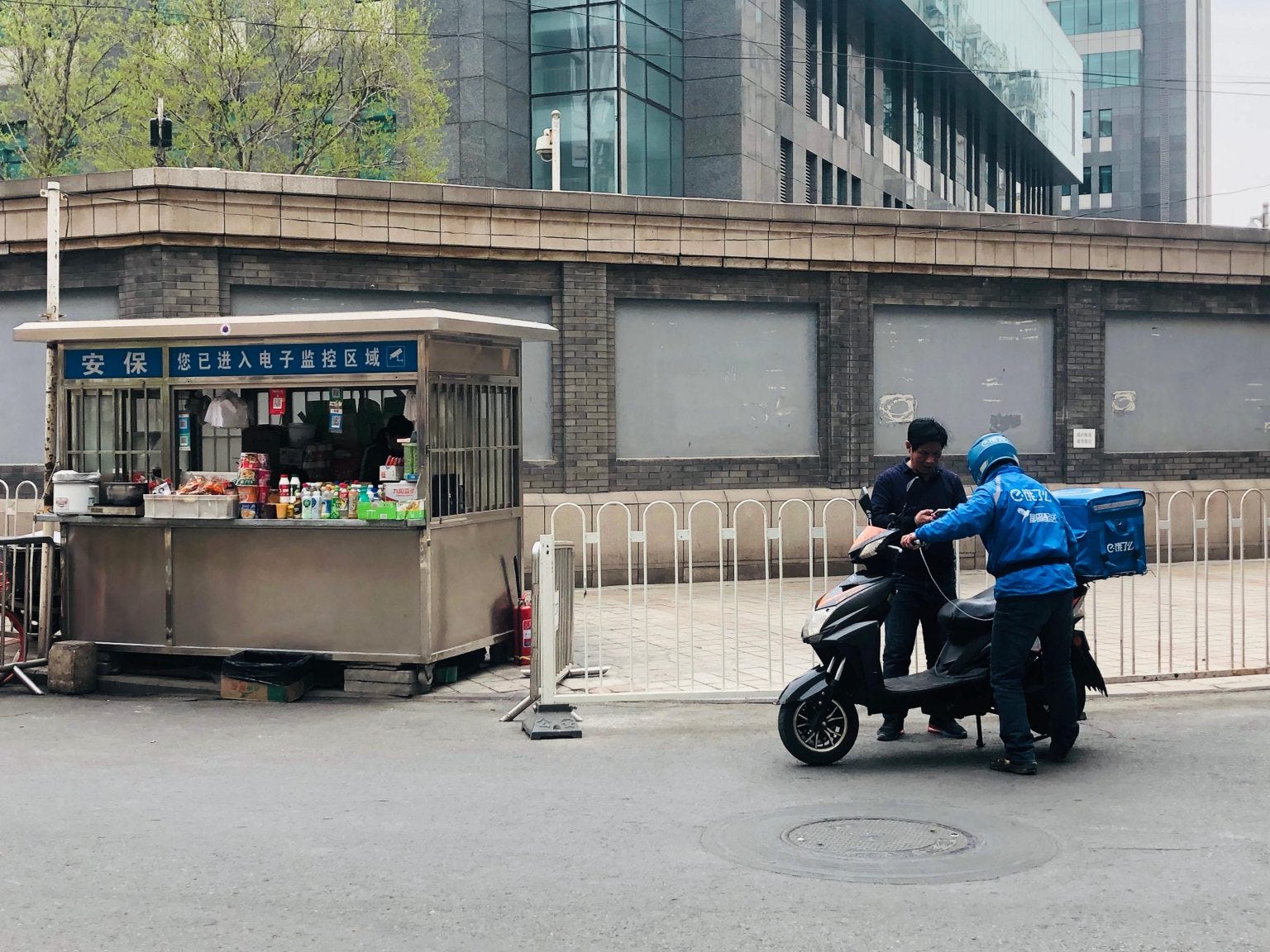
An Ele.me driver picking up an order
Chapter 2: Behind the scenes: details of Douyin’s local services business
In this chapter, we have relied on insights from proprietary expert interviews in the Six Degrees Intelligence database.
Douyin local services primarily cater to a young, female demographic aged 25-35, with 76% of its GMV generated in first- and second-tier cities. But that’s not to say it is not also focused on lower-tier city expansion like every other Big Tech platform in China. Most of the merchants on Douyin are middle and upper-market businesses, and the platform provides them with short-term resources to generate sales, including guidance for livestreaming and subsidized training.
Douyin’s local services can be broken down into several categories:
Dine-in (到餐): Going to a restaurant to eat out, mostly using a coupon bought through a group-buying promotion in the app. We’ll refer to this segment as ‘dine-in’.
In-Store (到综): literally ‘to comprehensive’, meaning in-store services that cover dozens of service sectors, including bathing, KTV, beauty treatment, parent-child activities, weddings, sports and fitness, entertainment, education and training, home furnishings, pets, bars, and lifestyle services, etc. While this includes ‘hotel & travel’ this category is often discussed separately.
And finally … takeaway food delivery, which is a segment that Douyin has launched and re-launched as it struggles to find a business model that makes sense.
Douyin’s Same City menu with local services
Dine-in has done well while in-store has been lackluster. Douyin's 2022 GMV targets were actually 50Bn yuan for local services, split into 60% or 30Bn yuan for in-store, and 20Bn yuan for dine-in. However, the actual GMV was 30Bn for dine-in and less for in-store. Whether or not that mix will shift now that the pandemic has ended is still unknown and something we will explore below.
Doing Better than Expected: Dine-in Group-Buying
Although previously prioritizing video and livestreams, Douyin now emphasizes cost-effective graphic content for marketing. Users have embraced this as it can be more convenient than dragging the progress bar of a video to a certain spot. With 220,000 videos and 70,000 to 80,000 graphic posts uploaded to its video section each day, the platform has seen a significant increase in the dine-in sector. It has grown by 40 to 50% using the same coupon-based promotion model as the early group-buying websites used some 13 years ago. Still, the offline dine-in business of Douyin’s local services remains relatively small, only accounting for 1% of total video views.
Within the category, large brands and chains account for the bulk of activity. Livestreams involving top merchants can generate 0.5-1Bn yuan per event, while small and medium-sized merchants contribute less than 30% of GMV. Interestingly, fashionable new consumer beverage brands such as HeyTea and Chanung are particularly popular and work well as low-priced recommendations in livestreams.
Example of group-buying in Douyin (and paying with Douyin Pay).
Doing Worse than expected: In-Store
In other categories, such as leisure, entertainment, beauty, massage, KTV, bars, and wedding photography, Douyin’s local services has been struggling to gain traction due to the pandemic, although some vendors, such as hotels, have been able to offset some of the losses by promoting their F&B.
In May 2022, Douyin responded by launching short trips (周边游) and expanding its focus on leisure and entertainment offerings, such as amusement parks, rafting, and escape rooms. However, the platform remains cautious in promoting categories like massage and KTV (karaoke), as these can be fronts for illicit activity such as prostitution. Other small businesses such as the beauty care industry have found advertising costs prohibitive, a platform-wide issue that is unlikely to improve even as the pandemic recedes.
Doing Well Within In-Store: Hotel & Travel, Tourism
Douyin has strategically focused on the hotel and travel industry, allocating 50% of its local services staff, which previously numbered 4-5,000 in total, to this segment in anticipation of significant growth opportunities. Although the company has observed strong sales, it has also encountered low coupon redemption rates, in large part due to the pandemic.
Douyin's GMV for travel (tourism) - encompassing travel agencies' tour packages and attraction tickets - surpasses that of hotels. In addition, the platform, via strategic collaborations with platforms such as Ctrip, 58.com, and Lümama, predominantly features internet-famous homestays rather than high-end hotels.
In response to the pandemic, Douyin provided users with the opportunity to explore cities with low COVID infection rates. Utilizing video to highlight attractions and tour activities, Douyin designed dedicated project pages with short videos and livestreams to facilitate trip planning.
Influencers (KOLs) serve a vital role in promoting the travel business. Douyin's Xingtu ('Task Pool') feature allows merchants to post advertising assignments, empowering creators with over 10,000 followers to monetize their content. Homestays were especially effective at leveraging this.
As we know, generally dine-in GMV has exceeded in-store, under which tourism is categorized. However, the numbers are still relatively small and so can be affected by just a handful of campaigns, such as in August 2022, when in-store surpassed dine-in GMV due to amusement park ticket sales for places such as Shanghai Disneyland.
Douyin’s local services platform primarily recommends group-buying for dine-in, hotel & travel, and leisure and recreation. Currently, Douyin Local Services doesn’t have its own page in the app but is integrated in the city pages.
Douyin’s same city menu.
Zooming in: The Role of Livestreaming in Group-Buying
Douyin's local services GMV comprises two elements: GMV generated by marketing tools, such as group-buying, and transaction volume brought by live-streaming, including pre-made meals and e-commerce products. Live-streaming is included in the GMV because the marketing tools by themselves are too weak and basically exclusively rely on low-price discounts.
Many key account merchants, however, are sensitive to discounts and are looking for brand and product promotion opportunities instead. Thus Douyin local services is adopting a two-pronged approach: live-streaming plus group-buying. This is why by the end of Q2, live-streaming's contribution to GMV exceeded 20%, up from 15% in Q1, with the year-end target for live-streaming's GMV proportion set at a minimum of 35%.
Acquiring Merchants
In January 2022, 750,000 merchants were active on Douyin, including e-commerce and local services.
These include those who have opened a Douyin Enterprise account, have opened a POI (Point-Of-Interest) or started group-buying offers. By August 2022, this number had nearly doubled to 1.41 million.
Douyin Point-of-Interest.
The local services team is relatively new, having been officially formed in September 2021 as a first-level department eventually numbering 4-5,000 staff by 2022. However, in early 2022, Douyin reduced labor costs by outsourcing operational tasks to regional service providers and agents in cities with strong competition from platforms like Dianping, Meituan, and Ctrip.
Douyin assigned individual managers to cities and divided China into five regions, with the Southern and Eastern regions having the most influencers.
Partner agents (合伙人) represent Douyin in a city and help the app expand its local services business there.
Service providers (服务商) assist merchants with online business, e.g. operating their online stores. If a merchant doesn't have the skills or resources to operate a Douyin store, the city agent can help him find a supporting service provider, which gets paid by the merchant. Service providers connect to 40-45% of all merchants and generate 60% of GMV.
About 70-80% of merchants are recruited by Douyin's local services teams, with the rest coming from inbounds or agent recruitment. Douyin imposes minimal restrictions on agents but holds service providers to KPIs such as merchant GMV and group-buying coupon redemption ratios. Recruiting partners is challenging due to the early stage of Douyin's local services business, and the platform's staff still accounts for 80% of the overall local services operations.
Working With Influencers
Let’s look at the Western region as an example to understand how Douyin’s local services are organized regionally and how they work with influencers. Operations consists of a front-end and mid-to-back-end team:
The front-end team, which connects with merchants to expand their business through means like group-buying coupons, consists of three business units: dine-in, in-store and culture & tourism.
The mid-to-back-end team is responsible for the merchant’s GMV indicators (order conversion, sales GMV and coupon redemption ratios), connections with content creators (whom front-end teams are not allowed to communicate with) and matches them to merchants (Douyin is also developing a system that can automatically match them). They also support the influencers with compensation based on commission per sale (8-10%) or a flat rate.
Matching merchants and influencers:
Influencers can register on the group-buying influencer marketplace in Douyin and Douyin’s local operations staff uploads business requests for them to choose from. Matching merchants and influencers is based on the characteristics of the followers. Generally, the income of influencers depends on the number of assignments they get, not their number of followers. To ensure authenticity, Douyin doesn’t allow influencers to promote a scenic spot without actually visiting it. If influencers violate this or other rules, it can lead to penalties in income and a downgrading of the influencer’s support from the platform.
Douyin also works with MCN’s (Multi-Channel Networks, basically influencer agencies/incubators). These require short-term incentives, as they try to monetize their influencers within 2 years of them becoming popular. MCN’s normally quote Douyin a budget for the collaboration and don’t simply accept traffic support.
During Douyin’s early years, all content was managed centrally at the head office in Beijing. There were no vertical or regional operations. When monthly active users passed 400 million, regional operations teams were necessary to maintain growth. Regional teams now create and manage content, including personalized content and city-specific ecosystems. They adapted these to the local characteristics and identified significant differences in user preference between regions in China.
Content co-created by Douyin and local influencers often become a regional hot topic on the app. Local services teams also help influencers create time-sensitive content for trending topics like the first snow in Sichuan.
Challenging Meituan
A Note on Douyin and Ele.me:
Douyin's expansion into local services could be seen as encroaching on Meituan's territory, where in food delivery, Meituan has a dominating market share of 68%. So Douyin made a more explicit challenge by partnering with Meituan's rival, Ele.me. While the collaboration was announced last summer, Douyin and Ele.me have actually been working together since late 2021, following a signed agreement between the two companies.
Upon partnering with Ele.me, both platforms have integrated their services. In cities with dedicated delivery teams, Ele.me's services are now accessible through its public account on Douyin. Ele.me charges merchants while Douyin receives a 2-4% commission. Instead of completing orders within Douyin, users are redirected to Ele.me's platform. Merchants from Ele.me can also be migrated to Douyin for increased exposure.
As part of their collaboration, Douyin plans to showcase high-quality user-generated content related to Ele.me. To incentivize content creators, Douyin has allocated 600,000 to 800,000 yuan for producing engaging content. This arrangement means that Douyin bears part of the traffic costs for Ele.me.
Meituan and Douyin have different approaches to local services. Meituan offers Meituan Checkout (paying at a merchant in the Meituan app), while Douyin depends on video recommendations to sell discount coupons for in-store purchases. Discounts given by Douyin have risen as high as 44% in early 2022 and were 28% throughout the year (subsidized by Douyin and the merchant together). In contrast, Meituan's average discount is just 13-14%.
Perhaps partially due to the high discounts, in August 2022, a month for which we have relatively complete data, the average customer spending on Douyin was lower than Meituan except for dine-in:
Dine-in group-buying: 75 yuan (higher than Meituan)
Hotel & travel: 246 yuan
In-store & others: 132 yuan
The two are effectively competing for the same merchants, as evidenced by the considerable overlap between Douyin and Meituan:
Dine-in: 87-90%
Hotels: 85% (Douyin cooperates with Ctrip in this category)
In-Store: 60-70%
Currently, Meituan is still the much better transactional platform for merchants. Douyin’s primary promotion method is livestreaming and at least 70% of restaurants transact sales on the platform (in-store and dine-in are both 60%). At Meituan, the ratio is significantly higher at 91%.
To remain active on Douyin, merchants need to have at least 3 group-buying offers per month, which is very challenging for small merchants. To get sufficient traffic and sales, merchants must work hard to stand out in the algorithm. This is different from Meituan, where merchants remain visible even if they have lower sales because its business is built around location. Meituan is ultimately concerned with making sure that consumers can get quick service from merchants nearby.
In conclusion, Douyin requires higher operating costs and longer operating time investment. Merchants need to have the ability to create short videos and livestreams, making it difficult for small and medium-sized businesses to survive on the platform. However, Douyin provides advantages for larger businesses. Unlike Meituan’s passive search, Douyin actively promotes products and is more suitable for popular restaurants and national chain stores that want to promote products and open new stores.
On Douyin, merchants only need to pay a commission, while on Meituan they also need to open a merchant account, costing 2,000-3,000 yuan a year. However, merchants need to collaborate with influencers to promote their products on Douyin, which can lead to higher operating costs than on Meituan. The monthly churn rate of merchants on Douyin (9+%) is significantly higher than on Meituan (2.1-2.2%).
On the consumer side, Douyin's direct sales team selects group-buying packages that differ from those offered by Meituan, effectively sidestepping any direct price comparison conflicts. However, Douyin sees a coupon usage rate of just 61% (the remaining unused coupons are refunded), while Meituan’s is much higher at 87%. As such, Douyin’s actual GTV (Gross Transaction Volume, after refunds) will be much lower than its reported GMV.
The reason for Douyin’s low redemption rate is that on Meituan, consumers can get and use a coupon at the store or restaurant, whereas on Douyin they typically need to buy in advance and then go to the location to redeem. Since the merchant only gets paid when a coupon is actually used, this means that their gross sales on Meituan are more reliable.
In addition, Douyin’s repurchase rate is lower. The e-commerce repurchase rate on Douyin is less than 9.3%, the local services repurchase rate is 2.8%+, and Meituan's repurchase rate is 18-20%.
All these factors lead to the conclusion that at current, the ROI (return on investment) for merchants on Douyin is lower than that of Meituan. This is consistent with the fact that thus far, Meituan’s business has not been too impacted by Douyin group-buying, apart from some loss in advertising revenue from larger brands. Ultimately, Douyin will need to convince that its ability for restaurants to build an online presence, especially to acquire incremental traffic from live commerce, is worth the effort. Or perhaps both platforms exist in a symbiotic relationship for the near future. Remarkably, merchants that are active on both platforms use advertising on Douyin to boost their business on Meituan, allocating 60-70% of their advertising budget to Douyin (smaller brands up to 30%).
A Final Note on Monetization
Monetizing local services has proven difficult. Initially, Douyin didn't charge commissions to recruit merchants. However, the platform's scattered traffic across numerous cities and sectors resulted in limited sales conversions. Although the local services and commercialization teams hoped short videos would stimulate consumption, conversion rates turned out to be significantly lower than with e-commerce.
Since June 2022, commissions are being collected to avoid creating a future reluctance to pay due to extended free service. Contracts established before June remain unchanged, and key merchants or those sensitive to commissions can apply for reduced fees.
In conclusion, although Douyin local services has achieved success in terms of absolute numbers, it faces several challenges, such as being far removed from the point of actual transactions, limited search functionality, high operational costs, low ROI, and short-lived content popularity. Ultimately, we think it is safe to say that Douyin’s forays into local services have been much more disappointing than fruitful.
Chapter 3: Recent developments in Douyin’s local services
In this chapter we have gathered recent insights and news from Chinese tech media.
In November 36Kr reported (link in Chinese) that Douyin had exceeded its 2022 GMV goal for local services, 50Bn yuan, ahead of schedule in October. That month the monthly GMV had reached 10Bn yuan and the cumulative year-to-date GMV 60Bn yuan. 47% of this business had been generated through short videos (down from 70% in the first half of 2022), 35% through livestreams and 18% through search.
Sources for Douyin’s local services business
Douyin has been focussing on regions where Meituan was relatively weak: suburban towns of big cities and third-tier and fourth-tier cities. In October 2022, Douyin claimed to offer local services in 377 cities.
Douyin uses a self-built direct sales system and attracted large numbers of consumers through launching ‘lowest price on the net’ group-buying coupons. But low revenue earned by merchants can sometimes lead to subpar service. Douyin set up a team of ‘mystery shoppers’ to monitor the quality of service provided by merchants. This has proven to be more difficult and costly than expected. Therefore Douyin has pivoted away from low prices and started stimulating merchants to make better video content to increase conversion rates.
Meituan’s defense
LatePost has reported (link in Chinese) how the Douyin local service team was surprised by a lack of defensive response from Meituan, probably because it was focused on a community group-buying war with Pinduoduo at the time. In the second quarter of 2022, Meituan started to feel the impact of Douyin’s local services initiatives. According to 36Kr (link in Chinese), its market share in the in-store segment dropped by 5-10%.
After initially thinking the threat from Douyin was small, mostly present in the hotel & travel sector, Meituan became aware of the potential danger halfway through 2022. It has been phasing out cooperation with Douyin since and strengthened its partnership with Kuaishou, with which it first teamed up in December 2021 (Kuaishou users can access Meituan local services from within the short-video app). Meituan also changes its traffic generation model to a direct sales model in third- and fourth-tier cities.
According to 36Kr (link in Chinese), Meituan is most worried that consumers will change their behavior and start actively searching for food delivery and other local services on Douyin and Meituan and comparing prices. This has already started happening in group-buying. LatePost reported that between March 2021 and March 2022, the conversion ratio of people searching for local services deals on Douyin increased from 20% to 30%. Even Douyin itself was surprised by this active search behavior compared to users passively being served videos and livestreams.
Meituan realized its weakness in video content, and as Douyin was copying Meituan, so Meituan started copying Douyin. As Linkshop reported (link in Chinese) in April 2022, the company launched ‘Meituan Live Assistant’, a free broadcasting tool for merchants and hosts. In August 2022, Meituan started testing short video content on its app, while it also launched the ‘Meituan Pipi Xia’ app to help creators make videos more efficiently. In November, it launched short video for Meituan food delivery.
At the end of 2022, Meituan worked with 9.2 million merchants across 300 cities, serviced by 20.000 employees. Douyin had 700,000 merchants across 55 cities.
According to 36Kr (link in Chinese), the 2022 GTV of Douyin’s local services reached 1/8th of Meituan’s in-store business. Since the start of this year, Meituan’s dine-in sector employees have intensified frontline work.
In February, TechPlanet reported (link in Chinese) that Meituan was revamping its short video and livestreaming features to further counter Douyin’s competition. In the Meituan app, users can find 30-second videos that promote food. Tapping on a video opens the merchant’s page. Meituan has also opened a food delivery livestream channel. As on Douyin, merchants participating in the livestreams are mostly big brands that can offer standardized products (Haidilao, Starbucks, fast-food chains, etc.).
LatePost reported that Meituan is not aiming for profit growth this year but will focus budget on countering competition with Ele.me and Douyin instead.
Relaunching its own food delivery service
Douyin has been using its various experiments through the years to set up the ICT infrastructure necessary for food delivery, including interfaces between the app & merchants, merchant’s front office & kitchen and merchants & couriers. It has also built the ‘Douyin Laike’ app, a content management tool that merchants can use to manage group-buying offers, short videos, livestreams, online stores, etc.
Douyin is up against some formidable opponents in the food delivery sector. In 2022, Meituan held a 70% share in this market, with close to 700 million transacting users in Q2 2022, while Ele.me covered most (26%) of the rest of the market.
While the Douyin mini program for Ele.me kicked off in Nanjing and soon was available in 15 cities (link in Chinese), 36Kr reported (link in Chinese) that Douyin relaunched Heartbeat (Xindong) Takeout as early as October 2022. Douyin now offers food delivery services using third-party couriers (SF, FlashEX, Dada and UU Paotui) in Beijing, Shanghai and Chengdu. On a participating merchant’s page, users can now choose ‘group purchase at the store’ or ‘home delivery’. The three cities were the best-performing of the nine that were initially tested. According to Douyin, further expansion will depend on the results in these cities.
By the end of 2022, Douyin’s monthly food delivery GMV had increased to 80-90 million yuan, of which 20 million was generated by the cooperation with Ele.me. By comparison, Meituan’s monthly GTV for food delivery in 2022 is estimated to have been nearly 70Bn yuan. Limitations in Douyin’s food delivery offerings will make it difficult to conquer the same market share as it did in in-store and dine-in…
How Douyin falls short in food delivery
36Kr recently reported (link in Chinese) how using Douyin’s food delivery has not been easy for merchants. Douyin’s earlier group-buying service brought in extra foot traffic, but the food delivery business has suffered from slow deliveries. As mentioned, merchants have to arrange deliveries themselves, and the available (third-party) delivery drivers at any time might be limited. Anecdotal evidence has shown that ordering the same product in the same store on Douyin can take 40 minutes longer to arrive than when ordered on Meituan. Courier companies like SF Express tend to focus on 1-hour delivery and therefore have slower fulfillment speeds. They also charge higher delivery fees, starting at 15 yuan per km, further raising the costs for merchants.
Indeed, delivery is the last hurdle Douyin needs to take to make food delivery as successful as group-buying and Meituan’s strong delivery capabilities and army of more than 6 million couriers will be much harder to copy than its sales force recruiting merchants. Especially in these times of cost reductions: last year 36Kr reported that in 2021 the costs of couriers ate up 68.2Bn yuan, or 71% of Meituan’s food delivery business. According to Latepost (link in Chinese), Douyin has not yet decided whether to set up its own delivery service. Considering how Bytedance never build its own e-commerce fulfillment either, it seems unlikely.
Another weakness of Douyin’s food delivery offerings are the high item prices. Anecdotal evidence has shown that the price per food delivery order on Douyin is kept relatively high at 130-160 yuan, while orders placed via the Douyin-Ele.me cooperation were 45 yuan on average. Douyin focuses on afternoon tea, cakes and desserts (items that are not as time-sensitive as lunch or dinner) and on set meals and family dinner packages. This way it can keep the average order value high (150 yuan) to help merchants cover the cost of third-party couriers. But this also means it does not meet the needs of regular food delivery customers.
It also remains to be seen if the interest-based e-commerce model of Douyin works well for food delivery. A research report by "Hua Securities" has identified Dianping, Meituan’s review platform, as the main traffic source for Meituan. The average single usage time on Dianping is 2.5 minutes, while it is 6 and 7 minutes on Xiaohongshu and Douyin, respectively. While Xiaohongshu and Douyin help to ‘kill time’, Dianping helps people to ‘save time’.
According to 36Kr (link in Chinese), the number of merchants on Douyin’s local services is only about 10% of that of Meituan and the number of food delivery merchants is relatively small. According to insiders, Douyin hopes to be able to migrate some high-quality merchants from the Ele.me cooperation to its own platform.
Why the interest in food delivery?
Despite the competition, the lack of success with earlier projects like Heartbeat Takeout, the limitations in its offering and the fact that the margins on food delivery are small (Meituan reported only 6,4% operational profit margin in 2021), Douyin is still interested in food delivery. This raises the question why this business is so important to them.
One reason could be that Douyin’s market share in group-buying has started to hit a ceiling, and dine-in GMV had reached half of Meituan’s. According to 36Kr Douyin’s market share in group-buying was 40% in 2022 (with Meituan taking up most of the rest of the market). Douyin needs new segments for growth in local services. Besides food deliveries it is also starting aggregation services for ride-hailing, as TechPlanet reported (link in Chinese) in December 2022.
According to LinkShop (link in Chinese), another reason for Douyin’s interest in food delivery can be found elsewhere in Douyin’s business: advertising income. Early 2022, Douyin and Kuaishou were the only major platforms that still showed growth in advertising revenue. To sell more products in livestreams on these apps, merchants and hosts need to advertise to get people to watch their livestreams. This is referred to as ‘internal circulation revenue.’ According to Latepost, Bytedance’s advertising revenue in China in 2022 was about 330Bn yuan, of which e-commerce brought in 120Bn (36%).
Internal circulation has become a growth path for Douyin, and having more merchants sell products (e-commerce) and services (local services) on Douyin, automatically increases the advertising income. Merchants not only pay commissions for a transaction but also invest in visibility. According to 36Kr (link in Chinese) the advertising revenue from local services was 8.3Bn in 2022.
A third reason mentioned for Douyin’s motivation is its desire to become more than an entertainment product to ‘kill time’. Years ago, Bytedance management mentioned that the app should connect people to services like dining, shopping and travel. Bytedance wants daily activity to be as high as monthly activity and wants the app to become another ‘superapp’ for its 700+ daily and 1.1Bn monthly active users.
After Douyin’s e-commerce initiatives, about which we wrote in November, local services and its high frequency transactions was a natural next step to increases the daily traffic on the app. The frequency with which users open the app for non-entertainment purposes has already become an important KPI at Douyin, while average usage time (consumption of video content) is getting less important.
Last but not least, Douyin needs to show further growth potential to support its valuation for a possible future IPO.


