The long and winding road of TikTok Shop
How Bytedance's TikTok took a page from the Douyin's e-commerce playbook but faced challenges abroad
Things that caught our attention
How TikTok moved into (cross-border) e-commerce
TikTok’s struggles with live commerce in western markets
Things that caught our attention
Our Tech Buzz China writer Ed Sander picked up his China study tours where he left them when China closed its borders in 2020. He delivered a very well-received tour to a group of Dutch retail specialists in October. At Tech Buzz China, we are considering putting together one or more study tours in the near future. If the idea appeals to you, please fill out this short survey and let us know what you would be most interested in.
A few years ago, Meituan tried an unsuccessful Hema (Freshippo) clone called Ella/Xiao Xiang ('little elephant'), as we described in Need for Speed 3: Coming soon, from a Meituan warehouse near you! These supermarkets were shut down in 2019, but Meituan continued to use a green version of the logo for Meituan Maicai ('grocery'). Now, Meituan has changed the name of its front-end warehouse business, Maicai, to Xiao Xiang Supermarket. It is supposed to emphasize that Meituan delivers 10.000 SKUs and not just 'fresh products'. (source)
Meanwhile, Meituan Maicai’s main competitor, Dingdong Maicai, has opened its first offline store in Shanghai: Dingdong Outlet. The store is not meant to offload unsold products but to create an offline channel for Dingdong’s growing selection of direct-sourced products. (source) Read more about Dingdong in Need for Speed 2: Can the front-end warehouse model ever be profitable?
The "Instant Retail Industry Development Report 2023" by the Ministry of Commerce shows that the scale of China's instant retail industry reached 504 billion yuan in 2022. It is expected to grow to 3 times that size in 2025 and 5 times in 2026, far exceeding expectations. Read more about instant retail in Need for Speed: Instant Retail.
Pinduoduo’s cross-border webshop Temu has launched maritime shipments. Not only will this reduce logistics costs by 30-60%, but there are also shortages in air cargo: in 2023 demand is growing 9.5% and supply only 5.7%. Meanwhile, the vessel utilization rate is only 75% (dropping 6% from last year). Expect Temu's delivery times for some products to become longer, but not as long as you might think: Matson ships from Shanghai to Long Beach in 11 days. (source)
Alibaba Cloud suffered two system outages in a month and the third one in 12 months. (source) Didi and Tencent recently also experienced outages. Read more about Alibaba Cloud in Rain or Shine for Alibaba Cloud?
Introduction
In this new edition of Tech Buzz China Insider, we have a deep dive into TikTok Shop for you. After a short delay in our two-week publication schedule, this brings us back on track.
The first section, which is free to all subscribers, tells the story of TikTok’s first steps into e-commerce in the UK and US in the period 2021-2022. It features text from a series of articles that Tech Buzz China contributor Ed Sander previously published on ChinaTalk.nl. The section closes with a fragment of a presentation Ed gave about Chinese cross-border e-commerce platforms in early 2023. Watch this video summary if you are pressed for time.
The second part consists of an update on developments in other regions and the activities of TikTok Shop in the US in more recent months. It also includes a detailed look into TikTok’s different operating and sales models and the implementation of the fully managed model specifically. This section is only available to paying subscribers.
We hope you enjoy this deep dive.
Freya Zhang, Ed Sander & Rui Ma
(click on the images above for information on the Tech Buzz China team)
How TikTok moved into (cross-border) e-commerce
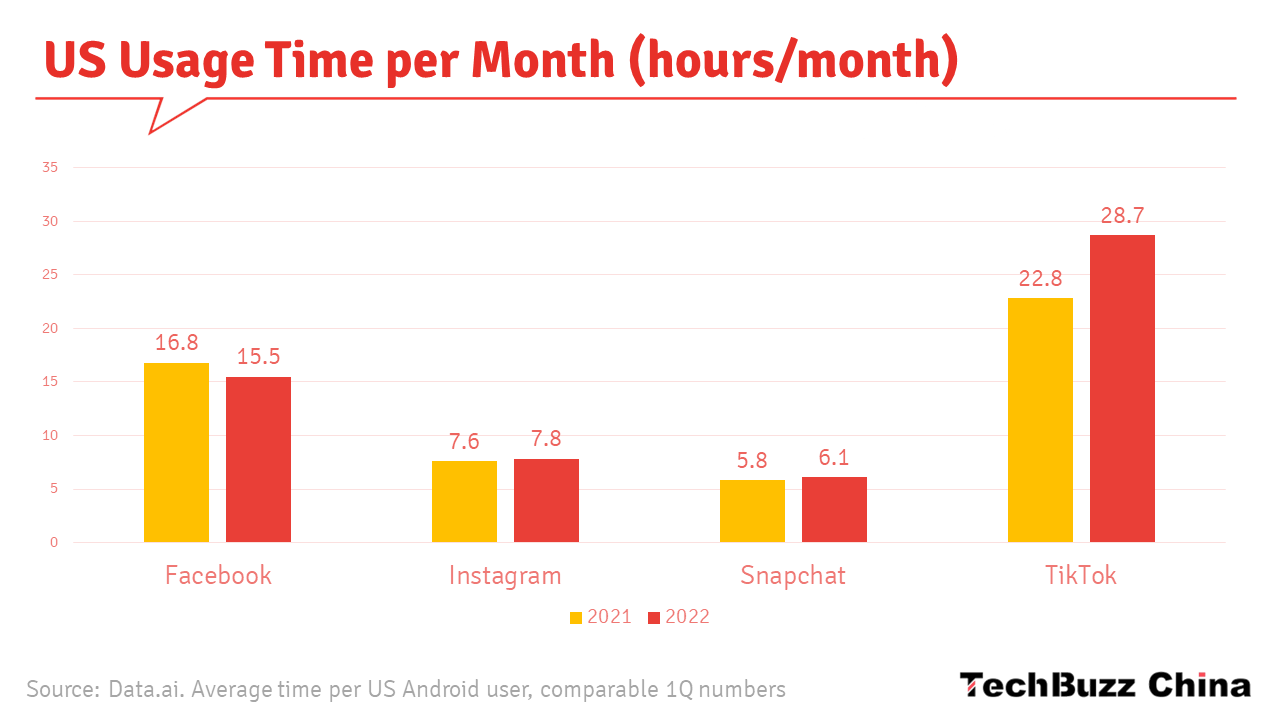
TikTok was launched in 2017 and gained traction in 2018, quickly becoming one of the most popular global apps, with 1 billion global users in September 2021. On average, a U.S. user spends about 29 hours per month on TikTok, surpassing the combined user time on Facebook (16 hours) and Instagram (8 hours). However, Facebook and Instagram still have a larger user base. [1]
In the past years, TikTok’s main monetization model has been advertising, with revenue from this source adding up to approximately $4 billion in 2021 and exceeding its goal of $10 billion in 2022. [2]
Meanwhile, Douyin, TikTok’s sister app in the Chinese home market, has been experimenting with various models for e-commerce since 2018. In that year, it started generating traffic to external webshops like Alibaba’s Taobao and JD.com. In 2020, it severed its ties to these external platforms and rolled out its own in-app e-commerce infrastructure. It has been very successful at that, growing its market share in China’s e-commerce market from less than 0.5% in 2019 to 8% in 2021 and is expected to grow this to 14% by 2025, mostly at the expense of market leader Alibaba.
Considering TikTok’s success in user penetration outside China, it was only a matter of time before Bytedance would try to replicate its domestic e-commerce initiatives in TikTok, thereby diversifying its monetization and no longer solely depending on advertising, like many Western apps still do.
Partnerships
As with Douyin in China, TikTok started its e-commerce ventures by teaming up with third parties that run their own e-commerce infrastructures. In October 2020, it partnered with Shopify, allowing Shopify merchants to build TikTok advertising campaigns from their Shopify dashboard. Video ads were automatically generated for selected products, driving traffic from TikTok to their Shopify stores. [3]
Shortly after, on November 8th 2020, Walmart ran a TikTok campaign called #unwrapthedeals, cooperating with TikTok creators to generate traffic to the Walmart website by clicking a button on the screen. According to the retailer, creators made over a million videos for the campaign, and it generated 5.5 billion views.
At the time, Walmart was a potential party in a possible forced sale of TikTok to the retailer and Oracle, initiated by the Trump administration. This never came about, as Bytedance managed to stall the negotiations long enough for the newly arrived Biden administration to scrap Trump’s executive order.
In December 2020, the Walmart partnership was extended to a test with TikTok’s first ‘shoppable livestream’, an attempt to recreate China’s popular live commerce trend in the US, using TikTok creators to promote apparel products. As with the #unwrapthedeals campaign, users were taken out of the app to the Walmart website if they wanted to buy products. Shoppers would have a separate check-out process, requiring setting up a user account if you didn’t have one yet. Considering how, at that time, e-commerce was already fully integrated in Douyin, it felt far from seamless.
Turner Novak’s recording of the Walmart purchase process on TikTok.
Although Walmart didn’t share specific sales results – only saying the stream had seven times more views than anticipated and that it grew its TikTok follower base by 25% – it called the test a success. Walmart held another one-hour TikTok livestream in March 2021, this time focusing on beauty care products. [4]
In August 2021, TikTok expanded its partnership with Shopify and launched TikTok Shop in the US, UK and Canada. [5] Shopify merchants with a TikTok for Business account could add a shop page to their TikTok profile and synchronise their Shopify item catalogues.
In September 2021, a comparable partnership was announced with Square, a US digital payment company. [6] Besides creating a shop with Square x TikTok (with actual sales taking place on Square), the connection also allowed for product links to be created in their TikTok videos that forward shoppers to a merchant’s Square webshops. Other partners TikTok expanded the shopping connection to were Ecwid and PrestaShop.
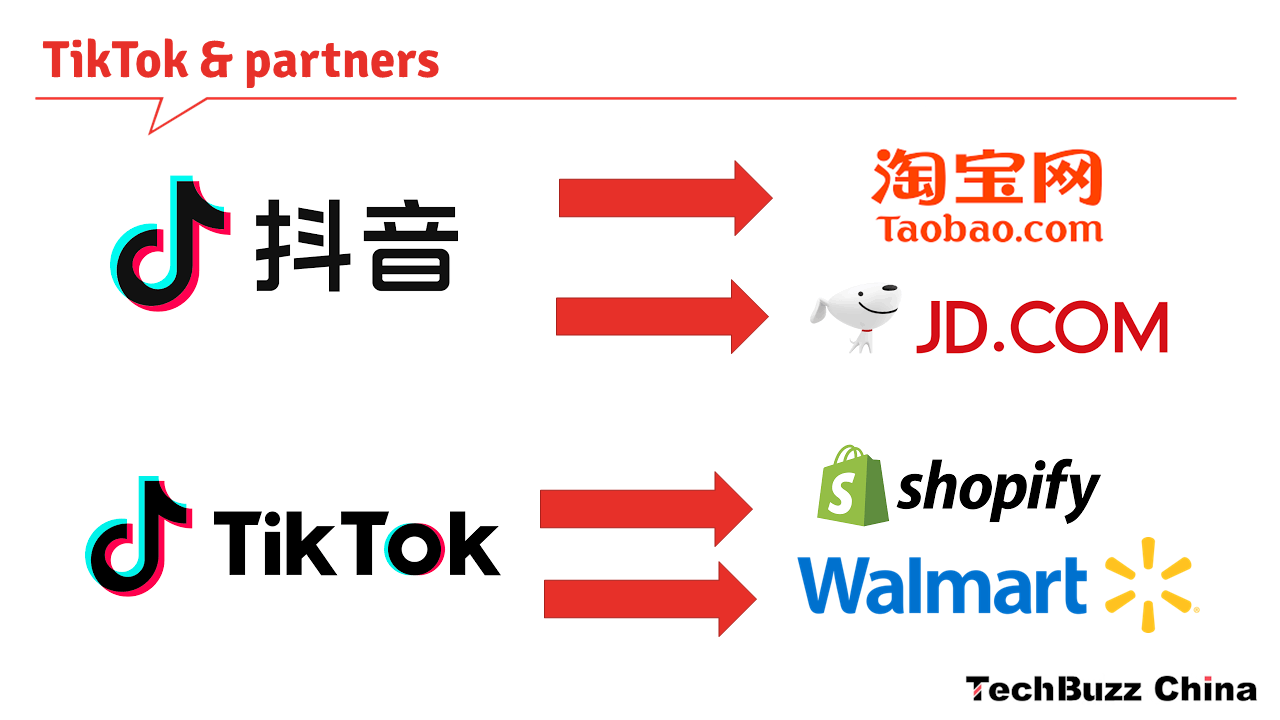
At the time, many of these partnerships reminded us of one of the first phases of e-commerce on Douyin when the app would forward traffic to external marketplaces like Taobao … before eventually cutting those ties and setting up its own e-commerce infrastructure. It seemed obvious what would happen to those partnerships if TikTok’s own e-commerce platform started taking off…
And that proprietary infrastructure was already being tested elsewhere…
Launching TikTok Shop
In early 2021, TikTok began testing e-commerce features in Indonesia and the UK. In February 2021, TikTok launched Seller University, a training hub to help merchants do business on the app. It was later rebranded as TikTok Shop Academy and rolled out to various countries in Southeast Asia. [7]
At a marketing event called ‘TikTok World’ in September 2021, TikTok presented in-app storefronts for brands and launched full-service e-commerce. [8] In November 2021, TikTok launched a stand-alone app for merchants in Southeast Asia to manage their TikTok stores. [9]
By this time, there were two ways that TikTok facilitated shopping in the app. First, there was the TikTok Storefront, which was used in the Shopify and Walmart examples from the US. In the Storefront model, products were visible in TikTok, but the transactions were completed on the third-party platform. Second, there was the TikTok Shop, in which transactions are completed in the app, and TikTok took a 5% commission. The first approach was called ‘semi-closed loop’ while the latter was ‘full-closed loop’.
Many Chinese merchants opened shops on TikTok, seeing it as an alternative to platforms like Amazon, especially after the latter started cracking down on fraudulent sellers. In November 2021, Bytedance started incentivizing merchants from Guangdong to sell to consumers in the UK through TikTok. Besides free commission on the first 90 days, they would receive various other benefits, like free shipping. [10]
But it wasn’t easy.
When Chinese merchants decided to promote their products through livestreams, they had three options: use their own staff, hire Chinese who can speak fluent English to make content or use locals in their target markets. This last option can be prohibitively expensive considering the higher wages in the target market. Still, the language skills of Chinese often leave much to be desired. A host with bad communication does not help build trust in purchasing from the concerned merchants. As a matter of fact, it puts more emphasis on its often-considered controversial origins.
Some Chinese teachers of the English language who had become jobless after the Chinese government banned after-school tutoring in the summer of 2021 were now working as livestream hosts. [11] Their language skills were a clear advantage, although many lacked good sales skills. They also weren’t as passionate about selling to an invisible audience as they were about teaching a foreign language to kids.
Another challenge was the delivery times. The cross-border logistics between a Chinese seller and a UK buyer were handled by different service providers for each of the three steps: the shipment from merchant to domestic warehouse, domestic warehouse to UK warehouse and UK warehouse to UK consumer. The last step was done by Royal Mail, and the full process could take 10 to 30 days.
In November 2021, TikTok rolled out its first live commerce streams in the UK for Black Friday. [12] One of the brands participating in a 3-hour broadcast was Charlotte Tilbury. The cosmetics brand offered special low prices during the livestream, a tactic that is one of the success factors of this type of e-commerce in China. The livestream had ‘over 500 viewers’ at its peak, which, compared to Chinese standards for livestreams, didn’t seem all that impressive. Another merchant, electronics seller TheTechHead, claimed to have sold £100.000 in its stream on the 25th.
December 2021 saw TikTok UK try another live commerce event called ‘On Trend’. [13]
Meanwhile, the share of local sellers kept growing. Before August 2021, only 10% of TikTok UK’s total e-commerce sales came from local UK merchants. By the end of 2021, this had risen to 50%. [14]
And then things got serious…
In January and February 2022, TikTok was holding weekly webinars to explain e-commerce on the app. TikTok also launched a new TikTok Shop Academy website for the UK and a UK seller Whatsapp group.
Image source: TikTok
Of course, to get users to start buying in the app, you first need a large number of TikTok Shops with lots of products. In January 2022, it became clear how much TikTok UK wanted retailers to use the app as a sales channel. Small businesses were invited to open an in-app shop, and the 13 top sellers would get awarded monthly prizes ranging from £1,000 to £10,000. [15]
Sellers could also win up to £3,000 in vouchers if they would do up to 30 livestreams of 2 hours each per month, incentives and subsidies that are very common in China. TikTok also subsidised some of the discounts that brands were giving, as well as the costs of livestreams, like studio space and technical staff. [16]
On top of these incentives, TikTok also lowered the commission on sales from 5% to 1.8% for the first 90 days of new TikTok Shops and offered £1,000 rewards for referrals of new merchants.
TikTok’s struggles with live commerce in Western markets
In February 2022, it was reported that TikTok had reached RMB 6 billion in GMV (~€880 million) in its global e-commerce business (excluding China, where sales are recorded under Douyin) in 2021. [17] More than 70% of these sales originated in Indonesia, the rest in the UK. TikTok was aiming to double this GMV in 2022. By comparison, the e-commerce GMV on Douyin, the Chinese version of TikTok, in 2021 was estimated to have been RMB 800 billion (~$110 billion). [18] The daily GMV of TikTok for the UK was about the volume of one medium-sized live commerce shop in China. [19]
Average daily sales of TikTok UK in June 2022 were only around $300.000. [14] TikTok had set itself a goal for global e-commerce sales of RMB 3 trillion (~€240 billion) in GMV within five years. At roughly three-quarters of the global GMV of Amazon, an almost three-decade-old company, that seemed unrealistically ambitious.
Struggling live commerce
On July 5th 2022, the Financial Times dropped a bomb with an article claiming ‘TikTok abandons e-commerce expansion in Europe and US‘. [20] The article specifically mentioned live commerce as the initiative that had failed to gain traction in the Western test market of the UK.
At home, Douyin had tripled live commerce sales year on year. According to sources of the Financial Times, TikTok’s plans to expand to Germany, France, Italy, and Spain in the first half of 2022 and the US later in the year were shelved. TikTok denied the news, stating that it had no plans for a roll-out of e-commerce to other regions in Europe and that it was still focussing on making it a success in the UK. [21]
Reactions among China tech watchers were sceptical, claiming the article was ‘inaccurate’ and ‘misinformed’ and that it was unlikely TikTok would fully abandon live commerce but would probably prioritise investing in other initiatives. Cailian Press claimed that sources at Bytedance said TikTok would refocus on its development in India, Malaysia, Thailand, Japan, South Korea, and the Middle East while shrinking its business in other regions. [22]
Despite incentives to live-streamers and brands, sales had indeed been disappointing. In the Financial Times, an anonymous TikTok employee was quoted saying: “The model doesn’t work because it is a different market and ecosystem in the UK, but management doesn’t listen and refuses to make changes. (..) It will only work if the company is willing to listen about how to do it in a culturally acceptable way that works for British brands and consumers.” According to an anonymous TikTok employee, the market was simply not ready for live commerce yet. [16]
Long delivery times and lousy service
Pingwest reported that the main problems of TikTok Shop were the faltering logistics and customer service of cross-border sales from China. [23] It quoted a TikTok employee as saying: “Good customer service, after-sales support, and reliable logistics can help platforms create a good shopping experience, build a solid reputation, and boost sales. Cross-border logistics are now too time-consuming, and supporting services are not ideal—all of these contribute to a bad experience for customers.”
According to a LatePost article, Bytedance was trying to solve the problem of long delivery times with a plan called ‘Aquaman’ (海王). [24] It called for setting up UK warehouses to enable e-commerce fulfilment, comparable to Amazon’s ‘Fulfilment by Amazon’ model, in which it stores and distributes sales for merchants on its marketplace for a fee. Products with stable sales would be stored in these UK warehouses to shorten delivery times to 3-5 days. Merchants would send goods to a central warehouse in China that would handle transport to the UK hubs.
TikTok started testing with a Fulfilled by TikTok Shop (FBT) in November 2022 and rolled it out in August 2023. [25]
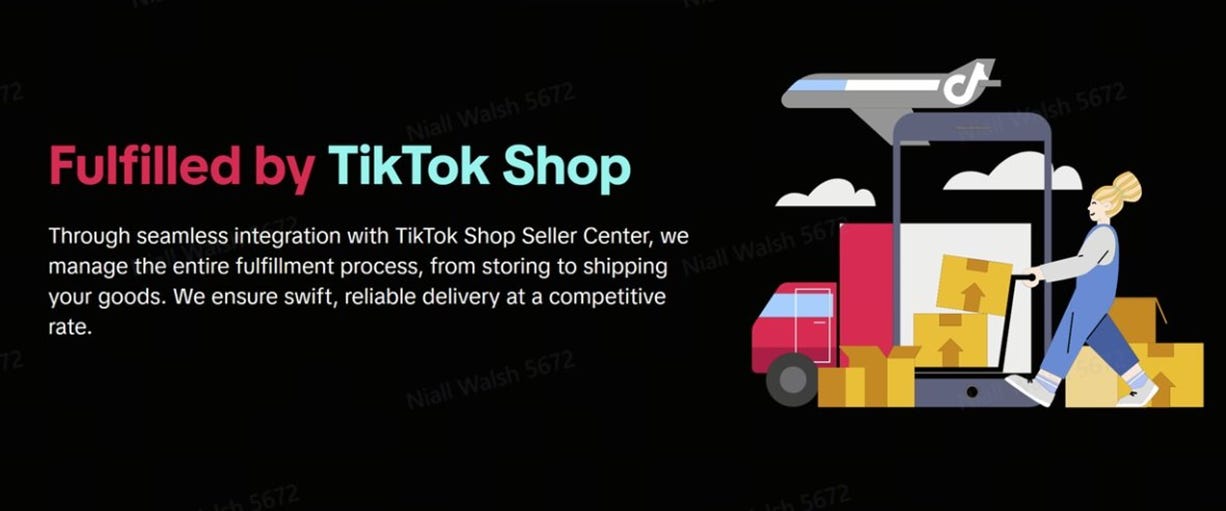
Image source: TikTok
Another problem customers faced was that Chinese merchants refused returns and refunds. The margins on products were simply too low, and the logistical costs to ship goods back to China were too high. Instead, merchants tended to negotiate a discount.
There was another possible reason for the difficulties live commerce was having on TikTok. [26] The app is largely algorithm-driven; TikTok chooses the content for the users, and it is hard for an influencer to build strong relationships on TikTok. On top of this, in the short, thirty-second videos that make up most of TikTok’s ‘For You’ selection, it was hard for influencers to convince users to actively follow them and watch their longer livestreams. Influencers were saying it was easier to build up loyal followers on platforms like YouTube, and some started moving to other streaming services.
This reminds us of what we have seen happening in China. Live commerce hosts on Taobao and short-video app Kuaishou tend to have much higher GMVs than those on Douyin, simply because Kuaishou is much more built around relationships between hosts and their followers and less by algorithmic recommendation engines.
Culture clashes
On top of the lack of traction of live commerce, TikTok was facing many other challenges in its e-commerce division in the UK. In June 2022, the Financial Times reported that the Chinese working culture at TikTok’s e-commerce division had caused a staff exodus. [16] Sources mentioned a Chinese-style ‘996’ working culture (long days of 12 hours, six days a week), ‘relationships built on fear’ and unrealistic targets of up to £400,000 per livestream (most ‘successful’ streams only generated £5,000).
LatePost published more details on the struggles of TikTok’s e-commerce business in the UK. [14] Frictions existed on both sides: employees in China were dissatisfied with being paid less for the same work, while workers on both sides disliked having to work unconventional hours to accommodate each other’s working schedules. English staff complained about their Chinese managers’ poor language skills, authoritative management styles allowing little participation in the decision-making (‘we decide, you implement’), and confusion caused by frequent changes in organisational structure and work objectives.
Most first and second-level managers in the TikTok UK e-commerce business unit were Chinese, and more Chinese staff had been added, changing the initial Chinese-to-English ratio of the division from 1:9 (comparable to TikTok UK’s full staff) to 5:5. A staff member told LatePost: “Chinese leaders who have never been to the UK and who can’t speak English well are managing a group of project managers with 5-7 years of experience who do not understand Chinese, have never been to China, and have always grown up in the UK environment.”
The first wave of resignations at TikTok’s UK e-commerce division took place between November 2021 and the start of 2022. A second wave followed in May 2022, after staff had received their year-end bonuses. Despite many people leaving, the team still counted about 300 employees and seemed to still be recruiting. In mid-2022, LinkedIn showed many e-commerce-related job openings at TikTok’s London office.
Time was scarce for TikTok; it was facing continuous geopolitical pressure, especially in the US, where politicians continue to call for a ban on TikTok. Meanwhile, TikTok’s user growth has started to slow down in many markets and competition from other Chinese cross-border platforms was increasing.
Being the most valuable unicorn, Bytedance was doubtlessly also contemplating an IPO and needed to make its international performance look good. Mid 2022, Bytedance saw its valuation drop by 25% in private investments. [27] Reports on job cuts at TikTok in the US, UK and EU continued, even though layoffs of an estimated 100 people only represent 1% of its workforce. [28]
What works at home might not work abroad
One of TikTok’s problems seemed to be that it took a strategy from China and expected it to work abroad as well. However rolling out the highly successful tactic of live commerce in China has not brought the expected results in the UK.
One of the success factors for live commerce in China is the ability of a popular host to negotiate substantial discounts from manufacturers and brands because they reach millions of consumers and can thereby guarantee a certain sales volume. However, European brands were uncomfortable with the levels of discounting TikTok was asking for. Brands did not want to disrupt their price system for a new channel with limited sales and an uncertain future. [14]
In February 2022, William August, the founder of a marketing company for live commerce, published an explainer video on TikTok shopping on YouTube. He was – obviously – very enthusiastic about the prospects of live commerce. But watching his video, you can’t help but notice the numbers in the top right corner of the examples of livestreams he was showing, representing the number of people watching the stream. In his video, they range from 4 to 54, with one exception of 166. They might not be representative, but do you think that’s enough to get the amazing discounts the maker of the video was talking about?
Another reason for the lack of success of live commerce is that influencers would rather make well-paid short videos for a brand than spend tiresome hours livestreaming with little potential pay, even if TikTok offers them a flat fee compensation.
Much of the context that makes live commerce successful in China is absent in Western markets, where TikTok is trying to make it successful. In China, live commerce is extremely popular among citizens in smaller cities and rural areas where retail infrastructure is often limited. These circumstances have been one of the main drivers for the success of e-commerce in China, and live commerce is simply an advanced form of e-commerce.
The concerned online shoppers from these markets have more time and less disposable income compared to those in bigger cities (according to data by Fastdata, 75% of buyers on live commerce earned less than RMB 5.000, or €700 per month). Hence, they are always keen on grabbing a discounted product that has been preselected by the livestream hosts’ teams and is thereby guaranteed to be of high quality.
Add seamless integration of e-commerce in Chinese apps, skilful hosts that know how to sell and a ‘fear of missing out’ on good deals, and you have all the ingredients for successful live commerce in China. Not only is this cultural context missing in the West, but we are also still more used to targeted searching and buying on websites (‘shelf commerce’) than making impulsive purchases while watching long livestreams.
Source: Tech Buzz China Livecast with Jordan Berke
Level playing field
Another challenge for cross-border e-commerce from China is the changing policies in Western markets that try to create a more level playing field. More and more often, Chinese platforms are being subjected to the same regulations as those for domestic players in Europe and America. AliExpress’ sales in Europe came under pressure after the EU scrapped the maximum value of €22, at which packages from outside the EU were exempt from value-added-tax. Previously, this meant that most of the low-cost goods from China could be sold through cross-border e-commerce without paying value-added tax. Now, value-added tax and possibly customs clearance fees would be added to the price of purchases from China. A purchase that would previously be priced at €10 on a Chinese platform might now be double the costs.
Chinese cross-border merchants are also facing increased postage costs in the coming years. Under the 1969 system of ‘terminal dues’ of the Universal Postal Union (UPU), China was considered a ‘group III’ developing country and therefore paid lower international postal fees. This has made it ridiculously cheap for Chinese merchants to send postage packages around the world. When, in the past decade, the amount of cross-border e-commerce sent by mail from China increased, the US started to run a net deficit in international mail. In Europe and the US, e-commerce companies complained that was more expensive for them to ship in their own countries than it is for Chinese companies to deliver from the other side of the world.
The US threatened to pull out of the UPU, which compromised by allowing postage fees to increase by 164% between 2020 and 2025. This will either hurt the margin of the e-commerce merchants or result in higher consumer prices.
Chinese platforms are also being forced to make their terms and conditions compliant with regulations in the European market, like the right to return products within 14 days of receipt. Europeans can now file a dispute with a court in their home country instead of only in China.
In the meantime, consumer rights organisations continue to warn about inferior quality and unsafe products sold on Chinese platforms. A 2022 consumer survey by a Dutch consumer rights organisation found that almost one-third of respondents had bought products on webshops outside the EU that did not meet expectations . [29]
Short presentation on TikTok Shop in 2022 by Ed Sander
(Note: the section below is only available to paid Tech Buzz China subscribers)
The state of affairs
TikTok was planning to grow its e-commerce business to $2 billion in 2022 and $23 billion in 2023. [30] As mentioned, it was also reported that TikTok had set an incredibly ambitious GMV target of RMB 3 billion (~$420 billion) in five years. [31] In order to achieve this goal, TikTok would need to expand to 10 more major markets before the end of 2023. According to sources of the Financial Times, TikTok was planning to expand its e-commerce business to North America, Spain, Ireland and Brazil (TikTok’s third-largest market). By the end of 2022, it was already recruiting staff in these markets. [32]
In and out of Brazil
Brazil has 150 million internet users, one-third of which use TikTok every day. Its logistics and payment infrastructure have improved in the past years, making it one of the fastest-growing e-commerce markets with a 2021 size of $34 billion. A source in TikTok claimed that TikTok had given Brazil a higher priority now that both short-video competitor Kuaishou and fast-fashion platform Shein were actively expanding there. [33]
According to LatePost, TikTok would not only launch live commerce but also ‘shelf commerce’ in Brazil. This traditional search-based form of e-commerce is easier to set up since it does not require finding talented livestream hosts nor convincing merchants unfamiliar with live commerce to use it. Bytedance had previously already implemented ‘shelf commerce’ in Douyin and TikTok Indonesia (more on that later).
But facing challenges with the compliance rules for cross-border imports in Brazil, TikTok withdrew its 20 staff members from the country after trying to enter the market for 3 months. TikTok transferred some of its staff from Brazil and Southeast Asia to its US operations. [34]
In and out of Spain
In December 2022, Alibaba opened a new webshop, Miravia, in Spain. Half a year later, the world would wake up to this when Michael Evans, president of Alibaba, mentioned in a speech that the company was planning to launch a European version of Tmall. [35] Spain also proved to be a market of choice for TikTok. While Spain was not yet listed on the seller portal, by the end of 2022, TikTok was recruiting category managers and logistics managers in Madrid. [36]
Reasons for the choice of Spain as a priority market for e-commerce are its strategic geographical position between northern Africa and Western Europe, its well-developed infrastructure, high penetration of internet usage (93%) and online shopping (68%) and a large e-commerce market (€58 billion). Spain was also said to be a relatively TikTok-friendly country, with political parties creating early TikTok accounts and local companies cooperating with the short video app. [37]
The Spanish user penetration of TikTok had more than doubled from less than 20% in 2020 to more than 40% in 2022. TikTok’s global penetration rate was less than 20% in October 2022, while Douyin’s domestic penetration rate is close to 54%. [38]
A source of Brandfactory claimed that Spanish users were more open to live commerce, creators were more interested in making such content, and consumers liked discounts and gifts. As such, they were expected to be more open to TikTok’s approach to e-commerce than the Brits. And finally, there was the language factor: with Spanish being the second most spoken language in the world after Chinese, it could open a potential of 437 million people worldwide that have it as their mother tongue. [36]
However, in May 2023, it was reported that TikTok had told its staff in Spain to move to the TikTok office in London. They were offered two flights home each month, as well as half a year rent in their new homes. [39]
The Middle East
While offline shopping remains the most common way to purchase goods, PWC found that 40% of Middle Eastern consumers also shop online. The sales of TikTok Shop in the Middle East are growing rapidly after TikTok has been issuing large coupons and free shipping. The main markets TikTok is interested in are Saudi Arabia, the United Arab Emirates, Israël and possibly Turkey. The first two countries have the highest penetration rate of TikTok, while the other two are also in the top 15.
A big difference with Europe and the US, where usage skews towards teenagers, is that most people who are using TikTok in Saudi Arabia and UAE are older than 18. They also have relatively high consumption power.
There are quite a number of e-commerce platforms active in the region: Amazon, Noon (which also owns Sivvi and Namshi), SHEIN and Alibaba’s AliExpress and Trendyol. The region also has well-developed logistics companies like Aramex, iMile, and Jitu. As early as 2021, Bytedance invested in iMile to prepare for entering the Middle East. [40]
But recently, TikTok found itself in a controversy in Saudi Arabia, when it found that its content review policies needed to be a lot stricter than those of the US it was also using for the Middle East region. Content making rude remarks about the king, burning of Qurans in live broadcasts and banning a Palestinian’s account after expressing gratitude to Saudi Arabia for support caused great dissatisfaction. Many users and livestream hosts were not happy, and there was even a ‘boycott TikTok’ hashtag going around, while some media organisations and celebrities withdrew from TikTok. After fluctuations in usage levels in early November, they have returned to normal. But TikTok has undoubtedly learned another lesson in localisation. [41]
Southeast Asia
In 2022, TikTok’s market share in Southeast Asia was modest at 4.4%, but its growth was noticeable. Projections in August estimated that TikTok might reach more than 13% market share in 2023. [42]
TikTok has an estimated 110 million users in Indonesia, according to DataReportal. They spend more than 100 minutes on the app every day. TikTok’s Seller Central app has been downloaded 5.5 million times in the country. [43] Ipsos reported in March 2022 that 71% of Indonesian consumers had watched livestreams, and 56% had made purchases in them. [44]
When TikTok Shops was launched in Indonesia in 2021, only local merchants were allowed to sell on the platform. This was considered a safe strategy because of the familiarity of these merchants with market conditions and faster delivery times. However, most of these local ‘Indonesian’ sellers were actually Chinese businessmen who had registered local companies and imported Chinese goods to warehouses in Indonesia, delivering them in 3-4 days. [34]
Sellers in Indonesia need to provide a business registration certificate and pay a 1% commission plus 2,000 Indonesian rupiah (13 dollar cents) per item sold. As in China, the anchors in the livestreams sometimes come from a talent agency that has trained them on how to sell. [43]
In 2022, TikTok launched a clean-up of its platform. It closed stores as it cracked down on counterfeits, inactive sellers and false accounts. It also forced merchants to specialise in a certain main category, no longer allowing them to operate multiple categories. [45]
After having expanded to Thailand, Vietnam, Singapore, The Philippines and Malaysia, TikTok opened the platform to cross-border merchants in 2022. Global GMV reached $4.4 billion that year, mostly coming from local merchants in Indonesia. [34] Indonesia was the single country market with the best development momentum for TikTok e-commerce, contributing US$2.5 billion in GMV (gross merchandise transactions) in 2022, accounting for approximately 60% of Southeast Asia's GMV. [46]
In Indonesia, monthly average GMV was $200 million in the first half of 2022, while in the UK, it remained at $24 million per month. [47] In Indonesia, the average unit price was $2-$3, and the majority of buyers were 18-24 years old. [31]
Indonesia’s GMV might seem high, but the GMV of market leader Shopee was $60 billion in 2021. And even those figures pale in comparison to more than $200 billion (1.41 trillion RMB) that was sold through Douyin in China in 2022. [48]
Considering how Indonesia’s 278 million people make up more than half of Southeast Asia’s e-commerce GMV in 2022, Indonesia is a highly important market for TikTok. [49] What’s more, the Indonesian government has forecasted the e-commerce market to grow to ($1.6 trillion) by 2045, making up about 18% of its GDP. [50]
TikTok Shop launched the Mall function (‘shelf commerce’) in Indonesia in October 2022. [51] TikTok Shop rolled out the Mall function in Thailand, Vietnam, Malaysia and the Philippines in February 2023. A ‘Shop’ button appeared next to ‘Home’ in the bottom menu. Opening it, users would see a search bar, ‘new customer offers’, ‘flash sales’ and a slider with various product categories. Within a product category, users would see images with links to product pages, short videos or livestreams. [45]
It topped $1 billion in the first three months of 2023, according to e-commerce research firm Cube Asia. [53]
On the 6th of June, 2023, TikTok Shop held a promotion to celebrate its first anniversary of entering the Southeast Asian market. In Indonesia, during the promotion, GMV was 130% of the normal level, and livestreams had 700 million views. [51]
In June 2023, it was reported that TikTok was planning to increase the size of its global e-commerce business from $4.4 billion in 2022 to as much as $20 billion in 2023. [52] 75% of that target would come from Southeast Asia.
At an event in Jakarta in June, TikTok CEO Shou Zi Chew said the company would invest billions into the Southeast Asian region over the coming three to five years. TikTok had 8,000 employees in the region, of which 2,000 in Indonesia. [53]
And then things went awry…
Teten Masduki, Minister of Cooperatives and Small and Medium Enterprises in Indonesia considered e-commerce to be harmful to Indonesia’s small enterprises and convinced his government to ban selling goods through payment within social media apps in September 2023. Companies can advertise goods on TikTok but no longer sell them there. TikTok reacted by pointing out that the new regulations would hurt ‘6 million sellers and 7 million creators’ from Indonesia who were making a living on the app. [54] It also stated that separating social media and e-commerce would hamper innovation. Nevertheless, on October 4th, it stopped facilitating e-commerce transactions in the app. [55]
Some sellers continued livestreaming on TikTok but used Whatsapp as the external platform to take orders on, like people in Indonesia had been doing on Instagram. Still, the conversion rate was less than 1/8th of that on TikTok. Other sellers moved to Shopee Live, and several MCNs (multi-channel networks) have closed and left Indonesia. [56]
Another rule implemented in Indonesia banned cross-border sales of goods worth less than $100. This also resulted in the closure of relatively small cross-border operations on other platforms like Shopee and Lazada. Goods priced over $100 can be sold but are subjected to government regulations and taxes.
While the new regulations in Indonesia are a blow to TikTok, Momentum Works still expects TikTok’s Southeast Asian market share to grow from 4.4% in 2022 to 13.9% in 2023, higher than its original projection of 13.2%. While TikTok is losing its Q4 sales in Indonesia, its performance in Southeast Asia has exceeded expectations. Even without Indonesia, TikTok is expected to exceed its target of $15 billion in the region this year. It is also likely that TikTok will return to Indonesia in some form, and/or it might shift resources to other countries. [57]
Source: [42]
Source [58]
On December 5th, news broke that Bytedance had struck a deal with Indonesia’s Go To Group to work with the group’s Tokopedia for e-commerce in the country. Details are still unknown, such as if this will be an investment by Bytedance or a joint venture, and the collaboration would need to be approved by regulators. According to Indonesian minister Teten Masduki, TikTok has spoken to five different potential partners about potential partnerships. [59]
[Update December 11th: TikTok will take a 75% controlling stake in Indonesia's Tokopedia e-commerce platform and invest $1.5 billion in the company over time. The partnership, which needs to be approved by regulators, would see the merged entity operate e-commerce on the TikTok app, including payment. Together TikTok and Tokopedia would have 40% market share in Indonesia, surpassing Shopee's 35%.] [85]
The fully managed model
In an interview, Shi Wenlu, founder and CEO of FastData, a global head short video data platform, named a number of advantages and disadvantages for Chinese cross-border e-commerce sellers on TikTok. [60]
Advantages:
Cognitive advantage: they are very knowledgeable about the internet and future trends and are quick to react to opportunities.
Ability to tell stories: because of their experience with fierce competition in China, they are experienced in telling stories and operating brands.
Knowledge of short video and live commerce.
Advantages of domestic supply chains and diligence of Chinese people.
But they also have disadvantages, including weak localisation abilities and lack of knowledge about local cultures, consumer preferences and local market scope. They also need local warehouses to meet consumer needs and lack relationships in local society, e.g. with local governments.
But TikTok had a solution for this problem…
In May 2023, TikTok announced that it was launching the fully managed model (全托管模式) for cross-border e-commerce to the Middle East and the UK. [61] This model closely resembled the model that Temu had used to launch in the US (as we described earlier this year) and that has also been adopted by AliExpress for some of the goods offered on its platform at the end of 2022. Lazada and Shopee also started using this model in April 2023, and SHEIN applies the fully managed model for its marketplace (goods it doesn’t procure itself).
Temu has shown that the fully managed model can increase basket size and improve customer experience because customers receive all items from one order in one package. In the marketplace model, one order could result in multiple packages from individual merchants. In the fully managed model, goods in the platform’s warehouse are owned by the merchants, and hence, the platform does not run any inventory risk. [61]
It is a demanding model for the platform, but the margins can be much higher than commissions in the marketplace model. The platform gets to negotiate a sales price by the merchants while setting its own sales price to the consumer. This way, it has large control over the margin. [61]
Manufacturers/merchants have a much easier job than under the marketplace model. They only have to send the goods to TikTok’s domestic collection warehouse and no longer need to get involved in international logistics, sales, marketing and after-sales. These are areas where merchants often have shortcomings. With this model, they can focus on what they are best at: manufacturing products. [62] They do, however, make lower margins as the platforms will pressure them to offer goods at the lowest possible price.
Logistical service providers that the platform works with can get very high volumes, and they no longer have to deal with individual merchants. But these high volumes give the platform much stronger bargaining power, thereby also putting pressure on the margins of the logistical partners. [61]
It’s a win-win situation: the platform wins twice.
The model has become the standard for major cross-border e-commerce platforms because: [62]
The platform has a better understanding of the local market, especially the European and American markets, than the factory. It can also do better quality control and product screening to ensure goods comply with local regulations and consumer needs. Teams at the platform have researched what products would be popular in these overseas markets. When a product breaks out, the platform can quickly mobilise resources (manufacturers, logistics, etc).
Inflation in Europe and America has been severe, and consumers are looking for inexpensive goods. The fully managed model can guarantee better cost control through economies of scale.
For AliExpress, the introduction of the fully managed model has attracted a number of factories across China to join the platform. Previously, language, logistics, overseas compliance and lack of cultural understanding have been roadblocks for them. In March 2023, the order volume on AliExpress increased by 50% YoY, this is thought to be largely triggered by the implementation of the fully managed model at the end of 2022. [62]
Differences in application of the fully managed model.
‘Project S’
Mid 2023, TikTok rolled out a new feature called ‘Trendy Beat’ in the UK. It was a section in the app displaying items that had proven popular in videos. These Items were shipped from China and sold by Seitu, a Bytedance-owned business in Singapore. This was basically the fully managed model, internally known as ‘Project S’, where the ‘S’ stands for ‘Store’. [63]
During an internal meeting in May, TikTok Shop’s management said that Project S would fully emulate Temu, including by stocking and selling the same viral / top-selling products. While it previously ran a fully managed model without the visibility of supplier names, it now started copying Temu’s approach of storefronts, with merchant names and logos visible. [64]
On the one hand, this meant that the merchant would no longer have to be experienced in or spend time on marketing, logistics, etc.; on the other hand, it was also a potential threat to those already selling on TikTok. Project S uses TikTok’s data on products that go viral on the app and then source those products themselves. Next, it would promote the products on ‘Trendy Beat’, competing with the other sellers. [63]
TikTok’s organisational structure was also adjusted, and has two teams. The first team serves overseas local merchants (the merchant is located overseas and normally delivers to an overseas warehouse). This team is normally managed by national managers of each country. The second team is responsible for servicing the cross-border e-commerce of Chinese merchants (who are located in China and normally deliver to a warehouse in China). This team is mostly stationed in Shanghai and Guangzhou and can be further divided into an AM team (merchant operations) and a CM team (service provider operations: MCNs, broadcasts, etc). [65]
Current operating and sales models
TikTok Shop now has two operating modes [40]:
Self-operated mode (as launched in Indonesia in February 2021): merchants (local or cross-border) open TikTok shops and sell products through livestreams and short videos. They set their own prices.
Fully managed mode (launched in May 2023): cross-border merchants only supply goods, and TikTok will set the pricing and handle all operations and logistics.
Sales channels on TikTok can also be divided into two categories [40]:
Content model (interest/content-based e-commerce; ‘products looking for people’): merchants attract users through livestreams and short videos.
Mall model (shelf/search-based e-commerce; ‘people looking for products’): merchants put their products in a ‘shelf-commerce’ mall and attract users through keyword optimization and search advertising. This model was first tested in Indonesia in late 2022. In countries where this ‘mall’ has been opened a prominent ‘Shop’ button will be visible in the menu on the screen.
In China’s typical horse-racing tradition, TikTok’s live commerce and shelf-commerce teams are competing with each other for sales. [66]
Operation and sales modes available per region, prior to Indonesia ban. [40]
All in all, there are now three types of e-commerce on TikTok with their own types of merchants [2/65]:
Local e-commerce: only applies to businesses that operate in the local market (even if they are subsidiaries of Chinese businesses). This is most suitable for official stores of brand merchants, local brands or overseas sellers with strong distribution capabilities (as in their own warehouses in the local market).
Cross-border e-commerce (self-operated): Merchants and brands that are capable of their own overseas operations, including content production, logistics and strong localisation. These can register companies overseas and use the self-operated model. This normally is most suitable for high-priced products and branded products in a phase before they switch to local e-commerce.
Fully managed e-commerce: high-quality merchants with strong supply chains or industrial brands can be linked to ‘Project S’ (fully managed). This model is also most suitable for standard products, products with extremely cost-effective advantages and factory-type merchants.
Within the TikTok ecosystem, sellers can collaborate with content creators through commission-based partnerships. According to TikTok, 100,000 creators have already joined this affiliate programme. [67] Merchants can negotiate commission rates with the creators for their short video and livestream content, normally ranging from 1% to 20%. TikTok pays the creator, avoiding potential conflicts with the merchant. [65]
Faltering fully managed
By the end of the summer, TikTok's daily GMV from fully managed e-com in Saudi Arabia and the UK was $600,000. Things seemed to be going well, or were they?
Well, implementing a new business model, like fully managed, did not come without its growing pains.[64]
The first two or three months after the launch of the model were downright chaotic. TikTok hosted frequent online and offline boarding events for merchants in collaboration with service providers. One hundred staff members were sent to look for suitable merchants. However, the merchant liaison teams had been hastily gathered and lacked experience. Traffic on the platform was unstable, and as a result, sales were unpredictable.
Small and medium-sized sellers were left without proper support and guidance. They had to post their questions in communication groups that included hundreds of other suppliers. If they did not get a timely answer from TikTok, they could only hope for help from a fellow merchant.
Because TikTok Shop had a lack of SKUs on offer, merchants needed to list 50 products before they could join. But when they uploaded all this product data, the backend proved to be buggy, requiring repeated attempts. Goods were often wrongly categorised by TikTok. One merchant was told that the goods he had delivered to a TikTok warehouse had to be returned to him, after which they could be re-categorized and sent to the warehouse again. Simply changing the product category in the database by the merchant or TikTok staff was seemingly impossible.
The same merchants found that under the fully managed model, his products were listed 50% cheaper than in his self-operated TikTok shop, and his GMV dropped by 90%.
Not every MCN was allowed to promote goods that were sold in the fully managed model. At the same time, commissions for influencers were exceptionally low at 10%, compared to 15-25% on the self-operated marketplace. As a result, influencers were not interested in promoting these goods. Some merchants were then allowed to do their own promotion, which basically destroyed the whole idea of the fully managed model.
Despite promises of short payment settlement periods during merchant recruitment, they proved to be longer than on the marketplace. According to some merchants, this was caused by TikTok’s misunderstanding of tax rates, which resulted in the inability to pay automatically. Until August, TikTok had to make manual payments to merchants.
An anonymous TikTok employee claimed the problems were caused by a lack of clear thinking by management, short-term goals and targets and a lack of experience in product selection, quality inspection, etc, among employees. Half a month of training that this staff had received proved insufficient.
It's still early, but the problems of this sloppy implementation bring back memories of other failed cross-border e-commerce projects by Bytedance. And guess what? One of those failed projects, Ifyooou, had used the fully managed model too, since the end of 2021. Bytedance had invested $100 million in Ifyooou in an attempt to rival SHEIN. It had more than a year to test before it used the base of Ifyooou to launch a fully managed model in Saudi Arabia in February which was rolled out to the UK in May.
By August 2023, TikTok Shop's fully managed model had 10,000 - 20,000 registered merchants in the UK and Saudi Arabia and over 100,000 SKUs. Daily GMV, the core metric internally, stood at $600,000. By comparison, two months after it launched in September 2022, Temu had around $3 million daily GMV. [64]
After a few months, when TikTok was certain it had straightened most of the creases, it was time for the next step: launching the fully managed model in the US.
TikTok Shop US
According to TikTok, there are 150 million (registered) users in the US, making it its biggest single market. [68]
The US market has always been in the crosshairs of Bytedance. The main reason why a full launch had been postponed was Trump’s 2020 executive order to ban or force the sale of TikTok in the US. As a result, the UK and Indonesia were chosen as pilot markets. [34]
While postponing a full launch, TikTok had been taking it slow in the US. As we’ve seen, it set up partnerships with Shopify and Walmart, creating traffic to third-party webshops or small storefronts in the app. But after two years of cautious preparations, November 2022 finally saw TikTok starting tests of the in-app TikTok Shop in the US, aiming for a GMV of $2.8 billion in 2023.
As it had done in Indonesia, it started by only allowing local merchants to open stores. Registration required a US ID and a local warehouse that could deliver in 3 days. This limited the number of merchants TikTok could recruit and, thereby, the variety of products. After 4 months, it had only 100 active US merchants. [34]
TikTok also allowed merchants from other countries, as long as they had goods in overseas warehouses in the US. The company had also been publishing job openings related to logistics, indicating it was planning to open a US distribution centre. All considered, TikTok aimed to shorten delivery times and no longer primarily depend on shipments from China. [69]
TikTok also registered ‘Fulfilment by TikTok Shop’ as a trademark, echoing the same service by Amazon. Supporting local small businesses might also create more goodwill for TikTok among US officials. [70]
TikTok charged a commission of 2% of the actual payment of the order plus a fixed fee of $0.30 per order, a good deal compared to Amazon's commission rate, which is usually 8%-15%. [65]
In February 2023, TikTok rolled out ‘Go LIVE, Make Money’, a programme that provided influencers incentives to start livestreams and encouraged viewers to send them virtual gifts. This is something that has been common in China for more than 10 years (watch the documentary People’s Public of Desire to learn more). If they streamed for more than an hour, TikTok would give them a performance bonus. This ‘entertainment livestream’ strategy seemed to be an attempt by TikTok to get people acquainted with watching livestreams for longer times. [71]
After TikTok’s CEO Shou Zi Chew's congressional hearing on March 23rd, it was no big surprise when, in May 2023, news broke that TikTok had delayed the full opening of TikTok Shop in the US from early spring to June. TikTok had struggled to attract more merchants, who seemed concerned about a possible ban of the app and the low adoption of live commerce in the US. [72]
TikTok also kept struggling to convince international brands to sell on its platform. On the one hand, brands thought the production costs for live commerce were too high, while they also worried that presence on the controversial TikTok might harm their brand reputation. Still, these brands are more interesting for TikTok than unbranded or unknown brands because the latter spend little on advertising in TikTok.
Advertising by brands that also livestream on TikTok has already been proven very lucrative in China.
In a market where many advertisers were decreasing spending, merchants and anchors in China continued to place advertisements on Douyin to attract users to watch short videos and live broadcasts and thereby sell more goods. In May 2021, this part of revenue accounted for about 10% of Bytedance’s domestic advertising revenue; in the second quarter of 2022, this proportion exceeded 40%. This has taught Bytedance the importance of so-called ‘internal circulation’; advertising in Douyin by merchants that want to generate traffic to their stores and livestreams on the app.
In June 2023, The Information reported that TikTok had established US warehouse partnerships to facilitate fast delivery of e-commerce purchases from US sellers. [73] Two months later, it reported how TikTok had recruited two retail experts from Amazon and Meta. [74]
But still, no full launch of TikTok Shop.
Meanwhile, products that were featured in viral videos often sold out. Videos with hashtag #tiktokmademebuyit have had more than 56 billion views, mostly through links to third-party websites. [71] But this ‘semi-closed loop e-commerce’ was not what TikTok was willing to settle for…
Cutting the ties
TikTok has copied the same approach to developing e-commerce in the US as it used with Douyin in China. It first partnered with platforms like Walmart and Shopify to provide them with traffic to third-party sites. Now that TikTok was getting ready to open its in-app mall, it started cutting off traffic to these partners, just like it had done with Taobao in 2020. After launching Douyin Shops in 2019, Douyin created traffic to merchants' shops on Taobao, while Taobao encouraged merchants to get active on Douyin, promoting their Taobao stores. Douyin would receive advertising fees and service fees for third-party links, and Taobao would get the traffic. [75]
Live streaming e-commerce (live commerce) pushed e-commerce on Douyin far beyond expectations. In 2020, it reached double its target with more than RMB 500 billion in GMV. But 60% of these sales took place on external webshops. That same year, Taobao reached RMB 400 billion GMV through live commerce on its platform. It was a symbiosis that worked until Bytedance wanted more ways to monetize the Douyin app. The company realised it needed to keep buyers in the app. Therefore, in 2020, Douyin started restricting traffic to Taobao, increased service fees, and, within months, completely stopped traffic to third-party shops from livestreams. [75]
After May 2023, the number of TikTok Shops and corresponding GMV in the US suddenly exploded. By July, GMV had almost caught up with that of the UK market but remained lower than that of Southeast Asian markets and only a fraction of Indonesia’s GMV. The reason for the sudden growth seems to be TikTok’s introduction of the fully managed model. Previously, it had been difficult for merchants to make money on TikTok using the semi-closed loop approach. [75]
What is being sold on TikTok Shops in the US differs greatly from goods in Southeast Asia. While both regions see sales in beauty & personal care and women’s clothing, the US sees more sales in collectables, hardware products and small home appliances. In Southeast Asia, consumers are buying relatively more food and beverage products. Unlike in Southeast Asia, where shopping behaviour tends to resemble that of China more, in the US, little sales take place on livestreams, and most are triggered through short video adverts. [75]
In August 2023, TikTok severed all links to third-party stores. On September 12th 2023, TikTok Shop was finally officially launched in the US, having been delayed for another three months because of compliance reasons. In the meantime, TikTok had transferred some of its staff from Brazil and Southeast Asia to its US operations. [34]
Compared to the aforementioned path of Douyin, TikTok had moved relatively slowly in the US, taking nearly three years to go from semi-closed loop (advertising on TikTok for third-party webshops) to fully-closed loop (advertising and e-commerce transactions in TikTok only). Its cooperation with Shopify, Walmart and others had been a strategy aimed at getting early advertising revenue, while getting consumers used to shopping on the app. [75]
As it had done in Indonesia, prior to the launch, TikTok had first done a thorough ‘clean up’ to improve the quality of stores before the important Black Friday season. According to some sources, TikTok closed as much as half of the stores in the US. The reasons for closures were:
Compliance: The information submitted when opening the store was incorrect, and the merchant needed to review/resubmit it.
Store violations: delivering goods through virtual warehouses, resulting in inconsistencies between logistics and actual situations or various forms of fraud, including brushing (shipping empty boxes to imitate it look like sales).
Bad store reputation: stores that receive many complaints and negative comments.
Some stores were closed in the middle of a livestream or when orders still needed to be fulfilled. Funds were frozen for 30 days. [76]
Local stores with warehouses in the US and local anchors are said to be the most stable and have the best sales. The same goes for brands that are already well-known on other platforms. TikTok is said to be less friendly to Chinese merchants and sometimes does not give them the traffic and subsidies in the US they do receive in Southeast Asia. [76]
In the second half of September, TikTok hosted a training session for merchants. It offered them subsidised discounts of 50% to convince them to participate in its Black Friday campaign, which ran from October 27th to November 30th. [77] As Temu has done, TikTok hopes that the large initial discounts will create a habit of shopping in its app among consumers.
In September, the monthly GMV of TikTok Shop reached $100 million, a 47% increase from August, despite the closure of many stores, indicating that sales of some stores saw a significant increase. However, stores that rely on organic traffic from short videos have found it unstable and are at a loss. [76]
By the end of October, top-selling items on TikTok Shop were already generating over 100,000 sales a month. [56] The Wall Street Journal reported how TikTok had set up a network of outsourced warehouses and fulfilment centres with logistical partners like ShipBob and Newegg to service independent sellers. [78]
TikTok Shop US had a daily GMV of $10 million in early November. It set a daily sales target of $16 million for the Black Friday period. By comparison, Temu already saw $45 million GMV per day. [34]
What lies ahead?
In a highly recommended Substack article (Is Live-Shopping Possible in the US? Probably Not), Keith Hermandez summarised TikTok’s phased approach to launching TikTok Shop in a market. It gives an interesting insight into what we can expect in the coming months. The mentioned number of months reflects how long these phases took in the nine months after the launch of TikTok Shop in Southeast Asia: [66]
Merchant acquisition (2 months): In order to have enough products on offer to encourage consumption, TikTok needs to increase the number of merchants through subsidised traffic, encouraging them to join. Combined with subsidies on the consumer side this kickstarts sales.
Merchant weedout (2-3 months): when there are enough merchants, TikTok will introduce new metrics, among which GPM, revenue per thousand impressions. If a merchant fails to reach a certain minimum, his subsidised traffic will be cut. Because TikTok begins to lower consumer subsidies, the merchants’ offers need to be very competitive. They need to improve their cost structure, adjust product selection and improve live streaming capacity. At this stage, sales grow double or even triple digits month on month.
Creator/Seller subsidies (2-3 months): TikTok increases the number of sellers/creators/hosts (the person selling the product in a livestream) through subsidies to this group. Competition for user time leads to higher GMV. Merchants reduce the emphasis on self-broadcasting stores and grow their seller community.
‘Pay to play’ (3 months): TikTok starts to monetize the platform by requiring merchants to pay for traffic. Merchants that have invested heavily in setting up TikTok as a sales channel would pay to maintain their sales. Some merchants will start looking for alternative emerging channels with fewer merchants.
This full process might take longer in the US, but considering how TikTok is following the blueprint of how Douyin did things, it is highly likely to follow the same route.
Challenges
In 2022, TikTok had to lower its advertising revenue target from $12-$14 billion to about $10 billion. While still being a 150% increase from the previous year, this is only 9% of Meta’s ad revenue ($113.6 billion in 2022). [46] TikTok urgently needs a new revenue stream that can help justify Bytedance’s $268 billion valuation [79], making it the world’s most highly valued private start-up, ahead of an expected initial public offering in the next two years. [63]
According to Financial Times, Bytedance achieved a positive EBITDA of US$25 billion in 2022. This means that, just like PDD with Temu, they can perfectly fund investments in TikTok. Then again, the road will not be easy…
One of the challenges that TikTok still faces in the US is the average profile of its users. While users on Douyin cover a much broader range of ages in China, in the US, its users are mostly younger people. As of 2022, half of TikTok’s users are 13-24 years old. [46] Not only is the spending power of this group more limited, but it also comes with larger compliance risks. Advertising and selling to young people are subject to serious legal restrictions in the US and Europe. This is the main reason why TikTok, despite having 1 billion users, is still loss-making. [80]
TikTok’s advertising conversion rates are 0.7% to 3%, far lower than Facebook’s 9%. This is largely caused by TikTok’s young user base. [46]
And then there is the difficulty of adoption of live commerce in western markets…
Many US internet companies jumped on the live commerce bandwagon in 2020, but three years later, still less than 5% of the total e-commerce market was taken up by social commerce, compared to over 25% in China. Many of the live commerce initiatives have already shut down. [2]
One of the hurdles to the adoption of live commerce is the fact that US Generation Z users are spending their ‘eyeball time’ more on ‘big screen’ video media like cable TV (205 billion hours) and streaming platforms (e.g. Netflix, 131 billion hours) than online video (125 billion) that include apps like TikTok. In China, ‘small screen entertainment’ has a much higher share of eyeballs and short video apps take a much larger share within that. [80] While livestreaming is a form of entertainment to kill time in emerging markets, there are too many better options in developed markets. [66]
While GMV rises on TikTok Shop, the app is not yet considered to be a shopping destination for users. Since it is primarily seen as an entertainment platform, it not only competes with ‘big screen entertainment’ for traffic but also with established western e-commerce platforms and Chinese apps that are primarily webshops (Temu, SHEIN, etc). [75]
Meanwhile, TikTok has been found to be facilitating sales of counterfeit cosmetics and prescription-only skin creams despite its ‘zero tolerance’ policy. [81] When TikTok Shop launched in the US, it was reported to offer ‘an overwhelming choice of categories and subcategories (..) including many listings with misspelt names and implausible prices raising red flags for potential counterfeit sales’. Besides low prices, coupons and free shipping are highlighted, and a sense of urgency is created with clocks ticking down the time left in a sale. As we’ve also seen on Amazon in recent years, product descriptions are often a long list of features targeted at search engines and algorithms. Some of the Chinese brands on TikTok were among the ones being banned from Amazon after review fraud. [82]
As Alibaba has done when it came under fire for IP issues, TikTok Shop launched an Intellectual Property Protection Center (IPPC) portal, which brands or merchants can use to download intellectual property documents and track violations of their intellectual property rights.
The platform claims that between April 2022 and March 2023, through platform governance tools, it removed more than 130,000 products that violated intellectual property rights and closed the accounts of more than 5,000 merchants in the Southeast Asian market that were confirmed to sell counterfeit products. [51]
At the same time, and despite the shared responsibility one would expect under a fully managed model, TikTok shies away from taking too much responsibility. Its terms and conditions state, “we make no representations, warranties, or guarantees, whether express or implied, that any content on TikTok Shop is accurate, complete, or up to date. We have no visibility or control over the contents on or available through those sites or resources and you acknowledge and agree that we have no liability for any such content.” And: “Sellers are independent controllers of the data that they collect about you via TikTok Shop, and TikTok is not responsible for their compliance with applicable law.” [82]
Besides TikTok Shop, Bytedance is also considering a different form of monetization in the US. After several months of testing, TikTok launched the LIVE subscription service in May 2022, allowing subscribers to receive exclusive benefits like fan-only content and camera control rights. In Indonesia and Brazil, it had already launched the music-streaming service TikTok Music for $3 a month. In October, TikTok started small-scale testing of an ad-free subscription service that would allow users to watch short videos without interruptions by ads. TikTok obviously hopes it can follow the route of YouTube, which had 80 million paying subscribers, bringing in $11 billion in revenue in 2022. [46]
TikTok wants to expand its user base to 1.5 or 2 billion daily active users, up from 1 billion at the moment. Southeast Asia, Latin America, the Middle East and parts of Africa are where that growth should come from. To increase DAU, TikTok wants to expand from being a tool app (shooting videos) and entertainment app (watching videos and livestreams) because the DAU ceiling for such apps is 1 billion. To grow, it believes it must develop into a social platform that allows users to participate in various topics, content creation and interaction, similar to Weibo or Instagram.
TikTok initially focussed on teenagers and young users but has been adjusting the content structure to attract and retain older age groups. The average age of users is now 25-26 years. TikTok has introduced a search function and expanded e-commerce scenarios.
Opening the Shop tab brings users to ‘Today’s Deals’. Some content creators can also tag products in their videos to make them shoppable. [77] TikTok is also testing a ‘buy similar products’ feature in the UK and US. It will automatically identify products in videos and guide users to TikTok Shops that sell similar products. [83]
Roadblocks in markets like India and Indonesia, which together represent more than 1/5th of the world population, also hampers growth for TikTok.
In February 2023, TikTok laid off its remaining staff in India, most of which supported other markets like Brazil and Dubai, giving up hopes of ever being able to launch the app that was banned with over 50 other apps after border clashes between India and China. [84]
Following the Indonesia ban, Malaysia and Vietnam are also looking at stricter regulations for TikTok. In October, Vietnam announced the results of business inspections at TikTok and claimed to have found multiple violations. [46]
Conclusion
Twenty years ago, companies like eBay tried to win the Chinese market, only to be beaten by Alibaba’s homegrown Taobao. The case has been extensively analysed in Duncan Clark’s The House That Jack Ma Built. Many other Western companies have also failed to get traction in the Chinese markets. Reasons are diverse, but lack of cultural adaptation and localisation often played a significant role. As one of the biggest Chinese internet companies to make the move in the opposite direction, TikTok’s e-commerce projects and handling of Western staff could go down in history as another case of failed international expansion … or Bytedance will eventually show us how it is done the right way.
In China, Douyin built up traffic, and once it had hundreds of millions of followers, it started live commerce, eventually cutting off ties to third parties and pulling sales into the app. By doing so, it was able to get the same GMV in 2.5 years that had taken other companies ten years to reach. Its e-commerce GMV is said to have been around RMB 1.4 trillion yuan ($208 billion) in 2022. [46]
More recently, Douyin has been vigorously developing search-based ‘shelf-commerce’ (see our article Douyin's E-Commerce Efforts & Increasing Taobao-fication) and local services (see our previous article Food Fight! Douyin’s local services business). It will be interesting to see if it can replicate that effect in the US. We’re getting out the popcorn and melon seeds …
Key takeaways
TikTok Shop is following the same path as Douyin did in China. First, it cooperates with third-party platforms to create traffic to their webshops through advertising and livestreams on the app (semi-closed loop). Next, it cuts these ties and does not allow outgoing traffic anymore, using revenue from e-commerce services and ‘internal circulation advertising’ to further monetize its user base.
Bytedance has faced many challenges with implementing e-commerce abroad. Aside from the controversies about the safety of TikTok, it faces cultural clashes among employees in the UK, and in-app shopping was banned in its biggest overseas market, Indonesia.
TikTok is facing other challenges in the US, where the user profile skews toward a very young audience with limited options for monetization.
TikTok Shop has found a solution to some of its cross-border e-commerce challenges by implementing the fully managed model that Temu has been applying so successfully the past year. It is expected that this will help grow GMV on its ‘mall’ shelf-commerce section of the app.
Live commerce continues to see limited success in Western markets. All involved stakeholders, from influencers to brands and consumers, have their own reasons to shun live commerce. TikTok Shop might depend more on e-commerce triggered by short video adverts, look-alike searches and keyword searches.
TikTok Shop’s planned activities in Brazil and Spain have been put on ice, with the staff in these markets relocated to help e-commerce ventures in the US and UK.
The Middle East shows great potential for TikTok Shop, but it has to navigate challenges in localisation of content moderation.
References
Images from a keynote by Tech Buzz China’s Ed Sander unless stated otherwise. These images may not be reproduced without prior consent by Tech Buzz China.
[1] Bloomberg 2022-06-03 [2] 白鲸出海 2023-06-07 [3] American Banker 2020-10-28 [4] Techcrunch 2021-03-09 [5] SCMP 2021-08-25 [6] American Banker 2021-09-29 [7] Social Media Today 2021-02-16 [8] Business Insider 2022-01-24 [9] SMCP 2021-11-22 [10] Sixth Tone 2022-03-02 [11] Sixth Tone 2022-07-22 [12] Pingwest 2021-12-01 [13] Protocol 2021-12-08 [14] Latepost 2022-06-24 [15] Business Insider 2022-01-28 [16] Financial Times 2022-06-08 [17] Technode 2022-02-28 [18] Technode 2022-06-01 [19] Pandaily 2022-02-28 [20] Financial Times 2022-07-05 [21] The Drum 2022-07-05 [22] Cailian Press 2022-07-19 [23] Pingwest 2022-07-18 [24] Latepost 2022-07-01 [25] Twinkle Magazine 2023-08-09 [26] Business Insider 2022-07-11 [27] Bloomberg 2022-07-20 [28] Wired 2022-07-18 [29] Consumentenbond 2022-01-24 [30] Yahoo Finance 2022-06-23 [31] Latepost 2022-08-10 [32] Financial Times 2022-11-08 [33] 晚点LatePost 2022-10-17 [34] 晚点LatePost 2023-11-20 [35] CNBC 2023-06-15 [36] 品牌工厂BrandsFactory 2022-11-04 [37] 品牌工厂BrandsFactory 2022-11-04 [38] 晚点LatePost 2022-10-17 [39] Financial Times 2023-05-23 [40] 白鲸出海 2023-08-09 [41] 白鲸出海 2023-11-30 [42] Momentum Works 2023-08-03 [43] Rest of World 2023-04-25 [44] Ipsos 2022-03-22 [45] 白鲸出海 2023-02-21 [46] 白鲸出海 2023-10-11 [47] Technode 2023-06-09 [48] Latepost 2023-01-11 [49] Momentum Works 2023-09-04 [50] Bloomberg 2023-09-28 [51] 白鲸出海 2023-06-21 [52] Bloomberg 2023-06-08 [53] Bloomberg 2023-06-15 [54] Bloomberg 2023-09-26 [55] Bloomberg 2023-10-03 [56] Momentum Works 2023-10-09 [57] Momentum Works 2023-11-07 [58] Rest of World 2023-11-14 [59] Bloomberg 2023-12-05 [60] 白鲸出海 2023-06-07 [61] Momentum Works 2023-05-24 [62] 36Kr 2023-05-12 [63] Financial Times 2023-06-21 [64] 雷峰网 2023-08-25 [65] 白鲸出海 2023-05-12 [66] Lao He 2023-11-13 [67] TechNode 2023-09-13 [68] TikTok 2023-09-12 [69] Pandaily 2022-11-04 [70] Semafor 2022-11-11 [71] Bloomberg 2023-08-14 [72] WSJ 2023-05-10 [73] The Information 2023-06-23 [74] The Information 2023-08-08 [75] 白鲸出海 2023-08-17 [76] 白鲸出海 2023-11-16 [77] Bloomberg 2023-09-16 [78] Wall Street Journal 2023-11-07 [79] Bloomberg 2023-12-06 [80] 白鲸出海 2023-10-16 [81] The Guardian 2023-04-23 [82] Bloomberg 2023-09-07 [83] 白鲸出海 2023-11-01 [84] SMCP 2020-02-13 [85] TechinAsia 2023-12-11


