The Staggering Hippo - Part 2: The Transformation of Alibaba’s Hema (Freshippo)
Once the 'Star of New Retail' now a discounter?
Introduction
Last month, in Staggering Hippo - Part 1: Ultimate Guide to Alibaba’s Hema (Freshippo) Store Formats, we introduced 12 formats that Alibaba’s Hema launched between 2016 and 2021. We explained which formats failed and which survived and how the Hema strategy was divided between the well-known Hema Xiansheng, ‘going up-market’ with Hema X, and ‘going down-market’ with Hema Outlet and Hema Neighbourhood.
In October 2023, when I led a retail study tour to China, I presented a group of Dutch retailers with these 12 formats during one of the tour’s masterclasses. The retail specialists were baffled by how Hema had stuck that many different formats for different target groups under the same brand umbrella. I argued that while you won’t often come across the same strategy in the West, it might make sense in China. After all, Hema quickly built up a reputation for being a trustworthy brand offering good quality. It seemed to be building on this reputation while targeting new markets, which seemed a better option than launching completely new brands.
While the retail specialists could understand this strategy, they failed to understand what Hema announced to do that same month they visited China: turn the successful Hema Xiansheng stores into discount stores. This resulted in heated discussions in which Hema was often ridiculed for its swaying positioning. “In all my professional career, I have advised brands to always stick to their positioning,” one of the highly experienced retail professionals said.
So, how did Hema transform itself? What’s behind this thinking? And is it working out, some nine months later? In this article, we pick up where the first part of this series left off, in 2023. We’ll discuss how Hema got fixated on competitor Sam’s Club, how it started the discount strategy, and many other recent developments, like the opening of Hema Premier, which seems to be the exact opposite of what Hema was trying to achieve.
The report below is the biggest we have ever produced and about twice the length of a regular newsletter. But instead of creating a third part in this series we decided to share the whole remaining text, allowing us to tell you about other exciting topics in the coming months.
The start of this report is free for all subscribers. The full report is available for our very supportive paying subscribers.
Note: Alibaba calls Hema Freshippo (yes, with one ‘h’) in English, but in this series, we’ll continue to use Hema because it is easier to differentiate the different concepts using this name.
Ed Sander, Research Editor
Hema into 2023
2023 opened well for Hema. In an internal memo, CEO Hou Yi shared that the Hema Xiansheng supermarket chain, Hema’s primary format, had broken even. But ambitious as ever, Hou Yi also wrote that Hema wanted to service 1 billion customers, reach RMB 1 trillion in sales in 10 years and establish 1,000 Hema villages.
By 2023, Hema had very strong product and innovation capabilities. But it was also facing high operating and delivery costs. Competition had grown fiercer and Hema had to battle with both internet companies like Meituan Maicai (now Meituan Xiao Xiang) and traditional giants like Walmart/Sam’s Club. Traditional retail also increased its e-commerce capabilities.
Hema’s online and offline integration model (store + warehouse) and self-delivery were its main competitive strengths. It also had the advantage of tapping into the user data of 800 million monthly active Taobao users, a resource no traditional retail company has available. The mandatory use of the Hema app to pay for offline purchases ensured a full profile of the consumption of its users. All this data also enabled Hema to do faster C2M product development with its supply chain. [1]
Hema certainly has shown some impressive accomplishments. In 8 years, it opened more than 300 Hema Xiansheng stores and became China’s 8th largest supermarket chain. However, for a long time, revenue and fast store expansion were more important than profitability. This typical ‘internet thinking’ had to change. [2]
When Hema started opening stores nationwide, it was convinced the stores should operate locally because different places have different habits and eating patterns. But it soon found it could not compete with local supermarkets that had been operating for decades. After 2021, Hema focussed on innovative products determined by headquarters, supplemented with local speciality products. It also started Hema Neighbourhood and Hema Outlet to accelerate expansion. [3]
According to Alibaba’s financial report for the quarter ending September 2022, the cash flow of most Hema Xiansheng stores had turned positive. Still, with an average margin of 3%, net profit remained meagre. It was mostly the Hema Xiansheng stores in first-tier cities that were profitable; other cities and store formats still had to reach that point.
"Hema still has an unresolved problem: the price is too high. At least in terms of price, we have no obvious competitive advantage. In today's economic environment, we need to solve this problem." CEO Hou Yi said. Hema saw two paths to solve the problem: target the ‘sinking market’ with Hema Outlet and lower the prices of goods for the middle class (at Hema Xiansheng, Hema Premier), as described in part 1 of this series. [4]
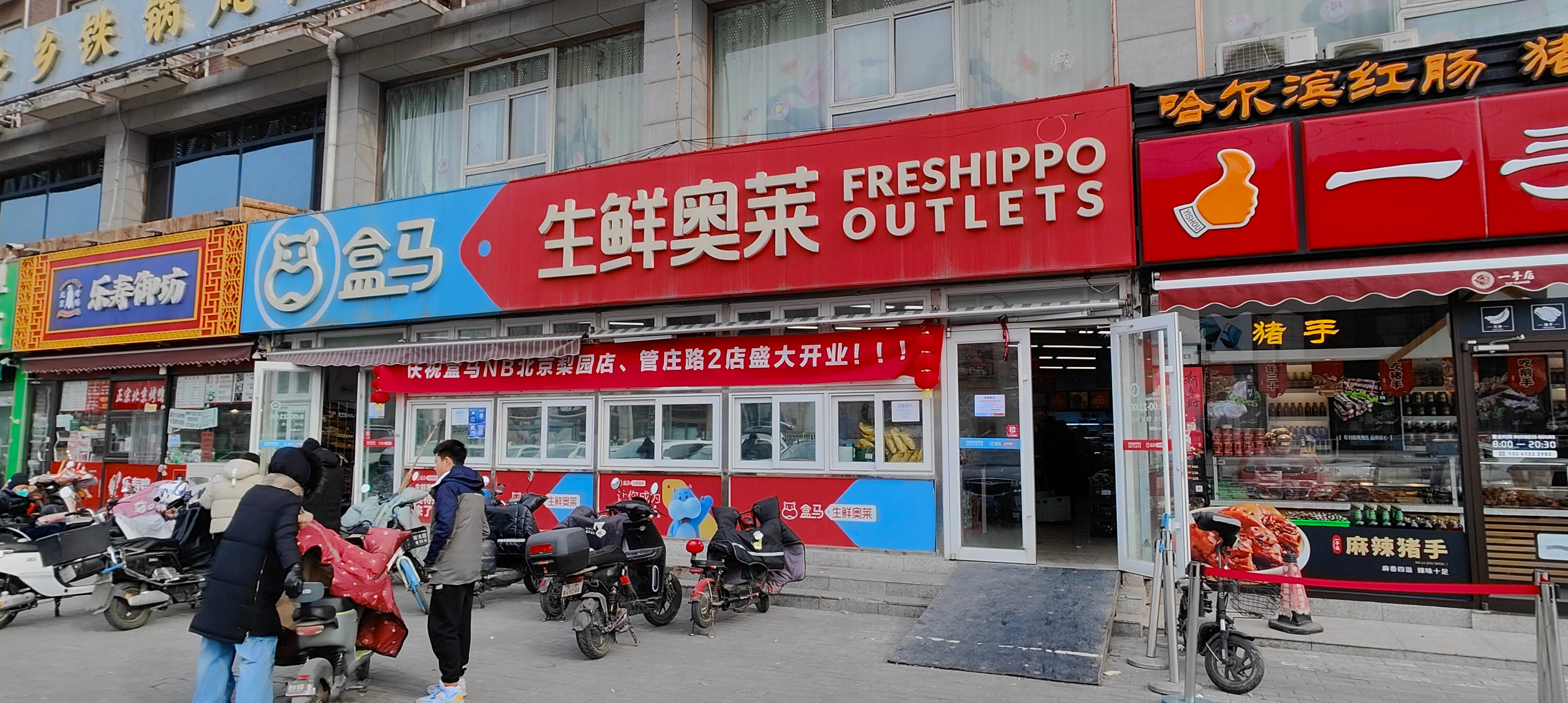
A Hema Outlet store in Beijing.
Hema Mall had basically withdrawn from the market, and Hema Outlet had a limited role in making profits. Membership store Hema X’s expansion was slow and stagnated at nine stores. Its service radius was small, so it had limited impact in the market. Hema X also couldn’t price its products too high because of its competition. Overall, these formats made double-digit losses.
Initially, the Hema Outlet stores mainly sell expired and discounted goods. While making less gross margin (or even losses) on products, they also need to deal with reversed logistics from Hema Xiansheng stores (at the end of the day, goods are transported from Hema Xiansheng stores to Hema Outlet stores). In theory, the Outlet stores could reach 30% gross profit, but in reality, profits are meagre. This has led to speculation that Hema Outlet is being used to transfer costs from one format to another.
Hema’s GMV in the first half of 2023 was the same as during the first half of the pandemic year of 2022, not showing significant growth.
To IPO or not to IPO …
On the 28th of March 2023, Alibaba announced its 1+6+N restructuring and announced that several business units and Alibaba-run companies would go public. On April 19th 2023, it was reported that Hema was working on a Hong Kong IPO that could happen within 6 to 12 months. While Hema initially denied the news, the focus on cost reductions in 2022 and more recent leaked news about profitability all pointed in that direction. [5]
On May 18th 2023, Alibaba confirmed that Hema would be one of the first businesses to be spun off in an IPO. At the time, it was said that the IPO could take place as early as late 2023.
In June 2022, Hema had begun seeking additional private funding, but the valuation had shrunk from $10 billion to $6 billion. [6]
All of this begs the question …
How profitable was Hema really?
When cooking up plans for Hema, founder Hou Yi had initially set the following requirements for Hema to succeed: [3]
online transactions should be larger than offline
the average daily order volume of a single online store should exceed 5,000 orders
the app should not require other traffic support and should be able to survive independently
achieve 30-minute delivery within a controllable range under the background of controllable cold chain logistics costs
Hema accomplished all those goals, but has it ever reached profitability?
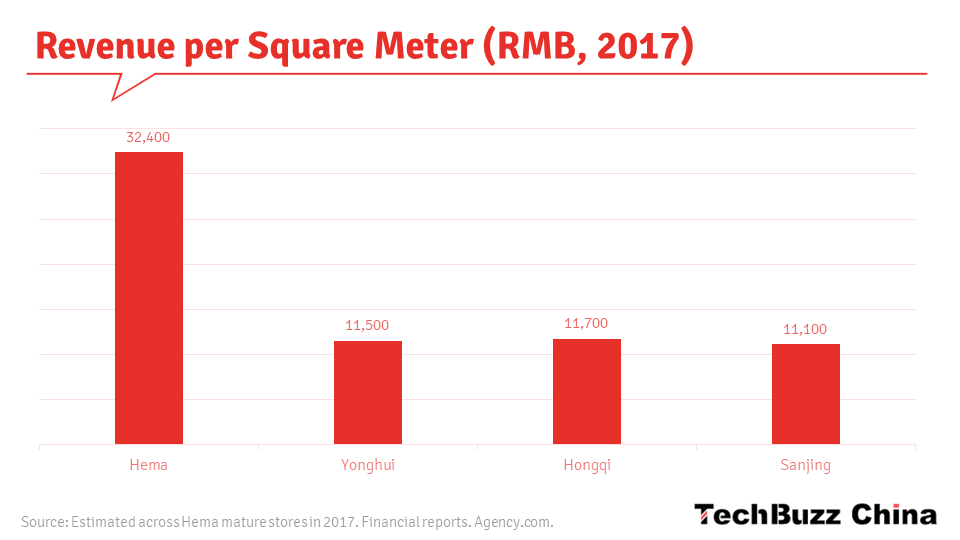
In the early days of Hema, it was eager to share that the sales per square meter of Hema Xiansheng were 3-5 times those of comparable supermarkets. That’s impressive, but it said little about the innovative chain's profitability and the costs of running Hema, which would undoubtedly also be multiples of those ‘comparable supermarkets’.
The costs of opening a Hema store were initially RMB 50 million but later dropped to RMB 30 and 17 million. A 5,000 m2 store would have 300 FTEs, and a 2,000 m2 store would have 100 FTEs (excluding couriers). Meanwhile, a Carrefour store of 30,000 m2 would have a maximum of 200 FTEs, and an 800 m2 ALDI would have 12. Hema’s original management staff came from hypermarkets and added many organisational layers. [2]
The first Hema store in Shanghai became profitable in 1.5 years. However, when it started to expand nationwide, the consumption power of most other cities did not match that of Shanghai. While the chain kept opening new stores, the average sales per m2 dropped from RMB 56,000 in 2016 to 30,000 in 2018. In 2018, some Hema stores suffered losses of tens of millions of yuan for several months, and in 2019, Hema was forced to close a store for the first time. [6]
Then, it launched all the concepts we discussed in part 1 of this series, trying to find a winning model. It invested a billion yuan in community group buying alone. About the opening and closing of store formats, Hou Yi said they were done "to study customer value and focus on the value of a certain type of customer through new stores." He said about opening and closing so many formats: “These decisions were made by me alone, and they were closed by me alone.” [3]
After trying many different formats, Hema’s profitability and GMV growth fell short of expectations within Alibaba. Hema was degraded from an independent business group to a sub-business segment of the B2B business group. [3] At an Alibaba internal conference, Hou Yi even received the ‘Bad Strawberry Award’ given to the worst business. E-commerce professionals estimated that in the first quarter of 2021 alone, Hema's losses had reached about RMB 3 billion. [7]
In 2020, Hema proudly claimed that online sales in Shanghai and Beijing accounted for more than 75% of total sales, and it wanted to increase this to 90% by 2021. However, not long after, Hema CEO Hou Yi changed the positioning and said that more attention should be paid to the logic of physical stores and that online should only take half of total sales. [2] Hema likely realised that being overdependent on online orders with high delivery costs while also running expensive offline retail locations made it difficult to become profitable.
In 2021, Alibaba made Hema responsible for its own profitability. It would get no more blood transfusions from the group. Hema became an independent company and started acting more sensible. But not by finding a stable and reliable business model … [6]
In January 2022, former Hema CEO Hou Yi made it clear in an internal letter that in 2022 the goal was to go from single-store profitability to overall profitability. After GMV targets of RMB 34 and 45 billion in 2021 and 2022, respectively, Hema set itself an ambitious target of RMB 100 billion in 2023. [8] It would reach a little over half of that target.
Revenue and operating profit Hema. [15]
Source: [8]
Hou Yi also applied the brakes and began to reduce costs. The IT engineers were moved from Nanjing to Wuhan, R&D costs were halved, store security and cleaning staff were reduced, and store management had to participate in hands-on work. Operational functions were centralised. [3]
Hema cut down the redundancy of departments and reduced labour costs through layoffs in 2022. It started to optimise procurement costs and reduce related personnel. Staff was centralised, and headquarters and procurement of standardised goods were consolidated. Hema also laid off its private label staff and merged this function with non-private label procurement, reducing internal competition.
In 2022, Hema reduced its operating costs by 5%. Store staff was reduced by 30% between 2021 and April 2023. In Q4 2022 and Q1 2023, Hema Xiansheng achieved profitability for two consecutive quarters. [3]
Hema said about the reorganisation: "We rearranged the most capable and experienced procurement. In just two months, the efficiency of the entire standard product area increased by 7%, and more than 70 million redundant non-performing inventory assets were processed. At the same time, the share of goods from the national supply chain has reached 83%. We will allow more and more suppliers to achieve better scale through similar integration.” [9]
Meanwhile, Hema closed some stores (including some Hema Minis) and improved its private-label offerings. It has also gradually reduced the large seafood and catering it offers. This was once one of its unique selling points, but it came with really high costs. Having visited many Hema stores since 2018, I was often shocked when I arrived around 8 PM and saw the number of dead fish and shrimps the staff would be fishing out of the basins.
Dead fish and prawns at Hema.
For retailers like Sam's Club and Hema, the live products they provide, such as Australian lobster and abalone, although popular with some consumers, are not actually profitable and sometimes even cause serious losses. The profitability of seafood in the aquaculture industry is also a headache for store managers. In general, physical supermarkets face considerable challenges in selling fresh products.
The average sales per store are about RMB 600,000, and the average order value is RMB 60 (the total number of orders per store is 8,000 - 10,000, of which online orders account for 60%). In Shanghai, the daily average sales of a Hema store are usually RMB 700,000 - 800,000. During holidays, it can even reach RMB 2 million. The average gross margin remains between 25% and 30%.
The one-time investment in setting up the store is RMB 20 - 30 million. For stores with an area of 3,000 - 4,000 m2, the rental costs is RMB 3 - 4 per square meter per day. The costs of daily operations include employee salaries (2-3% of gross margin), water, electricity, gas and marketing account for 4-5% of gross margin. Loss of goods is 2-3% of gross margin. Delivery of online orders costs typically 10% of the profit of a single order. Group-level warehouse investment and delivery costs from warehouses to stores should also be considered fixed costs.
In January 2023, Hou Yi stated in an internal memo that Hema Xiansheng (but not the rest of the brand formats) had reached profitability in 2022. "Hema has completed the first phase of the goal as a new retail format." [10] Alibaba’s financial report over the quarter ending December 2022 said that Hema had achieved double-digit growth and YoY losses had been significantly reduced due to improved distribution, operational efficiency and gross margin. It was the first time Alibaba’s quarterly direct sales, of which Hema is part, exceeded RMB 10 billion. [9]
It was later confirmed that Hema Xiansheng had been profitable in the December quarter of 2022 and March quarter of 2023. The financial report for 2023 (ending on 31st of March 2023) stated that Hema had “significantly narrowed losses year-on-year”. [8] But it had yet to achieve full-year profitability.
Rumours have it that despite Hou Yi’s announcements that Hema Xiansheng was profitable at the end of 2022 and the whole umbrella brand was profitable in early 2023, Hema’s costs are too high. Its annual losses would exceed billions of yuan. Without blood transfusions from Alibaba, it would likely not survive in its current form. [11]
While people in the industry have said that Hema would not have been possible without Hou Yi [12], Hou Yi himself has also stated on several occasions that without Alibaba’s financial and technical support, Hema would not have been possible. [13] Since its start, Alibaba has invested at least RMB 10 billion in Hema. It was willing to pay for innovation because "innovation is Alibaba's culture." [3] But as we described in The Collapse of Alibaba’s New Retail? - Part 2: Hypermarkets, Supermarkets and Convenience Stores, a culture that rewards innovation and ‘storytelling’ comes with its own problems.
The plans for an IPO were put on hold in September 2023. Alibaba could only achieve a valuation of $4 billion, much lower than the $10 billion it targeted when it tried to raise private funding in 2022. Blaming this on weak sentiment for consumer stocks, Alibaba decided to wait for more favourable market conditions. [14]
China’s physical retail has struggled with homogeneity. Traditional hypermarkets like Carrefour and Alibaba’s RT-Mart are facing pressure from changing industry trends, leading to continuous store closures.
A report by the China Chain Store and Franchise Association shows that in 2021, 67.1% of supermarket companies saw a year-on-year decrease in sales, 72.2% of companies saw a year-on-year net profit decrease, and 68.4% of companies saw a year-on-year decline in customer traffic. In 2022, nearly 7,000 physical retail stores closed down, of which at least 1,138 are from the supermarket industry. [16]
Sales in the supermarket segment declined 0.4% YoY in 2023. Some players in this market have even seen their revenue drop by more than 10%. [17]
Meanwhile, foreign discount stores (targeting price-sensitive mass consumers) and warehouse-style membership stores like Costco and Sam’s Club (targeting high-income families) have performed well in China, posing challenges to the supply chain-building capabilities of others. They have efficient supply chain management, can achieve global procurement, and provide distinctive product supplies to meet the diverse needs of consumers. They usually adopt a low gross margin strategy, and their primary source of profit comes from the membership fees. Membership renewal rates and annual consumption transaction volume are the main KPIs.
The membership store market in China has been booming in recent years. Market size reached RMB 33.50 billion in 2022, growing 10.1% YoY and is expected to grow to RMB 38.78 billion in 2024. [18] Euromonitor even estimates the growth rate to be nearly 20% and has doubled between 2018 and 2022. According to a report by Bain & Company and Kantar Worldpanel in the first quarter of 2023, the number of Chinese consumers in warehouse-style member stores will increase by 30.3% year-on-year, and the purchase frequency will increase by 12.8%. [19]
And for a change, Hema was not to lead market development but to follow them …
Characteristics discount stores and membership stores. [17]
Hema’s new inspiration: Sam’s Club
To understand Hema’s next steps, we must explain the leading membership store, Sam’s Club, a subsidiary of Walmart, which opened in China in 1996. Until 2010, it only had four stores in four cities, and it wasn’t until the mid-2010s that it seriously started growing, now having 47 stores in 25 cities (end 2023). By comparison, Walmart opened 100 hypermarkets between 1996 and 2004 (most of which have already disappeared). [20]
Initially, Chinese consumers did not understand why you would have to pay for a membership to shop somewhere. When Pulsemart, another membership store, went bankrupt in 2006, Walmart suspended the expansion of Sam’s Club for six years. With only 4% of Chinese families belonging to the middle class in 2000, the country did not seem ready. [20]
From 2010, Walmart China was hit hard by China’s emerging e-commerce. While Walmart went into decline (just like other hypermarkets like RT-Mart), Sam’s Club slowly started expanding. Under the new management, it changed its employees’ understanding of membership stores: they are not about making profits from sales, like ordinary supermarkets, but from membership fees. Indicators that affect the staff’s bonus are primarily membership profit (membership fees minus customer acquisition and retention costs) and secondarily operating profit, not sales of goods. [20]
Despite internal opposition from opponents of the membership system, SKUs were cut from 10,000 to about 5,000, resulting in larger volumes per product and more bargaining power with suppliers. Meanwhile, the membership fee was raised from RMB 150 to RMB 260 in 2016. Despite initial customer complaints, Sam’s Club has stuck with this price. “If someone does not accept this fee, they are not our target group”, Andrew Miles, CEO at the time, said. [20]
Sam’s Club, known for its best-quality products and low prices, relies primarily on local supply chains, which are more adaptable to local needs. Sam’s also focuses on developing innovative and unique products you can’t buy elsewhere. The Sam’s Club procurement team prefers to talk to a supplier’s R&D teams over its sales teams. And while the margins of Sam’s Club suppliers may be limited, the endorsement value of being a Sam’s supplier is enormous. It will definitely lead to more business with other clients.[20]
According to some industry insiders, Sam's Club's sales compound growth rate in the past three years is no less than 30%, and sales exceeded 80 billion in 2023. The average annual contribution of a single user is RMB 14,000, 1.6 times that of Taobao and nearly five times that of Pinduoduo. Sam’s Club contributes 60% to Walmart China’s total sales. [20]
Sam’s Club compared to leading online platforms. Source: financial reports and public information. [20]
The original vision for Hema was that online orders would increase a store's sales and help it to make profits earlier. This required at least 3,000 orders per day. Otherwise, both the store and online channels will lose money. Meanwhile, Sam’s Club’s online sales were initially just a supplement to its store business. But it grew unexpectedly to more than 50% of sales by Q4 2023. [20]
Sam’s Club’s e-commerce business was built under two ex-Alibaba senior executives. Around 2021, the e-commerce team counted 60-70 employees, primarily ex-employees of Alibaba, Hema and Dingdong Maicai. They optimised the app and implemented the front-end warehouses (see our October report Need for Speed 2: Can the front-end warehouse model ever be profitable?). Partially caused by changed consumer habits under the pandemic, Sam’s e-commerce GMV began to increase rapidly by the end of 2021. As a result, e-commerce became a higher priority in the company. [20]
Note: the sales for Hema and Sam’s Club exclude offline sales.
By the end of 2023, Hema had 360 stores (including Hema Xiansheng, Hema Outlet and Hema X), which approached RMB 60 billion in sales but was not yet profitable overall. Meanwhile, Sam’s Club had 47 stores (plus a network of some 500 front-end warehouses) and saw RMB 80 billion in revenue, and the profit from membership fees alone was RMB 1 billion. [20]
Internally, Sam’s Club learned from Hema and JD’s lessons in digitisation and online order fulfilment and poached others’ employees. But at the end of the day, the main strength comes down to being able to offer low prices on commodities. Sam’s learned from Costco about products. Sam’s even has a dedicated team of 8-10 people that track Costco information on merchandise, supply chain, membership, services, sales data, etc. They use Costco staff and suppliers as information sources. When Costco plans to attract customers with some specific products, they might even appear at Sam’s shortly before at a lower price. [20]
Unlike Hema, Sam’s Club abandoned the sales of king crabs and other live seafood because of the high risks involved in transportation and difficulties in guaranteeing nutritional value and flavour. In July 2023, Hema also seemed to have come to this conclusion when it started selling chilled fish with scales, gills and organs removed, extending the shelf life to 4 days. [21]
Sam’s Club’s newly opened stores are performing well, with annual sales exceeding RMB 1 billion and average monthly sales of approximately RMB 100 million. The gross margins in the best-performing stores in Beijing, Shenzhen, and Shanghai are approximately 17%. Sam’s Club has improved its margin by reducing the number of big-brand items and increasing the number of private-label products. Some of the main costs for Sam’s Club are shown below.
At Hema X, Hema’s attempt at the membership store, the net margin is 2-3%.
Although the membership model seems easy to implement, the operational complexity is quite high. Chinese players find it difficult to replicate the advantages of Sam’s Club in supply chain management and product differentiation in the short term. It takes a long time, maybe 5 to 10 years, to lay out a similar (global) supply chain.
Sam’s Club has a robust global supply chain and long-term accumulated R&D. It can maintain low margins on its 4,000 SKUs and its private labels account for 30%, contributing about 40% in sales. It does not pursue the most expensive or cheap goods but those suitable for consumers. It has a wide range of categories but only 1-3 varieties for each product. If domestic players want to compete, they must build a product matrix of 3,000-4,000 SKUs covering fresh food, dry goods and non-food.
Domestic players have tried copying specific products like Swiss rolls, layered durian cakes and roast chicken. RT-Mart even hired a former Sam’s Club purchasing director. Despite the large moats of these membership stores, Alibaba’s Hema (with Hema X) and RT-Mart (with M Store) tried nevertheless.
Walmart and specifically Sam’s Club is a strong competitor to Hema because of:
strong product power and product selection (variety and quality of products matching customer’s needs)
delivery services in cooperation with third parties (Meituan, JD Daojia)
better membership system and prices than Hema, resulting in higher customer loyalty and improved consumer spending
higher average order values and number of paying members
Some data on Sam’s Club’s front-end warehouse
In 2017, Sam’s Club began testing the front-end warehouse model in Shenzhen to speed up expansion. By 2023, it had 500 such 500-800 m2 warehouses nationwide, helping to achieve city-wide coverage. The average order exceeded RMB 200, and the number of orders per warehouse per day exceeded 1,000, making the model profitable as a whole. [22]
Sam’s Club has solved some of the challenges of its competing self-operating grocery stores: online consumer spending is high, covering the high costs of instant delivery. Customer acquisition is not high because it is shared with the offline business, and retention is high. Sam’s only offered 1,000 of its 4,000 SKUs in its online channel. [20] Certain products and offers can only be bought in the store to ensure store traffic. It also does not provide coupons for online orders.
Sam’s front-end warehouses (a.k.a. ‘cloud warehouses’) have performed well, while Hema has not tried the model, and Metro has only experimented with it on a small scale. Hema’s model is based on having the Hema supermarkets close to its customers and, therefore, it has more stores than Sam’s. In Sam’s model, there are fewer stores, but the front-end warehouses are closer to the customer, enabling speedy delivery of 25% of the entire assortment. Goods are transferred from the parent store to a front-end warehouse, and the sales are allocated to the parent store. Each parent store can manage about 5-6 front-end warehouses.
Still, small warehouses have some limitations. Regarding space, inventory, staff, and distribution turnaround capabilities, a 400 m2 warehouse can only handle 1,500-2,000 orders daily.
The average order value of front-end warehouses is RMB 210 - 230 in first-tier cities and about RMB 180 in second-tier cities. Daily orders fluctuate between 800 and 1,200. Some warehouses reach 1,500 in peak periods, and above that, it might be unable to meet demand.
JD affiliate Dada handles delivery from the front-end warehouses, and delivery costs from a front-end warehouse are RMB 7 - 9, RMB 2 higher than the industry average. Heavier orders can cost RMB 11. The rent of a warehouse costs about RMB 100,000 - 150,000 per month, and the costs for utilities are relatively low (e.g., a 50 m2 warehouse will use RMB 20,000 in electricity per month). The staff consists of Sam’s Club employees and third-party packing and shelving personnel who get paid per piece.
Sam’s Club couriers outside a front-end warehouse.
Owing to weakening consumption, the average order value has declined by RMB 50-70 in 2023, roughly the price of one item. The average number of items ordered dropped from 4.5 in 2022 to 3.4 in 2023.
In June 2022, the customer overlap between Hema and Sam’s Club users had reached 43%. [22] Sam’s Club had 4 million paying members in November 2022, while Hema had nearly 3 million in March 2023. [23]
Hou Yi was inspired by Sam’s Club's success. He had already launched the Hema X membership store in October 2020 (see part 1 of this series), but that wasn’t enough …
Mountain-Moving Prices
On July 31st 2023, Hema started a price war with Sam’s Club. Sam’s Club’s name in China is 山姆 (Shānmǔ), where the first character means ‘mountain’. Referencing a famous Daoist story (The Foolish Old Man Removes the Mountains) and with a clear stab at Sam’s Club, Hema called its campaign ‘Mountain-Moving Prices’ (Yishan Jia, 移山价). It launched a copy of Sam’s popular Durian cake for RMB 99, driving a Sam’s Club manager in Shanghai to reduce its price from RMB 128 to RMB 98.9. Hema lowered its price twice more to RMB 79, while Sam’s dropped to RMB 85. [20]
On August 21st, Hema rolled out the ‘Mountain-Moving Prices’ campaign to 15 cities, including Beijing and Shanghai, benchmarking products to Sam’s Club and Costco. [24] Meanwhile, the upper management of Sam’s Club rolled back the price cuts in Shanghai and the local manager who had made them resigned by the end of 2023. Dynamic promotions are taboo at Sam’s since they increase the complexity of the business model and, thereby, costs, which would then need to be passed on to its members. [20]
The two also have different policies for the loss of products. At Sam’s, the loss rate is 1.2% and at Hema 1.7%. Hema will discount such products, but Sam’s Club won’t sell them and includes the loss ratio in the cost price. For Sam’s, discounts mean that a product is not very good and should not be sold to members. Hema also allows products that generate traffic to lose money (loss leaders), while Sam’s approach is that a product’s margin may be thin, but it should always be positive. [20]
Hou Yi said in an interview that behind the ‘Mountain-Moving Price” is essentially a battle of life and death for Hema. Hema needed to constantly reform itself through price competitiveness. [12] Meanwhile, Zhu Xiaojing, President and CEO of Walmart China, stated in an internal meeting that Hema was the only real competitor of Sam’s Club in China. [23]
Indeed, the presence of a Sam’s Club has a significant impact on Hema. If there is no Sam’s Club, daily sales rise from RMB 600,000 to 700,000. Once a Sam’s Club opens nearby, sales can drop by RMB 100,000.
Hou Yi has praised Sam’s Club and said that Hema needed to learn from Sam’s global supply chain. "If we can't compete with our competitors, consumers will choose others instead of us in the future. Therefore, our price competition does not last a day or two but is a long-term state." [22]
In its attempt to get Sam’s Club customers to shop at Hema X, Hema sometimes went to extremes. In Shanghai, it even launched a ‘Mountain-Moving Bus’ that, for two days, drove customers from the Sam’s Club store 500 meters down to the Hema X store. [18]
Source: [18]
Maybe this Mountain-Moving bus inspired ALDI to drive its staff recruitment busses to the doorsteps of Hema stores in June 2024. [25]
A former Hema Purchasing Director stated that Hema and Sam’s Club have very different company personalities. Where Sam’s Club is calm, Hema is impatient and eager for quick success. He hoped the two would avoid mutual attacks like in 2023 and strive for coexistence.
Although Hou Yi thought that Hema could surpass giants like Sam’s because it was a local company and had a better understanding of the Chinese consumer, he also admitted in a July 2023 interview that "compared with them, we are still 'primary school students'.” And he was not afraid to ‘humbly learn’ from foreign retail giants. [26]
Still, after initiating the price war with Sam’s in early August, Hema experienced a notable 13.6% growth in average weekly daily active users (DAU). Sam’s only saw an increase of 3.9% in the same period. [27]
This must have given Hou Yi more confidence in his next step …
Farewell to KA
Hou Yi once said bluntly: "The traditional retail and supply relationship has brought all Chinese retail into a trap." Traditional retailers charge suppliers shelving fees (better and more shelf locations), stacking fees (main aisle locations in the store), promotion fees (locations on store exterior walls, promotional materials, etc), etc. This leads to many markups by the suppliers to the goods consumers buy and uncompetitive prices.
Hou believed there was a 5 to 10 times difference between China's retail prices and production costs, stemming from such channel, logistics, marketing and even grey expenses. He thought these fees should not exist. The KA (Key Account) system has also led to suppliers deciding what retailers sell rather than consumer demand. Companies like Carrefour that relied on the KA model are now losing ground. Since 2018, Hema has moved away from this KA model. It has cancelled many such fees and tried to select products based on consumer needs. [3] [21] [28]
From the beginning, Hema established a ‘new retail channel system’ that did not require entry fees, channel fees, barcode fees, etc. The system exchanged and shared information upstream and downstream and established the traceability of products for origin and food safety. Hema also eliminated intermediate links and improved the efficiency of supply chains and the freshness of products. [4]
At Hema’s first New Retail and Supply Relationship Conference in 2019, Hou Yi said that China’s retail industry had three significant problems: imbalance of retailer-supplier relationships, lagging product R&D and outdated business concepts. Suppliers had dominated the industry, and retailers would transfer business responsibilities to suppliers, creating an unhealthy relationship between the two parties. Hema wanted to change this by implementing a global buyer team. [4]
Hema has tried private labels, direct sourcing, and global supply chains to improve prices. Although this team has expanded the overall scale of private labels (currently accounting for 35%), the scale of a single SKU is small. And if you are part of Hema’s global supply chain, don’t be fooled. Ultimately, Hema will try to source products locally, increasing the scale and lowering local consumers' prices. This is what Hou Yi called ‘go outward’ (using the global supply chain) and then ‘go upward’ (improve product competitiveness and quality). [19] [28]
Hema private label products at Hema X (Max) and Hema Outlet (NB).
While it has tried before it seems that Hema never wholly got rid of the KA system because, in August 2023, it was once again reported that Hema was taking new steps aiming to build its private labels and gradually phase out the traditional key account (KA) model. Hema was restructuring by consolidating its in-house brand business team, global sourcing team and category procurement team. [29] Some industry insiders claim that because of capital injections by Alibaba, Hema had lacked the motivation to truly reform before and that the planned IPO and increased competition had now given it that renewed motivation. [28]
Hou Yi had found that changing the status quo wasn’t easy. Hema chooses to continuously change suppliers, forcing optimisation in the relationships. "The final competition for price competitiveness is who has strong OEM/ODM and supply chain capabilities. Today, Hema already has this capability." Hema was even ‘horse racing’ its private labels against suppliers’ customised brands. [4]
The coming of Hema’s revigorated fight against KA had become clear in July 2023 when Hou Yi said in an interview that the traditional retail-supplier relationship had made China’s retail ‘a place to rent’. "In the past, hypermarkets did not make money from consumers, but from merchants, so the more products, the better, no matter whether [a supplier is] good or not, as long as you come in, I will collect your money first." Retail showed more responsibility to KA suppliers than consumers. When Hema mostly used KA suppliers, its prices were above market averages. But it no longer wanted to do business this way. [30] [31]
According to Hou Yi, the traditional KA model resulted in higher consumer prices: "In the original KA model, the brand owner is responsible for losses, replacements, and a large amount of advertising market expenses, so the price is very high. But in such a fiercely competitive and changing environment, the brand owner must make changes." [32]
He thought retail companies had to abandon the KA model entirely and move towards global supply, direct sourcing, OEM/ODM, and private brands. Suppliers should win market trust based on product competitiveness, balancing the retailer-supplier relationship. [4]
While Hema will lean more on OEM suppliers, Hema has weaker control and negotiating power over key account (KA) brands’ powerful suppliers. Therefore, brands like Coca-Cola will remain at Hema. [33]
Transforming into a discounter
In September 2023, a former Senior Purchasing Manager of Hema shared how Hema Xiansheng had reached a gross profit margin of 42% in its vegetable category, higher than supermarkets and convenience stores. Even if sales do not increase, Hema could increase its gross margin to improve profitability. But things would take a very different turn…
In hindsight, the signs were present in interviews with Hou Yi throughout 2023, especially when he criticised the KA system. But on October 13 2022, the bomb dropped. I remember preparing for the arrival of one of our ChinaTechTrip study tour groups and putting the finishing touches on a number of masterclasses, one of which was about Hema. I had just about finished my slides when Hema announced it would overhaul its strategy for its Hema Xiansheng and Hema Mini stores and become a discounter.
At the end of 2022 and the first half of 2023, Hou Yi had travelled to Europe, the US, Australia and Japan and had visited various retail chains, including mature discount store brands such as Aldi, Lidi, and Mercadona. It convinced him that discounting was already a global trend and a necessary reform that China’s retail industry should also undergo. His aim was not to sell cheap goods but quality goods cheaply and drive down the prices of high-end goods. He wanted to achieve this through supply chain optimisation, direct procurement from manufacturers, and OEM products. This would reduce intermediate links, operating costs, and ultimately lower prices. [34] His visits to Europe and America made him realise that private labels account for 60-70% of sales in advanced retail industries. [22]
A change was necessary. At a supplier conference in 2022, Hema’s chief merchandising officer had already claimed that more and more customers, even the youngest ones, were paying more attention to prices. "They are no longer willing to use high premiums to experience new and unique things, but to use low prices to experience new products." [20]
Since the pandemic, consumer’s acceptance of brand premiums has been significantly reduced. In a 2023 interview, Hou Yi said: "So far, Hema's profitability is good. However, after the Spring Festival this year, we have clearly felt the changes in the consumption environment under the influence of the economic environment, and the problem of 'high Hema product prices' has begun to emerge. If it remains unchanged today and stays in the business comfort zone, consumers will definitely leave in the future. Therefore, long-term pain is worse than short-term pain. You can only repair the roof on a sunny day, and you will not get wet when it rains." [32]
According to Hou Yi, Hema would reach a revenue of RMB 1 trillion within ten years after implementing the hard discount model. [35]
Hema announced it would reduce the prices of 5,000 SKUs in offline stores nationwide by 20%. It would also eliminate about 3,500 of its 5,000-6,000 finished product SKUs while introducing 800 new products. With 2,000 fresh product SKUs that would remain unchanged, Hema would reduce its SKUs from 7,000 - 8,000 to about 5,000.
The overall strategy of SKU elimination aimed to reduce duplicate products in the same category and achieve ‘wide category, narrow depth’; many different categories but few choices per category. This showed Hema was following the Sam’s Club and Costco strategy, although those retailers had limited their range even further to 2,200 and 2,300 SKUs, respectively. A lower number of SKUs would also result in large volumes per SKU and more negotiation power with suppliers. The first criterion is price power, followed by quality. Brands with a relatively small sales share would often exit first. [36]
Hema also changed its procurement from selections of products presented by suppliers to selections driven by consumer needs based on market analysis and customer research. It said the transformation would be completed before Chinese New Year 2024. [3] [4]
To compete with membership stores, Hema, which always had a large share of fresh products, wanted to improve the daily necessities and standardised product categories. The battle was no longer a competition between Sam’s Club and Hema X, but Sam’s Club and the whole Hema business. After all, they were targeting the same audience. [26]
Hema put the signing of procurement contracts on hold and started renegotiating cooperation with many suppliers. [28] It has also been reported that since Hema sells products at ultra-low discounted prices, it disrupts the price system of some brands and has, therefore, been ‘banned’ by certain suppliers. [16]
Hou Yi wanted to use the discount store model to run the 350+ Hema Xiansheng stores. He considered discount retail stores a form of operation, not a format. He stressed that a discount strategy is not about selling cheap goods, nor is it a price war. He wanted to maintain quality while providing competitive prices to deal with the sluggish consumer demand. The model would be based on three aspects: [30]
Extreme efficiency in operating costs: no more fancy store design and decoration, product packaging or product tastings but a minimalist approach.
Vertical supply chain: merging the procurement teams and adopting direct sourcing should reduce procurement costs by 20%.
Differentiated product operation: development of private brands. Skip the brands and directly order from manufacturers. This should improve gross profit margins by 5% while consumers buy better quality goods at cheaper prices. The target for the share of private labels was raised from 50% to 70% (similar to Europe’s).
Let’s unpack these a bit more.
Extreme efficiency in operating costs
In the ‘battle of life and death’, Hema’s secret weapon would no longer be its famous seafood, 30-minute delivery or fancy technologies but a discount store model. Hou Yi realised that the digitisation of the past years had not changed the nature of retail and that Hema, at the end of the day, wasn’t an internet company but a retail business. Digitisation only solves the efficiency and service problems of retail but cannot solve the essential retail issues. [30]
"In an offline market, how do you get consumers to come? It's not about letting them taste food or see your beautiful decorations. The reason for coming here is that the things you buy here are the cheapest and most unique." [31]
Vertical supply chain
According to reports, Hema had hired two world-renowned consultancy agencies and spent a lot of money to study the possibilities and space for the discount model in China. As a result of the research, Hema started to vigorously reform the supply chain. [37] Hou Yi stressed that the discount reform was based on innovation in the supply chain and should deliver ‘high quality at low prices’. [24]
185 Hema Villages in 25 provincial-level regions that produce 699 SKUs are part of the vertical supply chain. Hema has been exploring this contract farming model for five years, using digital technology to manage the entire chain. On top of these Hema Villages, Hema maintains 500 direct sourcing bases with farmers and fisheries, purchasing fresh ingredients directly from the source, reducing intermediate links and ensuring freshness. Hema’s nine supply chain operating centres integrate agricultural product processing, finished product food research and development, semi-finished product frozen storage, central kitchen, and cold chain logistics distribution. [38]
An example where Hema already achieved this integration is its ‘Tanghe’ (糖盒) bakery factory, with which Hema has accomplished ‘from a grain of wheat to a loaf of bread’ supply chain integration. Vertical supply chains also give Hema stronger control over quality and help with ‘differentiated product operation’.
Differentiated product operation
Differentiated products should “provide consumers with three meals and four seasons, involving four aspects: category trend research, annual product plan, new product research and development, and regular product improvement.” Hema would emphasise the product selection concept of ‘only Hema has it’ and promote prepared dishes, organic food, private brands, and large-scale imported products. [9]
According to Hou Yi, the development of prepared dishes was irreversible, and it would become the largest category in fresh food in the future. He said the commodity structure of supermarkets would usher in revolutionary changes. [39]
Earlier, Hema’s investments in direct sourcing were heavily criticised in the industry. Now, it looked like it would help the company significantly reduce prices. By constructing a vertical supply chain, Hema has been able to cut costs while ensuring quality. Hema also reorganised its purchasing teams into: [40]
finished product department (industrialised products like ready-to-eat, prepared dishes, and daily necessities): this department takes the factory as supplier
fresh product department (fish, meat, eggs, fruit and vegetables): this takes the direct source (place of origin, Hema Village, etc.) as supplier
The reorganisations in the procurement team also improve efficiency, and Hema is planning to raise the share of private labels (currently about 35%) to the aforementioned 70%. [40]
Defending the plan
The strategy seemed related to Hema’s quick expansion in stores in 2023. This expansion meant that Hema’s customer base changed from the middle class to mass consumers. Hema needed more ‘friendly prices’ to appeal to this new target group. Meanwhile, the price sensitivity of Hema’s original target audience also increased. [16][41]
On November 22, at the Hema 2023 New Retail Conference in Shanghai, Hou Yi said that discount reform had become a trend and was a path China’s retail had to undergo. [42] He also said that in the future Hema would apply a ‘753 price system’. remaining KA products would be 70% of the market price, private brands and temporary products 50% and commodities 30%. [24]
As if to stress the correctness of their choices, Hema invited a professor of the Capital University of Economics and Business to speak at the Conference. Professor Chen Liping claimed that the (KA) business model made domestic department store and supermarket products too expensive. He believed that the economic cycle was the most essential driving force for retail innovation, and the development of all discount stores is based on the economic cycle. Under China's economic slowdown, ageing population, declining birth rate, and small families, new business formats and new retail giants would inevitably be born. [43]
Chen believed that, in the future, only the middle class with downgraded consumption will be the most profitable market for discount stores in China. “China has a multi-trillion market, which is now almost monopolised by Sam’s Club and Costco. We see that Sam’s Club and Costco have rich experience absorbing consumption downgrades.” [43]
In China, discount stores are transforming from soft to hard discounters. Characteristics that make the latter competitive are selling off-date merchandise, stable supply chains, direct sourcing, private labels and maintaining low operating costs. However, if the model is based on compressing profits in the supply chain and squeezing suppliers, it may not be sustainable. According to a former General Manager at Hema, the discount model should focus on direct sourcing (removing intermediate links and unnecessary middlemen), finding cost-effective products, improving operational efficiency and passing cost savings on to consumers.
Hema's "big price reduction" has undoubtedly caused some losses in gross profit, but in the long run, according to the company, it would help increase consumer stickiness and promote growth. [32]
Many doubt Hema’s discount strategy because it goes against its original positioning as a store with premium products for the middle class. A low-price positioning is probably the last thing consumers think about when they think about Hema. And considering the idea of ‘going minimalistic,’ the store Hema had launched just weeks earlier seemed as far removed from the new strategy as anyone could imagine …
All Formats, All Channels
In April 2023, Hou Yi said that Hema’s future strategy would be ‘all business formats, all categories and all channels’. [50] After having tried 12 different formats in the previous seven years something was still missing. Hema kept adding new ‘formats’ and, even more remarkably, appeared in new ‘channels’.
Hema Premier ‘Black Label Store’
Last month, we discussed 12 formats Hema has opened in its eight years of existence. But seemingly, this was not sufficient. Around the same time, Hou Yi announced the new discount strategy, a new format opened in Shanghai’s Longemont City Life Center mall near Zhongshan Park, an important subway transport hub. The store, located at the spot of a former Carrefour store, seemed to be the opposite of the new discount direction: an upgrade compared to Hema Xiansheng. Still, both were positioned as ‘high quality for low price’.
Hema Premier, also known as ‘Hema Black Label Store’, was announced during a conference in May. It had been described as a ‘5,000 m2 experimental store with prefabricated dishes as the core and a new category structure’. [39] The store opened on September 27th 2023, and was positioned as a boutique. The concept is specifically targeted at high-end consumers, making it difficult to replicate nationwide (or even outside Shanghai).
Instead of Hema’s common light blue, black and gold were used to radiate high quality and exclusivity. [44] Hema Premier would offer many unique products, as well as the domestic debut of some imported products from North America, Europe and Australia. Hema claimed that nearly 50% of the products were imported. By launching Premier stores, Hema could provide higher-end products and higher-quality services to attract consumers who pursue high-end consumer experiences. [45]
Hema Premier staff clothing. [44]
While Hema Xiansheng focused on home delivery, Hema Premier clearly focused on in-store experience. Peng Xi, chief designer of the Black Label store, said: “The people that Black Label store wants to attract are not positioned by income. They are a group of people who love shopping, are willing to explore food, and are also people who pay attention to health and pursue quality life. (..) Rather than saying Hema Premier is a supermarket, it is better to say it is a lifestyle collection store.” [46]
Despite what Peng might say, Hema Premier is positioned for mid-to-high-end consumers looking for quality, and the prices will be relatively high. Two prominently displayed product categories are baking and flowers. [47] The final store is more than 6,000 m2 large. [48]
Hema claims it has ‘commodity power’, reflected in two aspects: [48]
Going up: differentiated commodities oriented by quality upgrades based on consumer insights (Hema X, Hema Yunchao, Hema Xiansheng).
Going down: Basic commodities oriented by price advantages based on supply chain construction (Hema Outlet, Hema Neighbourhood).
Hema Premier is another example of ‘going up’. It is a brand upgrade with Hema’s highest product and service capabilities. The store targets younger audiences that pay attention to health and healthy products. As with Hema Xiansheng, Hema Premier delivers in as fast as 30 minutes in a radius of 5 kilometres. [48]
At Hema Premier, there are lots of places where you can sample products, and serious effort has been put into design and presentation. I have visited the store on several occasions, twice with a group of retail professionals, and they were impressed by what they saw. However, the store is very different from the Hema Xiansheng stores, which act as store + warehouse. Hema Premier misses the conveyor belt system under the ceiling and is clearly focused on offline experience. In the store, the characteristic blue Hippo is less present, and it, therefore, feels less playful and more serious.
Still, Hema Premier is a bit of a head-scratcher because it mismatches Hou Yi’s vision for Hema. While Hou Yi wanted to make the Hema Xiansheng more minimalistic, Hema Premier was a feast of decorations, product displays, and sampling, as can be seen in the pictures below, which I took shortly after the opening in 2023.
Perhaps it could no longer be stopped since the preparation time of the store was two years. During that time, Hema’s global import teams travelled the world to source the 50% of imported goods that Hema Premier sells. Product proportions are more suitable for small families than those at Hema X. [46]
However, according to Hema, its new Premier store has proven that the discount model can work, as it claims it offers quality at low prices. These prices have been achieved by vertical supply chain integration, with prices only being 50-70% of those at traditional supermarkets. [28]
Hema Premier has become Hema’s best-selling store in Shanghai. [41]
Earlier in 2023, long before the shop was opened, Hou Yi had explained the necessity of Hema Premier. "We classify Hema's current business model as follows. Hema Xiansheng and Hema X member stores, including Hema Mini, mainly serve the consumption level of Hema's middle class; Hema NB and Hema Outlet mainly serve ordinary people's consumption. In addition to these two formats, we still lack a few formats; the first one is a top-notch boutique supermarket, so we will launch ‘Hema Best’ (a temporary name) in the second half of this year. At the same time, we have established a new business format, FOD (Food Operation Delivery), that truly integrates wholesale and retail, is oriented to B-end customers, and the price is very competitive." [49]
Despite Hema’s high share of online sales, Hou Yi was convinced of the importance of offline stores. "First of all, Hema's store establishes a brand image. People come as soon as you open the store and queue up when an Outlet store opens. Second, the store is there to strengthen the awareness of your products. What exactly is Hema? These two are the core elements that help Hema stabilise the consumption of the middle-class today. In addition, the store is a place for experience.” [49]
However strange Hema Premier may seem compared to the discount strategy, it does fit with Hou Yi’s announcement in April 2023 that Hema’s future strategy would be ‘all business formats, all categories and all channels’. [50] Hema Premier would fit ‘all formats’, and wide but shallow categories would fit ‘all categories’. So, how about ‘all channels’?
Sleeping with the enemy
As Hou Yi said in a July 2023 interview: “Today's competition is all-round competition on platforms, front warehouses, and stores.” [26] Hema had integrated the stores and fulfilment warehouses, but what about the channels?
To achieve a bigger scale for procurement, Hema started expanding to more sales channels. In April 2023, it became available on Alibaba’s internal channels Ele.me, Cainiao and AutoNavi. [3] Some products are priced lower in these channels than in the Hema app. They are also available through next-day delivery, even when some of the products sold are out of stock in the Hema app. Hema is also active on Douyin, selling its MAX brand products and integrating into Douyin’s local life services, with stores launching flash sale events and having products 40% cheaper than on the Hema app. [21]
Hema had already opened a channel on Douyin a few years ago. Some Hema stores have launched local group purchase products on Douyin. Moreover, Hema launched the Hema Yunchao mini program on WeChat. Through these new channels, Hema seems to be trying to increase its online order volume to dilute the fulfilment costs of warehouses, distribution, etc. [50] [46]
In July 2023, at the start of the ‘Mountain-Moving Prices’ campaign, several Hema stores became available in the JD Daojia app, but the response was mediocre.
At the end of October 2023, it was reported that Hema had opened a flagship store on the JD app. It also had an entrance at the ‘hourly delivery’ section of the app, meaning that JD would provide instant retail for Hema orders. Delivery would be done within 90 minutes and free for orders over RMB 49, lower than Yonghui’s RMB 59 and Sam’s Club’s RMB 99. [51] Alibaba’s other supermarket chain, RT-Mart, also joined JD Daojia, although only a few stores in areas such as Shanghai were available. [50]
All of this is pretty amazing for someone used to China’s infamous ‘walled gardens’ where internet companies refuse to give access to any competing brand. Maybe they are finally complying with the government's demand to tear down the walled gardens. Or have they? Tests in the JD app in October showed how Hema did not show up unless you specifically searched for it, and even then, it only showed a small number of monthly sales (100+ compared to Walmarts 10,000+). When searching for nearby supermarkets, those of Walmart, Sam’s Club and Yonghui (all affiliated with JD) would be displayed first. [51]
On JD.com’s platform, Hema sells none of the fresh products it has been known for with Hema Xiansheng (they are available for quick delivery on JD Daojia or Alibaba’s Taoxianda) and mainly offers private labels like Hema MAX, and the delivery time is a sluggish three days. Some of the products have participated in JD’s ‘tens of billions of subsidies’ campaign in 2023, resulting in prices lower than in Hema’s own app. [50] The same has also happened in Alibaba’s own ecosystem. By using exclusive coupons on Ele.me and Taoxianda, consumers have been able to get goods cheaper on those platforms than on the Hema app. [1]
The conditions for delivery on the apps also differ. On JD Daojia, delivery from Hema could be done from orders of RMB 29, and shipping was free above RMB 49. On Alibaba’s Taoxianda, these numbers were RMB 0.1 and RMB 39, respectively. [50]
Regarding channels, in 2023, Hema also opened up a B2B supply chain for canteens of enterprises and institutions. That was the other ‘missing link’ Hou Yi had mentioned. Through this channel, Hema hopes to create greater demand for its self-built supply chain centres and give it greater upstream negotiation power through larger volumes. However, some industry insiders point out that supplying this market requires the support of political and business relations and other factors. Requirements for the kitchen supply chain of enterprises are also stricter compared with the retail chain. Hema isn’t the only retail player in this market: Yonghui is involved in two businesses (Fuping Yunshang and Caishixian) that have been growing strongly in the past years. It remains to be seen if Hema can wrestle itself into this market. [52]
Hema Neighbourhood + Hema Outlet = Hema Neighbourhood Outlet?
As if the Hema positioning wasn’t confusing enough with all the changes and different formats, Hou Yi, had been planning to rename the Hema Outlet stores to ‘Hema Supermarket’ (盒马超市, Hema Chaoshi) or ‘Hema Community Supermarket’ (盒马社区超市, Hema Shequ Chaoshi). [24]
Maybe this explained the strange appearance of two ‘Hema NB Outlet’ stores in Beijing and Hangzhou in January 2024. This subbrand combines ‘Hema Outlet’ (a discount supermarket) and ‘Hema NB’ (Hema Neighbourhood, a community group buying pickup point), two formats we described in the first part of this series. Judging from the pictures, the store is much more organised than a regular messy Hema Outlets, looks more like a Hema Mini, has a bakery, and lots of pre-made dishes, things you won’t usually find in a Hema Outlet. [35]
Image source: Longshang Supermarket Weekly [35]
More recently, it has become clear what Hema was up to with this combined format. On June 15th, Hema NB Outlet opened its first franchise store in Chongmingbao Town, Shanghai. According to Hou Yi, Hema NB Outlets will enter Jiangsu, Zhejiang, and Beijing in 2024, opening 500 stores. The stores form the basis for Hema’s further expansion into a 1+N+N model: 1 Hema NB Outlet store that supplies N small pick-up stores servicing N communities. This is not unlike Sam’s Club’s model of stores + front-end warehouses. [53]
The pick-up stores are now available for franchising, which explains the explosion of hundreds of NB locations on the Hema website. Franchisees can open a dedicated Hema NB store, integrate it into an existing store or act as a ‘group point’ for part-time freelancers (comparable to being a community group buying leader). The franchise model allows Hema to expand faster while operating at low costs, reducing the pressure on capital reserves, personnel training, and operational control. [53]
Store planning for Hema NB Outlet will have three phases: [53]
Cross-regional expansion in 2024, covering the 19 cities Hema Xiansheng has already entered within 2-3 years, opening 800-1,000 stores. Hema already has brand awareness in such cities.
Expand stores in these 19 cities and surrounding cities in the provinces and regions, and open up franchises on a large scale. By then, Hema NB Outlets should already have multi-regional store operation experience and a large-scale supply chain, which will be attractive to franchisees.
In 10 years, Hema NB plans to have opened 10,000 stores nationwide, covering all cities and towns (more than 2,800 county-level cities and about 290 prefecture-level cities in China). To help set up stores in remote provinces, Hema NB may recruit regional general agents.
The average daily sales of Hema Outlet stores that have been open for more than six months are close to RMB 150,000. This complies with Hou Yi’s ‘two 15 indicators’: 15% gross margin and daily sales of RM 150,000.
Pressure on the supply chain
Hou Yi once said that commodity capabilities were Hema’s only core competitiveness. The company had penetrated procurement channels in various countries worldwide and had established 185 Hema Villages around China by May 2023, planning to grow this to 1,000 in the next decade. Since 2019, Hema has also opened nine supply chain centres integrating fresh food processing and central kitchens. [42] [54]
A former Hema Purchasing Director expects Hema to merge upstream supply chain resources and improve the organisational and management structure. It might further follow the examples of Walmart and Sam’s Club, especially regarding the latter's product selection and pricing strategies.
Compared to Sam’s Club, in which the former purchasing director would rate 9 out of 10, Hema still has a lot of room for improvement in its supply chain optimisation, only scoring 6 out of 10. Sam’s Club’s procurement team is more stable than Hema’s, which faces frequent personal changes. Sam’s Club also has much stricter processes for selecting and training purchasing staff than Hema.
Hema has invested more in hardware, software, and data, but Sam’s Club has a much stronger relationship with its suppliers, most of whom have been partners for many years. These suppliers deeply understand Sam’s Club’s members and have even developed differentiated products for them. Hema has a more practical approach to its suppliers and frequently changes them. It should also consider building stronger, mutually beneficial partnerships.
Hema also requires suppliers to produce Hema-branded products and give up their own branding. Suppliers who do not cooperate risk being replaced. Some suppliers have been reported to complain about Hema’s aggressive bargaining. [12]
Not that suppliers weren’t used to being pressured by Hema. In 2022, Hema started a program for supplier elimination (Hema X Accelerator), causing a lot of uncertainty among suppliers. Hema also has many restrictions for suppliers and fines them if they fail to meet standards. This is great for maintaining consumer satisfaction but does not build lasting relationships in the supply chain and reduces supplier stickiness. Hema also requires fixed prices from suppliers, not market prices, as is typical for agricultural products. [5] [34] There are even rumours that Hema’s procurement requires suppliers to hand over formulas. [42]
When Hema purchases goods, suppliers must fill out a product cost analysis form. Purchasing staff will ask suppliers to list the costs required for each link of producing goods, such as raw materials, manufacturing, equipment depreciation, labour, water and electricity costs, etc. The two parties will then negotiate what kind of supply and selling price can make both parties profitable. Since the October strategy adjustment, the form has become more detailed. [34]
Last April, a former Hema Purchasing Director shared his doubts about the new approach. By pressuring suppliers to lower prices, Hema could negatively affect the supply chain's quality assurance and standardisation process. Some suppliers might terminate their partnership or adjust product quality. Meanwhile, the price-cutting did not effectively increase the total sales or gross margin of products. Its only effect was some marketing exposure.
Some suppliers have replaced original raw materials to save costs, which could lead to quality problems. When Hema asked a supplier for a lower price for one of its formats, it solved the challenge by adding 10-20% less juice to a product for Hema Outlet compared to the same product for Hema Fresh (Xiansheng). [34]
Some big brands, among which a prominent dairy company, have begun to suspend supplies to Hema. However, most resumed supply after two to three months because the sales volume to Hema could not be ignored. [21]
On the other hand, some large suppliers that were asked to adjust their products and prices have seen significant increases in sales volume. While their gross margin may have declined, their total net profit increased. Higher production volumes have sometimes also reduced costs for suppliers. Small and medium-sized suppliers have suffered, though, as they can no longer supply goods with a profit. Suppliers of SKUs removed from Hema’s assortment were given a deadline to collect their goods. [34]
Global sourcing, global selling
Hema is not just sourcing its products globally. It is also planning to sell some of them globally.
In June 2024, Hema started selling a selection of its private label products at 99 Ranch Market, the largest Chinese supermarket chain in the U.S., and online via Asian goods retailer Yamibuy. The SKUs include pre-mixed spice blends and sauces, meat-focused Freshippo Daily Fresh, pre-made meals from Freshippo Kitchen and Freshippo’s seafood and meat range Difresco.
Hema plans to launch its private-label products in Australia, Singapore, South Korea, and other countries this year. [64]
‘Hema products are now available!’. Photo credit: Alibaba Group.
This is an apparent attempt to increase SKU volume and improve Hema’s bargaining power in the supply chain.
Pressure on customer and staff satisfaction
In October 2023, Hema launched the strategy with ‘offline exclusive prices’. Offline prices of 5,000 SKUs were reduced by 20%, but online prices remained the same. Hou Yi defended the price differences by saying the online delivery costs were very high and offline expenses were low. The new delivery threshold was used to cover the online delivery costs. At the same time, Hema was trying to increase the share of offline purchases from 30% to 50%. [24]
In the stores, some products, especially those in the finished products department, were tagged with ‘offline exclusive price’. To the chagrin of Hema Membership users, the 12% member discount did not apply for those products. ‘Ordinary consumers’ could buy at lower prices than members buying online! [41]
Hema introduced its membership system in 2019, priced at RMB 218. This was raised to RMB 258 in 2022. Hema’s membership strategy faced several problems:
The costs of acquiring and retaining members are high. While Sam’s Club membership maintenance costs are about RMB 100, they are RMB 320 at Hema. These costs include coupons for new members, sign-up gifts, and gifts for renewing. While Sam’s Club sees a net profit on membership fees, at Hema, the costs are higher than the membership fee.
The 12% discount given on member days resulted in an intense concentration of sales on those days. This made members concentrate their purchases on this day, directly impacting the profitability of this most important customer group. Because of the concentration of orders on member days, the other days had relatively small orders, making it challenging to cover the delivery costs. [2]
In December 2023, Hema stopped accepting new members in its membership program for Hema Xiansheng, in which 3 million members were paying a total of RMB 600 million. [34] Active memberships could be manually extended in the app but not automatically renewed. Members with expired memberships would have to go to a Hema X store to have them renewed offline. However, only four cities have Hema X stores. [55] [56]
At the time, Hou Yi explained there was no need for a membership program if all customers enjoyed low prices in Hema’s new discount approach. He wanted to redesign the program to meet members’ individual needs. [55]
In January 2024, Hema added a RMB 1 packaging fee to online orders. If the order did not require additional plastic bags (e.g. in case of bags of rice or boxes of fruit), customers could request a refund from customer service. Packaging fees will not be refunded if an order is cancelled. [57]
As you can imagine, these changes offended many customers. Some consumers have also complained about the substitutes of some SKUs, the disappearance of favourite products and the deterioration of store services. [42]
Starting on February 18th 2024, Hema tested simultaneous price reductions of almost 20% for online and offline orders in Beijing, Nanjing, and Changsha. Relevant products included seafood and aquatic products, meat, poultry, eggs, vegetables and fruits, baking, snack foods, and alcohol. At the same time, it raised the threshold for free shipping from RMB 49/39 to RMB 99. Below that threshold, customers would pay RMB 6 for delivery. [3] [34] Hema X members could continue receiving free delivery once daily and enjoy a 12% discount on most products during member days. [24] At least this approach of charging extra for home delivery made more sense than charging different prices in different channels.
According to estimates of industry insiders, Hema’s fulfilment costs account for almost half of the gross profit of the average order. With the heavy discounting, keeping online orders profitable had become even more of a challenge. Hence, it is understandable that Hema implemented these changes. It’s also why, after years of proudly proclaiming that 70% of its orders were done online, Hema wants to decrease the share of online orders to 50%. [42]
Thresholds for free delivery of different supermarket brands. Below this threshold, charges of RMB 3-15 apply. [58]
And then there was Hema’s staff …
The former Hema Purchasing Director shared how team morale has declined compared to the early days of Hema. It has gone through a period in which many middle and senior managers experienced salary cuts, impacting their work attitude. In the early days, many employees from Tmall, including staff in customer service, operations and procurement, joined Hema. But most of these have returned to their old jobs, have resigned or changed jobs. Those that remain have become part of Hema’s organisational structure and have less connection with Alibaba’s core businesses.
When regional procurement teams were being reduced or cancelled, most regional procurement staff resigned, and only a few transferred to headquarters, where they may face demotion. The work being done by multiple people now has to be done by only one or two staff members.
Competition in the supply chain is increasing. Hema’s procurement department is under unprecedented pressure in the current operating environment. Faced with high requirements in sales, gross margin, and supplier cooperation, the department’s performance appraisal has become complex and rigorous. However, according to the former purchasing director, Hema still faces problems with product quality, customer complaints, and even counterfeit products. KPI settings should be more objective and realistic to help Hema's long-term development and avoid more problems.
On March 7, news broke that Hema had adjusted benefits and salaries and asked some employees to transfer their work contracts to a third party. If they did not sign, their wages would be reduced. [34]
Other employees report how the workload has increased and how insurance and housing funds have been cancelled. [11] Sorters have also complained that their salaries have been cut twice in a year and reduced by 35%.
According to some sources, employee satisfaction at Hema has declined as wages were lowered and working hours extended.
A potential sale
Alibaba’s support for Hema was waning.
During Hema’s rapid expansion, Alibaba Group provided Hema with a lot of traffic support through platforms like Tmall, Taobao and Ele.me. But this support is now more cautious and could have been significantly reduced. Alibaba once also provided Hema with big data analysis, such as consumer analysis using AutoNavi and Taoxianda, but these may have also undergone adjustments. In the past, Hema used to share resources with Ele.me, such as setting up special stores and launching exclusive products on Ele.me. But because of Ele.me’s poor performance, those partnerships have been reduced. Alibaba also used to partner with Hema and RT-Mart in collective procurement, but because of the poor performance of Tmall’s self-operated business, such cooperation has gradually been terminated.
After Daniel Zhang suddenly resigned as chairman of Alibaba on September 10th, it didn’t take long until new CEO Eddie Wu clarified that offline retail was no longer among Alibaba’s priorities. And after eight years, Hema was still in trial and error with various formats and was still claiming resources. And Alibaba seemingly ran out of patience ... [15]
In early February 2024, Reuters reported that Alibaba was considering the sale of Hema, Intime, and RT-Mart. While discussions were still in the early stages and Alibaba had not made a final decision, the potential sale aligns with Alibaba’s new priority of ‘returning to the internet’. This strategic shift, as we discussed in our recent article 'The collapse of Alibaba’s New Retail? - Part 1', could see Alibaba refocusing on its core online business, potentially leading to the divestment of its offline retail assets.
A former Hema Purchasing Director said that the chances of Hema being sold to a local or central state-owned enterprise were high.
On March 16th 2024, a rumour went around that Alibaba would sell RT-Mart and Hema to state-owned COFCO, which Hema and RT-Mart later denied. COFCO is a leader in China's agricultural and grain industry and owner of brands like Mengniu and Great Wall wine. China Resources (known for the Vanguard brand and others) was also said to have participated in the bidding round. RT-Mart was said to be worth RMB 10 billion and Hema RMB 20 billion. This was remarkable since, as we’ve seen, Hema’s valuation was $10 billion in 2022 and had dropped to less than RMB 4 billion. [11] Alibaba denied the rumours, and an article by Linkshop about the news was scrubbed from WeChat (Tencent is sensitive to negative or fake news about competitors on its platforms). At the same time, RT-Mart threatened to take action against rumour-mongers.
Farewell to CEO Hou Yi
As discussed in the first part of this series, Hou Yi joined Alibaba after a career at JD.com, where his idea for Hema was rejected. Hou Yi, born in 1964, has more than 30 years of experience in e-commerce. At JD, he held important positions in JD Daojia, Asia No. 1 Warehouse and JD Logistics. These experiences also laid the foundation for his subsequent construction of Hema's logistics and distribution system. While at JD.com, Hou Yi was once the “General Manager of the O2O Business Department”. [13]
Hou Yi was 51 when he founded Hema and is 60 years old today. A Hema staff member said about Hou Yi: “He is one of the few senior executives in the [Alibaba] group who has experience in offline business, physical operations and large-scale supply chain management. Whenever physical trade in the supply chain is involved, he will give pertinent suggestions and even predict future problems.” [13] At the same time, Hou Yi himself once said his strength is in invention, and his weakness is in management. [34] In a 2019 interview, Hou Yi commented that his strong point is his strong business sensitivity, and his shortcoming is that he emphasises operations and despises management. [3]
In 2022, Hema CEO Hou Yi said within Alibaba that Hema had "made new retail a success." First, technology had changed the retail industry; second, there would be no distinction between online and offline in the future; third, Hema had made a profit. [60]
But on March 18th 2024, news broke that Hema CEO Hou Yi (60) was resigning and retiring. He would continue to serve as a ‘chief honorary advisor’. Hou Yi's resignation fits a pattern of rejuvenation of Alibaba's management, which has already seen former chairman Daniel Zhang, as well as many top managers of the Taobao/Tmall division and Ele.me resign. Shortly after the announcement about Hou Yi, RT-Mart’s Lin Xiaohai was also announced to resign.
Hema CFO Yan Xiaolei took over as CEO, a move that seemed to fit with the plans to sell Hema, as CFOs often take over the leading position for financial due diligence. It also allows potential new shareholders or management to bring in their own CEO and have greater decision-making power.
According to a former Hema Purchasing Director, several factors behind the leadership change were involved. First, in 2020 and 2021, Hema faced complaints about product quality, cost control difficulties, and internal management challenges. Second, Alibaba adjusted its strategic focus, reducing attention to asset-heavy industries like RT-Mart and Hema and no longer regard them as core businesses. Personal changes at the top level (the departure of Daniel Zhang, probably Hou Yi’s most significant supporter) also played a role.
People often say, ‘Hema is Hou Yi, Hou Yi is Hema’. It remains to be seen what a Hema without Hou Yi will be like. [7] It will probably be less ambitious but also more realistic and stable.
Press rewind?
Recent developments at Hema indicate it is, at least partially, pulling back from its discount strategy. The return of Hema’s membership program seems to indicate a willingness to strengthen the grip on the middle-class consumer. [55]
The delivery fee changes triggered a backlash from customers, and after two months of testing, it was lowered again to RMB 49, which it is in most cities. [55] A former Hema Purchasing Director shared how the changes in delivery fees were not well received in lower-level markets like Changsha, and the effect was not ideal. Even in Beijing and Shanghai, the increase in number of orders and AOV was limited. Therefore, other cities were reluctant to follow the example as the pilot failed to achieve the expected result. The membership program and free delivery threshold were rolled back when the new CEO took office.
When Hema cancelled its membership program, there was no clear formulation of goals (such as an increase in sales) internally or externally, showing a lack of long-term planning.
On April 24th 2024, Hema resumed its membership program with ‘upgraded terms’. Opinions differ on why Hema brought it back. Some think it was done because of complaints by existing members. Others think it’s proof of recovering consumer confidence and consumption power. Still, others believe it results from Hou Yi’s resignation and new management turning back certain decisions.
Strayed from the path too far?
Many people question Hema’s recent strategic moves and agree with the Dutch retail experts on my study tour: Hema should stick to its existing target group and concentrate on product upgrades and refined store experiences. Its constant trial and error in formats has made it lose focus. [59]
The many different formats Hema tried out in 2019 haven’t just wasted a lot of resources that could have been put into the main store, Hema Xiansheng. Hema could also have continued optimising the supply chain, improved the cost-effectiveness and become profitable. Instead, it dispersed Hema’s resources and prevented it from forming core competitiveness. The many different formats also confused consumers about the brand’s positioning. Some industry insiders think Hema’s current focus on becoming a discount store could damage its ‘high-end’ positioning, and the supply chain could be dragged into low-end price wars. [2] [12] [61]
Hema’s frequent strategy changes can also lead to confusion in in-store operations. Closing down and reopening stores a few months later wastes labour costs and damages the stability of the business. Different business formats can also bite each other, such as Hema Xiansheng reducing the evening discounts after moving products to Hema Outlet stores. [5]
To be able to offer its own semi-prepared dishes and private labels, Hema opened several processing plants. It recently opened a supply chain centre in Nanjing that services 35 stores in Nanjing and Hefei, providing thousands of fresh and standard products. [62] In May 2023, Hema had also opened a supply chain centre in Shanghai, spanning over 100,000 m2 and supporting 100 Hema locations in Eastern China. [63]
According to some critics, this required too many investments. [2]
In the opinion of a former Hema Purchasing Director, considering its current state of development, Hema should refocus on its initial positioning, which is to serve young white-collar workers aged 20 - 45 and people with high and medium consumption levels within 3-5 km around stores in 1st—and 2nd tier cities. It needs to meet their needs for high-quality food, leisure and entertainment, and fast delivery. Hema should also stop or reorganise loss-making stores and focus on improving the resource allocation of well-performing stores.
Hema had already diluted its positioning by opening stores ‘upward’ (Hema X) and ‘downward’ (Hema Outlet). According to some, Hema’s lowering prices has resulted in losing its quality image. What’s more, many customers are complaining the product quality isn’t what it used to be. This could result from the pressure Hema has put on its suppliers. Many have left, and others might have supplied lower qualities than before. [2]
While the new direction has made goods less expensive, the changes are going against what Hema always stood for. Hema is starting to lose its long-time fans, and on Weibo and Xiaohongshu, users have started complaining about the deterioration of Hema products and lax quality control management. In March, a blogger exposed the sale of fake Lancôme products at a Hema X Membership Store. [11]
On May 4th 2024, a Shanghai Yangpu district store got fined for selling mouldy and insect-infested pasta. A week earlier, a Jing’an district store was punished for having prawns with residues of pesticides and veterinary drugs exceeding safety standards. In April, a store on Xinhua East Street got into trouble for a salmon product, and the Beijing Shilipu store was found to have crabs with heavy metal content exceeding safety levels. Statistics show that Hema has suffered hundreds of penalties in more than a dozen stores in Beijing and more than 30 penalties in Shanghai. [6].
With competitors like Dingdong Maicai and Sam’s Club, Hema started losing its uniqueness. Stores also lost their sophistication, became messy and faced out-of-stock when Hema began to focus on these new competitors instead of consumers and innovation. [59]
Zhou Yong, a professor at Shanghai Business School, also doubted Hema’s approach: “A real discount store does not rely on negative cost control, such as cutting off employees and squeezing suppliers, but on systematic low costs, such as improving supply chain efficiency, providing customer value, making the brand trustworthy, and improving internal operating efficiency improvement, reduction in fulfilment costs, etc." [34]
Conclusion
On May 23rd 2024, Alibaba Group revealed in its annual report that Hema’s overall GMV in fiscal year 2024 exceeded RMB 59 billion, up from RMB 55 billion in the previous fiscal year. Online transactions contributed 63% to GMV. [65]
Currently, there are approximately 360 Hema Xiansheng stores nationwide. Hema plans to reach 400 in 2024. [66] However, Hema would also close six or seven underperforming stores. [67]
Despite all of its problems and ‘staggering’, Hema has played an important role, kickstarting online business for offline retail that is now a standard in the supermarket industry. Hema also introduced clear targeting (middle class) and developed an assortment for their specific needs. It provided the consumer with a wealth of product information in the app and had a high speed of refreshing its assortment (when it had 7,500 SKUs, up to almost 1/5th could be replaced in one month). [2]
As a former Purchasing Director of Hema said: ’[Hema and RT-Mart] have made many explorations in retail innovation, data utilisation, and the management of people, goods, and venues, injecting new thinking and motivation into the entire industry and becoming a model for the industry.’
Hema changed the role of the supermarket as a ‘landlord’ of shelf space, which it considered to be the reason for high product prices and slow product iteration in retail. In 2018, it cancelled all entry, promotion, and new product fees for suppliers. [2]
Hema created various ‘retail revolutions’: [68]
Market segmentation: creating supermarkets specifically for ‘high-end consumers’ in contrast to the one-size-fits-all supermarkets.
Product planning: Because of the target segment's demands, Hema could include product categories like seafood and in-store dining.
Business logic and delivery methods: building IT systems and a delivery model in line with the omnichannel approach. Hema was probably the first to figure out a self-operated online ordering and home delivery system for supermarkets.
Profit model: relying on commodities to make profits.
With a new CEO, Hema may focus more on financial performance and slow down expansion. It may also continue closing underperforming stores in second-tier cities and suburbs of first-tier cities.
Maybe it is very true what an employee of JD.com 7Fresh said. He lamented that new retail companies are full of innovative spirit, but "they are always pursuing data, telling stories, and proving themselves to the group to survive, but they ignore the essence of retail." [20]
And maybe that’s the conclusion Hema has also arrived at. Digitisation only solves the efficiency and service problems of retail but cannot solve the essential issues of retail. While other parts of Alibaba’s new retail empire have collapsed, Hema is still standing. But nowadays, this ‘Champion of New Retail’ looks increasingly like a traditional retailer.
By March 2024, Hema would still be searching for investors, but its valuation had further decreased to $3.7 billion. [3]
In April, a crazy rumour went around, claiming that Alibaba’s former chairman, Daniel Zhang and Hou Yi, were bidding $2 billion to take over Hema. Although it might fit the story of two resigned leaders trying to take hold of their baby, Hema denied these rumours. [69]
One thing’s for sure: the Hema story is far from over, and this probably won’t be the last time we write about it.
Sources
The information in this article has been collected from the sources below, augmented with insights from expert interviews conducted by Six Degrees Intelligence, a leading global expert network/quantitative research firm operating in China.
[1] 食部尚书 2023-06-14 [2] 第三只眼看零售 2024-04-12 [3] 晚点LatePost 2024-03-18 [4] 联商网 2023-10-13 [5] 银杏科技 2023-04-21 [6] 柒财经 2023-05-05 [7] 牛刀财经 2023-06-06 [8] 新经济IPO 2024-03-12 [9] 第三只眼看零售 2023-02-27 [10] 联商网 2023-01-03 [11] Linkshop 2024-03-16 (now deleted) [12] 联商网 2024-03-18 [13] 36氪未来消费 2024-03-18 [14] Bloomberg 2023-09-08 [15] 正经社 2024-02-18 [16] 柒财经 2023-11-17 [17] 第三只眼看零售 2024-02-05 [19] 36氪未来消费 2023-07-27 [18] 联商网 2023-09-15 [20] 董洁 2024-04-17 [21] 雪豹财经社 2024-01-15 [22] 联商网 2023-08-24 [23] 联商网 2023-09-01 [24] 联商网编辑部 2024-02-26 [25] 品牌新发现 2024-06-12 [26] 联商网 2023-07-26 [27] 36氪未来消费 2023-09-25 [28] 36氪未来消费 2023-10-14 [29] Technode 2023-08-28 [30] 36氪未来消费 2023-08-28 [31] 21 Jingyi 2023-08-25 [32] 第三只眼看零售 2023-10-18 [33] Yicai Global 2023-11-23 [34] 半熟财经 2024-03-21 [35] 龙商网超市周刊 2024-02-09 [36] 运营研究社 2023-11-27 [37] 龙商网超市周刊 2023-10-12 [38] 供应链星球 2023-08-09 [39] 联商网 2023-05-14 [40] 36氪未来消费 2024-02-21 [41] 第一财经YiMagazine 2023-11-06 [42] 联商网编辑部 2024-02-05 [43] 联商网 2023-12-06 [44] 盒马设计 2024-01-03 [45] 消费钛度 2023-09-12 [46] 天下网商 2023-09-29 [47] 龙商网超市周刊 2023-10-12 [48] 联商网编辑部 新零售 2023-09-28 [49] 联商网编辑部 2023-04-18 [50] 联商网编辑部 2023-11-07 [51] AI蓝媒汇 2023-10-31 [52] 第三只眼看零售 2023-06-30 [53] 第三只眼看零售 2024-06-17 [54] Fung Business Intelligence 2023-09-07 [55] 联商网编辑部 2024-04-26 [56] Yicai Global 2023-12-21 [57] Tech星球 2024-01-05 [58] 第三只眼看零售 2024-02-21 [59] Reuters 2024-02-04 [60] 晚点LatePost 2024-03-18 [61] 联商网 2024-03-19 [62] Fung Business Intelligence 2024-04-04 [63] Fung Business Intelligence 2023-07-13 [64] Alizila 2024-06-07 [65] 36氪未来消费 2024-05-26 [66] Fung Business Intelligence 2024-05-16 [67] Yicai Global 2024-03-06 [68] 新零售 2024-02-06 [69] Yicai Global 2024-04-23
Images by Tech Buzz China’s Ed Sander unless stated otherwise. These images may not be reproduced without Tech Buzz China's prior consent.