The collapse of Alibaba’s New Retail? - Part 2: Hypermarkets, Supermarkets and Convenience Stores
Has New Retail ultimately failed?
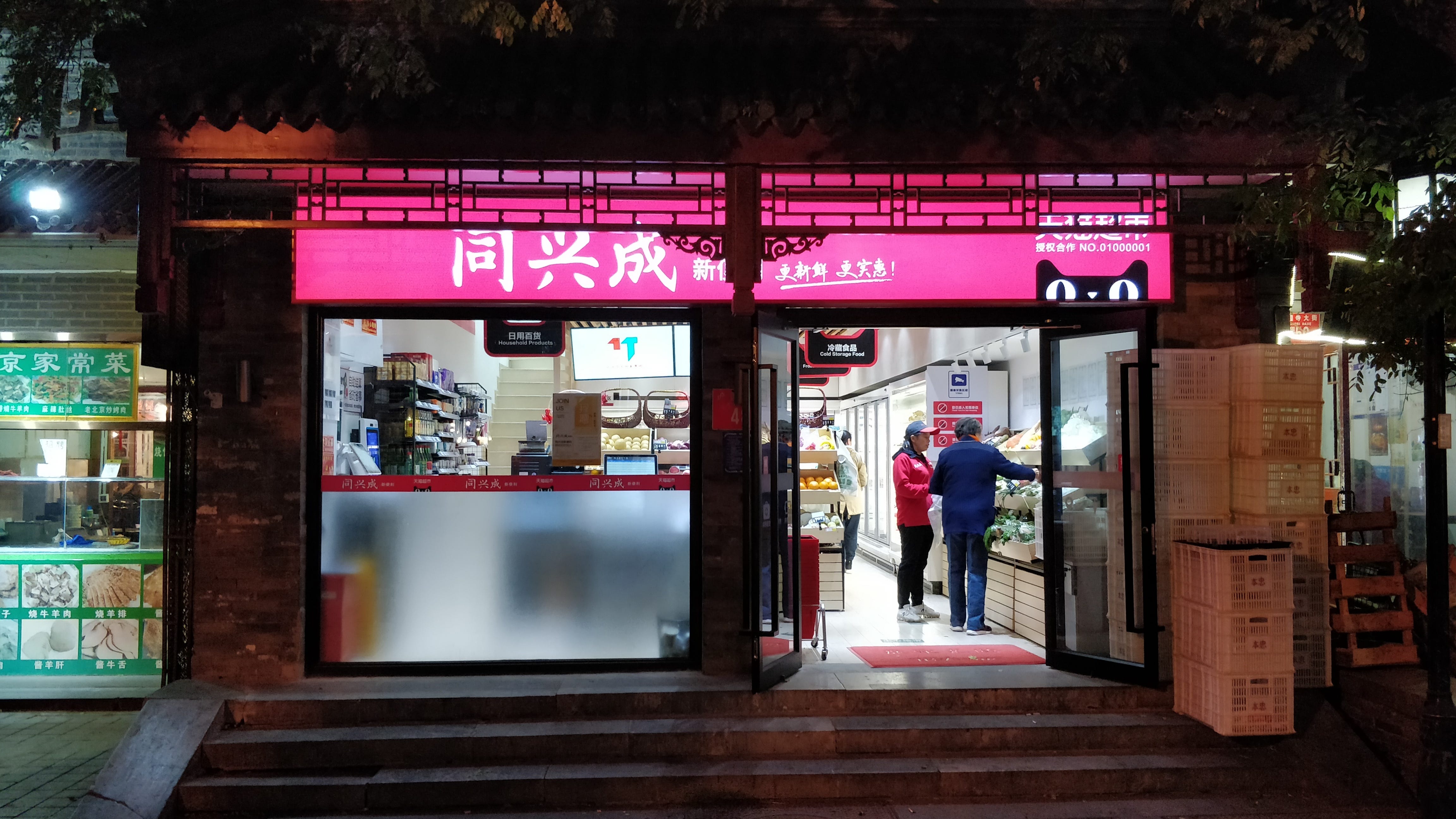
Tmall Convenience Store, Beijing 2018.
Things that caught our attention
We recently wrote about Xiaomi’s move into EVs. The SU7 has been launched with prices starting from CNY215,900 (USD29,870). (source)
NPR's Planet Money did an episode on Temu that features Tech Buzz China founder Rui Ma.
If you are from The Netherlands or speak Dutch, you might be interested in the new one-week ‘Retail & Digital Revolution’ study tour that Tech Buzz China editor Ed Sander delivers in October 2024. More information here.
While Rui Ma isn’t writing any articles for Tech Buzz China at the moment, she has become much more active on Twitter (X) lately. Here are some of her recent posts:
Introduction
In the first part of this series, two weeks ago, we described how Alibaba realised it had lost significant market share to new competitors like Pinduoduo and Douyin. In our August article, Whatever Happened to New Retail?, we described how, in 2019, cracks had started to appear in Alibaba’s New Retail initiatives and how many seemed to have entirely disappeared by 2023.
In 2023, Alibaba went through several significant organisational changes, including the 1+6+N split-up (which has largely been reversed, with the IPO of Alibaba Cloud and Cainiao cancelled and Hema being postponed), the resignation of chairman Daniel Zhang and the return of Joseph Tsai and Eddy Wu as the company leaders. The two immediately set to work to implement Jack Ma’s advice to ‘return to Taobao, return to the user, return to the internet’. What the latter ‘return’ meant became apparent when, earlier this year, news broke that Alibaba was considering selling some of its New Retail investments like Sun Art, Intime and maybe even its flagship project, Hema (Freshippo). Earlier, rumours went around that the company might sell Ele.me to Bytedance.
Clearly, Alibaba has put the New Retail course into reverse.
Two weeks ago, we looked into Alibaba’s investments in shopping malls, department stores and home furnishing chains. All seem to point to projects that have helped these businesses improve their online integration and internet (guided) sales. But most of these businesses do not seem to benefit enough from the New Retail integration of online- and offline that was supposed to save traditional stores. The majority keep showing disappointing growth or even a stark decline.
In the second article of this series, we look at another prominent part of Alibaba’s New Retail strategy: its enormous investments in hypermarkets and supermarket chains. How have they fared in the past eight years?
And then there’s Alibaba’s self-operated supermarket start-up, Hema (Freshippo). At the moment, the developments around Hema follow each other rapidly without a clear conclusion. There is also much information to share on its successes and failures. We have, therefore, decided to do a third article specifically on Hema (Freshippo), which will appear in May.
The article below is only available for paid subscribers.
Freya Zhang and Ed Sander, Research Editors
Rui Ma, Consulting Editor
(click on the images above for information on the Tech Buzz China team)
Sun Art Retail and RT-Mart - ‘Hema-nizing’ the hypermarket
An RT-Mart store in Datong, February 2024.
The business model of Sun Art Retail (高鑫零售, Gaoxin Lingshou), the leading hypermarket retailer with Auchan and RT-Mart as brands, is based on sales of goods, supplemented with leases to offline physical stores. Besides RT-Mart, Sun Art’s buildings normally have a range of other smaller stores and even shop-in-shop spaces. [1]
After opening its first hypermarket in Shanghai in 1998, RT-Mart grew until 2010, reaching a revenue of RMB 40.4 billion and becoming the ‘King of Chinese Supermarkets’. However, in the 2010s, the rise of e-commerce, facilitated through mobile phones, brought many problems to traditional retail. Carrefour China’s revenue and number of stores began to decline. Walmart closed 74 stores between 2012 and 2017, and China Resources’ Vanguard closed nearly 1,000 stores between 2014 and 2017. [28]
Before Alibaba acquired the 2000-founded Sun Art, it had already been exploring digitalisation. In 2014, it started its own e-commerce platform, Feiniu.com. Sun Art also acquired the online grocery store Fields and Xiaohehe, a mobile O2O platform targeting university campuses, in 2015. In December 2015, it launched the online wine platform Auchan Wines. [2]
However, these initiatives were unsuccessful and cost the company substantial amounts of money. Sun Art invested over RMB 1 billion in Feiniu and lost over RMB 400 million. [3] They learned that developing digital capabilities and an online customer base required enormous investments, even for a retailer as big as them. When they realised they wouldn’t be able to do it by themselves, they started looking for a partner. At the same time, Alibaba had realised through its Hema supermarkets that offline retail also had its challenges. As such, it's logical the two found each other. [4]
In 2017, Alibaba initially took a 36.16% stake in Sun Art Retail for HK$22.4 billion ($2.88 billion). Sun Art was clearly struggling at the time, showing only 2% growth while the overall retail market was still growing more than 10%. It had 446 hypermarkets, some as large as 17,000 square metres, in 29 provinces and unmanned stores under the brand Auchan Minute. It also had 140,000 employees. [2]
The new alliance would integrate Alibaba and Sun Art's resources: Sun Art would use Alibaba’s digital ecosystem and undergo digital transformation in O2O (online-to-offline), logistics infrastructure, etc. In turn, Alibaba would access Sun Art’s customer data and offline shoppers. It planned to invest $15 billion in the digital transformation. [5]
Promo clip about RT-Mart. Source: Alibaba.
Alibaba invested heavily in installing self-service counters, and in 2018, the Feiniu app was upgraded and revised to ‘RT-Mart Premium Fresh’, providing free shipping for orders over RMB 29. [6] Some claim that this came down to the original Feiniu being shut down because it conflicted with Alibaba’s e-commerce business. [3]
Notification on feiniu.com (machine translation).
With Alibaba as a main shareholder, Alibaba-related shop-in-shops soon started appearing in Sun Art’s RT-Mart (大润发, Darunfa) stores, including Taobao Xinxuan (white-label C2M products) and Tmall Mother & Baby stores. On June 11th 2018, RT-Mart announced that 100 of its stores had been revamped and upgraded under Alibaba’s New Retail initiatives, increasing its store efficiency by 15%. It planned to upgrade its other stores by the end of that year. [7]
I visited an RT-Mart store in Yangpu, Shanghai, on multiple occasions in 2018, 2019 and 2023. I noticed that the Taobao Xinxuan store would later disappear, just like it had at Alibaba’s own shopping mall, Qinchengli.
Tmall Mother & Baby shop inside an RT-Mart store, Shanghai, October 2018.
Taobao Xinxuan shop inside an RT-Mart, Shanghai, October 2018.
Alibaba was also a shareholder in Suning, China’s biggest retail company selling electronic appliances, having invested $4.6 billion for an almost 20% stake in 2015. In June 2018, Suning and RT-Mart signed a memorandum of understanding to sell home electronics in RT-Mart’s stores (393 at the time). Suning would source and sell the products in a home electronics concession within RT-Mart. While sales of home electronics could make up as much as 20% of the revenue of hypermarkets, RT-Mart had less bargaining power than specialists like JD, Suning and Gome and had been reducing this category since 2015 to focus more on fresh food. [7]
A Suning shop in an RT-Mart hypermarket, Shanghai, October 2018.
A selection of Tmall ‘internet famous’ products in an RT-Mart, Beijing September 2019.
Something else that stands out when visiting some RT-Mart locations (including those that formerly were still called Auchan) is the presence of the same in-store transport system under the ceiling that you will find in most of the bigger Hema (Freshippo) stores. Alibaba was ‘Hema-nizing’ the old hypermarkets to enable online order fulfilment through the store + warehouse model. Stores that received more than 1,000 daily orders were equipped with this order-picking system and a front warehouse. [6]
Transportation system for order picking in an Auchan store, Shanghai, September 2019.
An RT-Mart fulfilment centre at the back of one of its hypermarkets. Source: Alibaba
The video below gives an impression of RT-Mart stores in 2019.
In 2019, Tmall Supermarket launched a home delivery business with Sun Art Retail, offering half-day food delivery and daily necessities for consumers within a 3-20 kilometre radius around the stores. [8] In this Tmall Supermarket inventory sharing program, consumers placed their orders via the Tmall Supermarket platform, but delivery was done from the Sun Art branches. Delivery was done within an hour for customers within a radius of 5 kilometres and half a day for customers within a radius of 5 to 20 kilometres.
Sun Art’s stores were also integrated into Alibaba’s other online platforms, such as instant retail platforms Ele.me, which Alibaba acquired in 2018, and Taoxianda. Consumers could also place their orders through Sun Art's own platform, RT-Mart Fresh (Darunfa Youxian)
B2C (through Taobao) and B2B delivery radius at an Aunchan store, Shanghai, September 2019.
Taoxianda adverts at an RT-Mart, Shanghai, October 2018. Left: “Scan the QR code in Taobao on your mobile phone. New customers receive a red envelope. Delivery radius of 3 kilometres.” Right: ”Go to RT-Mart on mobile Taobao and get delivery within 1 hour. Buying groceries via mobile phone is hassle-free and allows you to spend more time with your grandchild.”
In 2019, the CEO of Sun Art at the time shared how both Alibaba and Sun Art had dedicated New Retail teams, which cooperated on projects. [4] But there were signs that cooperation did not always go smoothly, like in the case of Hexiaoma…
The curious case of the two Hexiaomas
After Alibaba became a shareholder of Sun Art retail in 2017, Hema and Sun Art’s hypermarket formula RT-Mart teamed up to create Hexiaoma (盒小马). The character 马 (‘ma’) in Hema means horse and 小马 (‘xiao ma’) means pony. As the name implies, Hexiaoma was meant to be a smaller version of Alibaba’s New Retail supermarket, Hema Xiansheng. It became the very first of many Hema spin-offs.
Hexiaoma was presented as a medium-sized boutique supermarket extension of the Hema brand for downtown areas in first- and second-tier cities. The stores would use Hema’s technology, offer catering stalls and focus on imported seafood and private labels. RT-Mart would be responsible for these small supermarkets' supply chain and store management. Like Hema, Hexiaoma offered home delivery in a 3 km radius, although it could take up to one hour, compared to Hema’s (promised) 30 minutes.
The first store was opened in Suzhou in June 2018 and measured 800 square metres. It looked like a cross between a Hema and a convenience store. Just two months later, in August 2018, Hexiaoma began testing a franchise model and rolled this out in October. By January 2019, there were 16 stores, only two of which were self-operated. The first store in Suzhou already closed after ten months, allegedly because of poor choice, and by mid-2019, only two new stores had been opened that year.
RT-Mart tried building on its strong presence in third- and fourth-tier cities and suburbs of larger cities by expanding Hexiaoma to small stores of 1,000 – 2,000 square metres there. Eventually, the product mix became more ‘RT-Mart’ than ‘Hema’. It had less fresh food and products like sportswear and home decoration that you wouldn’t find at Hema stores. Ultimately, Hexiaoma ended up being more like a small community store.
A Hexiaoma store. Image: Sina News.
Hexiaoma was also added to Alibaba’s online grocery delivery platform Taoxianda, which itself was part of Tmall Supermarket. The goal was to combine the strengths of Hema, RT-Mart and Tmall to create ‘the next Hema’. [9] Instead, it created a failure waiting to happen. To complicate things even further, another Hema concept, also named Hexiaoma, would appear.
In the summer of 2019, Hema opened a catering shop that sold (breakfast) snacks. It was initially called Hema Pick ‘n Go. The small 20-50 square metre shops offered about 40 different products, like ‘jian bing’, an extremely popular breakfast pancake (see photo below).
Pick ‘n Go, Shanghai 2019.
In July 2020, after having tested the concept for a year, Hema announced that Pick ‘n Go had been ‘upgraded’ to Hexiaoma (盒小马) and that it would open 60-80 Hexiaoma stores covering the entire Shanghai subway system, business districts and core office buildings. [10][11] This was confusing because Hema had operated small supermarkets under the same brand in cooperation with RT-Mart. It’s one thing to have your brand name copied by a third party, but doing this to someone in your own group? Clearly, something was amiss in the cooperation between the two parts of the Alibaba conglomerate.
Since its launch, the catering offerings of the RT-Mart Hexiaoma had disappeared, and there was little left to link them to the Hema brand. In January 2021, the ownership of the Hexiaoma supermarkets was fully transferred to RT-Mart when it bought Alibaba’s 51% ownership. At the time, 2.5 years after launching, RT-Mart’s Hexiaoma had only 14 stores. [11] RT-Mart announced that they would be renamed to Xiaorunfa (小润发), after RT-Mart’s Chinese name Darunfa (大润发). At the time, RT-Mart had already been opening Xiaorunfa stores since mid-2020. [12]
Meanwhile, Hema aimed to open 1,000 Hexiaoma Pick ‘n Go stores in 3 years. However, in 2021, the review site Dianping still only showed nine stores. [11]
Last year, I only found one ‘Hexiaoma’ store in the whole of China on Baidu Maps. The most recent picture, taken in April 2022, showed an ‘RT-mart version’. A search for Xiaorunfa resulted in many hits in Shanghai. Therefore, we can safely assume neither concept has survived, and this tale that reeks of internal friction between RT-Mart and Hema has ended.
Will the real Hexiaoma please stand up? (image source: Baidu Maps)
Alibaba takes over
In October 2020, Alibaba expanded its investment in Sun Art and took a controlling stake from its French owner, Auchan, for $3.6 billion. At the time, Sun Art had 481 RT-Mart and Auchan hypermarkets.
“As the COVID-19 pandemic is accelerating the digitalisation of consumer lifestyles and enterprise operations, this commitment to Sun Art serves to strengthen our New Retail vision and serve more consumers with a fully integrated experience,” Daniel Zhang, Alibaba’s former chairman, said in a statement at the time. [8] Alibaba’s quarterly report stated: ”The increased investment in Sun Art will allow us to digitise its offline traffic, synchronise online and offline channel inventory, broaden supply chain network and increase online purchases.”
The cooperation seemed to pay off. By December 2020, 24% of Sun Art’s goods sales were done online, most of which was driven by Alibaba’s digital technology. In the first half of 2020, same-store growth had been 5.7%, an improvement from the previous years -2%. [8] Sun Art had approximately 14% market share in 2020. [13]
But in 2020, Sun Art posted almost flat revenue growth (0.1% to RMB 95.5 billion) and a 5.4% profit drop to RMB 24.3 billion. The company started moving away from the difficult hypermarket sector by opening small to medium-sized supermarkets focusing on food grocery sales. [14]
In December 2020, Sun Art Retail and Alibaba’s Cainiao started offering community group buying services at more than 100 stores in 36 cities. Customers could order in the app and pick up the goods at nearly 8,000 Cainiao stations the next day. In 125 cities, RT-Mart also offered group buying through its self-operated Feiniu Pintuan. [13]
In 2020, Sun Art had 69 million registered and 16.5 million actively buying customers in the online channel. On average, a Sun Art branch received 1,000 orders per day. In the largest (first-tier) cities, the average was 2,000. The average order size was 66 RMB ($8.50). [15]
However, the delivery costs of individual orders were the major challenge of the ship-from-store model. The courier costs could amount to 10 RMB, and unless minimum order values or delivery costs were applied, there was little or no margin left for the supermarket after delivery. In the upper-tier cities, labour costs and the rent for retail properties are also high. As a result, stores rarely achieve more than a 3% net margin. Meanwhile, the height of the delivery costs quickly amounted to 5% to 10% of the online revenue. So, delivery from the store was not profitable unless you passed on the delivery costs to the customer, which often did not happen in the competition to win the customer.
Sun Art has been struggling with this problem for years, partly because it has to pay Alibaba a fee for using the Taoxianda platform in addition to the courier delivery costs.
RT-Mart’s current delivery fees (March 2024)
After Huang Mingduan, the former CEO of Sun Art Retail, resigned in December 2020, Alibaba executive Lin Xiaohai became executive director and later, in May 2021, CEO of Sun Art. Lin had previously worked for Procter & Gamble and was general manager of Alibaba’s Lingshoutong. [1]
In June 2021, the 69 Auchan locations were all rebranded to RT-Mart. [16] In the second and third quarter of 2021, revenue fell 5% YoY to RMB 41.5 billion. Same-store sales even fell 7.4% YoY. Net profit dropped by 86%. [17]
Meanwhile, the online share of orders kept on growing. In April - September 2022, they accounted for 35% of sales. Still, total revenue dropped 2.22% YoY (to RMB 40.6 billion), and net profit dropped 159% YoY (to RMB -69 million). [18]
During the pandemic, RT-Mart’s online business increased from 10-20% to no less than 70-80% and remained at 50% in the later stages of the pandemic. In 2023, online revenue accounted for over 60% of RT-Mart’s total revenue. This might explain how I found an RT-Mart I had visited several times before the pandemic almost deserted in 2023.
Diversifying formats
Hypermarkets have faced difficulties as more Chinese people have started buying non-food products and even fresh produce online. Carrefour alone closed 106 Chinese stores in the first half of 2023. Many supermarkets are also struggling. Yonghui Supermarkets is anticipating a loss of RMB 1.34 billion in 2023. [19] Meanwhile, newer retail formats like membership stores and instant retail also increased competition for Sun Art.
Industry insiders see a few ways for hypermarkets to turn the tide. [21]
In lower-tier cities (beyond 4th) and areas around higher-tier cities, retail still lags by 5-10 years. Consumers still like one-stop shopping and don’t have a high need for timeliness. Hypermarkets could play a role there. Costs for rent and labour are also lower there.
Abandon the focus on all consumers and target specific consumer groups, turn the hypermarket into an experience centre and strengthen the integration of store + warehouse (like RT-Mart attempts to do, see below).
Move upstream and become a manufacturing retailer (to a certain extent, this is what Hema tries to do).
Sun Art has decided to abandon its positioning of ‘servicing all consumer groups’ and focus on three target groups instead: [20]
Families with children who have high requirements for product quality and shop offline.
Elderly consumers who have time and money after retirement and consider shopping malls to be part of their lives.
Car owners with ‘purposeful purchasing’ attributes.
Online, the company would focus on young working people. [3]
For business development, Sun Art is focusing on three things: [20]
Differentiated products: more private labels and exclusive products based on consumer needs and quality-price ratio (good products at low prices) that draw consumers to the store. Like many other food retailers, RT-Mart has increased the number of private labels, offering 300 such items.
Accelerating store openings and renovating stores to strengthen ‘shopping + experience’. Sun Art is changing some of the areas of its stores it rented out into experience areas for ‘family leisure’. By doing this, it is sacrificing some of its rental revenue. Merchants whom Sun Art still rents to have shifted towards catering and services.
Create a reliable online fulfilment centre.
In its financial reports, Sun Art now describes itself as an ‘Offline Experience Center and Logistics Fulfillment Center Of Online Business.’
CEO Lin Xiaohai also diversified the RT-Mart formats. He launched RT-Mart Super (大润发Super or 中润发 Zhongrunfa) as a community-based fresh food supermarket of 1,000 - 4,000 square metres with about 5,000 SKUs. He also followed a trend in the Chinese market and launched the M Membership Store (M会员店) format, following the examples of Costco, Sam’s Club, Metro and group colleague Hema X. The first M Store opened in April 2023 in Yangzhou, an upgrade from the RT-Mart store located there after previously having been an Auchan location. [22] Sun Art owns about 33% of the properties in which its stores are located. This gives Sun Art an advantage since the locations for warehouse-style membership stores are scarce, and it can renovate its old hypermarkets. [23]
An RMB 260 membership of M Store offers selected goods, omnichannel shopping, hassle-free returns and a free relative card. The more expensive RMB 680 ‘black gold membership’ offers extra 2% discounts, monthly RMB 15 online shopping coupons, 15% off glasses, afternoon tea and more. [22] Seven months after opening the Yangzhou M Store, it had 100,000 paying members. [20]
Through Taoxianda, the store provides one-hour and two-hour delivery in a 5-kilometre radius and would add half-day delivery in a 5-30-kilometre radius later. It has 3,000 SKUs, among which 300 private-label products. This 10% is still much less than at Costco, Sam’s (30%) and Hema X (40%). [23] It uses the high-end equipment of Hema and RT-Mart to ensure that order picking is completed within 20 minutes.
According to Lin Xiaohai, the M Store is a hard discount store for the middle class. But Sun Art’s vision for its membership stores did not sound all that ambitious when Lin said: "We are not an innovator of the membership store model, nor do we challenge the model itself, but we hope to make the membership model more attentive, more persistent, and create more user value than our competitors. (..) As a latecomer, we adopt a learning attitude and do a good job in membership value and service. In the first year, we only set two indicators: the number of members and the renewal rate. Regarding profitability, we will look at it from a long-term perspective." Sun Art’s membership stores were not expected to make a profit in their first three years. [23]
After opening the second M store in Changzhou in December, the third M Store opened in Nanjing in January, covering 45,000 square metres. Sun Art plans to open five more M stores in the coming 12 months. [1]
Learning from Sam’s Club, which makes a profit from the memberships, not so much from the margin on products, RT-Mart has set membership renewal as the primary KPI. The stores currently have 120,000 paying members. Lin considers the M Store Sun Art’s second growth curve, but so far, the reception by consumers has been mixed. [1]
In February 2024, RT-Mart reported closing 13 stores the previous month because of ‘adjustments in regional operations strategies’. It opened 11 stores elsewhere. It is increasing the speed of opening RT-Super and M-Club stores. [24]
Another failed transformation?
At the end of the day, as with Intime, the transformation of RT-Mart has not had the desired effect. Sun Art not only failed to achieve significant results in its new retail transformation, but its financial data and capital market performance have also been poor. Sun Art’s market value dropped from HK$ 76 billion to around HK$ 10 billion. [25]
In the quarter ending March 31st 2023, Sun Art temporarily turned losses into a small RMB 78 million profit. The revenue of RT-Mart’s app (RT-Mart Youxian) increased by 40% compared to the same period in 2022. Taoxianda's business also continued to grow, and revenue through Ele.me increased by 20%. [26] In the six months that followed, the online B2C business grew another 4.7% YoY. [20]
After completing the restructuring of about 60 stores, Sun Art Retail's online B2C business grew revenue by more than 15% in fiscal year 2023 and continued to grow by 4.7% in the first half of fiscal year 2024, with order volume increasing by 8.9%. [3]
Clearly, RT-Mart’s online and instant retail business was growing, but was it enough as it continues to make losses?
In fiscal year 2023 (ending March 2023), Sun Art achieved RMB 83.6 billion in revenue, a YoY decrease of 5.1%. Net profit was 78 million, turning a loss into a small profit. But since Sun Art has turned to make losses again. [27]
Sun Art said its drop in revenue was due to the decreasing number of visitors to offline stores and rent relief given to support tenants during the pandemic. [26]
Alibaba’s financial report for the third quarter of fiscal year 2024 shows that "other businesses" (which include offline retail businesses Sun Art Retail, Hema, Fliggy, Dingtalk, Alibaba Health and Intime, among others) had a revenue of RMB 47 billion, a year-on-year decrease of 7%. The adjusted EBITA loss was RMB 3.2 billion, an increase of 86.81% over the same period last year. According to the report, the main reason for the decline in revenue was the decline in sales of Sun Art Retail. The main reason for the growing losses was the increase in losses of Sun Art Retail. [25]
While RT-Mart’s share of online orders has grown, and together with Alibaba, it performed better online than it had done on its own, profitability hasn’t improved substantially. Meanwhile, its offline business has been criticised by many. When visiting an RT-Mart in Datong, a fourth-tier city, I found many people shopping there during Spring Festival. Still, the presentation of products felt very outdated, comparable to Walmart's in the same city.
As of September 2023, Sun Art had 485 hypermarkets, 19 medium-sized supermarkets and one membership store. According to its interim report for 2023, in the six months ending September 30th, operating revenue dropped 11.9% YoY, and losses were RMB 359 million, five times that of the same period in the previous year. [28]
Despite all of Alibaba’s efforts, from 2018 to 2022, Sun Art Retail's revenue dropped from RMB 99.3 billion to RMB 83.6 billion, a decrease of 15%. [28] When Alibaba acquired Sun Art in 2020, the company's value was pushed up to HK$96 billion. In February 2024, it was worth about HK$12 billion. Almost HK$85 billion have evaporated. [1]
Overall, Sun Art Retail failed to become a new growth curve for Alibaba and instead became a liability with an enormous number of employees. After Alibaba acquired Sun Art in 2020, the number of Alibaba employees doubled to 252,100. By September 2023, Alibaba had 225,000 employees. Among the tens of thousands of employees it has recently reduced, Sun Art staff accounted for the majority. [27]
On March 27th 2024, news broke that Lin Xiaohai, the Alibaba manager who had joined Sun Art as CEO, was resigning. Sun Art shares soared as much as 9 per cent. Lin will be replaced by a former senior executive of Auchan, Shen Hui. [29] Insiders expect more Sun Art veterans to return with the withdrawal of Alibaba staff. [3]
People close to Sun Art said that while Lin had extensive experience in traditional offline channels, he had no previous experience managing hypermarkets, let alone a company as enormous as Sun Art. As a matter of fact, they considered the overall offline retail knowledge at Alibaba to be limited. They also said that physical retail emphasises efficiency and a long-term approach, which was too slow for Alibaba. Under the pressure of profitability, Lin’s performance was said to be mediocre. [3]
An executive of a hypermarket said, "How can a team that has been doing hypermarkets for decades change the DNA of the company in just a few years and do e-commerce, small formats or other businesses?” [21]
The integration of online, offline and RT-Mart and Alibaba’s ecosystem and constant exploration of new store formats consume a lot of resources in the group, distract the business direction and reduce overall efficiency. And efficiency is exactly what traditional hypermarkets that are in decline and have entered an era of low profits need most. [3]
Other supermarkets
In November 2016, Alibaba paid RMB 2.1 billion for a 32% stake in Sanjiang Shopping Club Company Limited (三江购物俱乐部股份有限公司), which operates community budget supermarket franchises. The company also conducts online sales through the Yuncai app and mini program, as well as Taoxianda and Ele.me.
In February 2017, Alibaba and Bailian Group (百联集团) announced a strategic partnership to explore retail opportunities across each other’s ecosystem. Bailian operates supermarkets, department stores, and shopping malls. At the time, Bailian had 5,000 outlets in 200 cities across 25 provinces and was especially strong in Shanghai. Balian had previously launched its iBailian e-commerce platform and app but failed to gain much traction. [7]
Alibaba did not take a stake in Bailian but would later, in May 2017, take an 18% stake in its subsidiary Lianhua Supermarket Holdings Company Limited (联华超市股份有限公司), which operates hypermarkets, supermarkets, and convenience stores in China under the brand names of Century Mart, Hualian Supermarket, Lianhua Supermarket and Lianhua Quik Convenience Store. At the time, Lianhua had more than 3,618 physical outlets in 19 provinces and municipalities. More than 60% of the stores were in Shanghai. In 2016, Lianhua had a revenue of approximately RM 27 billion, down 2% YoY. When Alibaba bought its 18% stake in Lianhua, it became its second-biggest shareholder. [7]
The move was seen as a way to strengthen Alibaba’s position against alliances between JD.com, Walmart and Yonghui in the supermarket segment.
Ye Yongming, the chairman of Bailian Group, said at the time: “A new consumer era calls for a new retail approach. Traditional commerce must embrace innovation and change to thrive if they are to ride atop this new consumption trend. New retail is not just the convergence of online and offline worlds. It also means we need to be able to leverage technologies such as the Internet of Things, AI and Big Data to provide consumers with new and immersive shopping experiences across channels and product categories anytime and anywhere. It is with this shared vision that our companies have joined forces in this strategic partnership to redefine commerce and reshape the retail industry.” [7]
Specifically, the cooperation between Alibaba and Bailian (and thus Lianhua) would focus on six areas: [7]
Retail outlets: Designing cross-channel operating and ordering systems for customers in physical stores.
New retail technology: Investing in R&D of new retail technologies (AI, IoT, big data, etc).
CRM: Integrate customer databases to enhance customer service capabilities through geolocation, facial recognition, big data and CRM systems.
Supply Chain Management: Combine customer insights and supplier channels to improve merchandise selection and reduce costs.
Payment tools: Make Alipay available at Bailian stores and integrate Bailian’s Safepass and OK Card into Alipay.
Logistics: Bailian Logistics would collaborate with Alibaba’s Cainiao platform to co-develop logistics to enhance service for consumers and merchants.
In June 2017, Bailian launched a Hema-clone named RISO in Shanghai. It integrated a supermarket with catering and sales of books and art. Through its app, RISO offers many imported goods and a 1-hour delivery service within a range of 3 kilometres. Alibaba did not take part in the initial trial of this new supermarket format. At the time, Bailian said that ‘in the future’, Alibaba might be involved in the operation of RISO in areas such as data analysis, merchandise selection and automatic stock replenishment. [7]
I visited an RISO store in Shanghai in 2018 and wasn’t impressed when I compared it to Hema and JD.com’s 7Fresh. However, the brand is still operational with two stores in Shanghai.
RISO, Shanghai, April 2018.
In October 2017, Alibaba took a 10% stake in New Huadu Technology Co. Ltd. ( 新华都科技股份有限公司) which operates and manages marketplaces, supermarkets, and department stores. The two set up a joint venture to pool their resources and respective advantages in the supply chain. New Huadu hoped to expand its business channels using Alibaba’s e-commerce resources. [30]
Unfortunately, we haven’t found many details on the results of the cooperation between Alibaba and these supermarket chains in our regular Chinese sources. Neither did these initiatives feature prominently in Alibaba’s PR on its New Retail initiatives.
Looking at the stock performance of these companies, there probably was little to write home about.
As with other offline retail companies that Alibaba invested in, these companies were already struggling before Alibaba got involved. New Retail was supposed to be their saviour, but salvation never came.
Lingshoutong (Integrated Retail) fades out
In 2016, Alibaba established a retail business department led by Lin Xiaohai (who would later become CEO of RT-Mart). Like Lin, many people in the team came from Procter & Gamble.
In and around each residential community, usually consisting of a few apartment buildings, you will find several small local shops or convenience stores run by couples, so-called pop-and-mom shops. In China, there are several such shops within a radius of a few hundred metres, wherever you are. Individually, each has a modest turnover, but together, these 6 million shops (70% of which are outside the major provincial capitals) have a significant market share. Alibaba wanted to get its hands on the offline data generated by these shops and persuaded many of them to use its B2B retail platform, an initiative called Lingshoutong (零售通), or ‘Integrated Retail’. [31]
Lingshoutong (LST) was originally an Internet one-stop B2B purchasing platform that provided ordering, logistics, marketing, value-added services, etc., for community convenience stores. Alibaba wanted to connect millions of these (often pop-and-mom style) stores through the supply chain and digital capabilities of LST. [32] LST was interesting for the shop owners because prices were cheaper than with regular wholesale. [32]
As a test, Alibaba transformed a local store (Tmall Weijun), including branding with Tmall's recognisable cat and voice recognition software Tmall Genie, a smart speaker similar to Amazon's Echo. Instead of ordering from separate suppliers, the retailer would only order on the Lingshoutong platform. Or at least as much as possible. According to Alibaba, the experiment and facelift resulted in 20% more customer visits and 45% higher turnover. [31]
Tmall Weijun convenience store, Hangzhou 2019.
In August 2017, Alibaba announced it would equip another million convenience stores with its retail management system, Alibaba Distribution Platform (ADP), within seven months. This system provided independent retailers with marketing, distribution and training opportunities. The system also provided advice on trends and the expected demand for certain products based on collected data. Ultimately, all this would make purchasing by these shops much more efficient. [32]
Alibaba wanted to transform about 100,000 participating stores throughout China into 'smart stores' where consumers can pay by scanning their faces. They could also have scanned products in the store delivered to their home. As with the Weijun test store in Hangzhou, 10,000 of these stores were to have Tmall Corner Store (天猫小店, Tian mao xiao dian) branding, complete with eye-catching LED screen. [31] By the end of 2018, 1 million stores would connect to LST, a goal already reached in September 2018. [32]
The intention was to offer also other Alibaba services in these stores, such as loans and booking trips. There was also integration with Alibaba's B2B wholesale platform, 1688.com, and Cainiao's logistics network. [31]
According to Alibaba, the benefits were clear; the shops could significantly increase their profits through this technology. However, most owners of local shops were not necessarily the most innovative entrepreneurs. So, getting them to join Alibaba's program took quite a bit of persuasion. The company employed 2,000 commissioned salespeople to convince retailers. It seemed to work; according to Alibaba, during Singles Day in November 2017, 600,000 local shops (10% of the total) were connected to the Longshoutong platform. These shops immediately acted as delivery points for purchases during the shopping festival. [31]
The local shops received many free services to make their lives much easier. In return, the stores had to transfer data about their customers' purchases to Alibaba. It has always been difficult to collect offline customer consumption data. At the time, 80% of consumption was still taking place offline (nowadays, it's roughly 72%). An important aspect of the New Retail strategy was collecting even more data about consumers and creating a more complete online plus offline data profile of them. [31]
While Alipay may have previously been able to determine where you bought something and how much you spent there, the details of those purchases (the exact products and services) often remained invisible to Alibaba's sister company, Ant Group. Alibaba would get those details through Lingshoutong, giving the company an even more precise picture of the consumer's consumption behaviour.
Chris Tung, Alibaba's Chief Marketing Officer, made no bones about it: “Simply put, we look for all data related to people – their behaviour, what they like, what they buy – and link that data to actual people. The goal is to find the right consumer for each brand and track them throughout Alibaba's entire system.” [31]
The market data from all those stores was also supposed to help brand owners with their product development (C2M). Alibaba could offer these brands a new sales channel. Former Alibaba chairman Daniel Zhang said at the time that within the entire Alibaba business operating system, the role played by Lingshoutong was an intelligent channel solution. “The market insights from a million small stores are the most dynamic and can help us better serve brand owners.” These convenience stores would also offer a new sales channel for brands selling through Tmall. [32]
Promo clip about Lingshoutong. Source: Alibaba
LST grew to 1.3 million convenience stores in 25 provinces, serviced by 700 brands and dealers. According to Alibaba, the basic capabilities of logistics, capital flow, and information flow built by Lingshoutong became the FMCG industry's largest, most powerful, and lowest-cost digital distribution infrastructure. [32]
However, problems with Lingshoutong eventually started to appear. In 2020, Hema, Lingshoutong, RT-Mart, Cainiao and Ele.me were all dabbling in community group buying (CGB), showing a lack of internal coordination and waste of resources. In March 2021, Alibaba changed course and set up the MMC Business Group, which included Hema Jishi, Lingshoutong and CGB initiatives by Cainiao and Ele.me. In May 2023, there was another reorganisation, and LST was merged into Taobao Maicai. [32]
Last summer, I visited the Tmall Weijun store, which was prominently used in Alibaba’s PR campaign. Huang An no longer ordered all his goods on Alibaba’s Linshoutong system and seemed disappointed that after the original 2017 program, Alibaba had not continued to invest in further innovation. He was also no longer receiving any customer intelligence driven advise from Alibaba. When asked what caused this stagnation, he said: ”It’s just what happens at Alibaba. People change jobs, and existing projects get abandoned.” I now wonder if he was referring to Lin Xiaohai, the old Lingshoutong leader who moved to become CEO of RT-Mart in 2021.
With Huang An at Tmall Weijun convenience store, Hangzhou 2023.
Convenience stores have found it hard to make money because of rising labour and rent costs. Due to the impact of low-price community group buying (among which Alibaba’s own initiatives), many small stores have difficulty increasing sales of daily necessities, which has dealt a fatal blow to the store's profit margin. And community group buying didn’t just hurt the small retailers. When the B2C community group buying business emerged, and mainstream categories such as wine and beverages were used to offset orders, Alibaba’s B2B channel was also cannibalised and suffered a huge impact. In other words, the group buying giants used the core categories of LST as bonuses for orders. New logistics distribution models, such as front-end warehouses, subverted the original logistics channels. LST was physically and mentally exhausted in the group buying subsidy war. [32]
Meanwhile, LST support kept shrinking.
A senior insider of Lingxingtong said, "Alibaba’s LST's B2B business has been hovering between profit and loss, especially now it is facing losses, so there are no extra resources and energy to counter the community group buying sector." [32]
LST’s ordering system proved more suitable for small stores, say 200-300 square metres. For larger stores carrying more SKUs, placing orders on a webshop-like LST app was too time-consuming. Moreover, stores lost their LST salespeople when they changed jobs, while traditional wholesalers sent salespeople around to take orders, saving time compared to LST. After many reorganisations at Alibaba, LST had been in a state of 'leaderlessness' since 2021 (when Lin Xiaohai left). [32]
Then, on March 15th 2024, news broke that Alibaba was officially shutting down Lingshoutong on March 18th and merging it into its 1688 wholesale platform. LST participants must now use the 1688 wholesale app to continue purchasing goods. Both the hotline and text message link for small store registration were inaccessible. [32]
And so, Lingshoutong ended up in a growing list of once-trumpeted New Retail events that have failed to deliver.
A Great Leap Forward when Alibaba takes over
There’s an interesting angle to the evaluation of Alibaba’s New Retail. As we know, Alibaba and Tencent have had very different investment approaches. Whereas Tencent usually takes a small stake and supports the company it invested in with technology and tools, Alibaba tends to take much larger or even majority stakes and insert its own board members or even fully takes over management.
About a year ago, Yu Dongqi, a renowned business commentator, gave his view [33] on why many of Alibaba’s acquisitions fail. He argued that many follow a clear pattern. After the acquisition, Alibaba staff members enter the company, existing employees leave, and sometimes the company is eventually completely shut down.
When Alibaba implements its management system, employee ranks and salaries are realigned. Many original employees feel their ranks and total income have dropped and leave. This happened at Ele.me, where many business executives resigned, moved to competitor Meituan, and took many of their merchant contacts with them.
After a takeover, Alibaba sends in its own CEOs, CFOs, and other core executives, as well as a lot of ‘regular staff.’ Many of these staff members are unfamiliar with the new business. They join because of opportunities for promotion, not because they are necessarily interested in the industry. The newcomers who know how to ‘tell a story’ in the Alibaba organisation receive more resources than the old employees who actually understand the business. There’s also a ‘clan spirit’ among the group of Alibaba staff that gets flown in.
The criticism of ‘storytelling’ isn’t unique to Alibaba. When, in late 2022, JD.com’s Richard Liu reprimanded his managers, one of his major complaints was that the staff was ‘telling stories’ but not actually accomplishing anything.
According to Yu Dongqi, Alibaba staff is well-versed in ‘reaching the targets’ by gaming the system while not improving the overall business. Newcomers that would ‘spin the narrative’ well would get better performance reviews than the old employees. With their assigned budgets but without truly understanding the business, the newcomers would start new projects. Those would stand out but not necessarily improve the efficiency of existing businesses. When user numbers were a KPI, they could easily temporarily boost results through subsidies. But these projects often fizzle out the following year. Projects would have failed, but the employees would have been promoted, often to other divisions.
All of this sounds eerily familiar to me. I once worked for a pet food company that was acquires by one of Lin Xiaohui’s former employers, and roughly the same thing happened. The original, highly motivated staff loved their brand. Their credentials might not have been as impressive as the staff of the company that acquired them, but their passion for pets and their products more than made up for this. But bit by bit, they were replaced by managers from the new owner, and when the offices were relocated, most of the staff was laid off. Eventually, the business failed, partially because the new staff lacked the same passion. The job in this new pet food division was just one stop on their promotional path through different brand and category management positions. Some 15 years later, they broke up their pet food unit and sold it to competitors.
Other problems at Alibaba are: [33]
The lack of a standard or method for resource allocation. Many teams can start projects that interest them if they have spare capacity. They can get a budget from their managers and help from colleagues if they have been in Alibaba long enough to build a network.
The lack of a standard or method to replicate results during operations. For instance, when a particular product does very well at a Hema store, the manager and his team tend to hide its success for a while so they can reap the benefits. Instead, these successes should be quickly identified and nationally replicated.
The lack of a standard or method to set goals for new projects, where ‘shoot first, draw the target later’ is common.
It’s not that people aren’t trained when they start at Alibaba. But just training doesn’t lead to effective application. Alibaba lacks a stable ‘referee’: multiple metrics and someone monitoring these metrics. Besides a result metric, process-related metrics should also be part of the assessment of business executives. Not just ‘what’ was achieved (e.g. GMV), but ‘how’ it was achieved (discounts, subsidies, assortment, etc). With lots of data points, ‘storytelling’ would become pointless. [33]
Let’s look at the meal delivery business as an example. At Ele.me, business people can freely allocate their budget to any area or store. But at Meituan, there are caps on everything, and these are monitored by specially assigned staff. These Meituan business analysts promptly identify issues and share their metrics evaluations weekly with management. Only when anomalies disappear do they stop reporting them. At Alibaba, the referee is not the data but an individual. [33]
Note, though, that Meituan's extreme data-driven nature creates its own problems, such as low speed of execution or response. That’s one of the reasons it faces problems in its competition with the highly decentralised and agile Pinduoduo in community group buying, as we described in Community Group Buying: the ‘US military vs. the Red Army’.
Alibaba does have data evaluations, but [33]
The granularity is insufficient to cover complex businesses and fully understand actions and long-term impacts.
There is a lack of a unified business model to evaluate business efficiency.
Necessary data is missing. Many managers can select data to present in their PPTs during performance reviews, creating space for adjusting narratives and self-promotion.
The situation at Alibaba is the result of its organisational culture that was laid down in 2000-2010:
Sharing of success stories and internal PR so everybody could see their peers' progress, creating a winning spirit.
Encouragement of close bonding, fostering a culture of camaraderie and mutual support.
Implementation of a ‘361’ performance culture (30% overperform, 60% meet expectations, 10% underperform), forcing a distribution regardless of overall team performance.
A push for faster execution.
Encouraging and accommodating innovation to find new paths for business. Every innovative project was likely to receive resources, and failures were tolerated.
Within the original Alibaba organisation, the side effects were manageable. However, when Alibaba acquired new businesses that it didn’t fully understand, innovation, ‘clan spirit’, shortcuts, and storytelling became serious problems. Alibaba’s value-based culture has its merits but is less precise and stable than data-based refereeing. In the current market circumstances, higher operational efficiency than competitors is more important than innovation. [33]
A few words on Hema (Freshippo)
We will return to Alibaba’s New Retail supermarket chain in a dedicated article soon. But before we do so, there are a few things we need to mention.
In 2022, Hema CEO Hou Yi said within Alibaba that Hema had "made New Retail a success." First, technology had changed the retail industry; second, there would be no distinction between online and offline in the future; third, Hema had made a profit. [34]
But on March 18th, news broke that Hou Yi was resigning and retiring, and Hema's CFO was taking over his role. [35] Hou Yi (60) had joined Alibaba in 2015, taking the idea of Hema with him after it had been rejected by his former employer, JD.com (who would later copy the Hema concept with their 7Fresh supermarkets).
With 30 years of experience, Hou Yi is considered one of the few people with a deep understanding of offline retail and grocery supply chains at Alibaba. Alibaba is rumoured to be planning on selling Hema as it returns its focus to online business. A public listing of Hema was postponed because the valuation was considered to be too low. [35]
Hou Yi experimented a lot with various Hema formats, many of which were failures. He claimed that the Hema Xiansheng supermarkets became profitable at the end of 2022 and that the umbrella brand reached profitability in early 2023. However, the chain is also battling the 'consumption downgrade' and is turning many of its stores into discount formats. How profitable Hema will be under these changes remains to be seen. [35]
According to an internal letter by Alibaba Group CEO Eddy Wu, Hou Yi will continue to serve as 'the chief honorary consultant of Hema'.
Hou Yi's resignation fits a pattern of rejuvenation of Alibaba's management, which has already seen former chairman Daniel Zhang, as well as many top managers of the Taobao/Tmall division and Ele.me resign. Shortly after the announcement about Hou Yi, RT-Mart’s CEO Lin Xiaohai was also announced to resign. These resignations clearly point to a sale of Hema and RT-Mart in the near future.
Conclusion
The information in these two reports begs the question: ’Why did Alibaba start its New Retail initiatives anyway?’
According to some, the success of Shanghai’s Hema (Freshippo) Jinqiao store, the first in Alibaba’s supermarket chain, had formed the basis for launching the New Retail strategy. It launched in early 2016, and within half a year, the number of online orders reached thousands per day, a revolutionary achievement. The density of orders exceeded that of Taobao. However, because of the slow pace and heavy investment in Hema store openings, Alibaba feared it would miss this retail reform opportunity. It decided it needed more channels. [36]
In October 2016, Jack Ma endorsed the idea of New Retail. In the following years, Alibaba was confident and determined to win through three pillars: Hema (including copying its model to other supermarkets like RT-Mart, Sanjiang, New Huada and Lianhua), Taoxianda and Ele.me. It could also use synergies between these three pillars (e.g. Taoxianda using Ele.me couriers and sourcing products from RT-Mart stores). [36]
However, New Retail did not bring the desired results; instead, it brought enormous losses. Consumption power in second and third-tier cities proved insufficient for Hema, slowing down Hema’s development speed. Online orders for RT-Mart continue to grow, but Sun Art continues to decline with the hypermarkets. Ele.me was defeated by Meituan. These failures were easy to hide in Alibaba’s many organisational layers. [36]
Was Alibaba wrong about New Retail? According to some, New Retail was the right decision at the time. Initially, Alibaba kept its involvement in Hema low-key, but competitors like JD and Meituan noticed anyway and started their own copies in 2017 (7Fresh and Xiaoxiang). The only option was speeding up. In July 2017, Jack Ma famously appeared with Hema CEO Hou Yi and Daniel Zhang at a Hema store to hold up an enormous crab. Hema had proven instant retail around stores was working. But when Alibaba acquired Sun Art and Ele.me, it didn’t realise how fast the assets' value would fall. [36]
Jack Ma visited Hema in July 2017. Source: Alizila.
Before long, Alibaba’s biggest competitors, Tencent and JD.com, got into the New Retail game with their ‘Smart Retail’ and ‘Unbounded Retail’. They were all competing to invest in offline retail to occupy the scene first and make more plans later. Worrying that the other party would take limited offline assets first, this FOMO sped up the investment pace of the three companies. [34]
Affiliation between internet companies and leading offline retailers in 2017.
New retail seemed to offer a new growth path for Alibaba and a way out of the decline of offline retailers pressured by e-commerce, especially hypermarkets, shopping malls, and department stores. [37]
While Intime did show strong growth, Alibaba underestimated the difficulty of digitally transforming the traditional department stores. [25] Transforming a traditional offline business into a New Retail business is a major and complex overhaul that impacts all parts of an organisation. Even Hema, Alibaba’s flagship in New Retail, has softened its emphasis on omnichannel innovation and repositioned itself as a discounter (we’ll get back to Hema in a future article). Others that have tried the Hema format have failed: Meituan’s Xiaoxiang Fresh, Yonghui’s SuperSpecies, etc. After an enormous loss of RMB 4 billion in 2021, Yonghui returned to traditional supermarket formats. [37]
Hema-clone Yonghui Superspecies, Beijing, October 2018.
Almost everybody is online now, and with consumption power stagnating, digitalisation's effect is marginal as the pie doesn’t get much bigger anymore. There are only so many people with so much money to spend. This is an outcome that Alibaba did not foresee at the time. [37]
Looking back, Alibaba made the following investments in existing offline retail companies:
Alibaba’s New Retail Investments (excluding Hema).
If you take all investments in New Retail, Alibaba has invested more than RMB 100 billion into stakes in offline stores. As these past two reports have shown, return on investment remained largely absent.
Experts claim that the main challenges for Alibaba’s New Retail model include errors in market predictions (misjudging the ‘consumption upgrade’) and issues with internal resource integration. For instance, Intime has not developed as expected, thanks to competition with Tmall and the impact of live commerce. [28] Intime tried to get a piece of the live commerce cake, but its efforts have not been very successful, as shown in the previous article.
The three primary pillars of Alibaba’s New Retail (Hema, Intime and RT-Mart) not only failed to fulfil Alibaba’s expectations but became an enormous economic burden. While Hema claimed to have become profitable in early 2023, it remains to be seen whether it can maintain that profitability. Meanwhile, RT-Mart and Intime continue to make losses. Alibaba’s non-main business has not yet significantly increased its market value or profitability. [27] In fact, these New Retail initiatives have started to seriously harm Alibaba Group’s bottom line.
During the December 2023 Quarter earnings call, Alibaba’s CFO Toby Xu said: “Revenue from ‘all others’ segment decreased 7% to RMB 47 billion, mainly due to the decrease in revenue from Sun Art. Adjusted EBITA from ‘all others’ segment was a loss of RMB3.2 billion compared to a loss of RMB1.7 billion in the same quarter last year, primarily due to increase in year-over-year loss from Sun Art due to scale down of certain of its businesses. Excluding Sun Art, Freshippo and Intime businesses with physical retail operations, group revenue would have grown at approximately 8%, and our group consolidated adjusted EBITA margin would have been four percentage points higher at approximately 24% this quarter.” [33]
Alibaba’s traditional offline retail business is dragging down the group’s overall development.
The sooner Alibaba sells its New Retail initiatives, the sooner it can stop these losses from impacting its bottom line and reinvest in core businesses like domestic e-commerce. In the last nine months of 2023, Alibaba already sold $1.7 billion of non-core assets. However, selling RT-Mart, Intime, and even Hema will be challenging, considering the current retail climate and the general economy.
Alibaba’s new CEO, Eddy Wu, has identified three focus areas for the company's further development: technology-driven internet business, AI-driven technology, and global business. China’s New Retail doesn’t fit these categories.
During the earnings call, chairman Joseph Tsai said about the sale of non-core assets: “We're making very good progress on non-core asset sales. During fiscal 2024 to date, so we're nine months into this fiscal year, we have exited US$1.7 billion in non-core investments. (..) We have a number of traditional physical retail businesses on our balance sheet, and these are not our core focus. Given the challenging market conditions, it would make sense for us to exit these businesses, but this will take time. But we'll continue to work on it.”
Alibaba sells … but who’s buying?
Al in all, As many of the cases we have described in these two articles have shown, Alibaba’s investments in digitalising these businesses have certainly improved their share of online business, in many cases to tens of percentage points. However, at the same time, most of these businesses have not improved their profitability. Perhaps they would have done even worse without Alibaba. Still, the payback time of these investments is very long, and changes in consumption behaviour, such as the consumption downgrade, keep hurting businesses. New Retail feels like flogging a dying (but not yet dead) horse.
Not just Alibaba
It’s not just Alibaba that is reducing its investments in offline retail. JD.com holds a 13.39% stake in Yonghui Supermarkets. JD is planning to reduce this by 1% but will remain the second largest shareholder after Dairy Milk Co., which holds a 21.07% stake. JD most likely reduced its shares to open up capital for its primary focus: defending JD.com against players like Douyin and Pinduoduo, echoing Jack Ma’s ‘return to the internet’. It might hold on to its remaining stake or continue to divest in small portions in the future. Nevertheless, Yonghui, which, like Hema, is applying a store + warehouse model, saw its online business achieve profitability in February. [38]
Still, Yonghui is another example of how online businesses can boom but cannot compensate for offline decline. As part of Tencent’s ‘Smart Retail’ program, Tencent and Yonghui launched Yonghui Supermarket and Super Species. Yonghui also launched Satellite Warehouses, a front-end warehouse model. As we’ve seen, Super Species, a Hema clone, failed, but Yonghui Life, its self-operated home delivery business, had an average daily order volume of 311,00 in September 2023. Its repurchase rate was 49.8%. On top of this, Yonghui also delivered 206,000 daily orders through third-party platforms. However, as with RT-Mart, it can’t make up for Yonghui’s overall decline in revenue, which has dropped from RMB 93 billion in 2020 to an estimated RMB 80 billion in 2023. Yonghui has been making losses since 2021. [39]
Other ‘smart retail’ initiatives by Tencent that supported the likes of Walmart and Carrefour have also been unable to save these companies from plummeting revenues. Tencent only had small stakes or strategic partnerships with the companies it collaborated with through Smart Retail. Obviously, whether an offline retailer is taken over by Alibaba or remains autonomous while receiving Tencent’s more ‘soft support’ makes little difference for the outcome. [39]
We talked about how Alibaba shut down Lingshoutong. In 2017, JD.com launched a comparable initiative called Xintonglu. However, JD.com’s new channel has also experienced closures and transfers during its development. After being merged into Jingxi Business Group, it was merged into JD Retail. Suning also opened convenience stores under the name Suning Small Store (苏宁小店, Suning Xiaodian). However, the company lacked experience in running small stores and had already been divested from the listed company after continuing to suffer losses. [32]
Suning Small Store, Hangzhou 2019.
JD Convenience Store, Beijing 2019.
So, has New Retail ultimately failed?
After more than eight years, Alibaba’s New Retail has not brought substantial economic benefits. The way things have played out shows how New Retail is not an extension of the internet but is, in essence, still retail. As a Linkshop retail expert said: “To do retail, you must be professional, pragmatic, responsible and down-to-earth.” [3]
So, has New Retail completely failed or not? While it has not reached the goals it set out for, and Alibaba isn’t able to continue investing long enough because of challenges in its offline business, New Retail did have an impact. A Linkshop retail expert described three aspects of Alibaba’s contribution: [40]
As a disruptor, forcing the transformation of physical retail.
As an investor, leaving investments in physical retail and leading other capital to follow this path, paving the way for retail transformation.
As an entrepreneur, specifically where it concerns building its own large-scale New Retail business in the form of Hema supermarkets.
Other forms of New Retail continue to be a growth market. As a matter of fact, a Linkshop retail expert described how New Retail could be divided into three stages: [40]
New retail 1.0 is ‘online’, marked by online shopping and home delivery. The keyword is "convenience";
New retail 2.0 is ‘near-field’. Front-end warehouses and flash delivery , express delivery, instant delivery, intra-city retail, community group buying, community stores, etc., are all manifestations of ‘near-field’. The keyword is ‘fast’. (At Tech Buzz China, we have written about these trends extensively in the past 12 months)
New Retail 3.0 is ‘intelligent’, making retail more intelligent and consumption more considerate. The keyword is ‘good’.
It seems like we are well into the New Retail 2.0 era.
Some industry insiders, integrating online and offline retail have really brought incremental growth to physical retail companies and met the diversified needs of consumers. The digitisation process of physical retail has been accelerated. However, many companies are incapable of self-operating these changes without capital investments. This has led to subsidy wars to promote their online business. But as soon as the online share of sales becomes 20%, profitability becomes an issue. Now that capital from large internet companies is leaving offline retail, innovation and enterprise-scale development will slow down. [38]
Looking at the business models mentioned under New Retail 2.0, they are mostly self-operated initiatives by internet companies. The only exception is instant retail platforms like JD Daojia and Meituan Flash Shopping that link existing offline businesses to consumers. As such, traditional retail will continue to suffer from online competition. Many will see a further decline that New Retail has not been able to slow down.
Jack Ma once said that transforming New Retail would take 12 years. But since 2020, Alibaba has rarely mentioned ‘New Retail’. [41] Maybe the horse that Alibaba bet on got shot before it ever reached the finish line.
Sources
[1] 浑水报告 2024-02-21 [2] Fung Business Intelligence November 2017 [3] 联商网 2024-03-26 [4] McKinsey July 2019 [5] Forbes 2018-11-15 [6] Linkshop 2024-03-16 (now deleted) [7] Fung Business Intelligence New Retail reports 2017, 2018 [8] Reuters 2020-10-19 [9] ikanchai.com 2019-10-04 [10] 连锁产业观察 2020-07-15 [11] Sina Finance 2021-01-18 [12] Jiemian 2021-01-21 [13] Caixin 2021-02-02 [14] Caixin 2021-02-02 [15] Sun Art 2020 12-Month Interim Results Announcement [16] Fung Business Intelligence 2021-06-24 [17] Fung Business Intelligence 2021-11-04 [18] 联商网 2022-11-20 [19] 潘多拉 电商头条 2024-02-26 [20] 第三只眼看零售 2023-11-14 [21] 第三只眼看零售 2024-03-01 [22] 联商网编辑部 联商网 2022-11-21 [23] 联商网编辑部 新零售 2023-04-29 [24] Yicai 2024-02-26 [25] 正经社 2024-02-18 [26] 第三只眼看零售 2023-05-19 [27] 中国企业家杂志 2024-02-02 [28] 新经济IPO 2024-03-12 [29] Yicai Global 2024-03-27 [30] Inside Retail Asia 2017-10-09 [31] ChinaTalk.nl 2018-02-08 [32] 联商网 2024-03-15 [33] 于冬琪商业笔记 2023-03-27 [34] 晚点LatePost 2024-03-18 [35] 36氪未来消费 2024-03-18 [36] Lao Zhang talks about retail 2024-02-21 (now deleted) [37] 金角财经 2024-02-04 [38] 第三只眼看零售 2024-03-22 [39] 联商网 2024-03-24 [40] 新零售 2024-03-19 [41] Forbes 2018-08-02
Images from by Tech Buzz China’s Ed Sander unless stated otherwise. These images may not be reproduced without prior consent by Tech Buzz China.