
The Month China Closed the AI Stack
ChatGPT is not yet four years old. Two June announcements challenged some of the AI race’s biggest assumptions.

Things you might have missed
From our recent coverage: a few of the most-read TBC X posts since June 29, 2026:
Kimi avoids becoming a services company. Moonshot plans to rely on partners for enterprise deployment, betting model quality and KV-cache efficiency matter more than a large delivery team. Read the post.
AI-generated code is becoming the norm. Some large Chinese tech companies reportedly generate up to 90% of new code with AI, leaving engineers to supervise multiple AI agents. Read the post.
Cambricon tops RMB1 trillion. China now has its first trillion-yuan AI chip company, though the valuation far exceeds its current market share. Read the post.
JD Logistics tests L4 autonomous trucks. A 31 km Beijing cargo route extends its autonomous logistics efforts from last-mile delivery to long-haul freight. Read the post.
From Weijin Research:
Zhipu’s GLM-5.2: A Usability Breakthrough for Chinese Open-Source Models? — Weijin Research examines the model’s practical improvements and open-source impact.
Our recent reporting has traced China’s expanding AI ambitions from overlooked model makers, to the business systems underpinning the country’s AI push, and to how Tencent’s AI strategy is embedding intelligence directly into WeChat. This piece is the next step in that thread.
The Gap
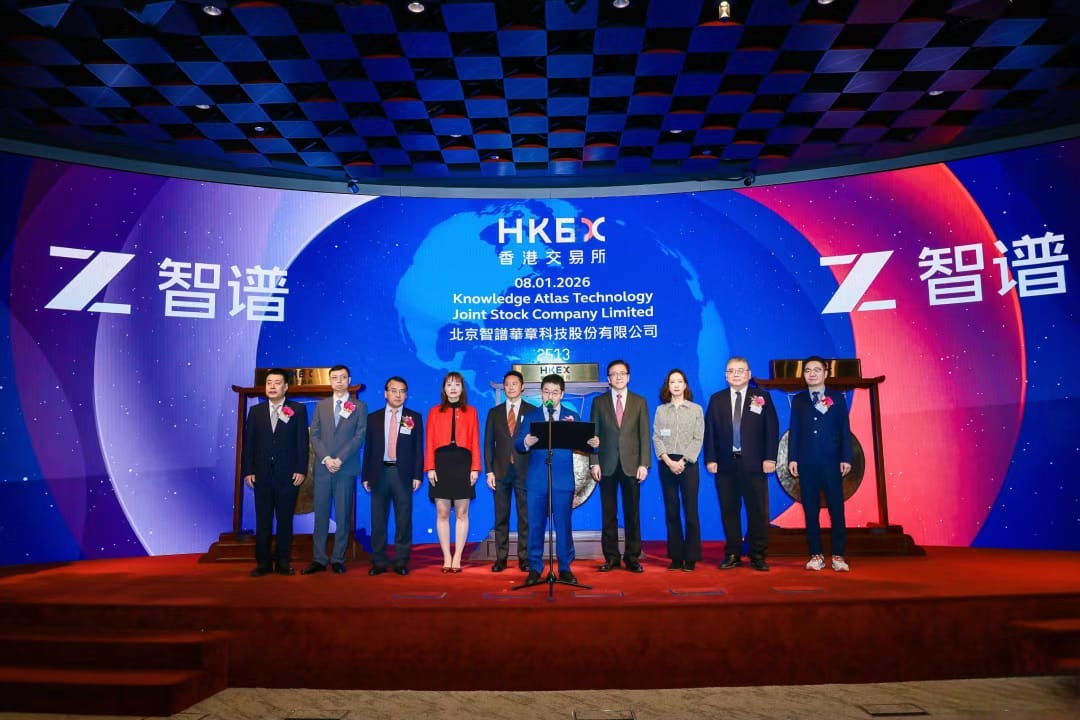
When ChatGPT launched in November 2022, China’s large-model landscape was still shaped by the pre-ChatGPT race for ever-larger parameter counts. Models such as Baidu’s ERNIE Titan, Huawei’s PanGu and Alibaba’s M6 had demonstrated impressive scale, but few were open, externally validated or competitive in practice. The main exception was Tsinghua spinout Zhipu (智谱), later rebranded as Z.ai and now listed in Hong Kong as Knowledge Atlas (2513.HK). Its GLM-130B model, open-sourced three months before ChatGPT, became the first Chinese model Western evaluators rated at GPT-3 level. By then, however, the frontier had already moved to GPT-3.5, and ChatGPT reset expectations for what a large language model could do.
The reaction inside China’s AI community was immediate. Many had helped build China’s consumer internet leaders and were accustomed to competing at the technological frontier. Instead, they watched demonstrations of capabilities they could not reproduce, built on chips they could not buy and trained with budgets they could not raise.
The pessimism reflected the circumstances. China’s models and developer tools lagged, advanced AI chips were increasingly constrained by US export controls, capital remained cautious, and even optimists measured the gap in years rather than months.
By early 2023, that assessment had hardened into consensus. At a closed-door session hosted by technology investment firm Shixiang (拾象), whose meeting notes circulated widely in Chinese technology circles, participants broadly agreed that Chinese labs trailed the frontier by roughly two years on models. On chips, the conclusion was starker: the limiting factor was no longer technical capability but access. (In a sign of how much the landscape has changed: Shixiang, aspiring to be China’s Iconiq, became a DeepSeek investor in June.)
A frontier AI ecosystem requires more than a frontier model. It needs training-grade chips at cluster scale, the software stack to use them efficiently, models worth running, distribution, demand and capital. A weakness anywhere in the stack leaves the rest dependent on someone else’s technology.
June 2026 brought two developments that suggest that dependence has changed. One drew global attention: Z.ai released GLM-5.2, the first Chinese model to genuinely approach the top tier of global benchmarks. The other received far less notice outside China: Meituan, better known internationally for food delivery, disclosed that it had trained a 1.6 trillion-parameter model entirely on roughly 50,000 domestic AI accelerator cards.
Individually, one was a model release and the other an engineering milestone. Together, they suggest China now possesses the essential components needed to train and deploy frontier large language models on a largely domestic technology stack. US export controls continue to matter across much of the semiconductor industry, but they may no longer prevent the training of state-of-the-art Chinese foundation models.
Z.ai / Zhipu: Twenty Years in the Making
Few realize that Z.ai’s story begins long before the generative AI boom. The company was founded in 2019 as a commercial spinout from Tsinghua University’s Knowledge Engineering Group (KEG), a research lab established in 1996. Its founders, professors Tang Jie and Li Juanzi, spent decades building the lab before launching the company. Much of the team behind successive GLM models, including researchers such as Dong Yuxiao and Du Zhengxiao, also came through KEG. Our own China AI Atlas appropriately describes the company as an “Academic-to-Enterprise Pipeline,” a label reflected in the progression of its models: GLM-130B, ChatGLM, GLM-4 and now GLM-5.2.
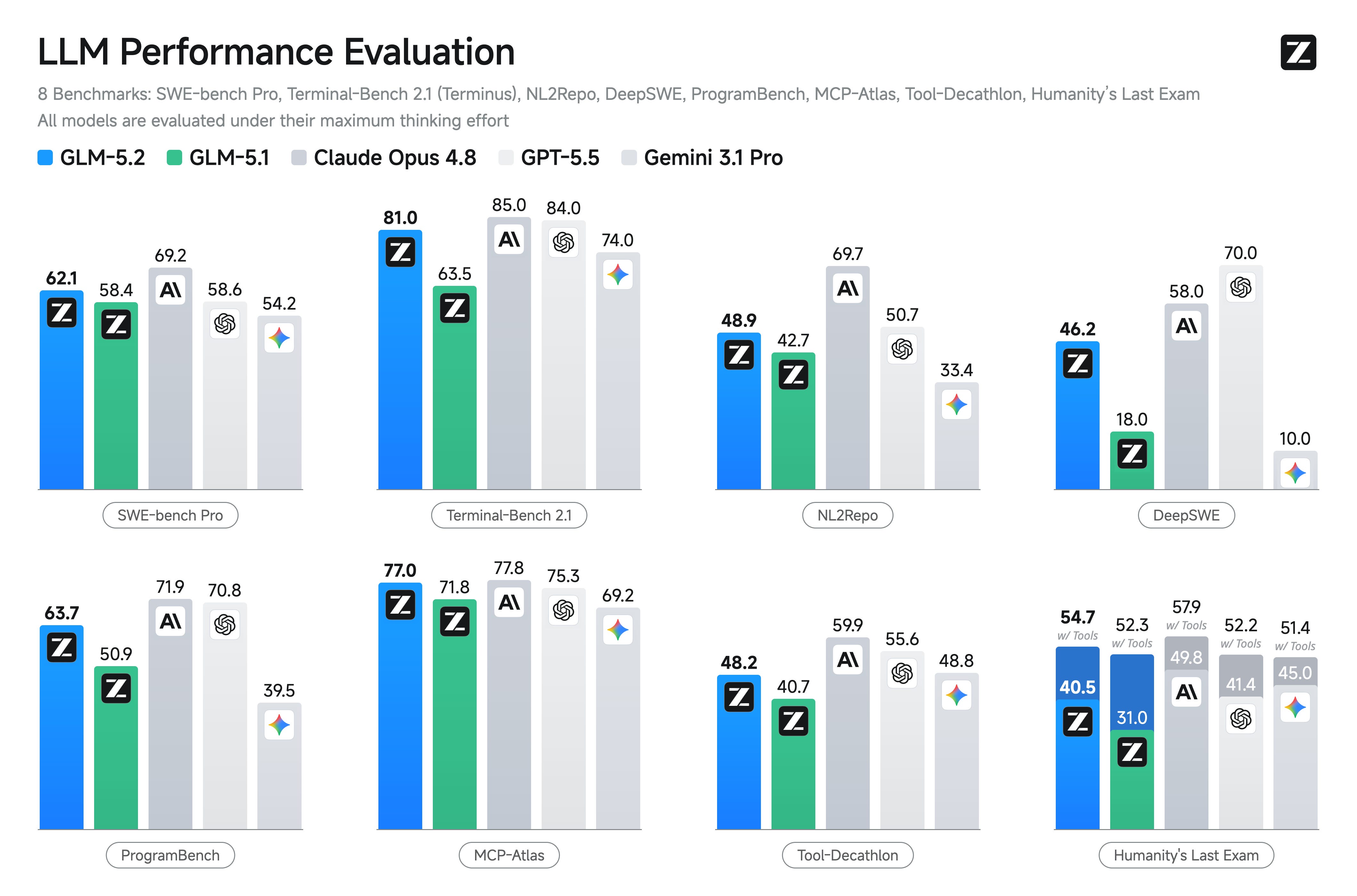
The latest release is notable on its own merits. GLM-5.2 is a 753 billion-parameter open-weight model released under the MIT license. It supports a one-million-token context window and up to 128,000 output tokens. Achieving that context length required a sparse-attention architecture called IndexShare, which reuses attention indices across every four layers and reduces per-token computation by roughly 2.9 times at full context. The company also trained the model on long-horizon agent trajectories using the full one-million-token window, rather than simply extending the context limit. In practice, that allows the model to process an entire code repository in a single pass and reason across large-scale migrations, framework upgrades and refactoring tasks. On the FrontierSWE benchmark for agentic software engineering, it trails Anthropic’s Opus 4.8 by roughly one percentage point while outperforming OpenAI’s flagship model.
The timing also worked in Z.ai’s favor. On June 12, Anthropic’s Fable models went offline following a US government export-control order that was broad enough to restrict access even for some of Anthropic’s employees outside the US. GLM-5.2 was released the following day, capturing developer attention as the industry searched for alternatives and reran benchmarks. Whether the launch date was accelerated or simply coincidental is unclear. We do know that by the time Fable returned on July 1, much of the discussion had already shifted. When Meituan disclosed its domestic-chip training run, attention had already moved back to Anthropic, a timing that likely contributed to the announcement receiving much less coverage than we would have expected.
Z.ai’s growing confidence has become increasingly visible. After Elon Musk posted that a Chinese rival to Fable 5 would arrive “probably Q1,” Z.ai co-founder Tang Jie replied: “Won’t take that long.” Musk’s broader point may prove more durable than the exchange itself though: benchmark performance can converge, but commercial success is determined elsewhere. As he put it, usefulness “doesn’t show up on leaderboards; it definitely shows up in revenue.”
But what distinguishes this cycle from previous episodes of “Chinese model” hype is adoption. Western companies are beginning to deploy Chinese open-weight models in production. Brian Armstrong said on X that Coinbase now runs GLM-5.2 and Kimi in production, cutting nearly half of its AI spending even as token consumption increased. Shopify and Airbnb have both discussed building on Alibaba’s Qwen models. Microsoft is evaluating a fine-tuned DeepSeek V4 as a lower-cost engine for Copilot Cowork, even as it directed its Windows and Office organization to stop using Claude Code by the end of June. At Uber, the C-suite described a similar dynamic: the company’s roughly 5,000 engineers adopted Claude so rapidly that its 2026 AI budget was exhausted by April. At the same time, tighter US restrictions on frontier-model access have made alternative models more attractive than they would have been a year earlier.
Z.ai has also begun translating technical momentum into commercial results. At the end of last year, its GLM Coding Plan had a relatively modest 242,000 paying developers. But by the end of March, Z.ai reported API and open platform annualized recurring revenue of roughly $250 million, while first-quarter API call volume rose 400% despite an API price increase of about 83%. The company also raised Coding Plan prices by roughly 30% for new subscribers in February, eliminating first-purchase discounts, and increased international pricing again in April. Sustained price increases alongside rapid usage growth suggest demand has remained resilient.
Meituan: The Company Nobody Expected
Outside China, Meituan is best known for food delivery. Inside the country’s technology industry, founder Wang Xing has long been regarded as one of its most intellectually curious entrepreneurs, with a habit of studying frontier technologies well before they become mainstream. Over the past several years, Meituan has quietly invested across the AI stack, backing companies in foundation models, embodied intelligence, AI chips and infrastructure while expanding its own research efforts.
Those ambitions became public in early 2023 when Meituan co-founder Wang Huiwen took $50mm of his own money to launch Light Years Beyond (光年之外), an effort widely described as an attempt to build an “OpenAI for China.” Wang Xing invested in the startup and joined its board. Just months later, Wang Huiwen stepped away after being hospitalized for depression, and Meituan acquired the company. The acquisition brought additional AI talent into Meituan as the company accelerated its own large-model efforts.
For months, a mystery model known as “Owl Alpha” ranked among OpenRouter’s most-used models, placing first, second and third, respectively, by call volume on the agent frameworks Hermes, Claude Code and OpenClaw. Developers speculated about the identity of the lab behind it. The answer, revealed at the end of June, was Meituan.
The timing made the achievement more striking. Over the past year, China’s three largest food-delivery platforms spent roughly RMB200 billion (about $28 billion) on subsidies, pushing Meituan from a RMB35.8 billion (about $5.0 billion) profit to a RMB23.4 billion (about $3.3 billion) net loss. Yet research-and-development spending still rose 23.5% in 2025 to RMB26.0 billion ($3.6 billion), which the company attributed to increased AI investment. The annual report makes no mention of what appears to be the largest publicly disclosed training run on domestic AI accelerators, which — because Meituan operates no self-built data centers — was likely conducted on leased infrastructure.
Rewind to 2023. Inside Meituan’s LongCat lab, which we label as “Local-Services Dispatch” in our Atlas, the idea of training a frontier model entirely on domestic AI hardware began as an unconventional bet. The prevailing view was that Chinese AI accelerators were suitable for inference but not for training large language models. The LongCat team disagreed. “Training a large language model isn’t some kind of black magic, nor is it a black box,” one person familiar with the project told Zhidongxi. “It’s simply an extremely complex systems engineering problem.”
In July 2023, the team began adapting its training stack to domestic hardware, holding weekly engineering meetings with the chip vendor. By September, it had assembled a dedicated validation team to work through the software stack operator by operator.
The engineering challenges help explain why few others attempted it. When the team first brought up a 10,000-card cluster, the scheduler failed before training even began because the job’s memory footprint exceeded the maximum value an integer could represent. As the cluster expanded to tens of thousands of accelerators, the team encountered random bit flips—not hardware defects, but statistical events that become routine at sufficient scale. A deterministic implementation of one attention operator initially ran between 20 and 70 times slower than the standard version, forcing the team to redesign it.
Around the 2024 Lunar New Year, the team’s first end-to-end training run succeeded. “We had already verified in 2024 that domestic AI compute was fully viable for frontier-model training,” a former team member said. “It’s only today that we’re stating that conclusion explicitly.”
In retrospect, there were hints before the formal announcement. The technical report accompanying LongCat’s smaller model, released in mid-2025, consistently referred to “accelerators” rather than GPUs—a vendor-neutral choice that attracted little attention at the time but now appears to have foreshadowed the team’s transition to domestic hardware. Even so, the prevailing view changed little. As late as May 2026, just weeks before Meituan’s disclosure, a DeepSeek product manager speaking at an HSBC event told investors that domestic AI chips were being used for training only in “selected small experimental settings.”
Meituan’s June announcement challenged that assumption directly. The company disclosed that LongCat-2.0, a 1.6 trillion-parameter mixture-of-experts model, had completed both training and inference entirely on domestic AI hardware, making it the first publicly disclosed trillion-parameter-class model to do so without Nvidia GPUs. The result was not merely a proof of concept. On SWE-bench Pro, LongCat-2.0 scored 59.5, trailing only Anthropic’s two Claude flagship models while outperforming Google’s Gemini 3.1 Pro. The team also reported more than a 50% improvement in hardware utilization through its ScMoE architecture and Zero-Bubble pipeline scheduling, gains that materially improve the economics of large-scale training.
Two details are worth noting. Meituan and the original Zhidongxi report (which we translated here) did not identify the hardware vendor, although the cluster is widely believed to have been built on Huawei’s Ascend platform. Multiple independent voices believe the system consisted of roughly 50,000 Huawei Ascend 910C processors supported by a domestic supply chain that included SMIC for logic manufacturing, CXMT for memory (we wrote about the company last week!) and Huawei’s CloudMatrix architecture. CloudMatrix integrates 384 processors into a single pod, using system-level design to offset the lower performance of individual chips.

The second finding surprised even the engineers. “People naturally assume domestic AI hardware has larger numerical errors, but our measurements showed exactly the opposite,” one team member said. If confirmed more broadly, the result would suggest that some long-held assumptions about domestic AI hardware deserve to be revisited.
The Layer Beneath the Chips
Meituan is not alone in training frontier models on domestic AI hardware. Huawei has long trained its flagship Pangu models on Ascend chips. According to the company’s technical papers, the 718 billion-parameter Pangu Ultra MoE was trained on a cluster of roughly 6,000 Ascend NPUs, extending a lineage that began with PanGu-α, which ran on 2,048 Ascend 910 processors in 2021. Baidu has also demonstrated domestic training. Reporting around the Hong Kong listing of its chip subsidiary indicates that a key version of ERNIE 5.1 was trained on a cluster of Kunlunxin P800 accelerators, the company’s in-house AI chip.