
China's Overlooked AI Model Makers: Xiaomi, Meituan, and StepFun
MiMo, LongCat, and StepFun are not trying to be China’s OpenAI. They are tests of a different AI business model.

Things You Might Have Missed
A few items from the past week worth having on your radar.
From our recent coverage:
Meituan’s delivery pressure is now showing up in the numbers. The renewed food-delivery fight with JD.com and Alibaba is not abstract anymore; the useful question is whether Meituan can defend order density while funding service and AI upgrades. Tweet
ByteDance and WeChat are already fighting over agent-era distribution. Doubao’s phone assistant and WeChat’s limits on agent-driven messaging show how quickly AI assistants become a control-point question. Tweet
MiniMax is exploring a STAR Board listing after its Hong Kong debut. Alongside Zhipu, that points to domestic institutional capital becoming part of the Chinese model-lab financing story. Tweet
From Weijin Research:
Chinese Token Export: A Vision, Not a Reality. A useful companion to this piece because it separates Chinese model usage on global routing platforms from where token production, infrastructure spending, and value capture actually sit. Read it here
Why These Three Are Easy To Miss
In last week’s Tech Buzz China piece, “Forget the Leaderboard: Mapping the Ten Business Systems Behind China’s AI”, we introduced the China AI Atlas as a living field guide to China’s foundation-model labs: the people, talent flows, investors, government backing, models, pricing, and parent-platform context behind them. This piece pulls on one part of that map: the model makers whose strategies are easiest to miss when the debate stays focused on the obvious labs.
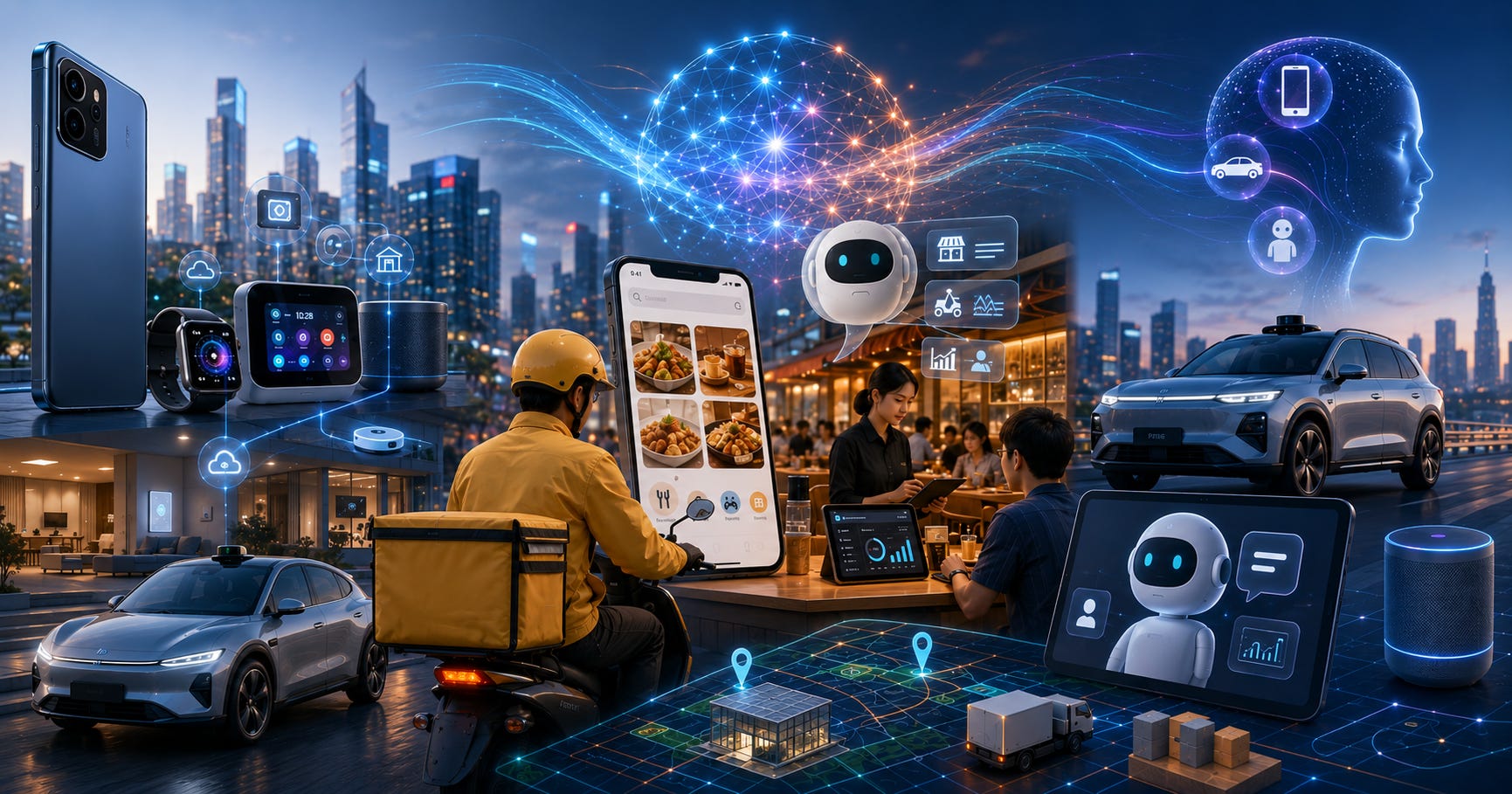
Xiaomi, Meituan, and StepFun are the awkward cases. Xiaomi’s MiMo is tied to phones, cars, HyperOS, IoT devices, and retail channels. Meituan’s LongCat and Xiaomei sit inside offline-service transactions, merchant operations, and a local-commerce machine that already has demand, supply, routing, payments, and service recovery data. StepFun still looks like a standalone lab, but its recent agent push is about phones, cars, and device partnerships rather than a pure API business.
Embedded AI is not unique to China. Apple is building Apple Intelligence into iPhone, iPad, Mac, and Apple Watch features. Tesla has put xAI’s Grok into vehicles. What is more pronounced in China is the combination of company strategy, hardware scale, offline-service density, and policy pressure. The State Council’s 2025 “AI Plus” guideline set a target for new-generation intelligent terminals and AI agents to exceed 70% penetration by 2027 and 90% by 2030.
For these companies, the useful numbers are device retention, merchant uptake, deployment volume, inference margin, and whether model work changes the economics of an existing product system. The public data is thinner there, which is why these companies are easier to miss.
Xiaomi: MiMo For Phones, Cars, And Home
Xiaomi’s AI work did not start with MiMo. The company set up its first visual AI team in 2016, had expanded its AI team to more than 3,000 people by August 2023, and formed a dedicated large-model team in April 2023. At the same 2023 update, Lei Jun said Xiaomi had already run a 1.3B-parameter model locally on a phone, XiaoAI had more than 110 million monthly active users, and Xiaomi planned more than RMB 100 billion in technology investment over five years. By May 2026, Lei Jun was also saying Xiaomi would invest RMB 60 billion in AI over the next three years.
In June 2026, Lu Weibing, Xiaomi’s partner and president, framed the reason for building MiMo from scratch as end-to-end mastery: without an in-house foundation model, Xiaomi cannot fully control the differentiated product experiences it wants to build at the OS and device level. That is a very Xiaomi answer. The company tends to enter categories where it believes hardware, software, supply chain, and brand can be combined into a consumer product. Phones were the original version of that playbook. EVs are the expensive new one. MiMo sits between them: less visible than a car launch, but potentially more important if it becomes part of how users interact with Xiaomi products.
The Luo Fuli hire gives a sense of how seriously Xiaomi is taking the model side. Luo, a former DeepSeek researcher described as one of the key developers of DeepSeek-V2, confirmed in November 2025 that she had joined the Xiaomi MiMo team. Chinese reports had linked the move to Lei Jun personally recruiting her with a compensation package in the RMB 10 million range, and later coverage noted that Luo had already appeared as a corresponding author on a Xiaomi-Peking University paper in October 2025. Xiaomi is not suddenly a frontier lab, but it is paying for model talent, not just branding a device feature as AI.
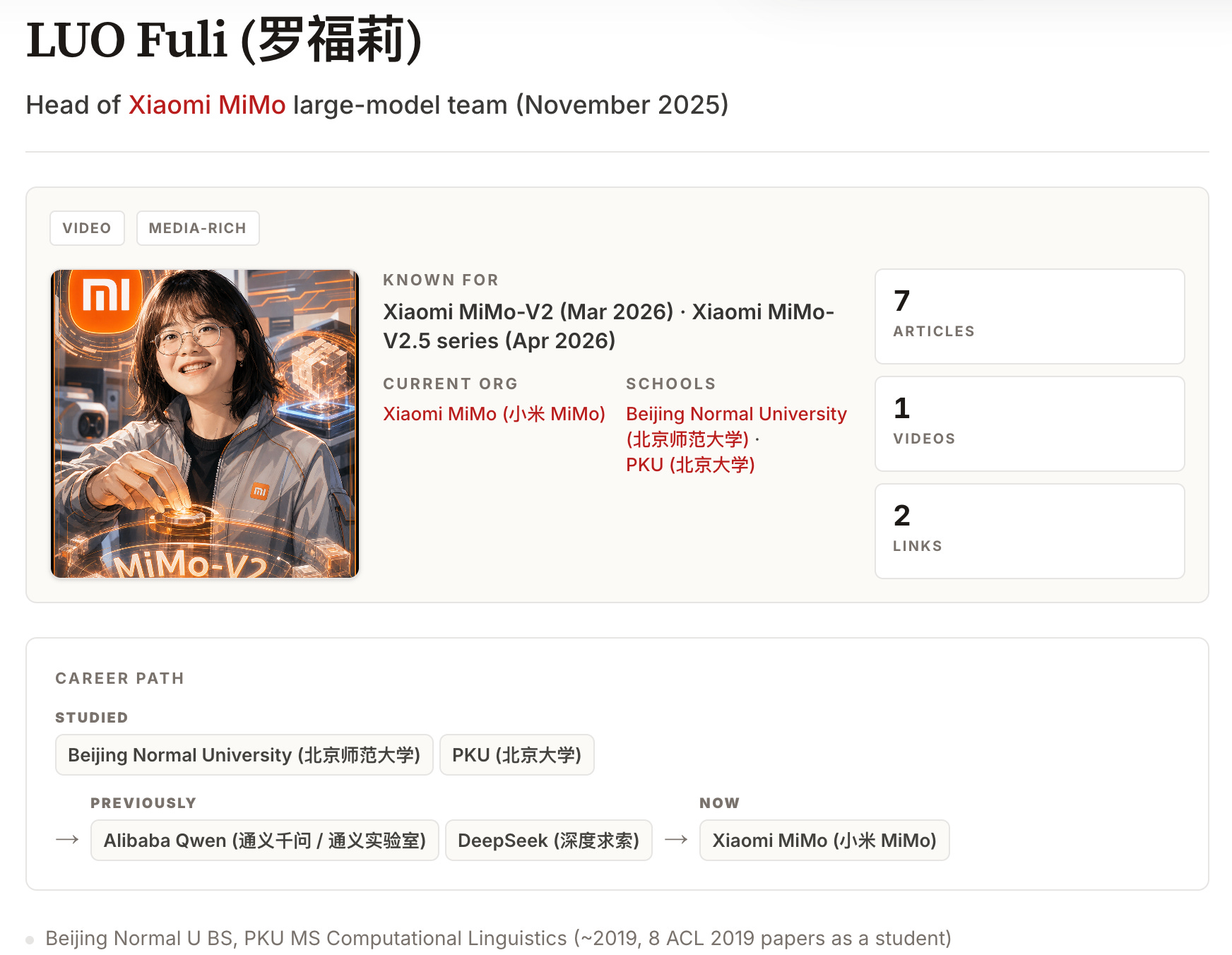
MiMo does not have to become a standalone API business. It has to make Xiaomi’s devices more valuable.
On May 27, 2026, Xiaomi said MiMo-V2.5 series API pricing would be permanently cut by as much as 99%, another Chinese model company announcing a permanent API price cut after DeepSeek. For MiMo-V2.5-Pro, the new domestic price was RMB 3 per million uncached input tokens and RMB 6 per million output tokens, with cache-hit input priced at just RMB 0.025 per million tokens. The overseas price was $0.435 per million uncached input tokens and $0.87 per million output tokens. Chinese AI coverage framed the new table as bringing MiMo pricing back down to DeepSeek-level competition.
The developer seeding came first. Xiaomi launched the MiMo Orbit 100T Token plan to give developers a large pool of free MiMo usage, and by mid-May 2026 it had distributed nearly 80 trillion tokens toward a 100 trillion-token target in 30 days. During that push, MiMo ranked first in OpenRouter model call volume. MiMo-V2.5-Pro was also reported in early June 2026 to have reached the top five globally on Artificial Analysis and ranked first among open-source models.
Xiaomi has earned some benefit of the doubt on product execution. In 2025, the company shipped 165.2 million smartphones, delivered 411,082 EVs, and had 1.079 billion connected IoT devices on its AIoT platform, excluding smartphones, tablets, and laptops. It also had 22.7 million users with five or more connected IoT devices. That does not prove MiMo economics, but it does show why Xiaomi can think about models differently from a lab selling API calls.
What Xiaomi has not disclosed is MiMo standalone ARR, paid API retention, device-level active usage, or any model-specific contribution to service revenue. Its broader financials show rising AI and EV investment, but those numbers cover several programs at once and cannot be cleanly attributed to MiMo. The answer will have to come from device behavior and service economics.
Meituan: LongCat Inside Local Commerce
Meituan’s AI strategy is easier to misread because most of it is not meant to be visible.
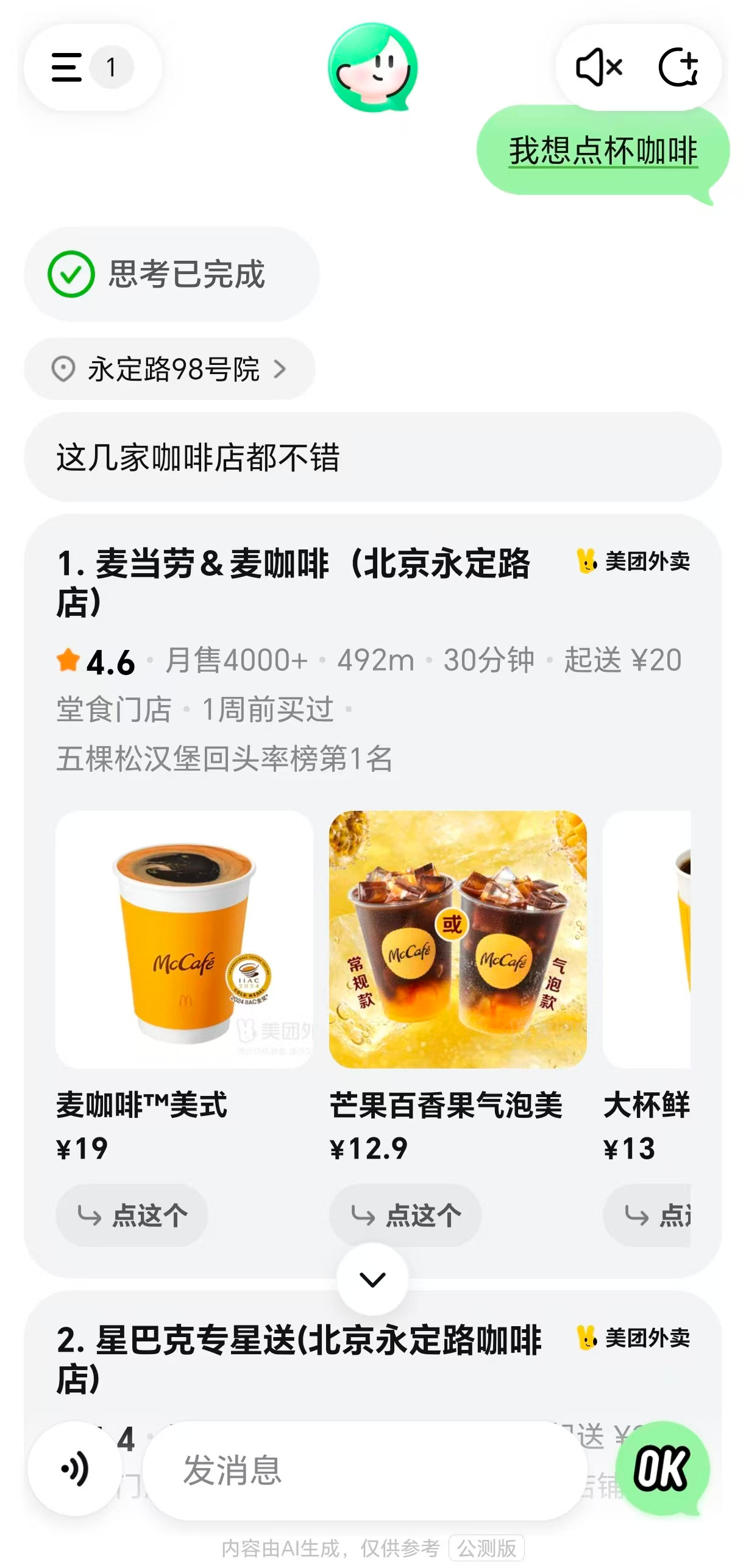
The company acquired Light Years Beyond, the large-model startup founded by Meituan co-founder Wang Huiwen, in June 2023 for $233.7 million in cash while also taking on about $50.7 million of debt. By September 2025, LongCat-Flash-Chat had been released as a 560B-parameter MoE model that activates roughly 18.6B to 31.3B parameters per token, about 27B on average, with 128K context and a claimed 100-plus tokens per second on H800 GPUs. Xiaomei followed that same month as Meituan’s first AI agent app, powered by LongCat, meant to let users order meals by voice, book restaurants, and get food recommendations.
Xiaomei is the standalone consumer agent. Ask Xiaotuan is the AI search and assistant function inside the Meituan app, meant to answer local-service questions and help users move from search to recommendations, price comparison, and order placement. In its Q3 2025 materials, Meituan said LongCat had been integrated with “trillions” of food-service industry data points to roll out AI tools for restaurant merchants, while Xiaomei and Ask Xiaotuan covered scenarios including dining, accommodation, transportation, travel, entertainment, shopping, search, price comparison, and order placement. A separate October 2025 report described merchant-facing assistants for restaurant opening, delivery operations, store management, and front-desk service, all using LongCat-Flash-Chat as the common base. The same report put Meituan’s cumulative AI investment at the RMB 10 billion level, which makes LongCat look less like a demo layer and more like a core infrastructure bet inside the local-commerce system.
Meituan maintained roughly 70% of China’s food delivery market as of June 2025, even as JD.com and Alibaba’s Ele.me intensified competition. JD entered food delivery aggressively in early 2025, and later reports said JD had already gained meaningful share and was targeting more than 30% in 2026. Even allowing for that pressure, Meituan still operates one of China’s densest offline-service networks. That gives it data a pure model lab does not have.
A recent Chinese analysis described Meituan’s offline interactions as producing “unique, non-simulatable“ real-world operational data: merchant inventory changes, rider routing, demand peaks, local service failures, and transaction context that cannot be scraped from the open internet. Meituan sees patterns that a general-purpose model provider does not see unless Meituan exposes them.
The missing evidence is operating conversion: LongCat-linked merchant uptake, Xiaomei active usage, or measurable savings in customer service and dispatch. Those are the numbers that would show whether model deployment is moving take rates, order density, merchant retention, or rider efficiency.
Wang Xing has historically been willing to run ugly, operationally dense businesses if they create durable transaction infrastructure. Food delivery required subsidies, routing, merchant acquisition, rider management, and a tolerance for thin economics. Meituan’s warehouse and instant-retail buildout fits the same pattern. Warehouses, delivery robots, and routing optimization are related background, not evidence of LongCat economics.
Meituan has also been writing checks across the AI stack, including investments in Zhipu, Moonshot, Unitree, Moore Threads, and other AI and robotics-related players; Meituan Longzhu, also translated as DragonBall Capital and essentially Meituan’s corporate venture arm, reportedly led Moonshot’s roughly $2 billion Series D. That gives Meituan broad exposure. The more interesting LongCat question sits inside Meituan’s own products. A closer comparison may be ByteDance, where much of the AI value comes from improving internal products and infrastructure rather than selling a generic model to the outside world. If LongCat works, the payoff may be less visible model revenue and more mundane improvements in search, merchant tools, service recovery, and ad conversion.