
Forget the Leaderboard: Mapping the Ten Business Systems Behind China's AI
Introducing the China AI Atlas, a free, interactive field guide to the ten labs that actually matter: the people and talent flows behind them, the money, and head-to-head model matchups.

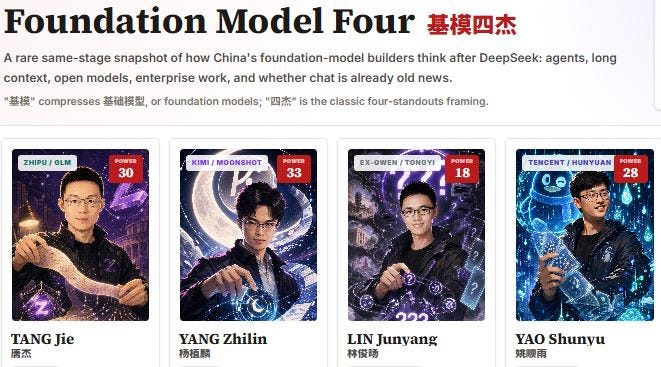
The China AI Atlas maps the people, money, models, and talent behind China’s AI labs, and it updates continuously: listed market caps refresh daily and model pricing is pulled live, so the site is always more current than this post. The deeper analysis in the second half is for paying subscribers.
Explore the Atlas free → ai.techbuzzchina.com
With thanks to AI Proem, for helping us refine the content, and to the China Research Collective, who did the PhD-cohort analysis built into the talent maps. They are collaborators, not sponsors; the Atlas is better for their input, and any errors that survived it are ours.
Things you might have missed
A quick roundup before you dive in. Here is what mattered most this week in China AI:
From our recent coverage:
ByteDance’s $70B capex signals a new infrastructure phase. Per Bloomberg, ByteDance is discussing up to $70 billion this year on data centers and chips, the scale at which platform giants stop renting compute and start owning it.
DeepSeek’s 75% price cut unbundles AI from Nvidia’s memory. Effective June 1, V4 Pro drops to $0.35 per million input tokens. The point is less deflation than using price to validate Chinese chips and storage at scale.
Partner read, from Weijin Research: An AI Boom Fit To Crack Vertical Integration, a sharp look at who integrates vertically and who gets unbundled.
Where we have been featured:
Rest of World, May 2026: “China’s tech rise is creating a new kind of tourism”
Wired, May 2026: “The $6 Billion Chinese Startup Trying to Build Hands for Every Robot”
What we’ve built
We have spent the past year mapping China’s AI from several angles. We profiled DeepSeek’s playbook for rewriting the rules of the AI game in March 2025, tracked the state of China’s consumer AI apps in October 2025 (where the contest is won on apps, distribution, and product, not on which model sits underneath), and asked why China’s chip strategy matters more than any single model release in January 2026.
The Atlas is not the next essay in that series. It is a different kind of thing: a data-driven, open, interactive tool, the first of several we have in the pipeline. We will keep building these out to provide ongoing, navigable analysis rather than one-off pieces. This post is the guided tour.
What this is, and why we built it
The China AI Atlas is an interactive field guide to the labs building China’s foundation models: the people, the models, the money, the talent flows, the universities, and the government anchors behind them. It is free to explore.
It tracks ten active frontier labs, plus two that have already pivoted out of frontier work. We built it because the English-language conversation about Chinese AI tends to circle the same few headlines while paying less attention to the structure underneath: who these researchers actually are, where they trained, who funds whom, what the models cost to run, and which of these companies are even competing with one another.
Three things you can do inside it right now:
Browse the researchers and trace individual careers, school to lab to lab.
Compare the labs side by side: investors, government backing, models, and live pricing.
Follow the money, the overlapping cap tables behind almost all of it.
Each lab also carries a one-line “faction,” our shorthand for how it actually operates. Here is the field at a glance. (Pricing across the Atlas is OpenRouter listed pricing; native first-party pricing in China can differ.)
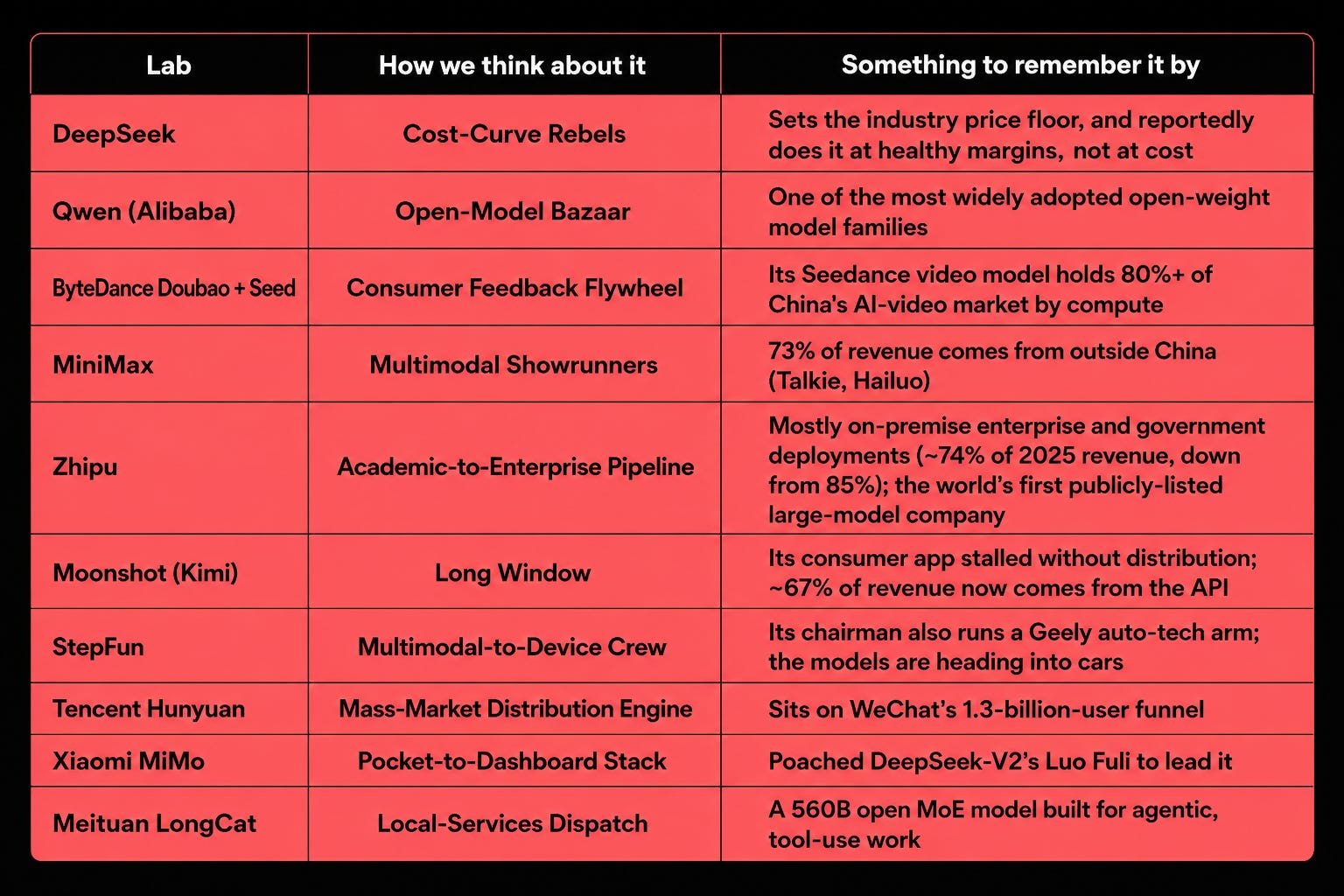
Click to know more: DeepSeek | Qwen | ByteDance | MiniMax | Zhipu | Moonshot | StepFun | Tencent | Xiaomi | Meituan
Ten key takeaways
These are not a data dump. They are patterns we found by analyzing the tracked dataset, a sample of the kind of insight we will keep mining and publishing as the Atlas grows.
27 Tsinghua connections. Tsinghua has more researcher links than the next three schools combined.
MSRA is the top Western link. Microsoft Research Asia (MSRA) appears in more China foundation-model leadership paths than any other Western lab.
The Yao Class shows up everywhere. Tsinghua’s elite IIIS “Yao Class” CS track recurs across StepFun, Tencent, Meta’s MSL, and related leadership paths.
Beijing: 7 labs, 5 still active. Beijing remains the densest cluster, even after 01.AI and Baichuan left the general frontier race.
One founder with no Western lineage. DeepSeek’s Liang Wenfeng (梁文锋) is the rare top-lab founder with no tracked US or Western-lab stop.
3 single-source founding teams. Baichuan, MiniMax, and StepFun each show tight founding links to a single prior employer.
Meta MSL hired 7 of 11 from Chinese-origin researchers. Its first public hires drew heavily from OpenAI, Apple, DeepMind, and Anthropic alumni of Chinese origin.
Alibaba has the widest investor footprint. It backed five tracked labs and later absorbed 01.AI’s model and infrastructure teams.
5+ senior US-lab returns in 2025-26. Visible senior returns from Google DeepMind, OpenAI, Microsoft, and MSRA-linked paths.
2 of 12 have already exited the frontier. 01.AI moved into Alibaba’s orbit; Baichuan pivoted to healthcare. The active field is smaller than the headline count.
Several of these recur in the analysis below, particularly the talent concentration in takeaways 1 through 3 and the two frontier exits in takeaway 10.
Using the Atlas: the graphs
The most-used parts of the Atlas grew out of questions readers sent us. Two are worth a walk-through.
The first is the talent-flow graph, which maps where each researcher studied, the labs they passed through, and where they sit now. The dominant pattern is concentration. About 63% of the tracked researchers carry a China-school signal, and DeepSeek’s core research bench is entirely China-educated. The foreign influence is also narrower than the “returnee” framing suggests: the single largest overseas thread runs through Microsoft Research Asia (MSRA), which is itself a Beijing lab staffed largely by Chinese researchers. Talent does move between labs, DeepSeek alumni now lead work at ByteDance’s Seed team and Xiaomi’s MiMo, for example, but the pool they circulate within is overwhelmingly home-grown. China’s depth in AI talent is real, and it is mostly domestic.
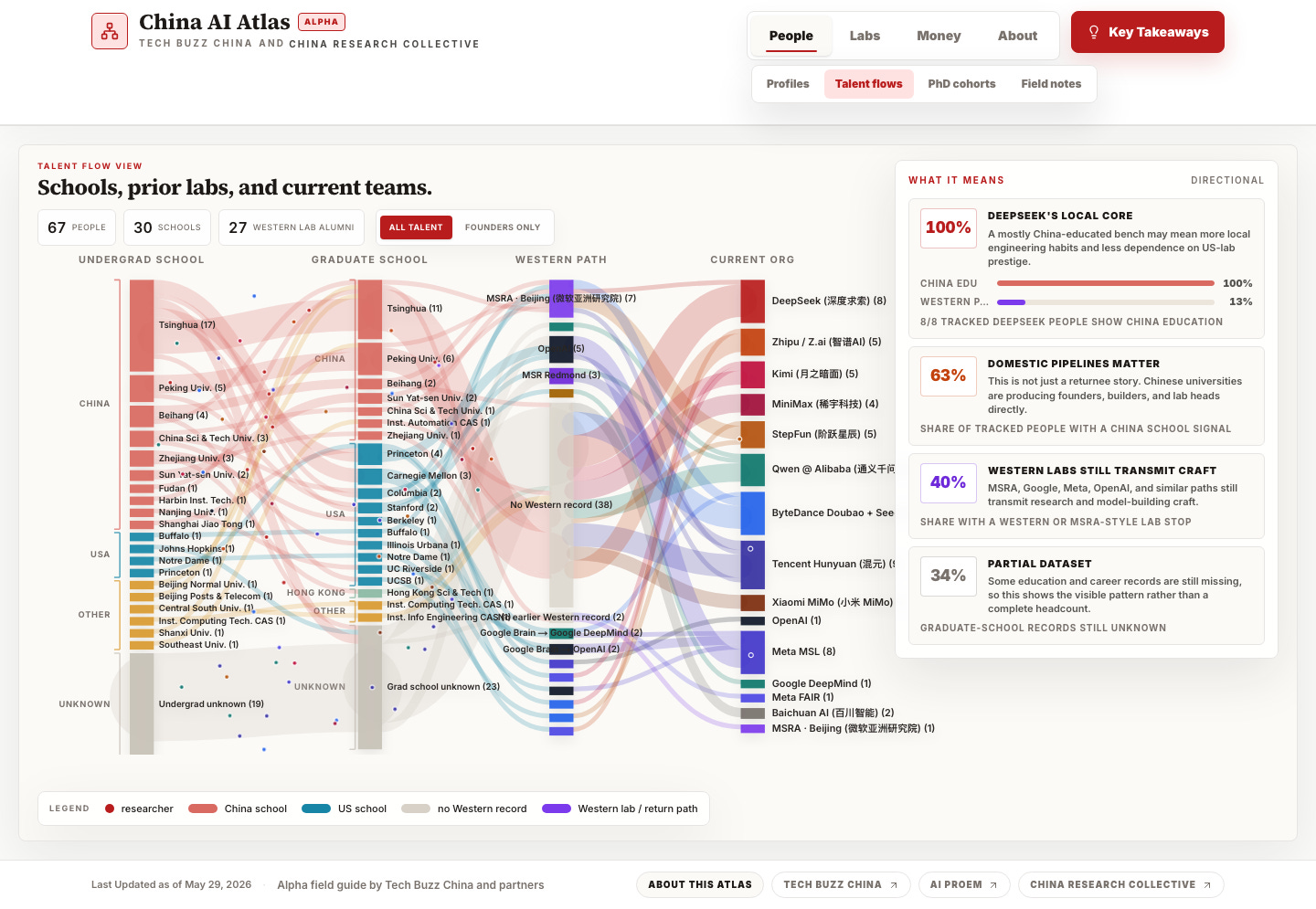
Every tracked researcher's path from school to prior labs to current team. About 63% carry a China-school signal, and the top foreign thread, MSRA, is itself a Beijing lab. Explore it live.
The second graph, the PhD-cohort analysis built with the China Research Collective, picks up exactly there. It addresses a question the brain-drain narrative tends to get backwards: how long before China-trained AI PhDs come home. The domestic pipeline has grown roughly 7.9x since 2015, with about 605 China-trained PhDs in the 2025 cohort alone. Domestic retention sits near 79%, and returns from abroad arrive on a delayed 7-to-10-year clock, so a low return rate among recent overseas cohorts reflects careers still in progress rather than people choosing to stay away. Read together, the two graphs describe circulation within a largely self-sustaining domestic system.
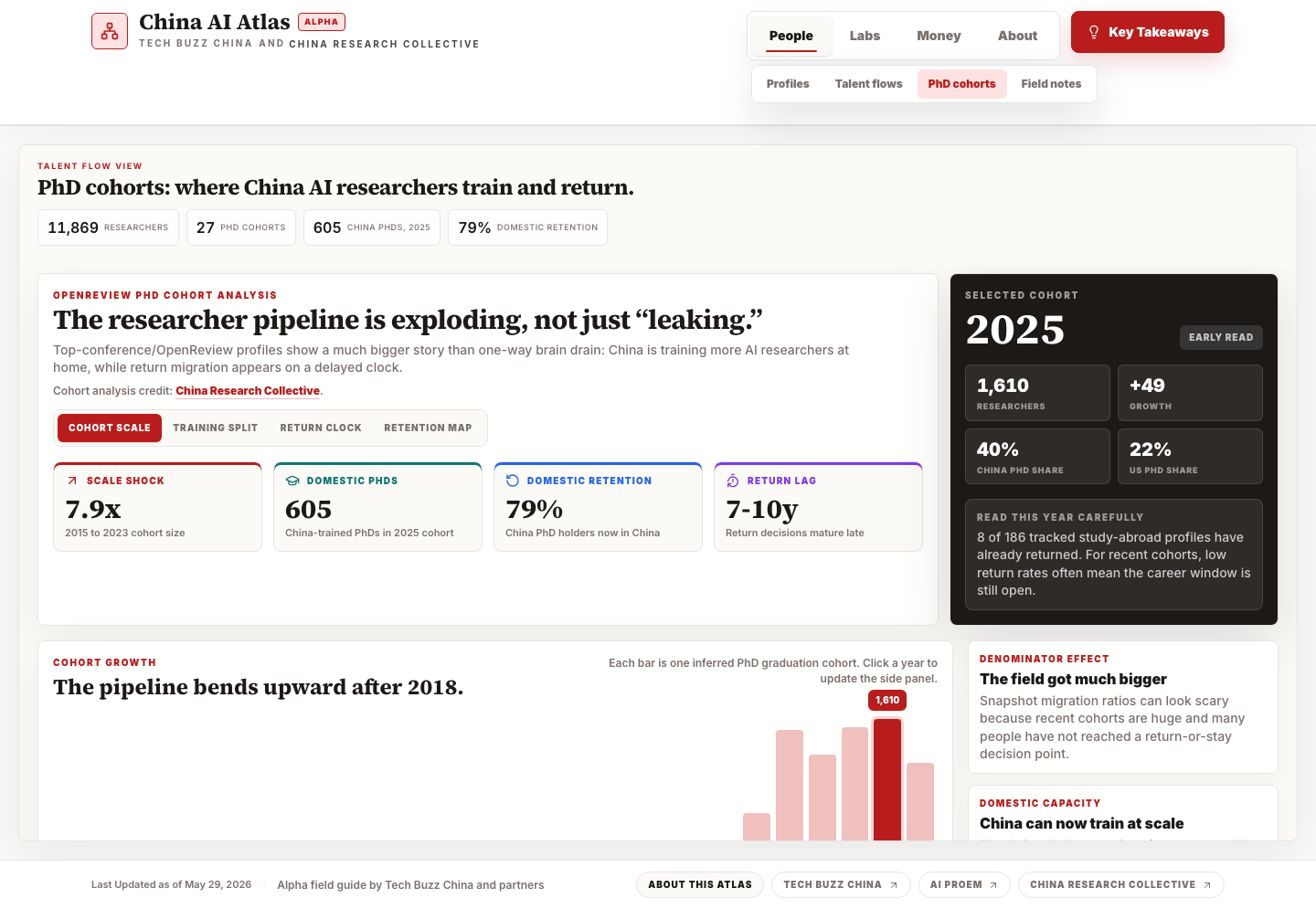
Built with the China Research Collective: how long before Chinese AI PhDs come home. The domestic pipeline is up ~7.9x since 2015, ~79% stay in China, and overseas returns run on a delayed 7-to-10-year clock. Explore it live.
Using the Atlas: the profiles
Behind the graphs sit the profiles, and they are where most of the source work lives.
Each researcher profile collects a person’s career path (school to lab to lab), their degrees, the work they are known for, interviews and media, and links back into the talent graphs. Below is the profile for DeepSeek’s founder, Liang Wenfeng (梁文锋): his route from Zhejiang University through the quant fund High-Flyer (幻方量化) to DeepSeek, the models he led, and a “in their words” section that quotes him directly, with the source for each line. We also had some fun with these. The people building China’s models are names you will be hearing for years, so we gave each one a totem, a character card, and a short, memorable handle. The aim was a directory you actually enjoy browsing, not a spreadsheet of strangers.
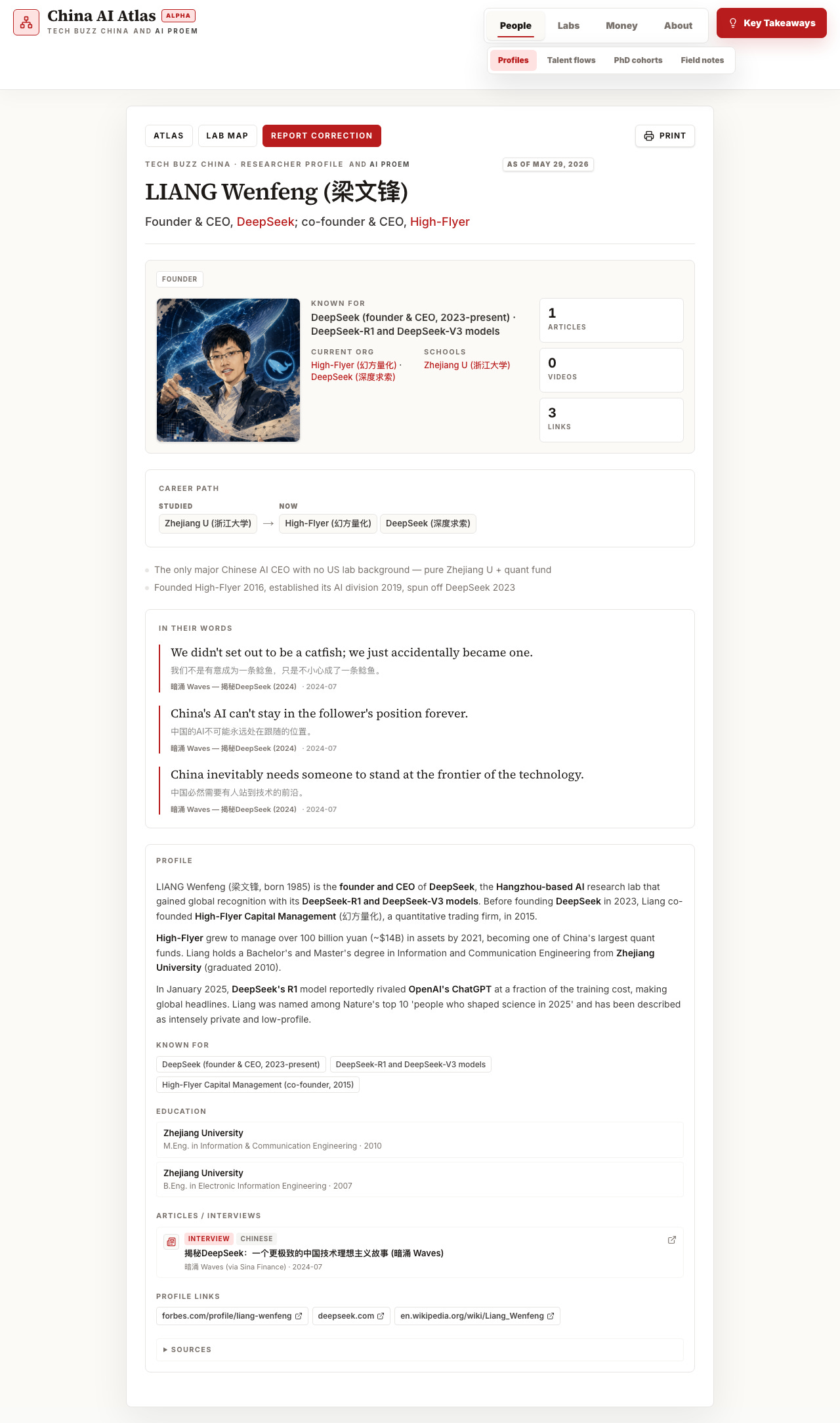
Career path, degrees, notable work, quoted remarks with sources, and media, all linked back into the talent graphs. This is DeepSeek's founder, Liang Wenfeng (梁文锋). See it live.
Each lab profile does the same for an institution: what it is known for, founders and key people, investors, government backing, the models it has shipped, live API pricing, and a running news feed. Here is DeepSeek's.
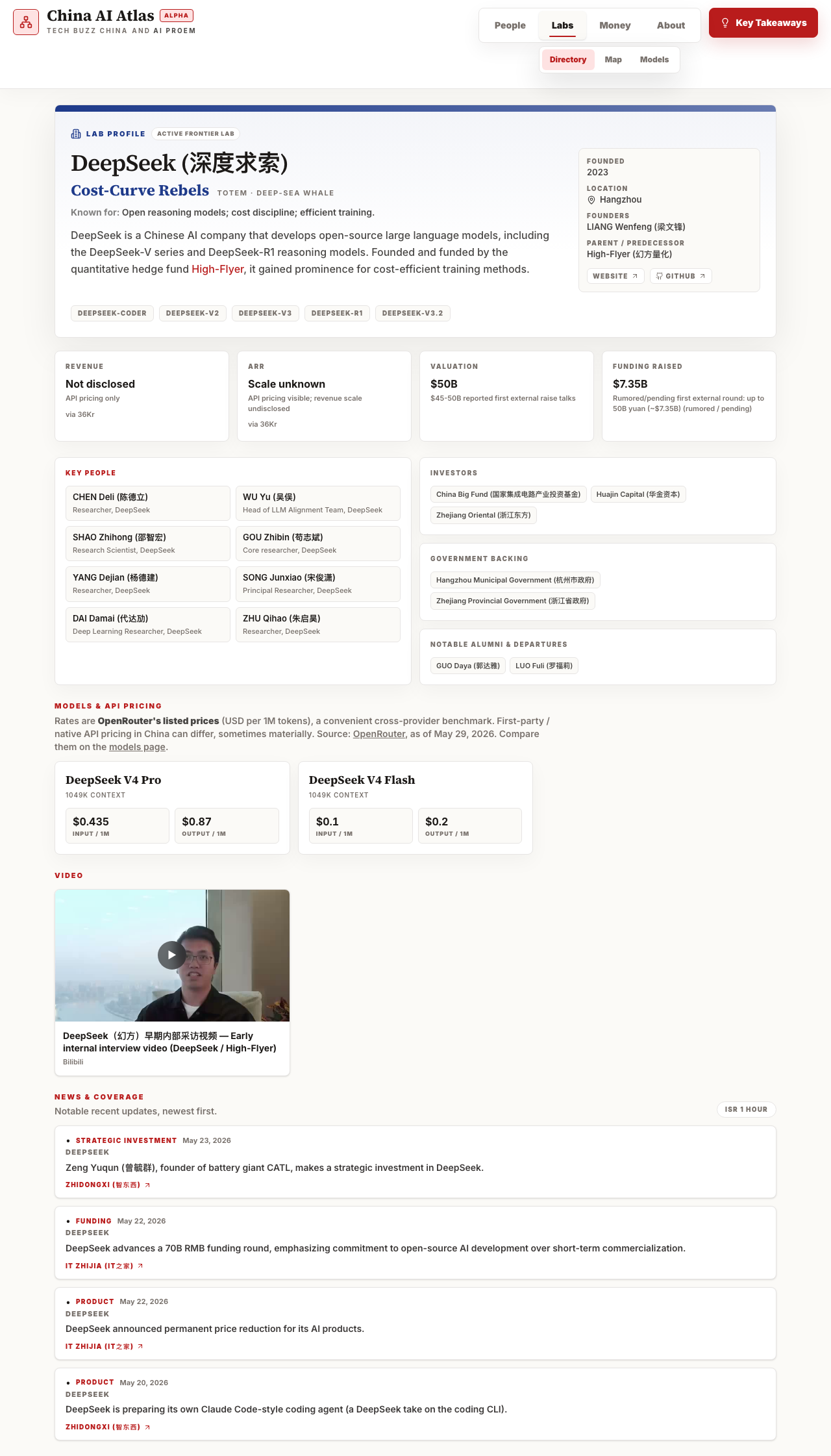
Known-for, founders and key people, investors, government backing, models, live API pricing, and recent news, on one page. See DeepSeek's live.
What’s next
The Atlas is a living dataset, and we want it both accurate and useful. Send us corrections, errata, and the questions you want us to dig into next (you will find ways to reach us across the site and the Atlas). Both talent graphs above started as reader questions, and we would rather build the analyses and tools you actually want.
Forget the leaderboard
We did not build the Atlas to argue a thesis; we built it to see what the data would show. Here is what it taught us.
Start with a scene from late April. On the 24th, DeepSeek released a preview of its V4 model, and within hours the shares of Zhipu and MiniMax, the two newly-listed Chinese AI companies, fell about 9% on a day the Hang Seng index rose. The read in the market was that a single model launch had reset the competitive order.
We would interpret it differently, and so did some analysts. J.P. Morgan called the sell-off an overreaction and described V4 as a sector tailwind rather than a zero-sum shock: the release showed that Huawei’s Ascend chips can serve a frontier-scale model, easing a compute constraint every Chinese lab shares. V4 itself landed only fourteenth on the Code Arena benchmark, behind Zhipu’s GLM-5.1, Moonshot’s Kimi K2.6, and Alibaba’s Qwen3.6 Plus. On a capability ranking that reads as a stumble; in business terms it widened the runway for everyone.
That gap, between what a benchmark score says and what it means commercially, is why the Atlas is organized around five structural questions rather than a scoreboard: distribution, commercialization, compute, talent, and parent-platform context. The benchmark is one input to a business. These five describe the business. We will take the first here and the rest below.
Axis 1: distribution, own the pipe or rent it
The cleanest split among the ten is between labs that own their distribution and labs that rent it. The platform-embedded group (Qwen, Seed/Doubao, Hunyuan, MiMo, LongCat) ships through apps that hundreds of millions of people already open daily. The stand-alone group (DeepSeek, Zhipu, MiniMax, Moonshot, StepFun) has to build an audience from scratch, win enterprise buyers one at a time, or route its tokens through someone else’s cloud at someone else’s margin.
ByteDance illustrates the advantage. Its Seedance 2.0 video model holds over 80% of China’s AI-video market by daily compute, against roughly 14% for Kuaishou’s Kling and 4% for Alibaba’s Wanxiang. A creator never makes an abstract API call; the output renders inside CapCut, the editor already on their phone, then publishes to Douyin, feeding back usage data no stand-alone lab can match. As Director AI’s Ben Chiang put it, US video models “don’t perform well enough,” so he uses Kling, Seedance, and Hailuo instead.
The constraint shows up at the edges. When ByteDance’s own Doubao agent tried to act across WeChat, Taobao, and Alipay, all three restricted it. An agent without system-level access, as one analyst put it, ends up “running inside someone else’s ecosystem.” For a lab that owns neither an operating system nor a super-app, that is a ceiling, and it is why the strongest independents route around the giants entirely.
63% of the tracked researchers carry a China-school signal, and DeepSeek’s core bench is entirely China-educated. Two of the original twelve labs have already left the frontier.