
Visual Report: JD.com's JD Mall Strategy
How JD wants to grow its business by opening more than 30 malls.

Content
Free section
Paid section
Things that caught our attention
Introduction
This report describes the operational strategy, customer experience model, and business drivers of JD’s JD Mall physical retail stores, based on research and in-depth facility tours of the Qujiang location in Xi’an and the Shuangjing location in Beijing, as well as two visits to other JD Mall stores.
The first section of this report, available for free, describes the malls' strategies and facilities. The second section, for paid subscribers, contains a visual report with more than 60 pictures and videos taken at four JD Malls between July 2023 and October 2025, along with an assessment of the feasibility of its goals. The report closes with some thoughts on what this could mean in the context of JD’s planned acquisition of Ceconomy in Europe.
Become a paying subscriber to unlock the full report and support our in-depth research into key China tech trends.
Ed Sander, Tech Research Analyst

Before the Mall
Unlike Alibaba, JD has always had a strong foothold in offline retail, either through self-operated stores or franchise formulas. The JD brand has been a common sight in the streets of both high-tier and low-tier cities in China. You’ll see anything from computer stores to pharmacies, from mother & baby stores to car maintenance workshops and from liquor shops to (unmanned) convenience stores.
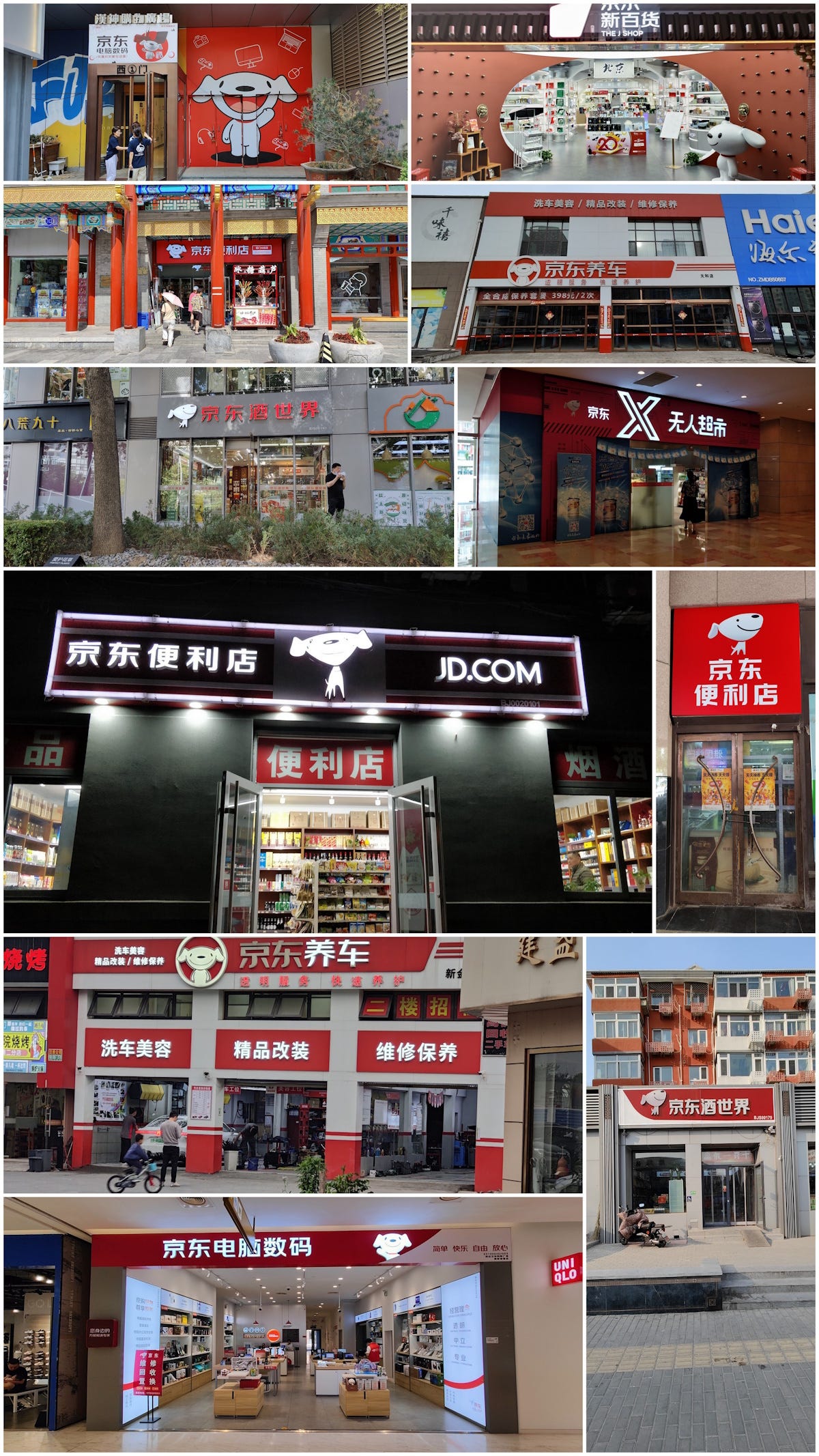
Examples of offline JD stores.
I have seen many of these stores appear and disappear in specific locations, but the JD Mall stores are without a doubt JD’s most ambitious offline retail project to date.
Unlike Alibaba, JD actually has its early roots in offline retail. The company even takes pride in the fact that in 1998, its founder, Richard Liu, started the company by selling hard drives from a small store in Beijing’s Zhongguancun. JD even replicated the store in its headquarters’ exhibition space.
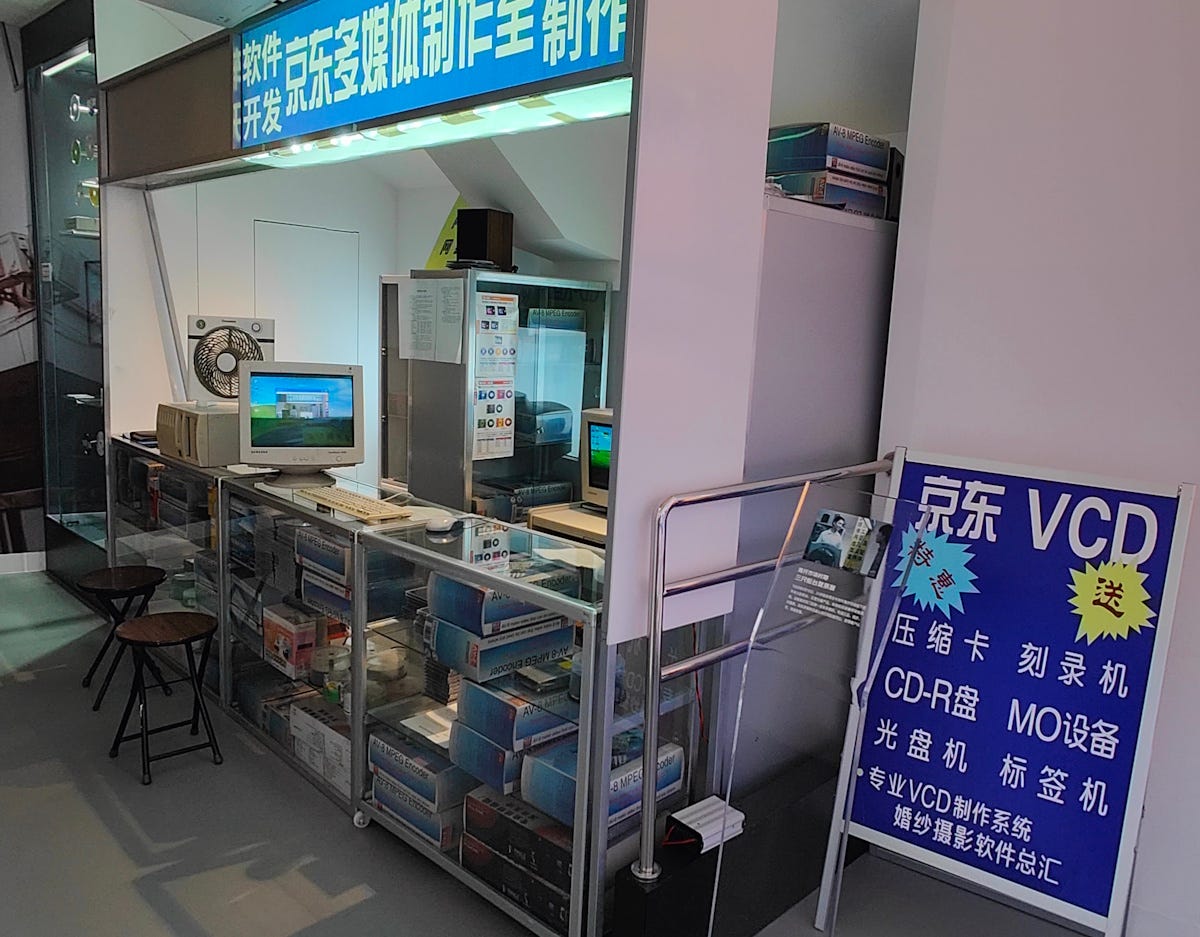
Replica of Richard Liu’s optical disc store at JD’s headquarters in Beijing.
While the company moved online in 2004 as 360buy and changed its name to JD Mall in 2007, it began launching more offline initiatives in the mid-2010s. In the battle for ‘New Retail’, both Alibaba and JD kept launching comparable physical stores. Both opened their own supermarkets, with Alibaba leading with Hema (Freshippo) and JD following with 7Fresh. Both launched franchise convenience store initiatives: Alibaba with Tmall Convenience Stores, and JD with JD Convenience Stores. Around the same time, JD began launching 3C retail experience stores under the JD Home (JD 之家) and JD Exclusive (京东专卖店) brands. Here, consumers could touch and feel products before buying them. We will later discuss the relevance of this.
In 2019, this idea was taken to the next level …
The Dream of Offline
In 2019, on Double 11 (Singles' Day, 11-11), JD opened the 50.000 square meter ‘JD E-Space’ in Chongqing. At the time, a press release stated that E-Space ‘enhances shopping by offering unique and immersive experiences, allowing customers to interact fully with state-of-the-art, innovative, and smart products from more than 1,000 of the world’s leading brands in various themed experience areas. (..) It brings experiential shopping to the electronics and home appliances category, enabling consumers to touch and test in-store, and then buy online, hassle-free. (..) After experimenting with the products, consumers can scan a code to buy and have items delivered to their homes by JD Logistics, usually within 24 hours, or they can complete their purchase onsite and carry home in-stock products immediately.’ [11]
As early as 2019, JD had proposed the goal of “recreating JD Home Appliances offline”, and Jiangsu Five Star Appliance, the third largest home appliance chain-store in China after Suning and Gome, was an essential part of realising this plan.
In 2019, JD.com purchased 46% of Five Star Electric’s shares. A year later, it announced the completion of the acquisition of the remaining 54% of Five Star’s shares, achieving full ownership. Next, JD Home Appliances and Five Star Electric Appliances started the road of integration, and a complete offline business map was formed: [1]
JD Mall for core cities
JD Electric City Flagship Store (京东电器城市旗舰店) for large and medium-sized cities
JD Five Star Electrical Appliance Experience Stores (京东五星电器体验店)
JD Home Appliance Stores (京东家电专卖店) for county and town markets, etc.
In 2023, while traditional home appliance retailers such as Gome and Suning were in retreat, JD accelerated its offline expansion, opening stores frequently, especially with the launch of JD Electric City Flagship Stores. By the end of 2023, more than 100 self-operated stores were operating in 80 cities across 15 provinces/municipalities. [1] JD currently operates 4,000+ JD Electronics Stores and 100+ JD Appliance City Flagship stores nationwide. [2]
JD Mall
The E-Space stores that were opened in 2019 (Chongqing) and 2021 (Xi’an and Hefei) were eventually upgraded to JD Mall. In addition to traditional categories such as electronics, home appliances, and digital accessories offered in E-Space, JD Mall also provides a wide range of items in home, furniture, kids, smart healthcare products and auto accessories. [3]
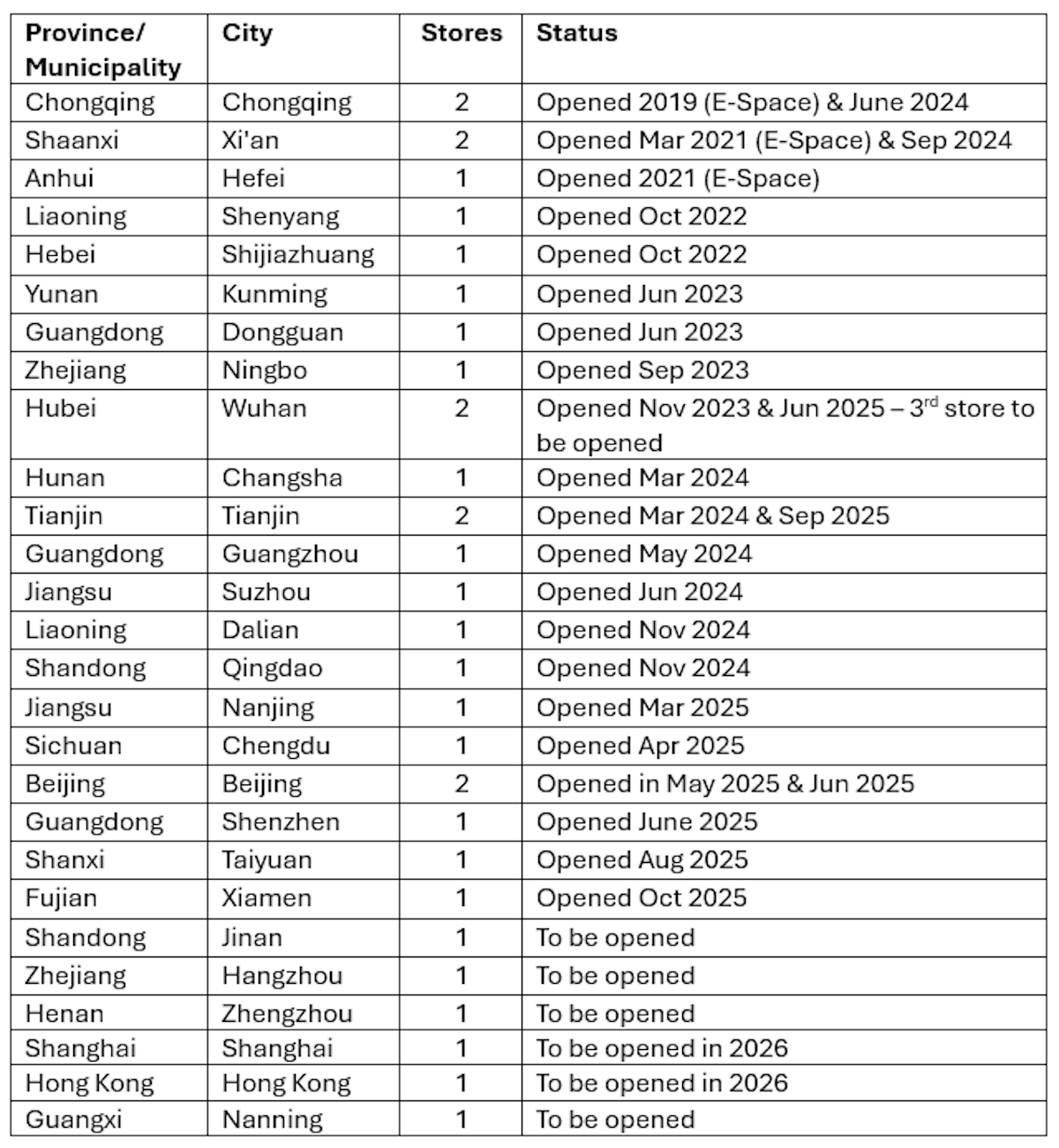
In August 2020, JD had announced it would open 20 ‘E-Space stores’ by 2025. [4] It has more than met that target, which could be called unique, given JD’s reputation for overpromising the number of offline stores across any format. At the time of writing, there were 26 JD Mall stores, with an additional 7 stores preparing to open. The preparation time for opening a store is typically 6 months, starting from the moment the location is selected and renovation begins.
Most JD Malls have 30,000-70,000 square meters of shopping space, over 200 well-known brands, over 200,000 products, tens of immersive themed experience zones, and online services similar to those offered on JD.com. The Malls provide a diverse range of categories, including home appliances, mobile communications, trendy digital products, and home decoration materials. It aims to create an immersive, digital, one-stop shopping experience centred on the “home scenario.” JD.com has also established robot demonstration and sales areas in its JD Malls.
With the milestone of reaching 100 JD.com City Flagship Stores and the rapid rollout of JD Mall, JD’s offline commercial model is gradually taking shape. Centred on these two main formats, and branching out with JD.com Five Star Appliance Experience Stores, JD.com Home Stores, JD.com Home Appliance Exclusive Stores, JD.com Computer & Digital Exclusive Stores, and JD.com Exclusive Stores targeting county and township markets, this model is becoming a reality. The dream of “recreating JD.com Home Appliances offline” is becoming a reality. [1]
Regarding pricing, JD claims: “JD Mall operates on a self-operated model, sourcing directly from brands and managing prices. This ensures competitive market pricing, eliminating distributor markups and guaranteeing competitive pricing. For example, in the home furnishing category, JD Mall’s price advantage is particularly pronounced compared to traditional home furnishing stores. Prices for the same brands and configurations are generally 50%-60% lower than in traditional stores.”
In the next section, we will further explore JD Mall's strategy.
The JD Mall Strategy
JD describes the Malls as “one-stop shopping for home appliances and home goods, and first-hand experience of tech-enabled lifestyles.” [5] While JD.com’s strategy echoes Amazon’s and Walmart’s push into omnichannel retail, it has its own unique twist: the mall doubles as a tech showroom and lifestyle hub. [6]
The core philosophy is “Experience-Driven Sales,” a model that moves beyond traditional retail by creating immersive, hands-on environments where customers actively use and test products before purchase.
Several key pillars anchor the strategy.
1. The Core Philosophy: Experience-Driven Sales
The fundamental principle guiding the JD Mall is to shift the retail paradigm from passive viewing to active participation. The stated goal is to “gradually drive sales” by allowing customers to go beyond simply seeing a product online or on a shelf; they are encouraged to interact with fully functional items in realistic settings.
Active Participation vs. Passive Demonstration: Unlike traditional electronics stores, where staff demonstrate products, the JD model requires customers to perform the actions themselves. For example, visitors are guided to make a cup of coffee with an espresso machine, bake cookies using an in-store oven, or test a vacuum cleaner on a deliberately dirtied floor.
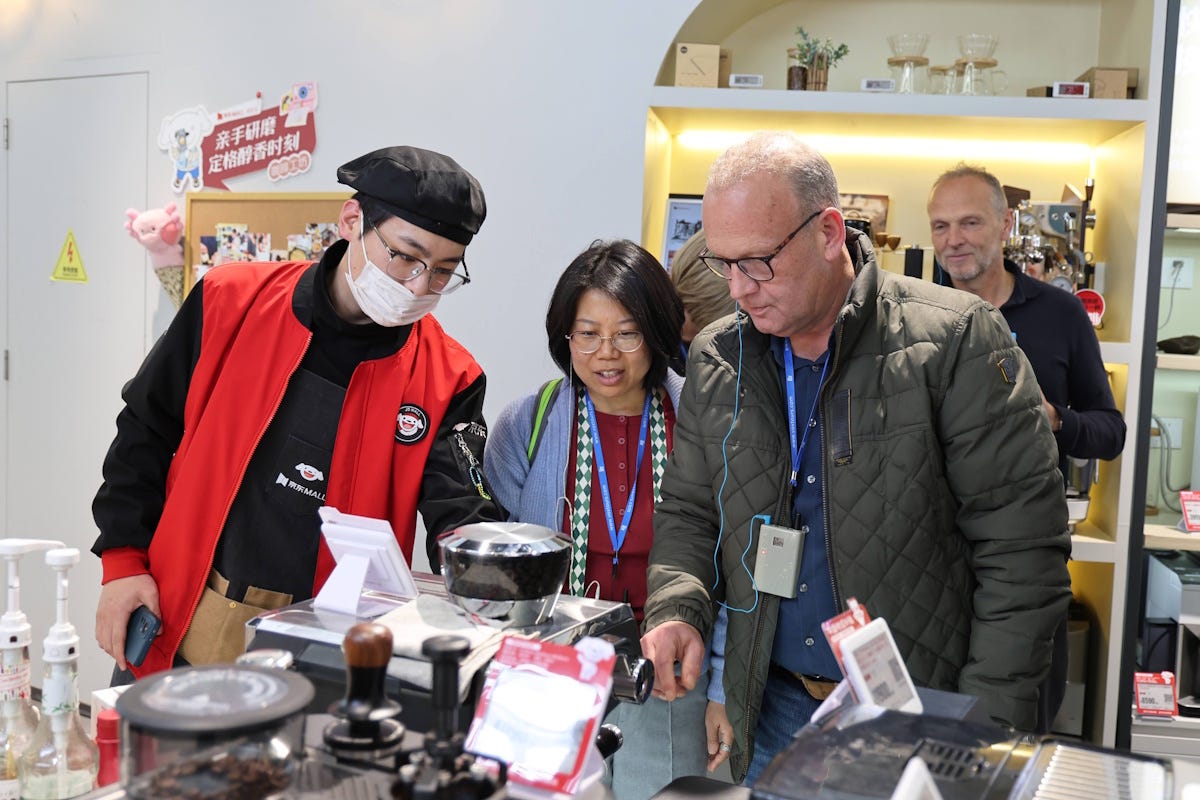
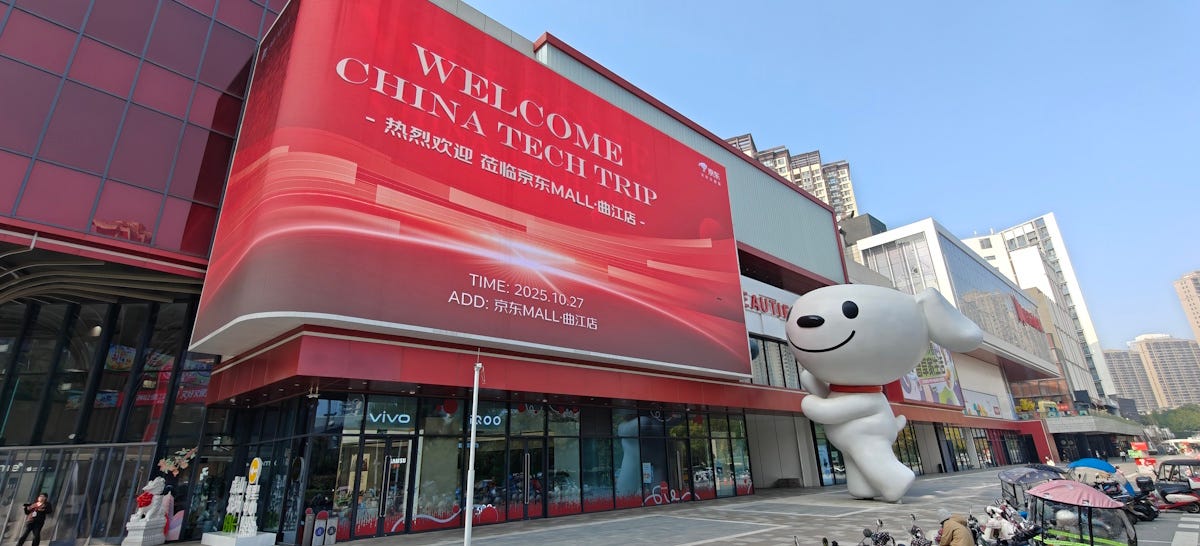
A participant of a ChinaTechTrip study tour is being instructed how to use the espresso machine.
Purpose-Built Environments: All display models, from washing machines to ovens, are fully connected to power, water, and drainage. This infrastructure is central to providing an authentic user experience.
Driving High-Consideration Purchases: This hands-on approach builds customer confidence and reduces purchase friction, especially for high-value items. By experiencing a product’s performance firsthand, customers can identify the item that genuinely meets their needs, which in turn is expected to increase customer satisfaction and reduce return rates.
2. Store Strategy and Design
The physical store is conceptualised as more than a point of sale; it is a dynamic, themed destination and a local community asset.
Community Hub Model: The “5-Kilometre Penetration” Strategy
JD aims to integrate each JD Mall into its local neighbourhood, fostering repeat visits and community loyalty.
Target Radius: The primary goal is to achieve high penetration within a 5-kilometre radius, turning the store into a “neighbourhood space.”
Free Value-Added Services: To attract local residents, the store offers complimentary services, most notably a professional-grade laundry and shoe-washing facility. Residents can book these services and visit the store, creating regular foot traffic.
Lifestyle Integration: The store features food areas and hosts activities such as children's baking classes, positioning itself as a quasi-recreational destination for families.
Themed and Dynamic Environments
Each JD Mall is given a unique identity that reflects its location, and the interiors are regularly updated.
Localised Themes: The Xi’an Qujiang store, for instance, features a “Tang style” and “Guochao” (national trend) design, with a central atrium designed to evoke the Silk Road. In contrast, the Nanjing store has a Ming Dynasty capital theme.
Renovation Cycle: Every JD Mall undergoes a major renovation every three years to refresh its look and offerings, ensuring the concept does not become dated.
Construction Timeline: A new JD Mall can be built and ready for opening in a maximum of six months from site confirmation.
Store Layout and Structure
The mall is organised by product category across multiple floors, with a consistent structural division between brand-led and JD-led spaces. Take the Xi’an Qujiang store as an example:
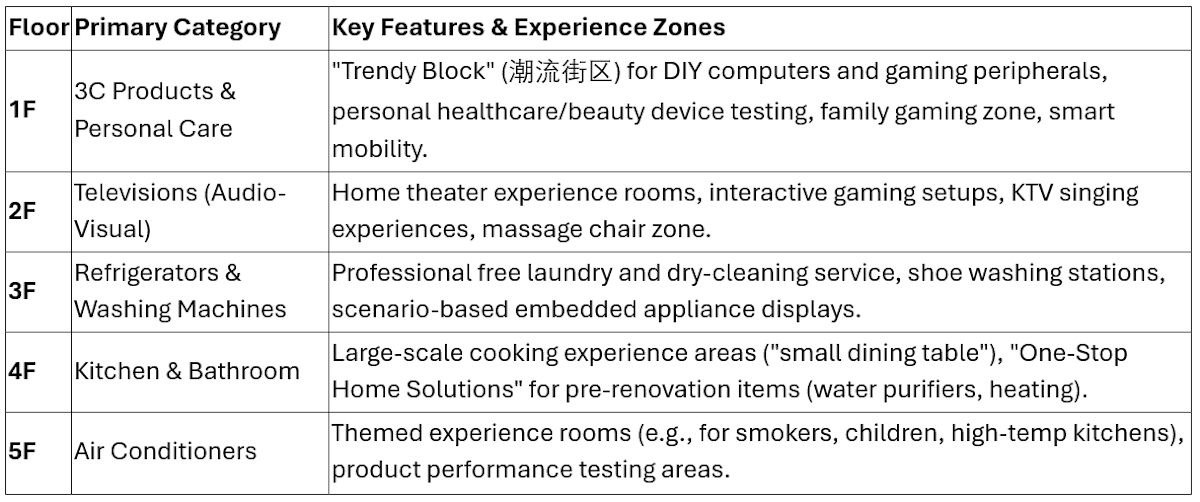
The sales floor is divided into two primary sections:
Brand Showrooms: Dedicated spaces managed by individual brands like Huawei, Apple, or Haier.
JD Self-Built Areas: Curated sections managed directly by JD to supplement the brand offerings.
3. The JD Self-Built Area: A Curated Experience
The Self-Built Areas are a strategic component designed to showcase a unique product mix and deliver the core “experience-driven” philosophy. These areas are further divided into two sub-sections.
Experience Zones & “Experience Officers”
These zones are staffed by “Experience Officers” who are explicitly not salespeople and do not carry sales quotas.
Their sole function is to guide customers through product experiences, provide expert assistance, and ensure a positive interaction, effectively acting as brand ambassadors and product educators.
Curated Product Selection Areas
Present on every floor, these sections display a dynamic assortment of products based on two key criteria:
Online Best-Sellers: Top-selling and “explosive” products from the central JD.com online platform, giving customers a chance to interact with popular online items physically.
Locally Scarce Products: Items that are difficult to source through local supply chains. This includes niche brands, products with limited distribution, and items from JD’s national procurement team that supplement local inventory sourced from Five Star Appliance's legacy supply chain (a company acquired by JD).
4. Key Experiential Zones and Services
The store’s “experience-driven” model is brought to life through numerous specialised zones.
Personal Healthcare & Beauty: Customers can freely test devices such as high-end hair dryers (equipped with instruments to measure wind speed and temperature), facial massagers, and receive a professional-grade skin analysis. Massage devices, particularly popular among male customers, are also available for trial.
Coffee & Baking Experience: A comprehensive station where customers can get free coffee daily. The process is educational, with staff teaching visitors how to choose beans and operate various machines. The goal is to create a complete experience that showcases accessories and demonstrates how to recycle used coffee grounds. The baking station holds daily classes for children and adults to make items like cookies and doughnuts, using different appliances each day to highlight their specific strengths.
Gaming & DIY Computers: An e-sports area hosts competitions and features live-streaming capabilities. A dedicated “Trendy Block” allows enthusiasts to assemble their own high-performance PCs from a wall of components (keyboards, mice, video cards, etc.). The assembly itself is often live-streamed, catering to a niche online audience.
Family Gaming Zone: Equipped with consoles like PlayStation, this area encourages parents and children to play video games together. The aim is to reframe gaming as a positive family activity and allow users to test different systems to find the best fit for their home.
Home Theatre Experience: A soundproof room designed to demonstrate high-fidelity surround sound systems, including Dolby Atmos. JD staff offer customised home theatre configuration solutions based on a customer’s room size and budget.
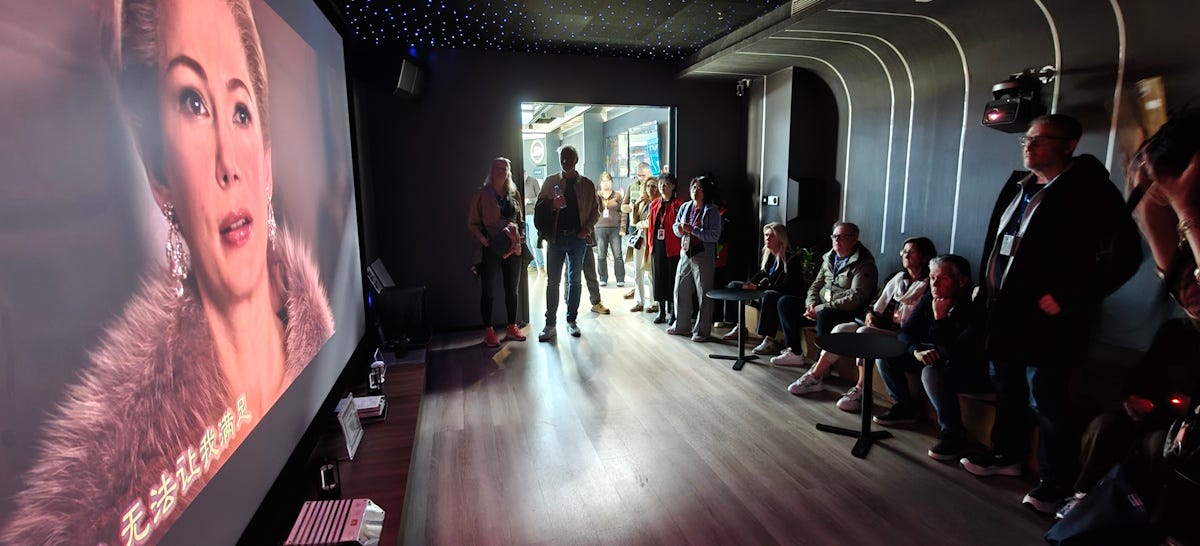
Retail study tour group experiencing the home cinema room.
Professional Laundry & Shoe Washing: A major community draw, this area provides free laundry, dry cleaning, and shoe washing services. Customers book appointments through a JD mini program. For high-value clients, a pickup and delivery service is available through JD Daojia. The area features professional-grade commercial equipment and separate, specialised machines for washing shoes.
Interactive Cleaning Demonstrations: To showcase cleaning appliances such as robotic vacuums, staff create realistic messes (e.g., spilling trash on floors and rugs) for customers to clean up using demonstration models.
5. Omnichannel Marketing and Customer Acquisition
Customer acquisition for JD Mall stores is a sophisticated omnichannel effort that combines in-store promotions, targeted online advertising powered by JD’s backend data, and a novel social media matrix in which all employees maintain individual accounts on platforms like Xiaohongshu to build influence and drive traffic.
JD employs a multi-pronged strategy to attract and retain customers, seamlessly blending online and offline channels.
Online Channels:
JD App Integration: When a user searches for a product on the JD app, the platform recommends the nearest physical store. A click-through leads to the store’s dedicated mini-program, which lists all current activities and promotions and allows for booking experience sessions. For activities in experience zones, people register and redeem a voucher. This way, JD identifies the offline customer.
“Virtual Store” Operations: In the store, there are many activities on Friday, Saturday, and Sunday. From Monday to Thursday, JD basically operates a ‘virtual store’. This includes content marketing on platforms like Xiaohongshu and Dianping, posting videos, and hosting live broadcasts.
Employee Social Media Matrix: Every store employee (the Xi’an Qujiang store, for instance, has ~300 staff) is required to operate a personal Xiaohongshu account. They are trained to build an online profile (e.g., as a foodie or tech expert) rather than act as direct salespeople. They create content, livestream, engage with users, and build trust, subtly guiding interested followers to the store.
Data-Driven Advertising: JD leverages its extensive backend user data to deliver targeted ads and promotions to users who have shown interest in relevant product categories.
Offline Channels:
Community Outreach: Staff are regularly dispatched to residential communities within a 5km radius to host events (e.g., free massages, movie screenings, free haircuts) and promote the store’s services.
In-Store Events: The central lobby is used every weekend for activities such as new product launches, brand promotions, and culturally relevant events, including cosplay gatherings, to attract younger demographics.
The Omnichannel Bridge: Electronic Price Tags
The price tags are electronic displays, not paper, and are centrally updated to ensure price parity with the JD.com website. Still, offline discounts are often better than online discounts, because JD wants to give customers a reason to visit the store and experience products.
Crucially, each tag has a QR code. If a customer scans the code in-store but completes the purchase later online, the sale is automatically attributed to the physical store. This system tracks the store’s influence on online sales and strengthens its value proposition for brand partners in an omnichannel ecosystem. The actual time tracked for this ‘see offline, buy online’ effect depends on the product category, but can, for instance, be several hours for a TV.
6. Operational Model and Performance
The store’s success is underpinned by a unique staffing structure and a business model that capitalises on its target demographic.
Hybrid Staffing Model
Employees are distinguished by the colour of their lanyards, indicating their employer and role.
Red Lanyards (60%): Direct JD employees (”自营员工”). They are responsible for store management, training, and upholding JD’s customer experience standards. Their focus is on the overall service quality, not just selling a specific brand.
Grey Lanyards (40%): Brand Product Specialists (”厂家的产品专家”). They are employed by the brands (e.g., Haier, Siemens) but work within the JD store. They provide deep, specialised product knowledge. JD management reserves the right to request a replacement if a specialist’s sales tactics are too aggressive or misaligned with the store’s experience-first philosophy.
Employee Sales Empowerment
Staff are not limited to selling products physically present in the store. Using a backend system, they can sell any item available on the entire JD.com platform, significantly expanding their commission potential and contributing to high employee satisfaction.
7. Future Directions and Strategic Initiatives
JD continues to evolve the JD Mall model with several key initiatives.
One-Stop Home Solutions: The company is expanding its “appliance and home furnishing one-stop” service. This involves offering pre-renovation consultations and products like central air conditioning, water purifiers, and heating systems. For larger renovations, JD offers a service in which it acts as a guarantor, allowing customers to pay via JD Baitiao (credit service) only after the project is completed and approved, mitigating risk for consumers.
Commercialisation of Experience Zones: There are plans to commercialise successful experience zones. For example, the popular coffee-making area in the Xi’an Qujiang store is envisioned to become a full-fledged coffee shop with its own sales revenue stream.
Continuous Enhancement of Customer Service: A key focus is on post-sale service. When a customer purchases a product, they are added to a dedicated group chat with pre-sale, sale, and post-sale staff. This team provides ongoing support, sharing tips, tutorials, and recipes to help the customer fully utilise their new appliance, fostering long-term relationships and encouraging repeat business and referrals.
A store manager in Xi’an explained how JD Mall helps customers learn how to use home appliances.
“All these appliances have a lot of functions, and the instruction manuals are very thick, so you have to spend a lot of time learning how to use them every time you buy a new appliance. You might have mastered the basic functions when you buy it, but you still have to learn the other functions and additional features. So, it’s like buying a lot of appliances after renovating a house; it takes a lot of time.”
JD will create online communities to solve the problem.
“We will show you the different functions of the product and teach you how to use it. There may be hundreds of people in a group. Every day we will, for instance, broadcast the oven we are using today, what it can do and how to use it. We will tell you about a recipe and teach you how to make it. There are classes every day so that you can learn in a fun way instead of always having to read the instruction manual.”
The rest of this report, which is available to paid subscribers, contains a visual report with more than 60 pictures and videos taken at four JD Malls between July 2023 and October 2025, along with an assessment of the feasibility of its goals and thoughts on what this could mean in the context of JD’s planned acquisition of Ceconomy in Europe.
Visual Report of Store Visits
In July 2023, April 2025, September 2025 and October 2025, I visited several JD Mall stores. The pictures and videos below will give you an impression of what they are like.
Xi’an (Shenglong Store) – July 2023
The first JD Mall opened in Xi’an on September 30th 2021, with a total area of 42,000 square meters. [2] The new JD Mall was an upgrade of its JD E-Space. At launch, this Xi’an JD Mall featured 11 themed areas and 29 interactive experience areas, where consumers could enjoy beauty care, audio products, drones, massage, and other services. [7]
I visited the store in July 2023, on my first trip to China after the COVID border closures were lifted. The store, which was previously a regular traditional home appliance store, now has a Tang Dynasty style, with the central area decorated in the style of the Silk Road.
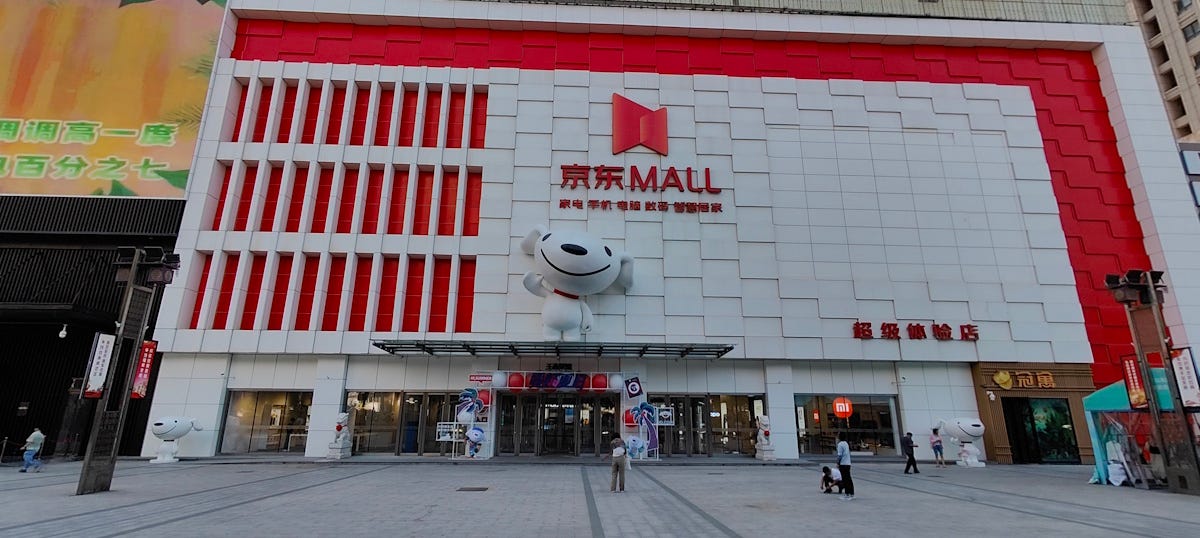
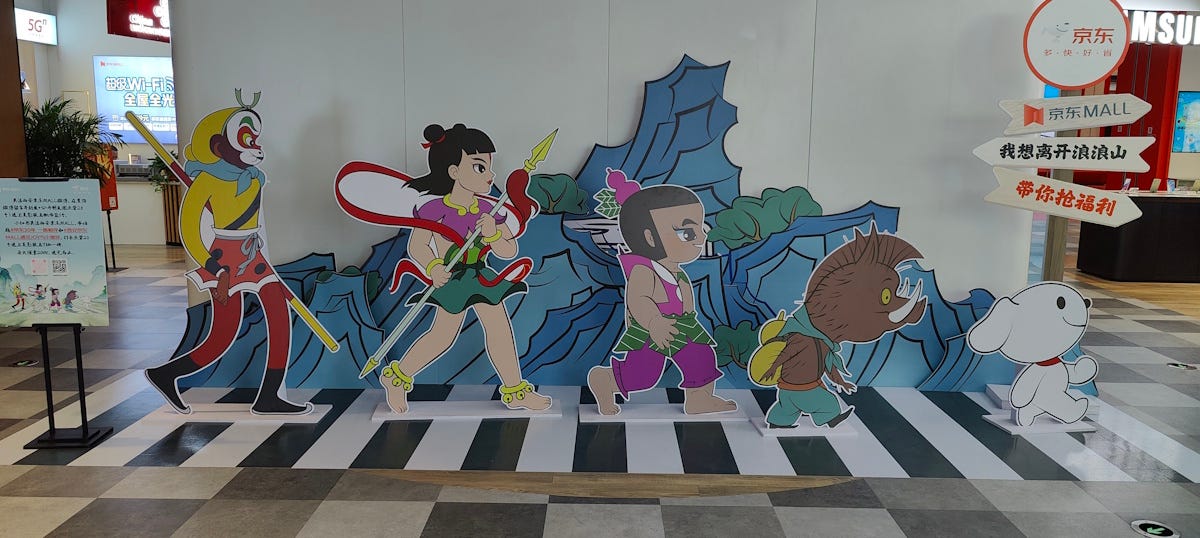
JD appeals to Xi'an's cultural context, referencing ‘Journey to the West’.
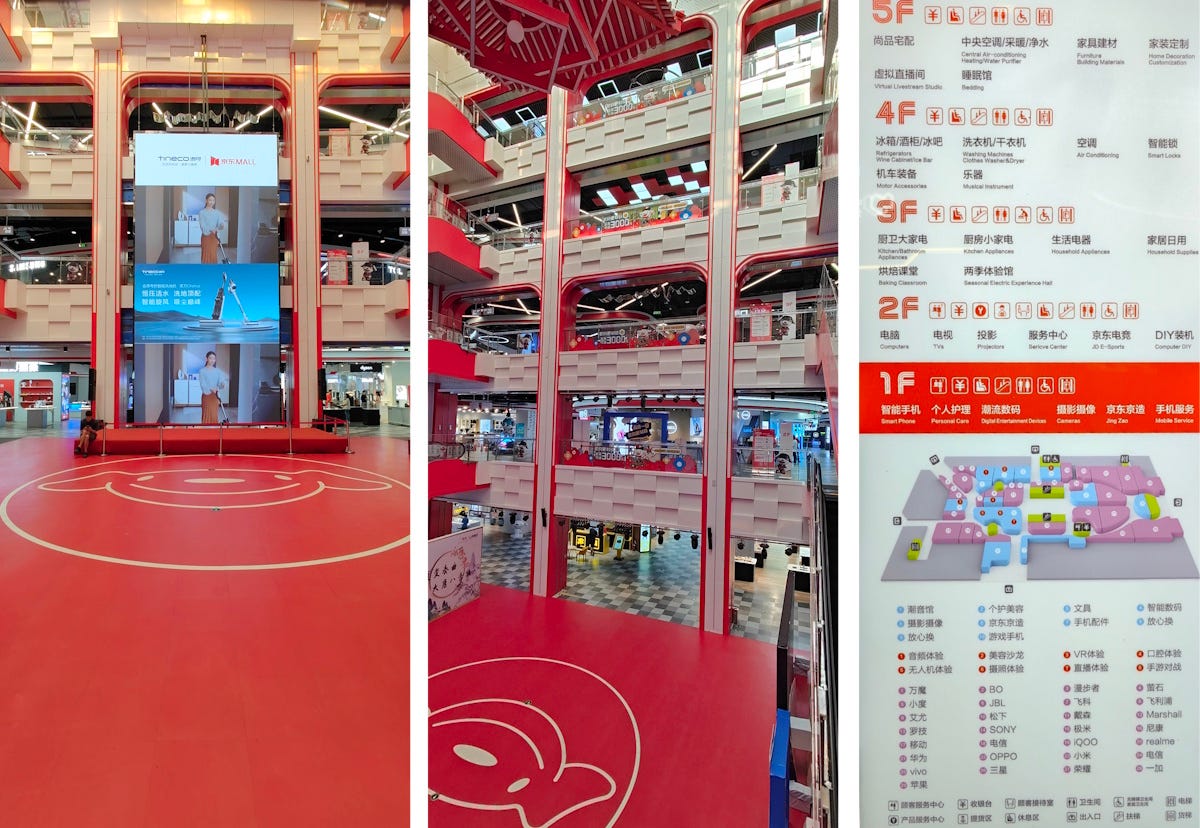
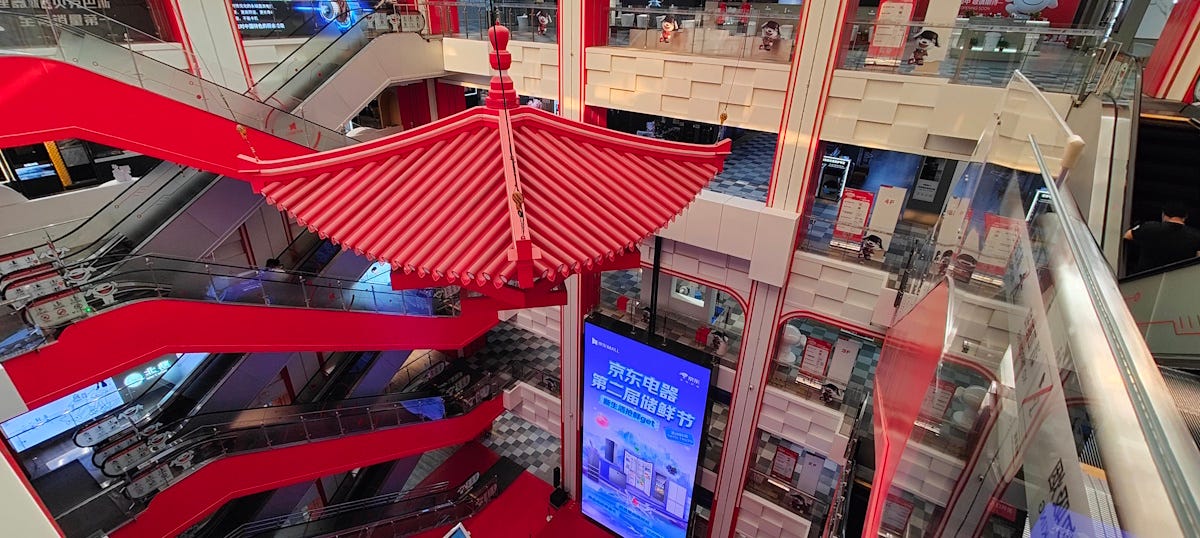
Central event hall and five floors.
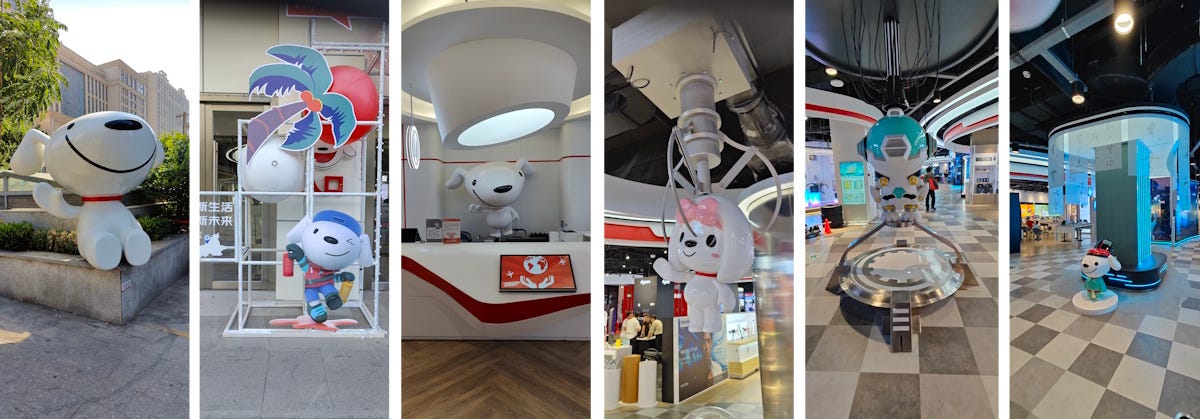
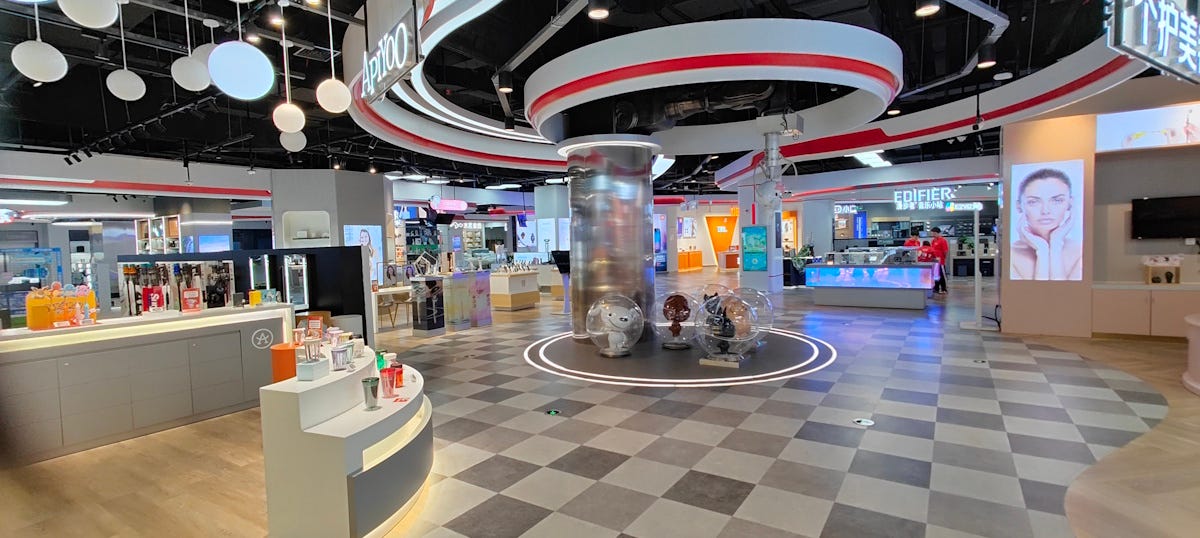
Prominent use of branding with JD’s Joy Dog family.
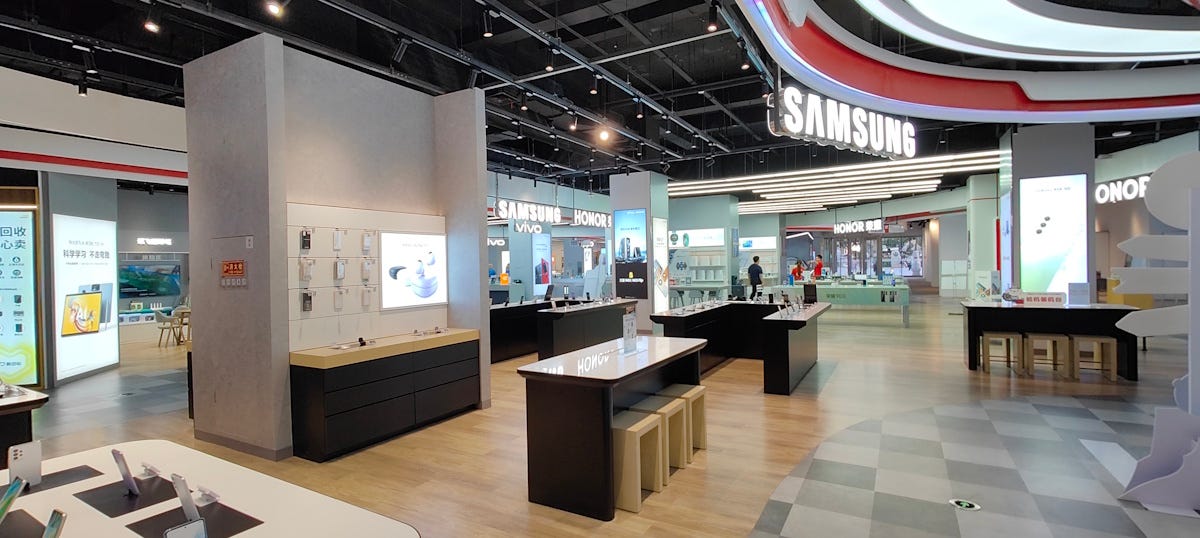
Samsung shop-in-shop.
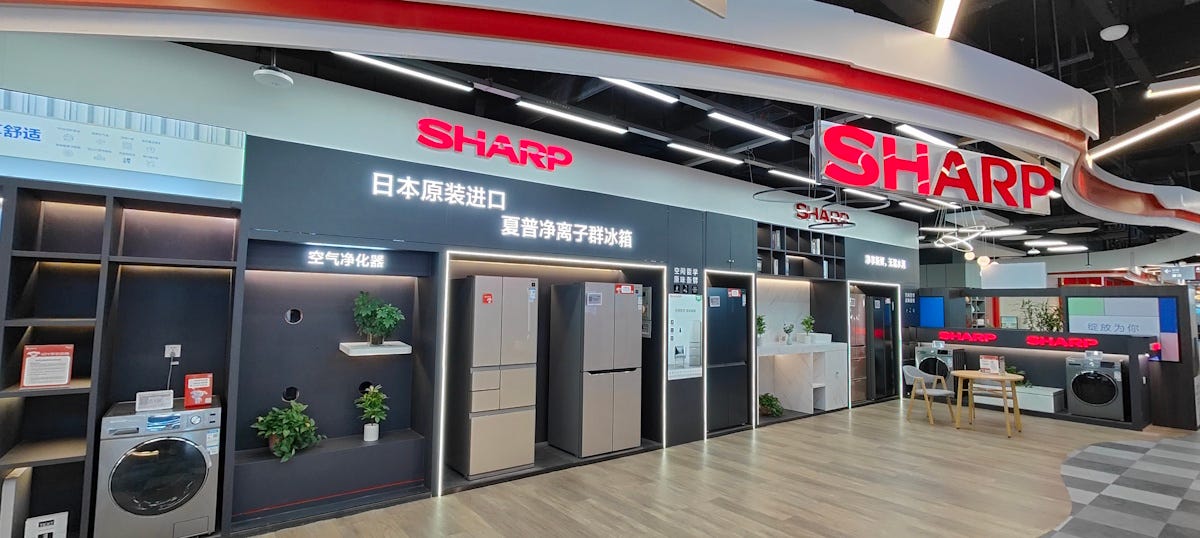
Sharp shop-in-shop.
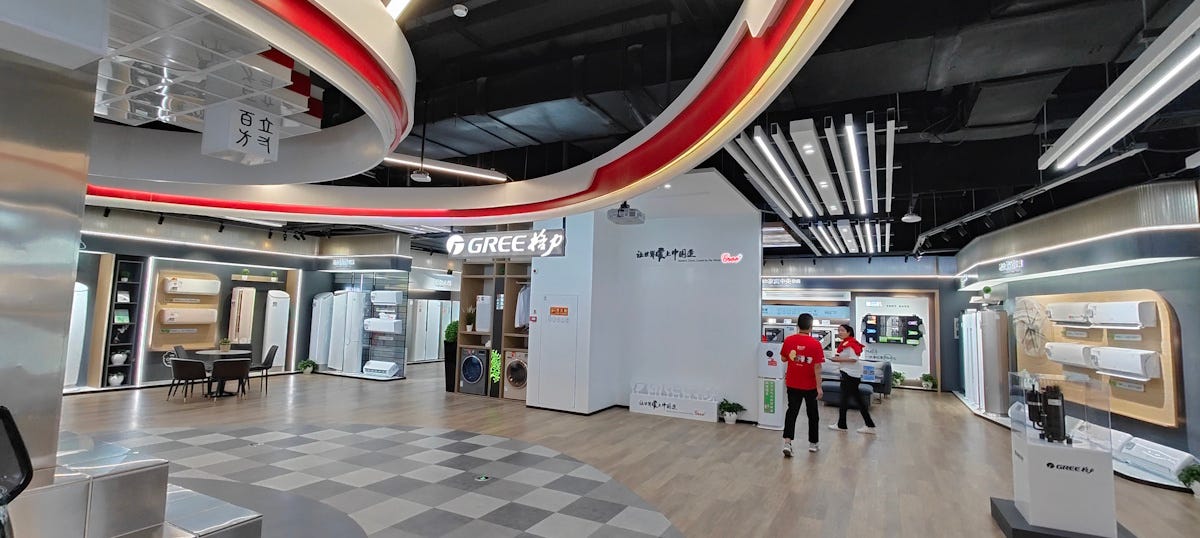
Gree shop-in-shop.
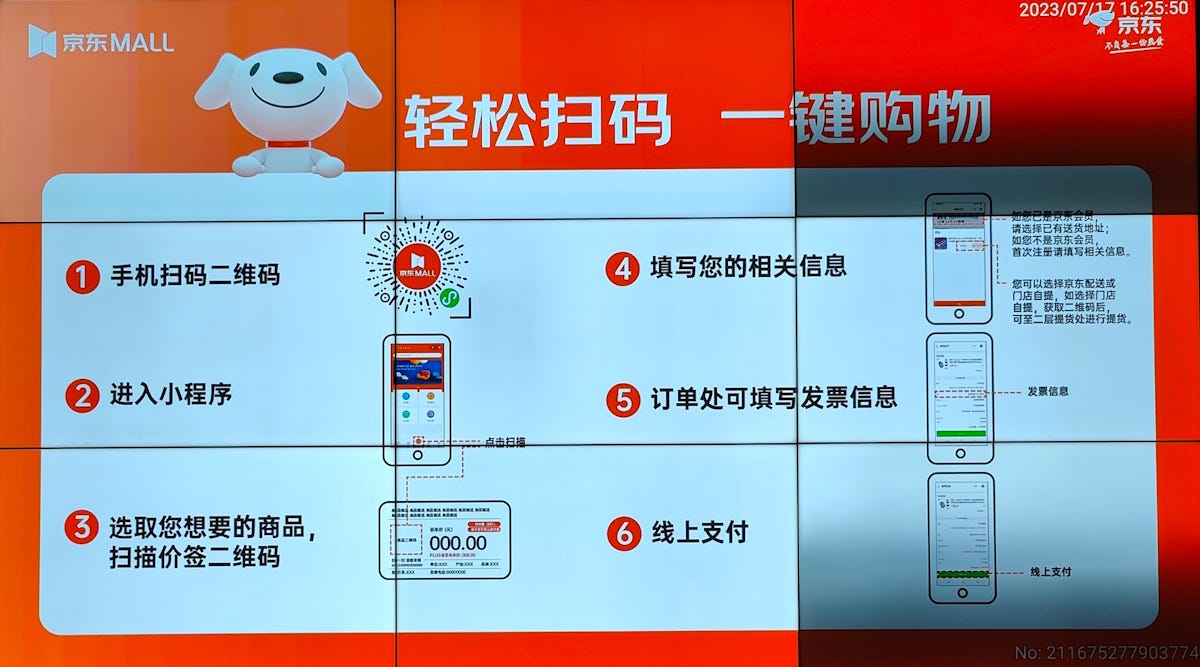
Easy one-click shopping with QR code scanning
Scan the QR code with your mobile phone.
Enter the mini program.
Select the product you want and scan the QR code on the price tag.
Fill in your relevant information.
You can fill in the invoice information in the order section.
Online payment.
Explore!
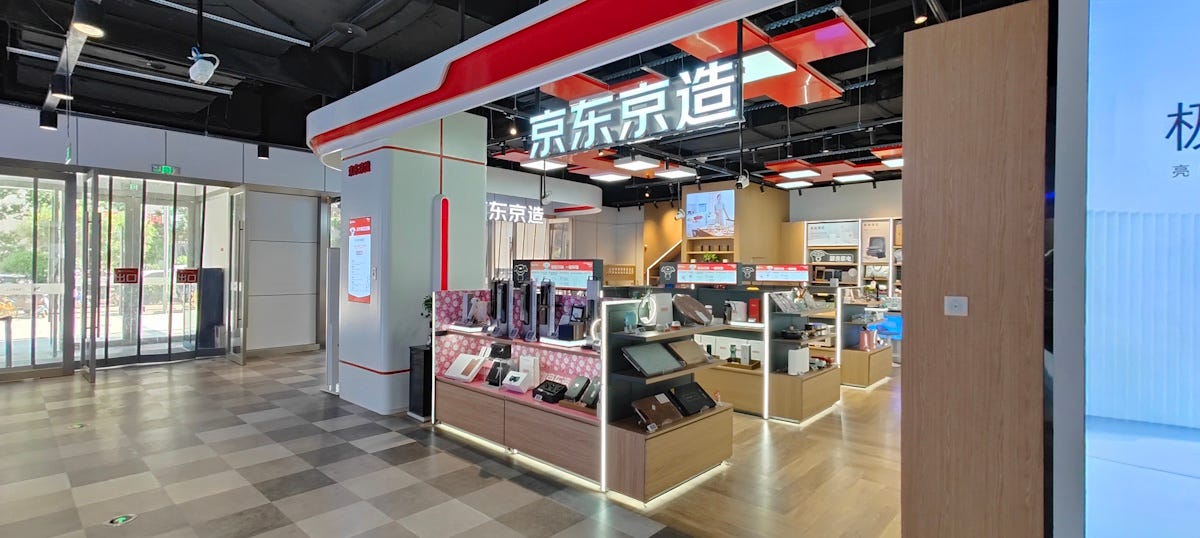
Store for Jingdong Jingzao (京东京造), JD’s private label lifestyle brand.
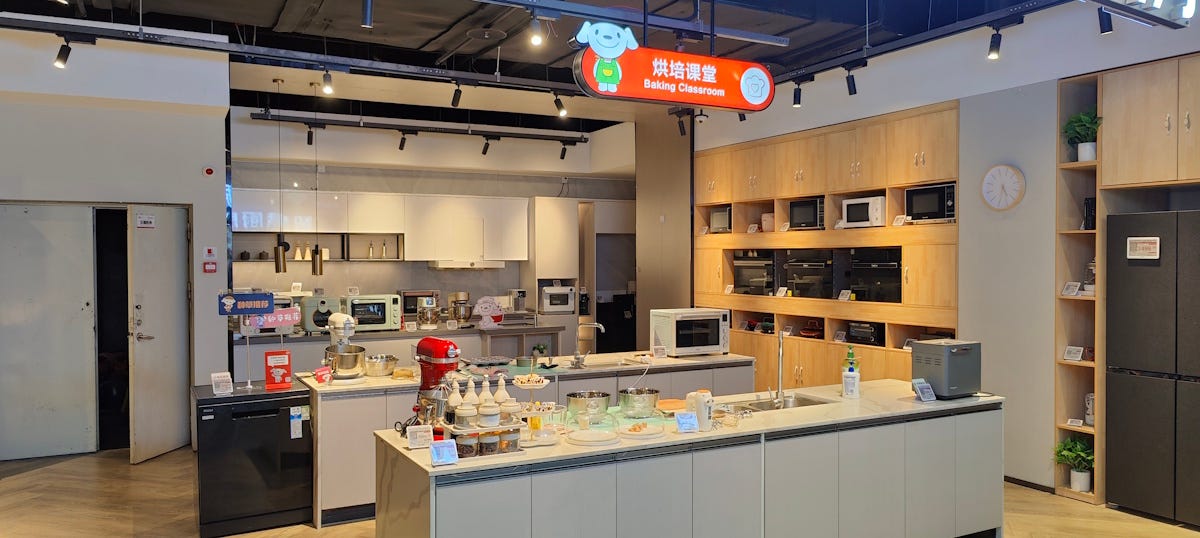
Baking classroom.
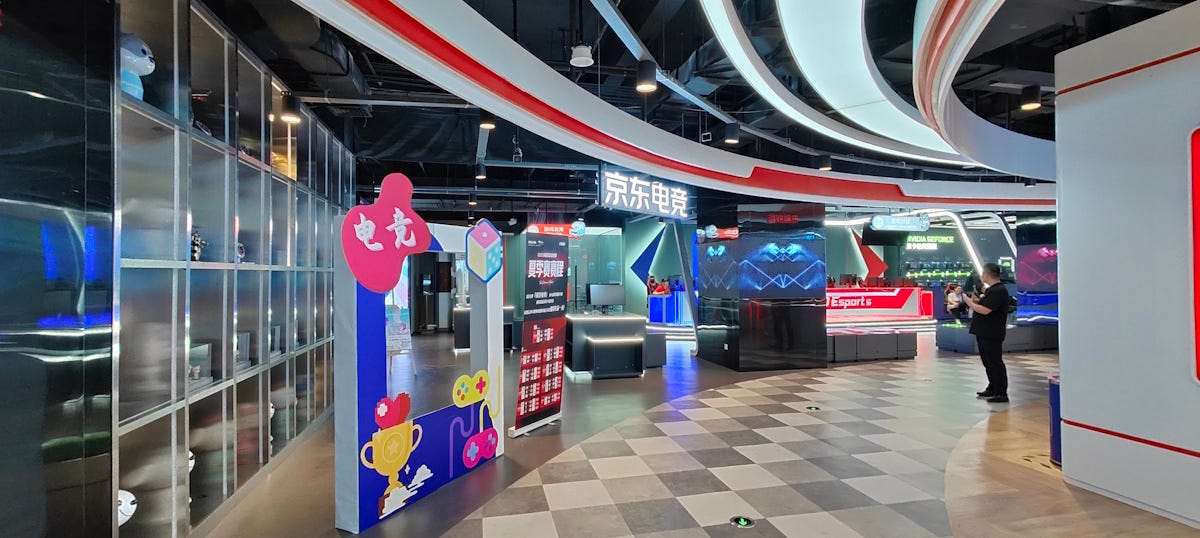
Jingdong eSports.
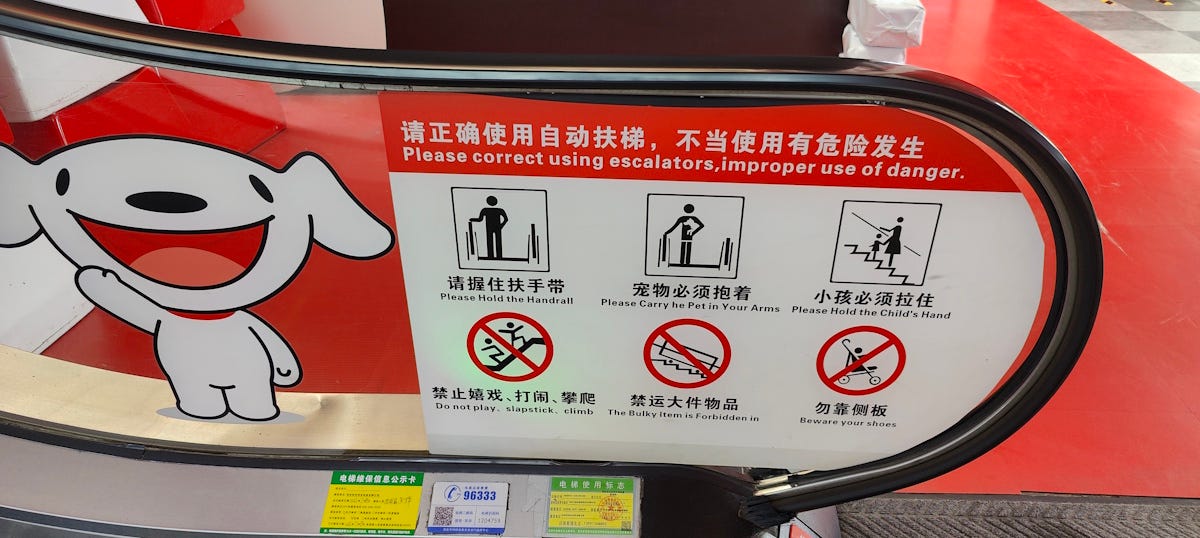
Appreciate the English messages, but …
Xi’an (Qujiang Store) – April 2025, October 2025
Xi’an’s second JD Mall in the affluent Qujiang district opened in September 2024.
This mall also has a supermarket, Chengshan Farm, in the basement. Chengshan Farm follows the same customer-oriented approach as Pang Donglai from Henan province, and it’s possible to have a meal there at several restaurants. I was a bit surprised that JD would not put its own supermarket brand, 7Fresh, in the mall. It might have something to do with 7Fresh’s limited penetration in this region of China. 7Fresh once opened a store in Xi’an but shut it down after a while.
When I visited in April 2025, JD was planning to open a food court in the basement that served, among other things, Shaanxi specialities.
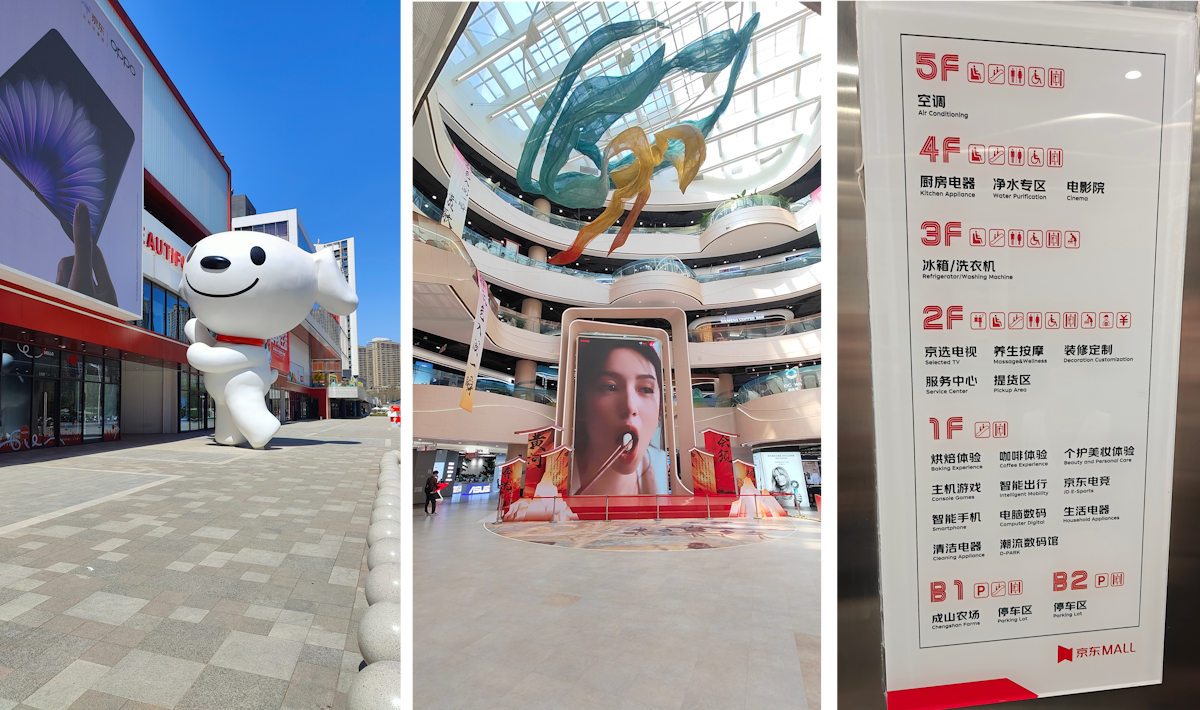
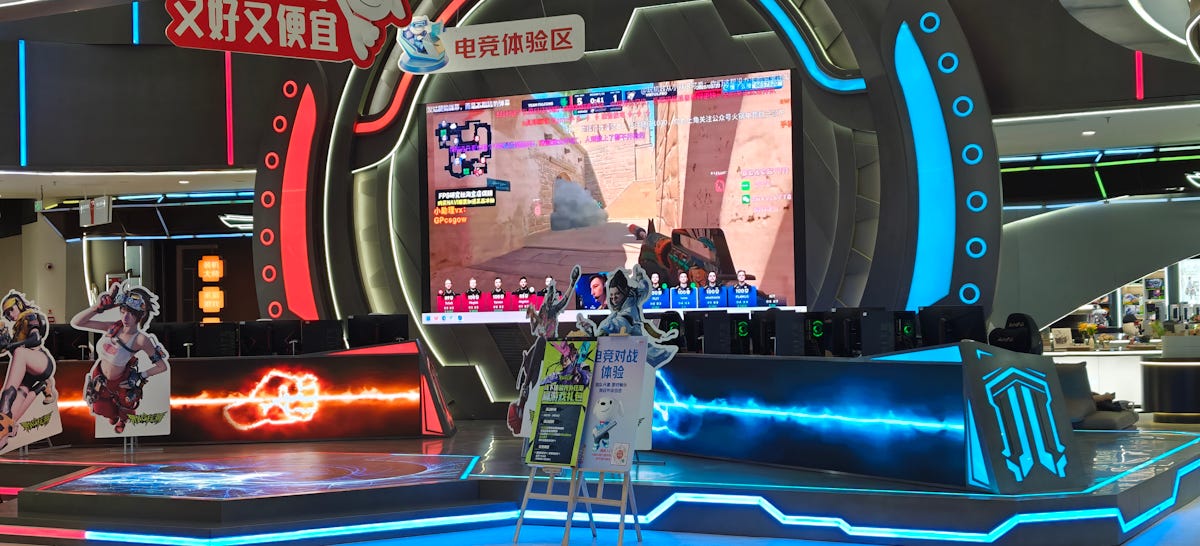
Experience corner: eSports.
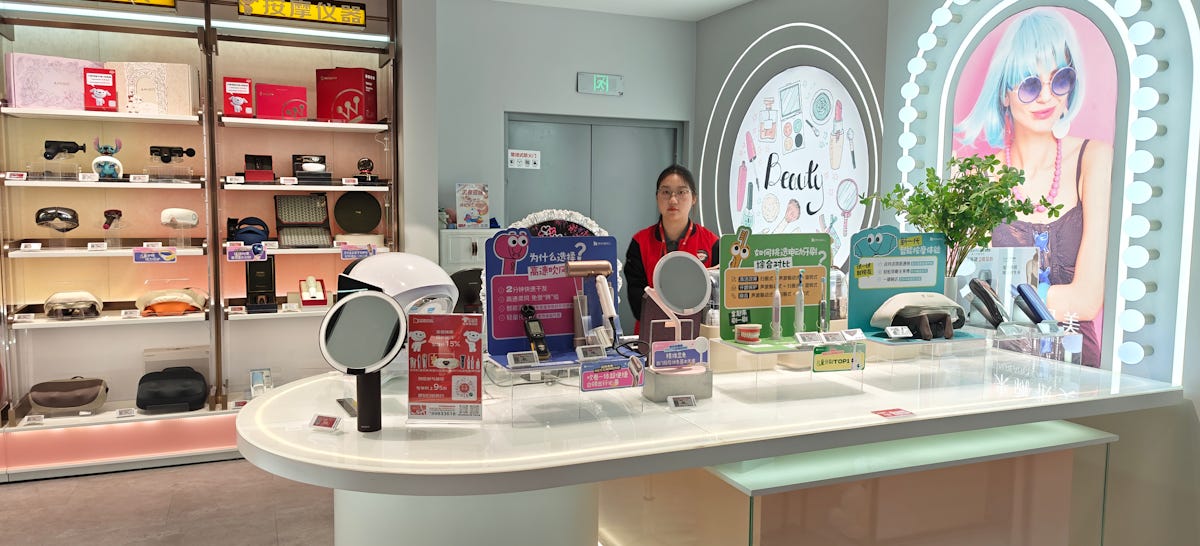
Experience corner: beauty care.
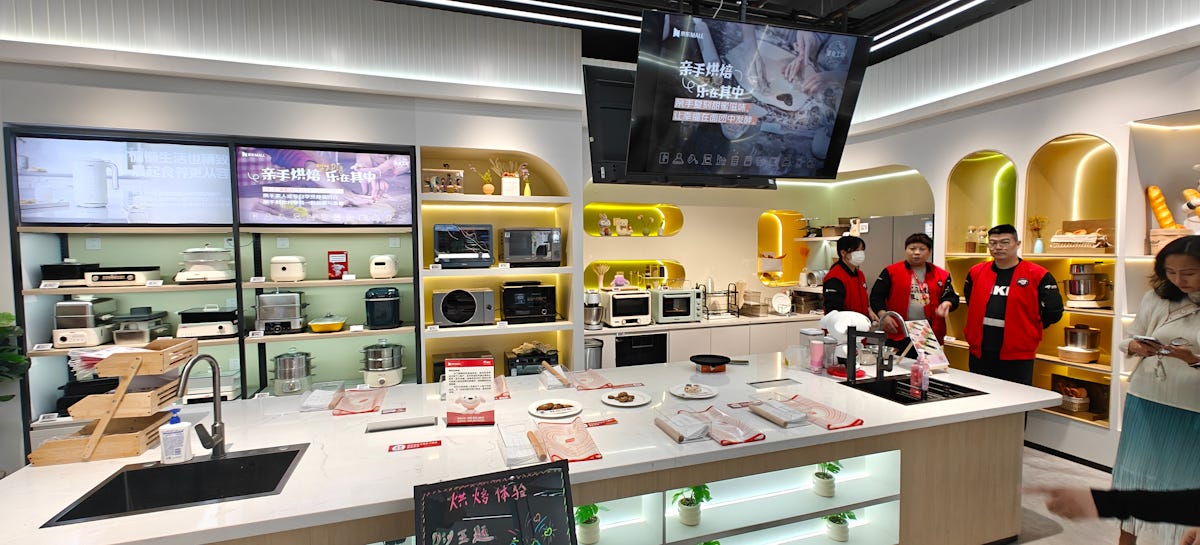
Experience corner: baking.
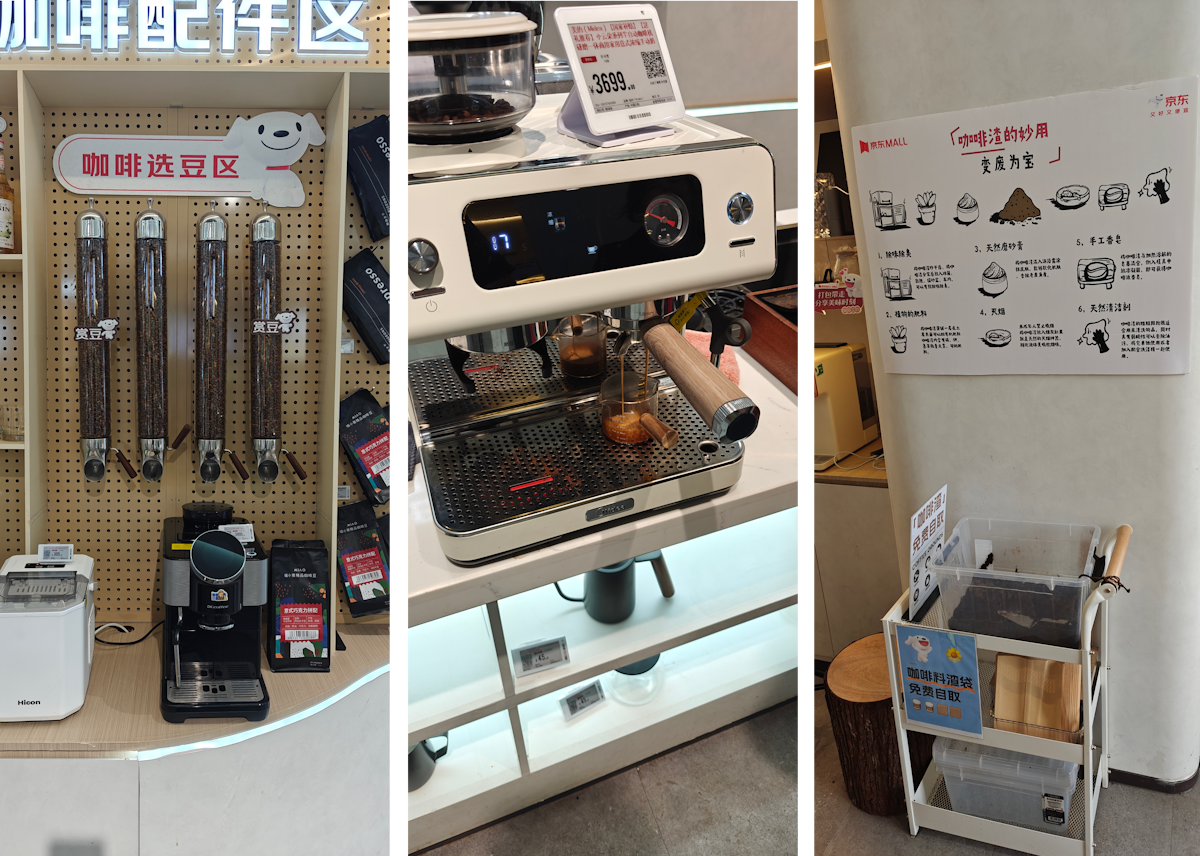
Experience corner: try out the coffee machines and brew your own coffee. “What JD calls ‘experience-driven sales’ is not directly selling to you. It’s not just about knowing how the coffee is brewed, but also about the entire coffee chain, from bean to coffee grounds. For foreigners, coffee might seem like just drinking water, but for us Chinese, it’s something special. Many people still don’t quite understand it”, the store manager explained.
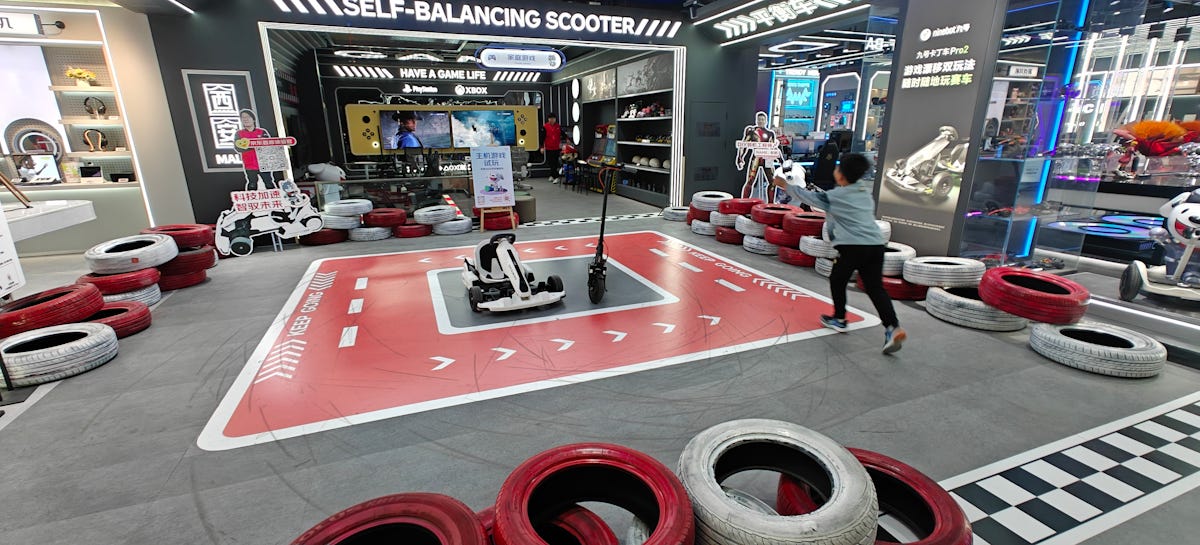
Experience corner: electric carts.
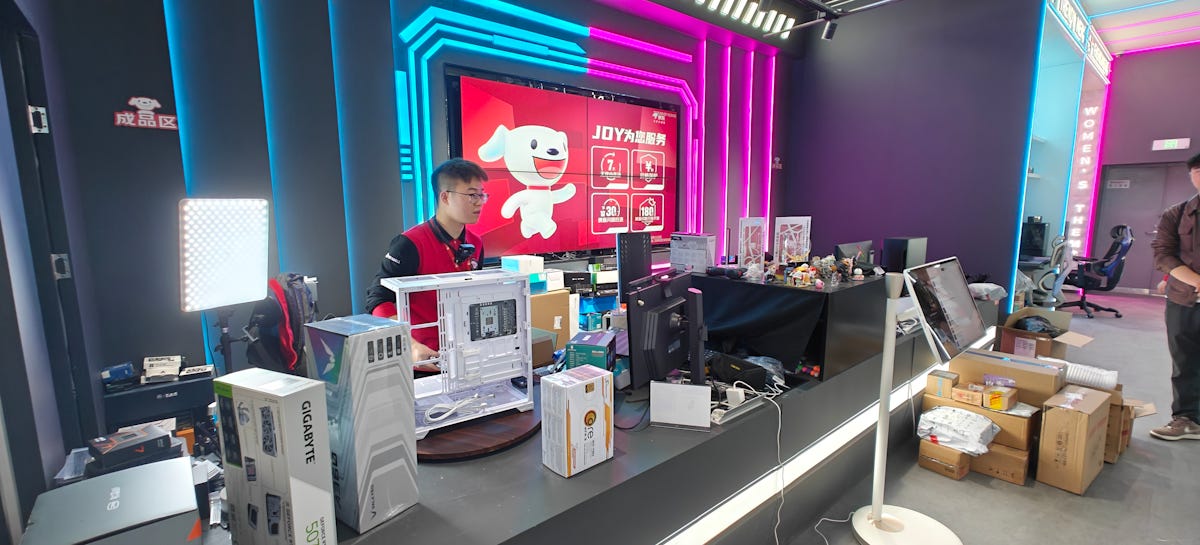
Experience corner: build-to-order computers, being livestreamed online.
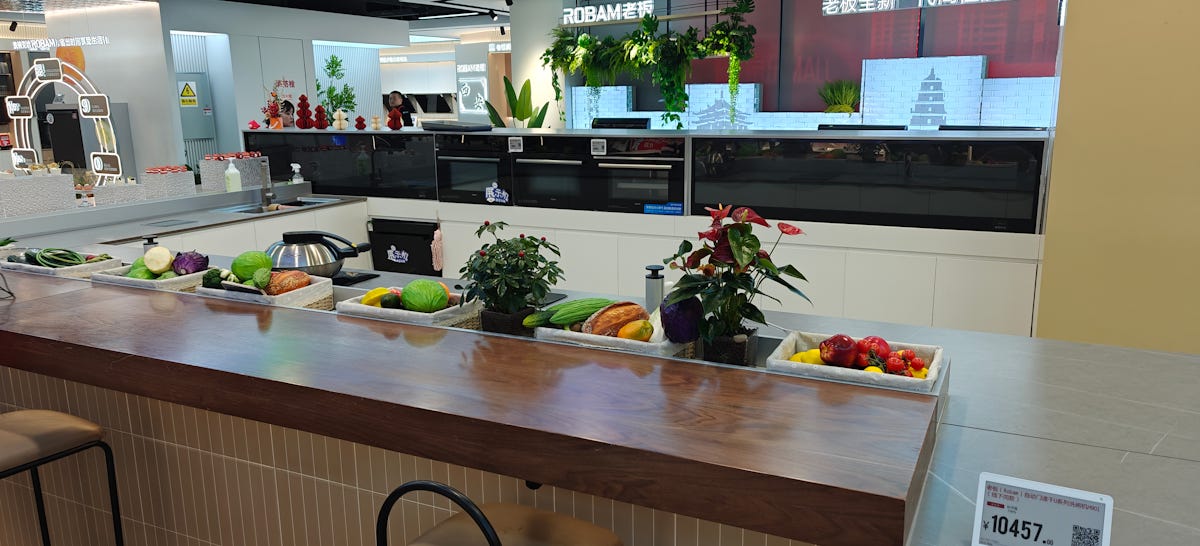
Experience corner: a fully operational kitchen where customers can cook alongside staff.
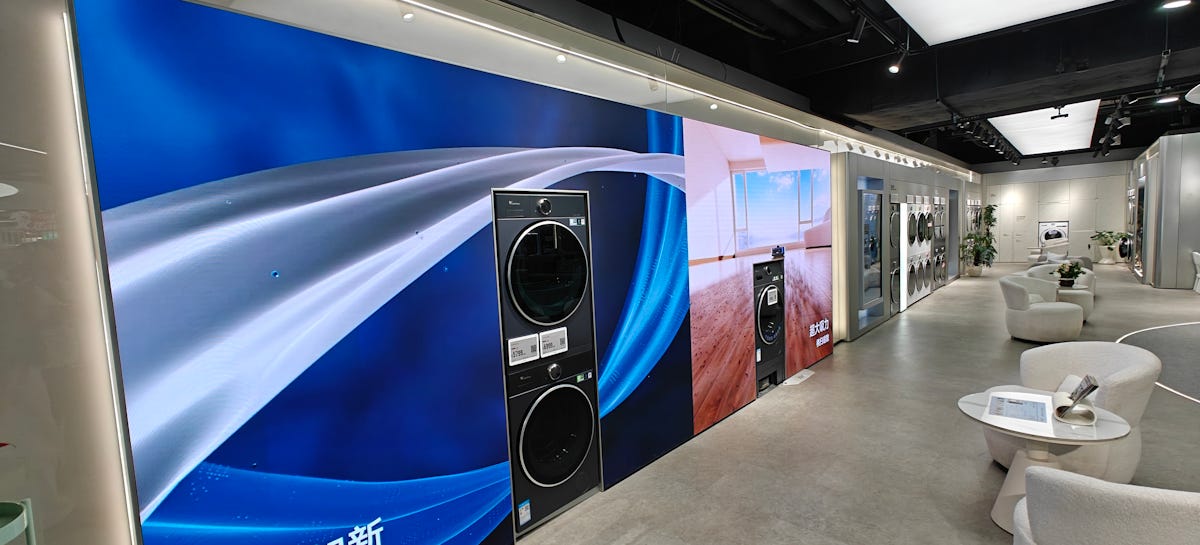
Experience corner: bring your laundry to try out these washing machines.
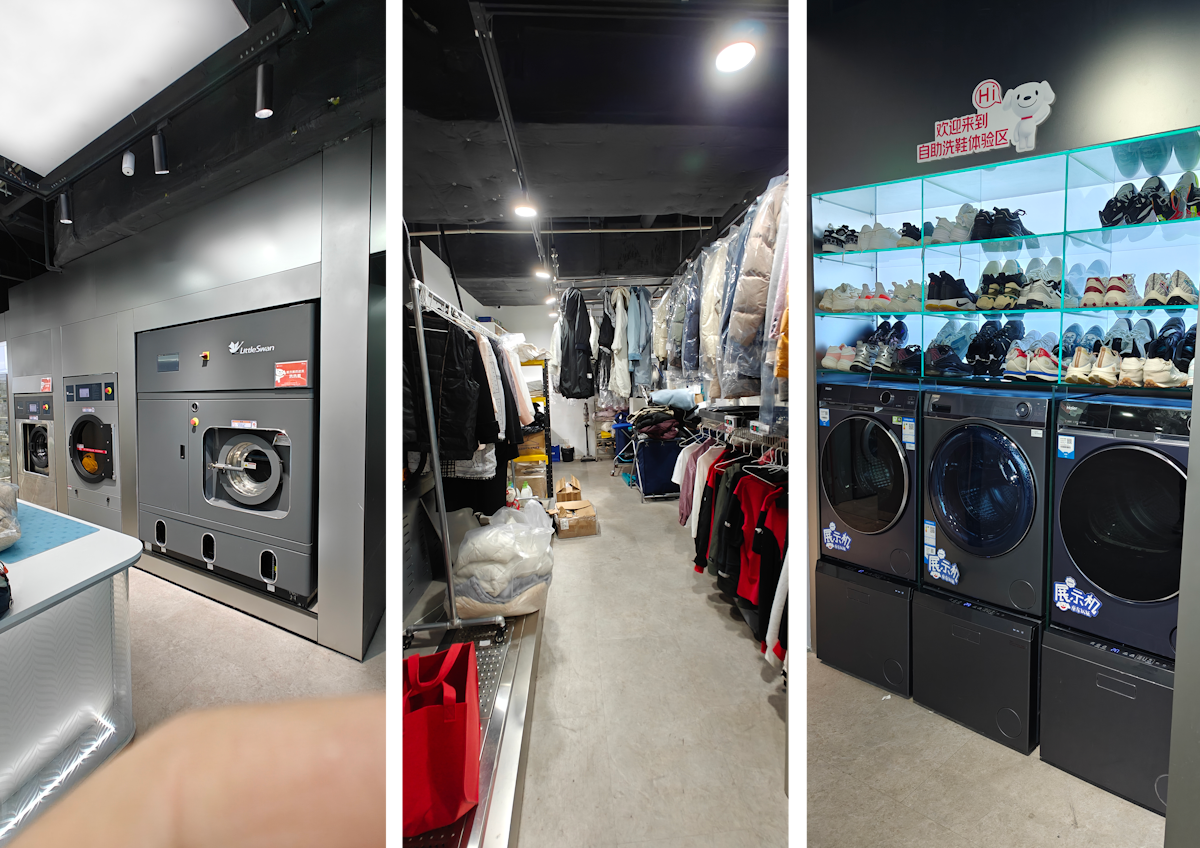
Experience corner: dry-cleaning and shoe washing service. “In the mini-program, there are various activities, such as laundry services. You can click on it, make an appointment, leave your phone number, and have your clothes picked up. After it’s washed, they will send you a text message to pick it up.”
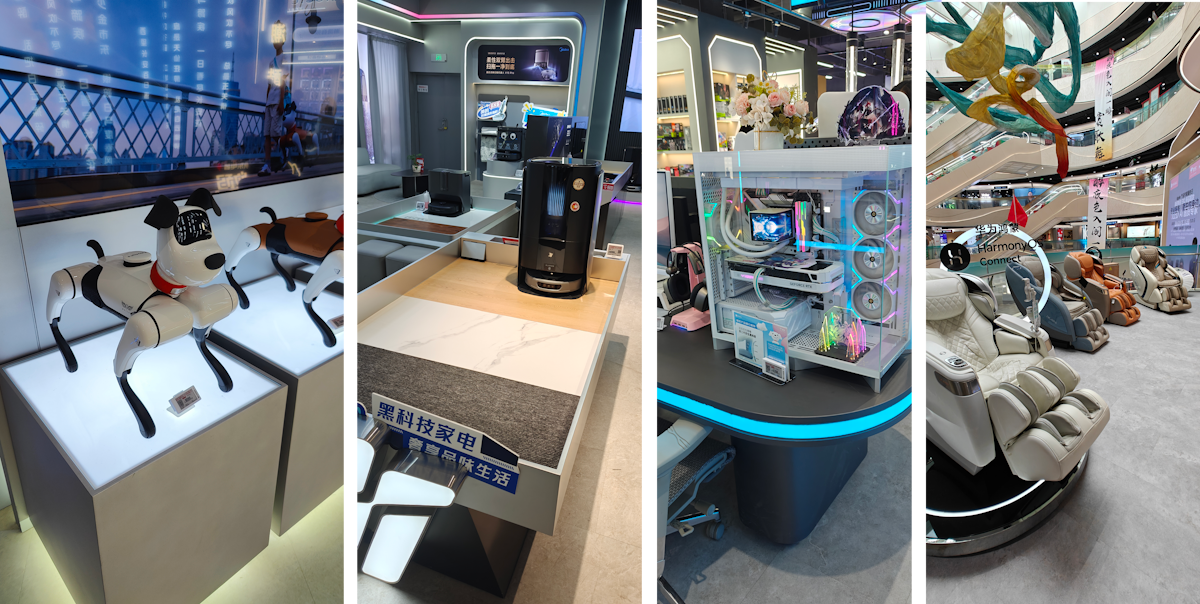
There’s something for everybody: robot dogs, cleaning robots, custom-built PCs and massage chairs. The store manager said about the robot dog: “We usually put them in the mall, where they just walk around. It attracts people, especially children. They can teach children English. Because it allows children to see and interact with them in real life, it can drive sales.”
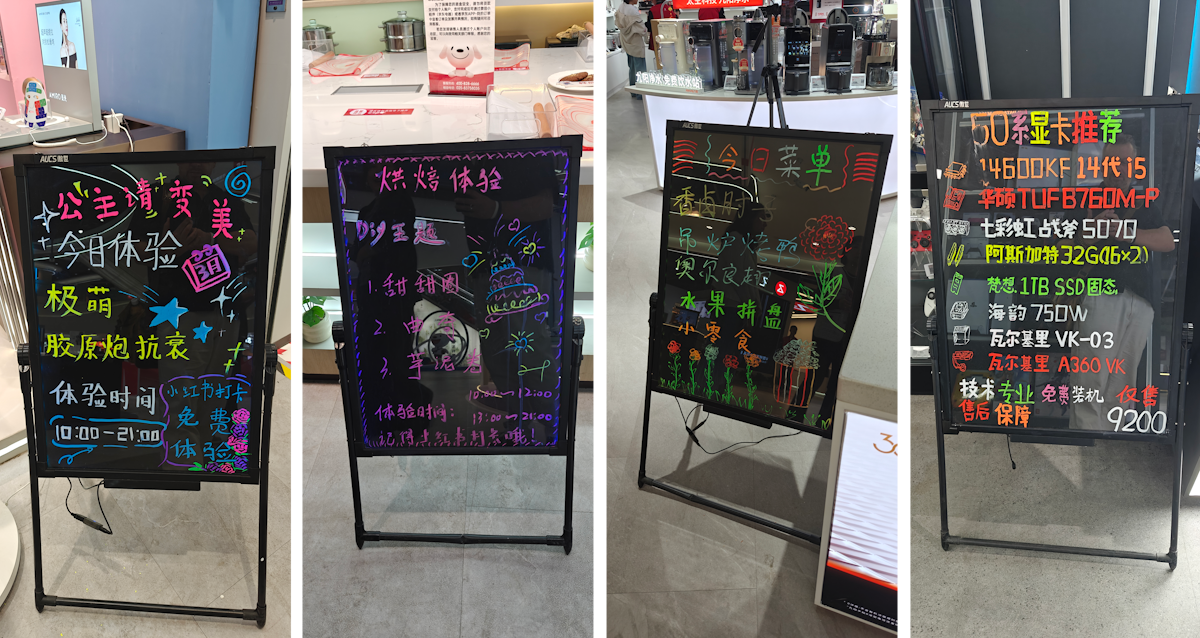
Each experience area will have boards that tell customers which activities will take place there or which promotions are active.
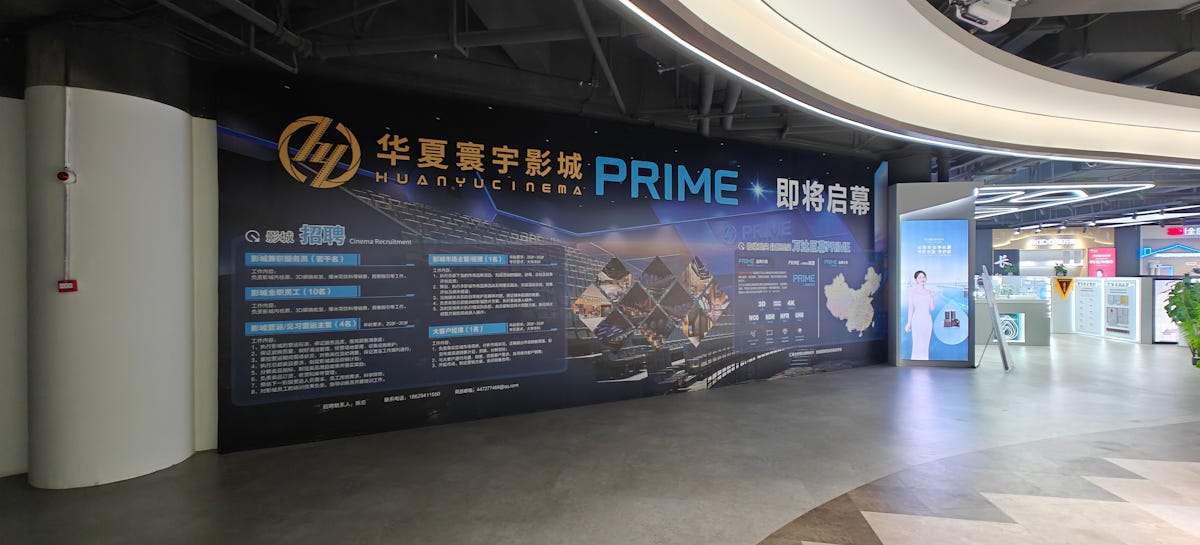
A soon-to-be-opened cinema.
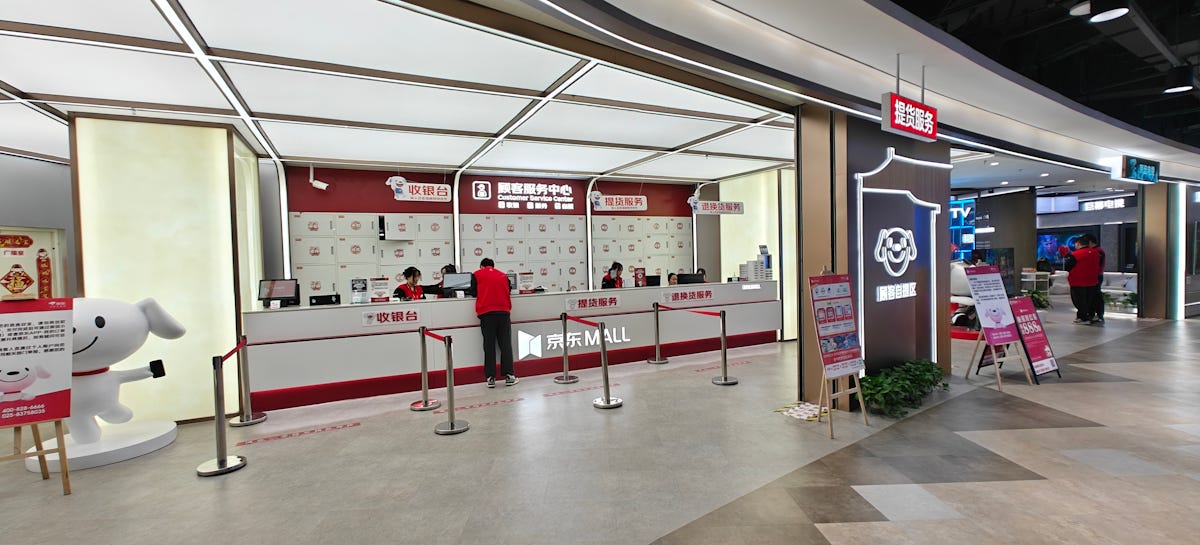
Customer service centre.
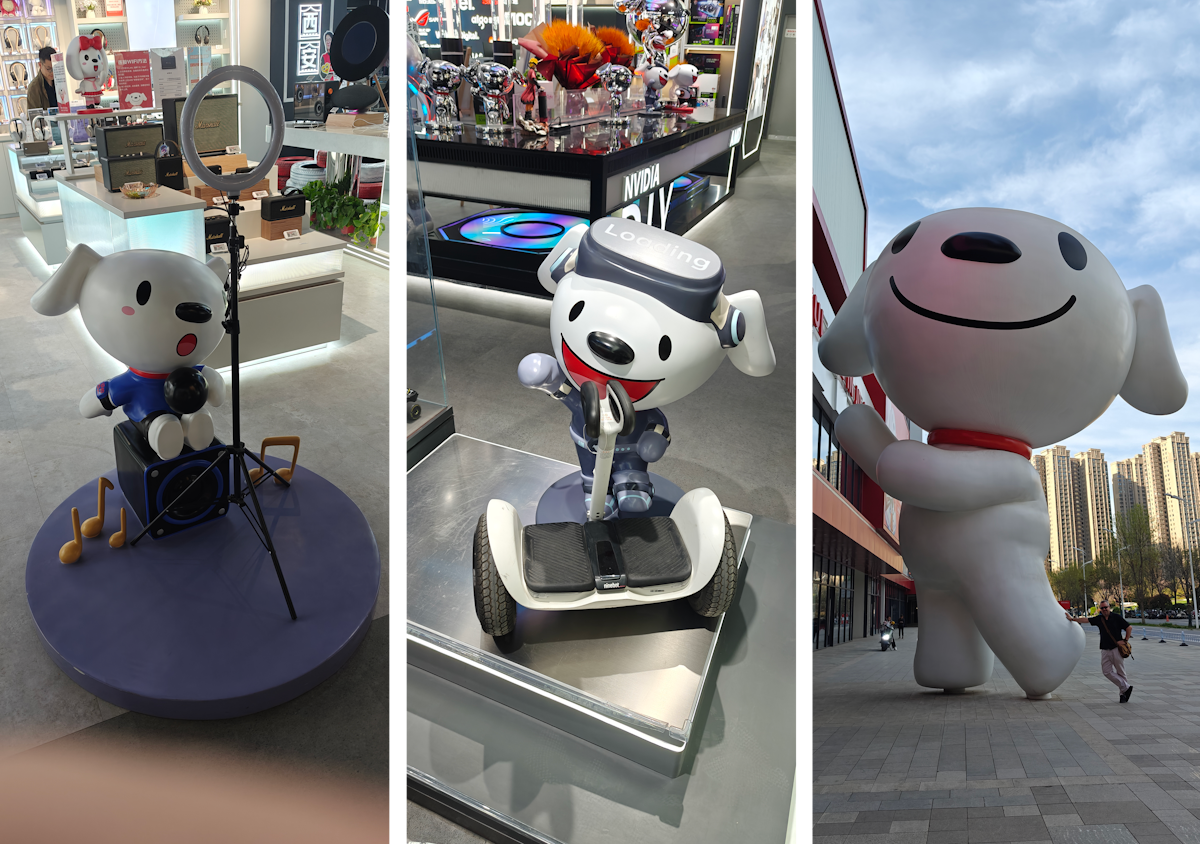
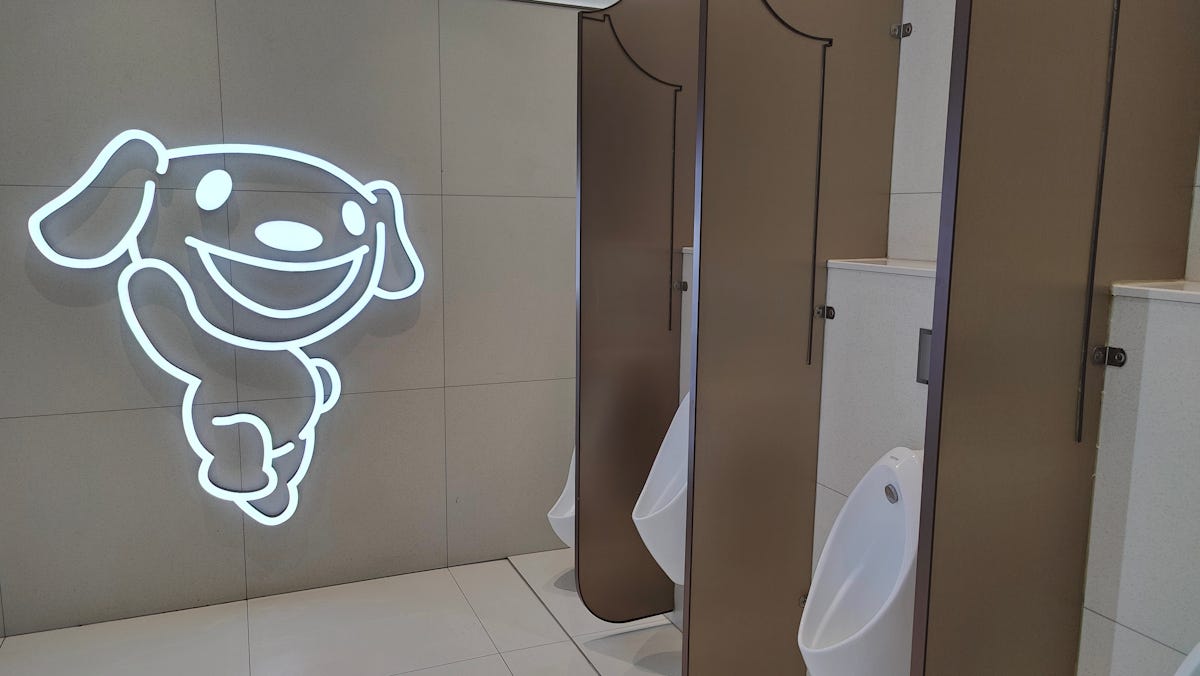
There is no escaping Joy Dog.
Qujiang Store Performance
Demographics: The store is located in Xi’an’s Qujiang district, widely considered an affluent area. Customer behaviour reflects this, with peak traffic after 3 PM and on weekends, and a less price-sensitive response to promotions than at other stores.
Key Metrics: Despite having lower overall foot traffic than the Xi’an Shenglong store, the Qujiang location achieves sales figures that are “infinitely close” to those of the Shenglong store. This is driven by (at least in April 2025):
Highest Average Transaction Value in the nation.
Highest Average Item Price in the nation.
Product Mix: The store successfully sells a high volume of premium and expensive products, validating the strategy of matching high-end experiential retail with an affluent customer base.
Chongqing (Liangjiang Store) - September 2025
Chongqing has two JD Mall stores. I decided to visit one of them during my stay in the city in September 2025.
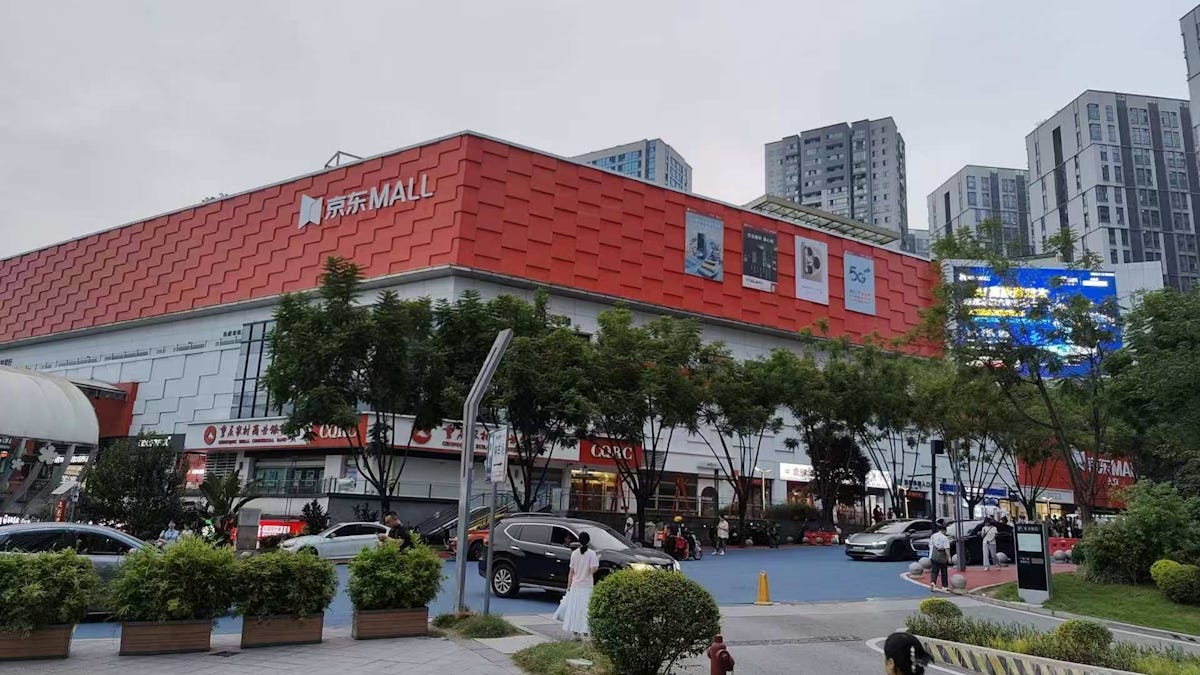
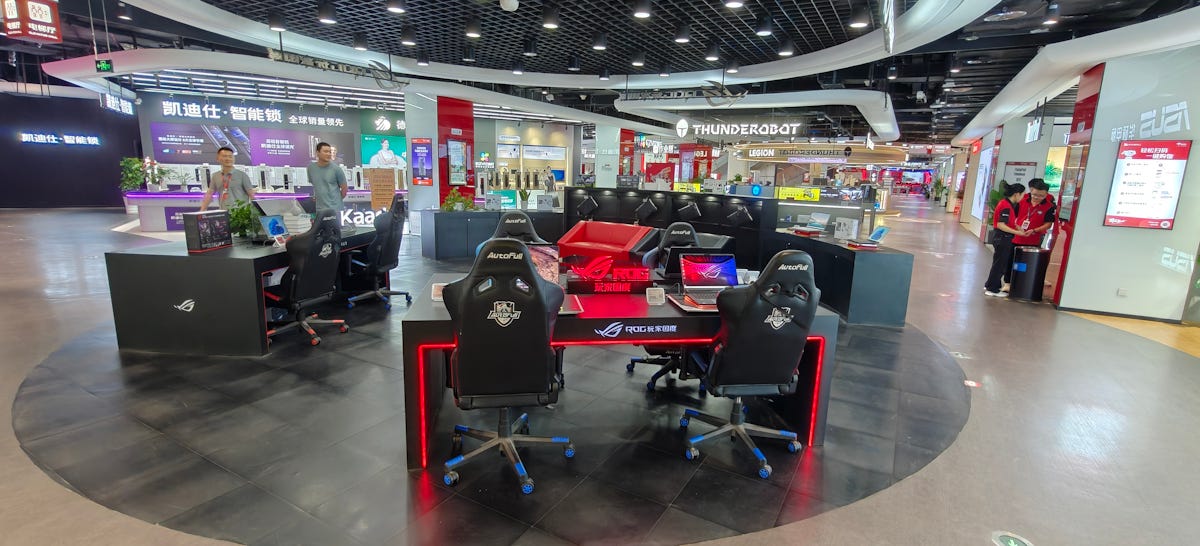
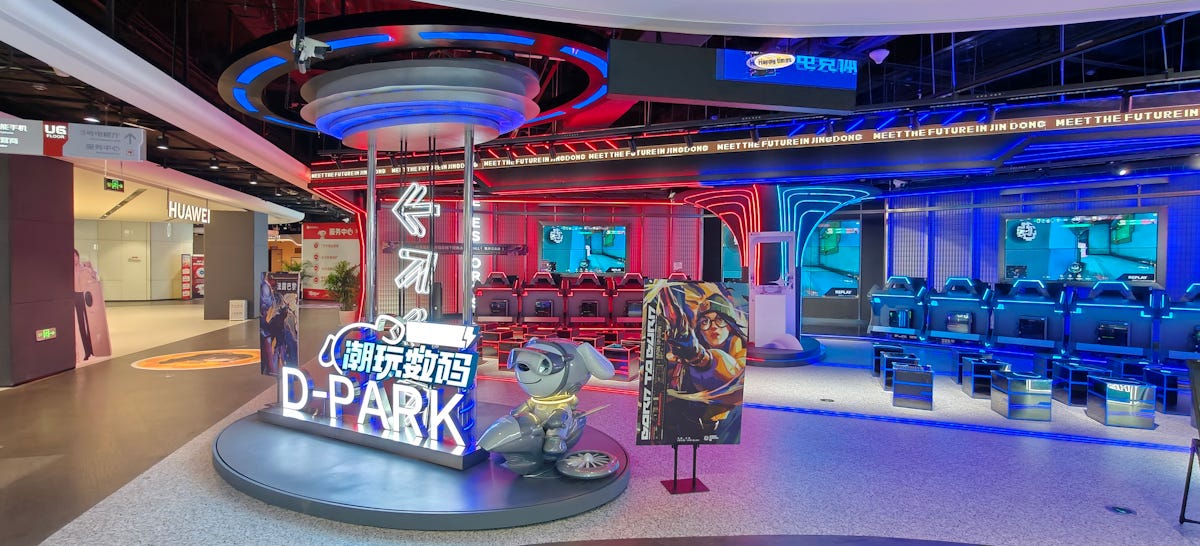
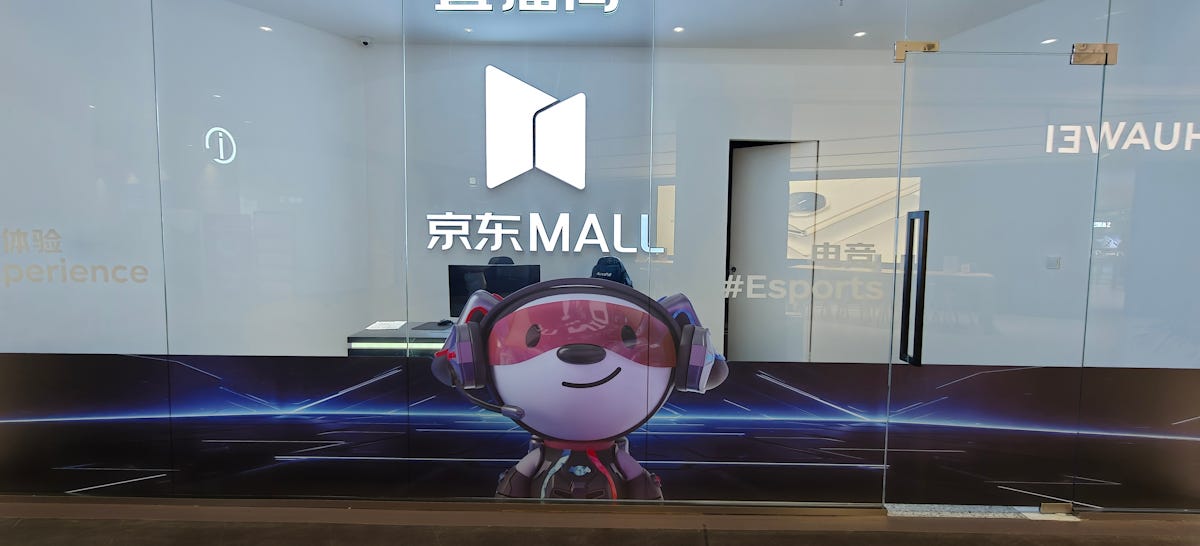
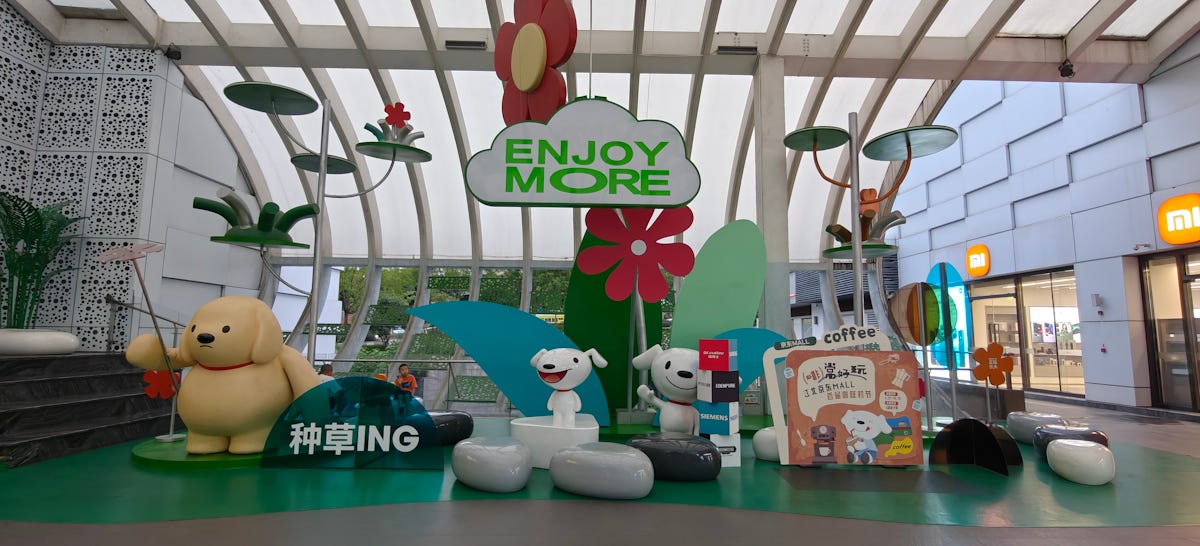
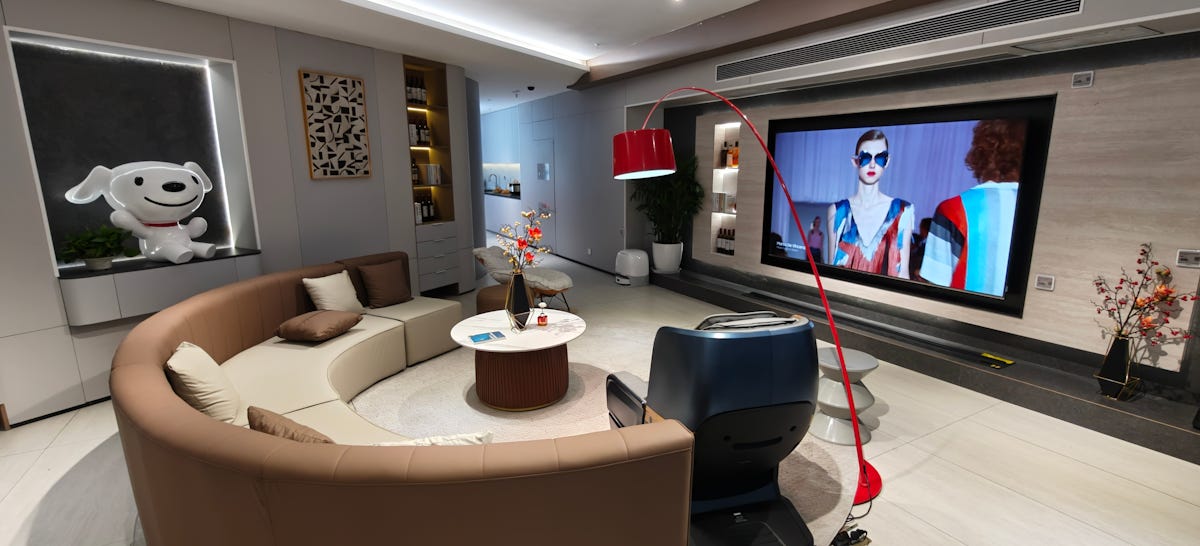
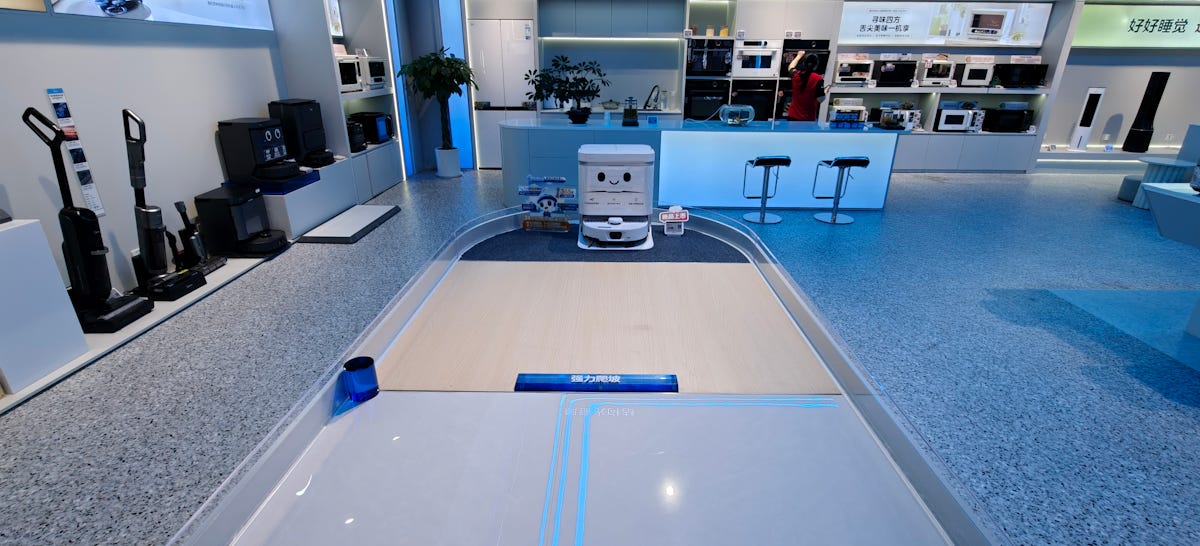
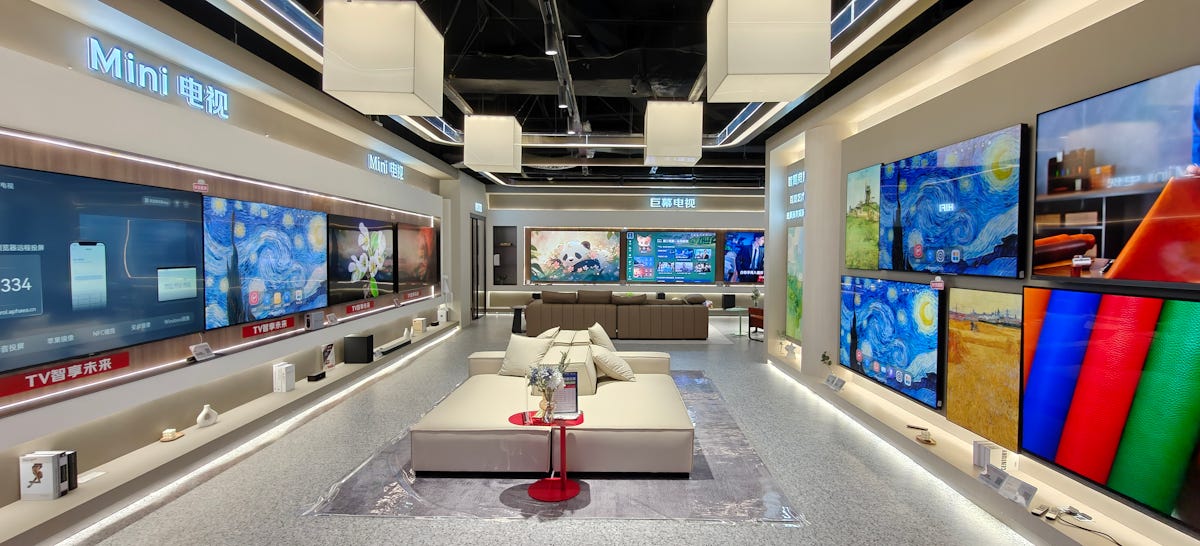
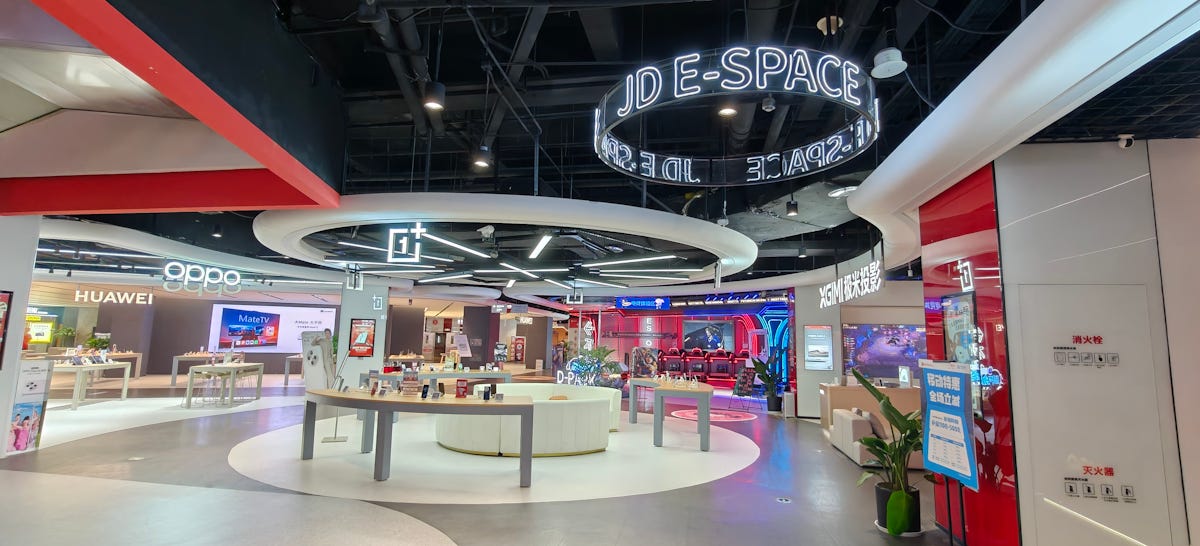
This Chongqing JD Mall clearly shows its JD e-Space heritage.
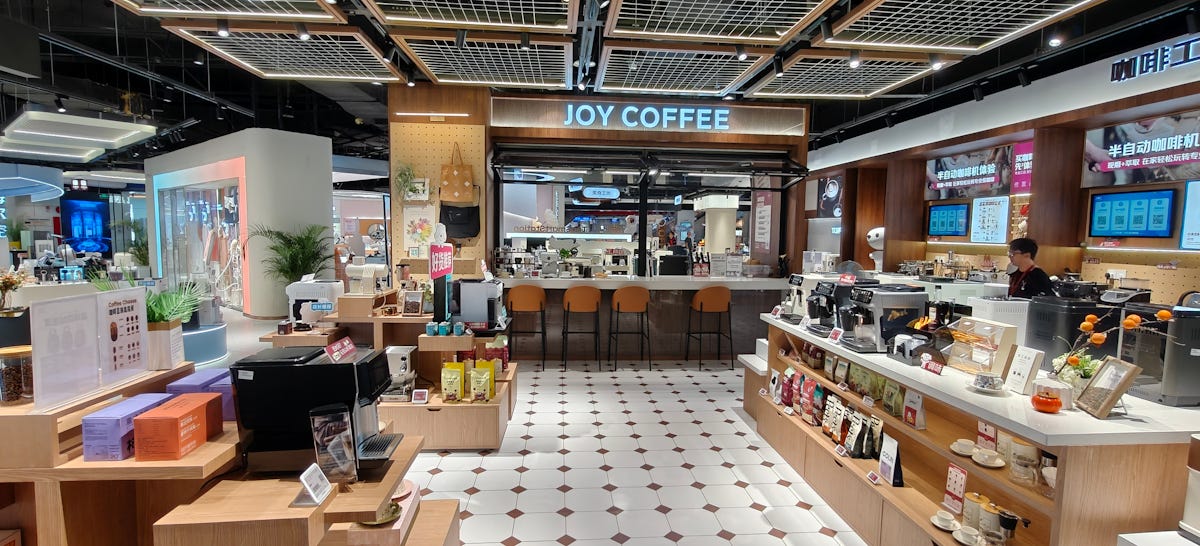
Joy Coffee store is an example of commercialising the experience zones.
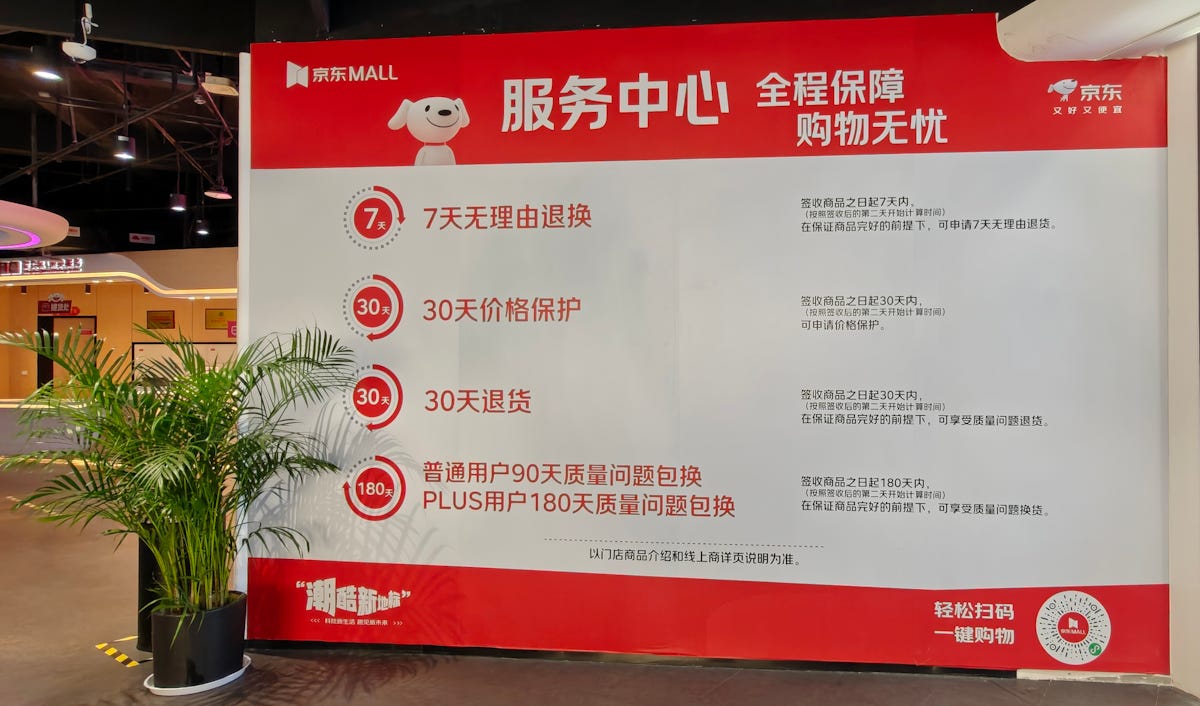
Worry-free shopping with full protection:
7-day no-reason return or exchange
30-day price protection
30-day return
Regular users get a 90-day replacement guarantee for quality issues; Plus users get a 180-day replacement guarantee for quality issues.
Beijing (Shuangjing Store) - October 2025
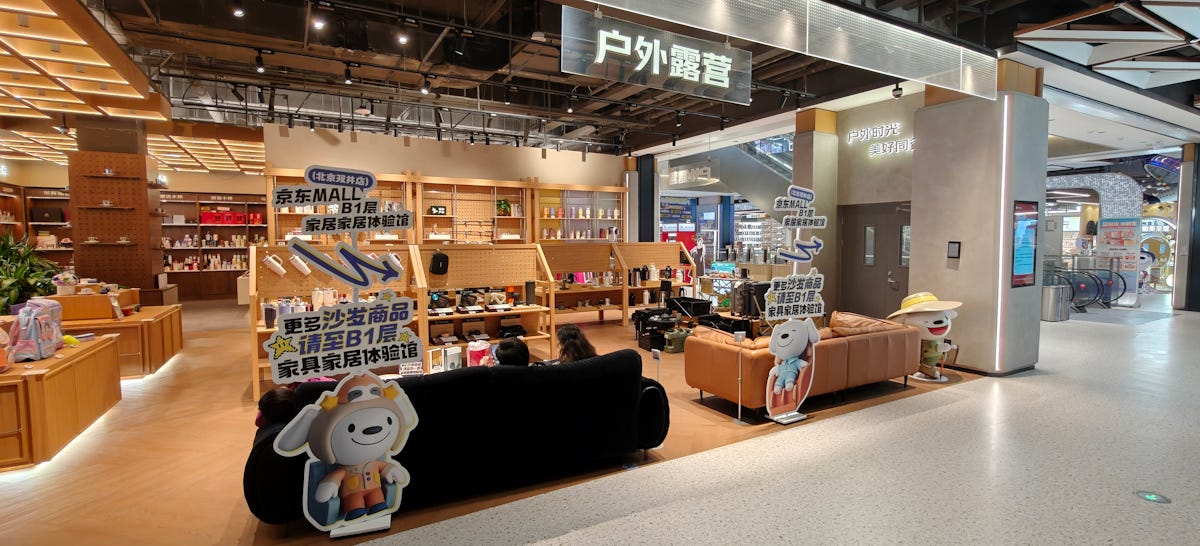
The Beijing Shuanjing Store, measuring 50,000 square metres, opened in June 2026. When I visited it twice in October, a few things stood out. Most importantly, this JD Mall went beyond the standard consumer electronics and, for instance, had a sizeable bookstore. It also offered many catering options, including coffee, food, and ice cream, on various floors. These additional facilities are meant to help extend customers' stays at JD Mall.
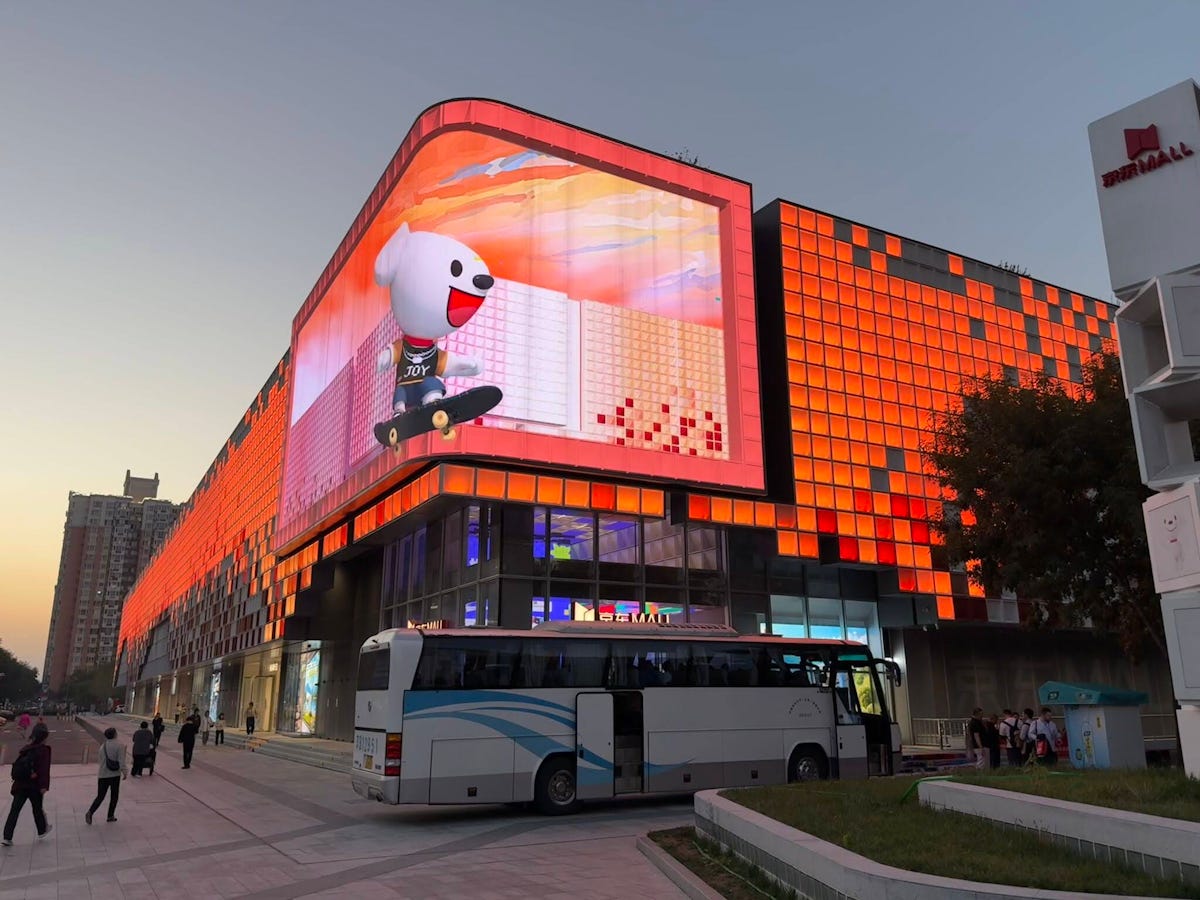
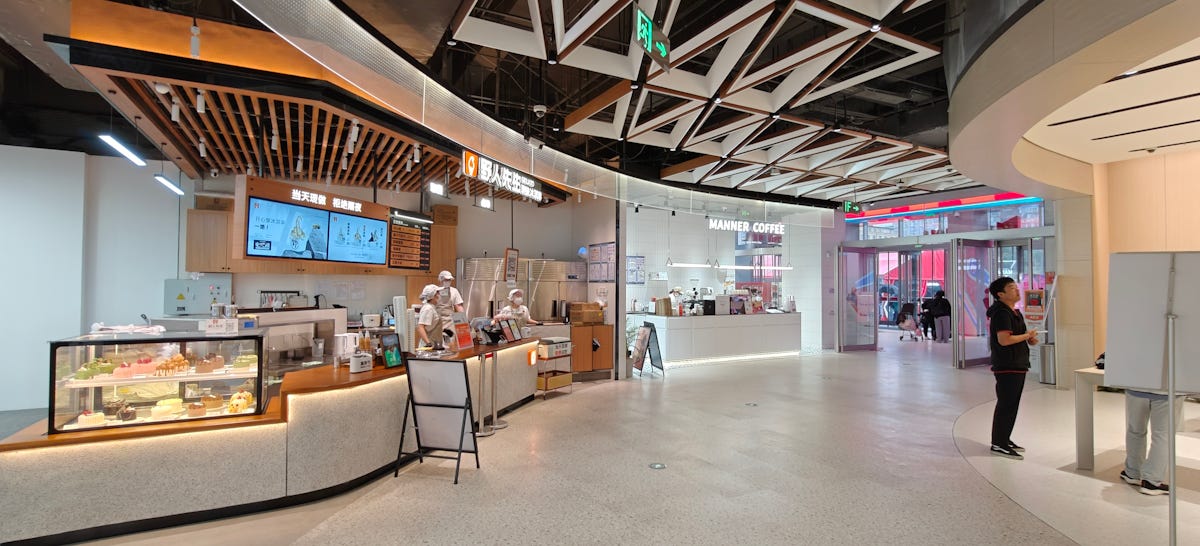
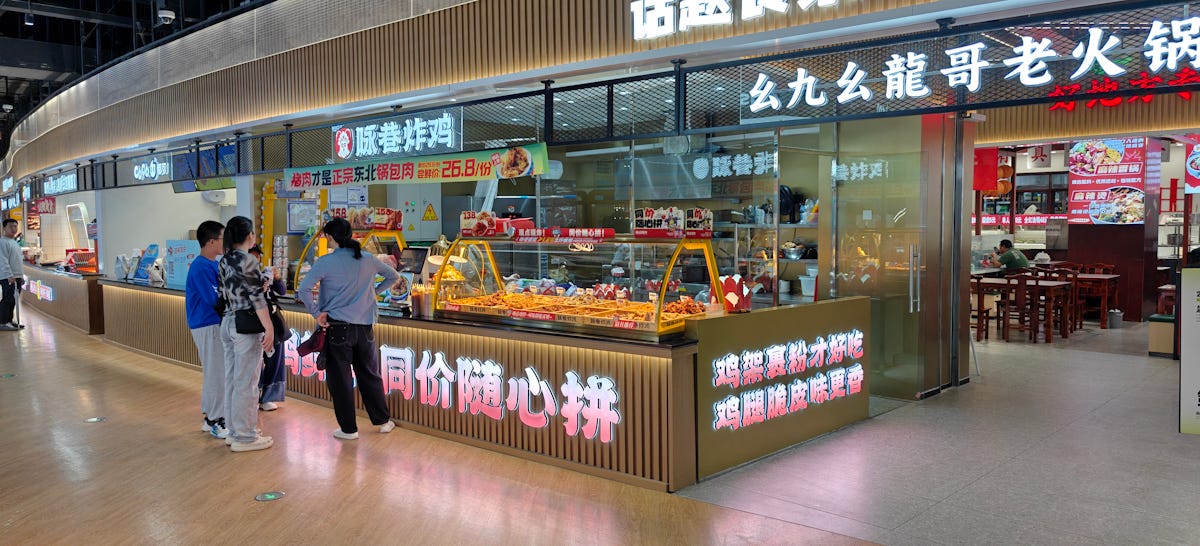
Catering facilities.
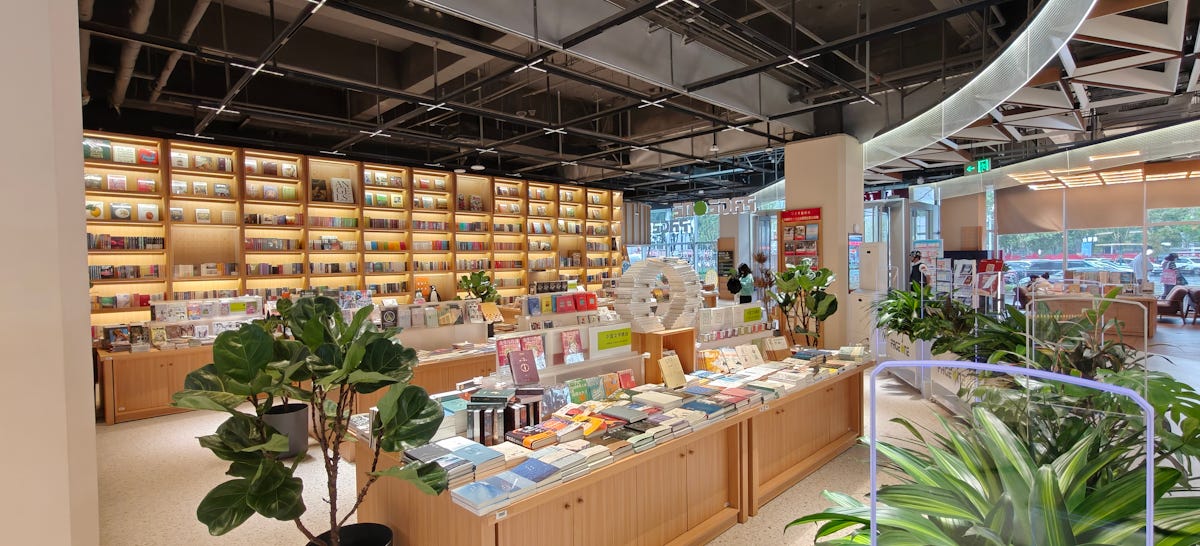
Bookstore.
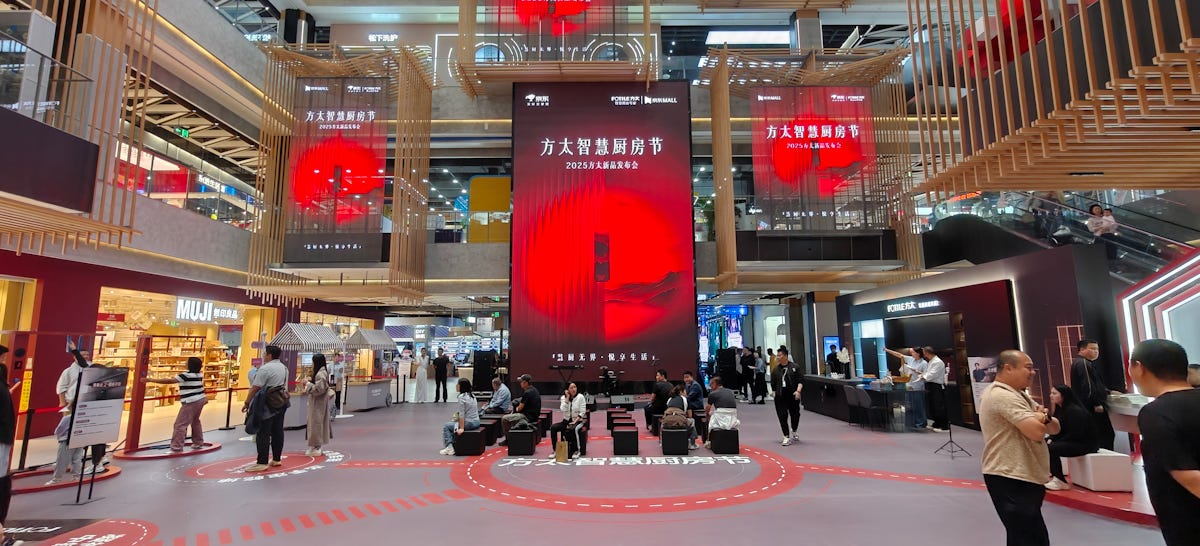
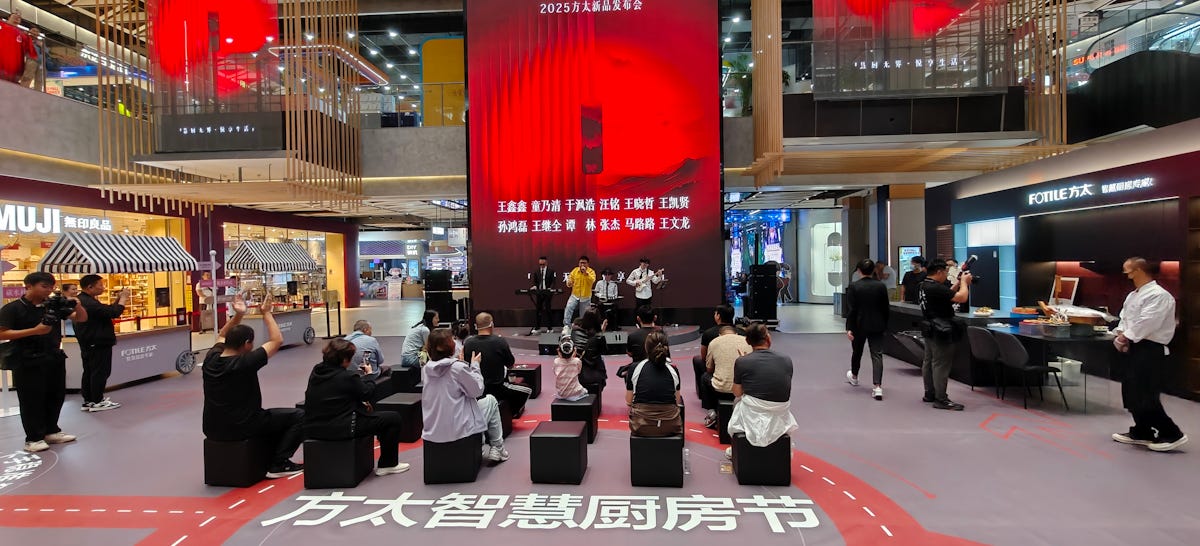
Performances in the main hall.
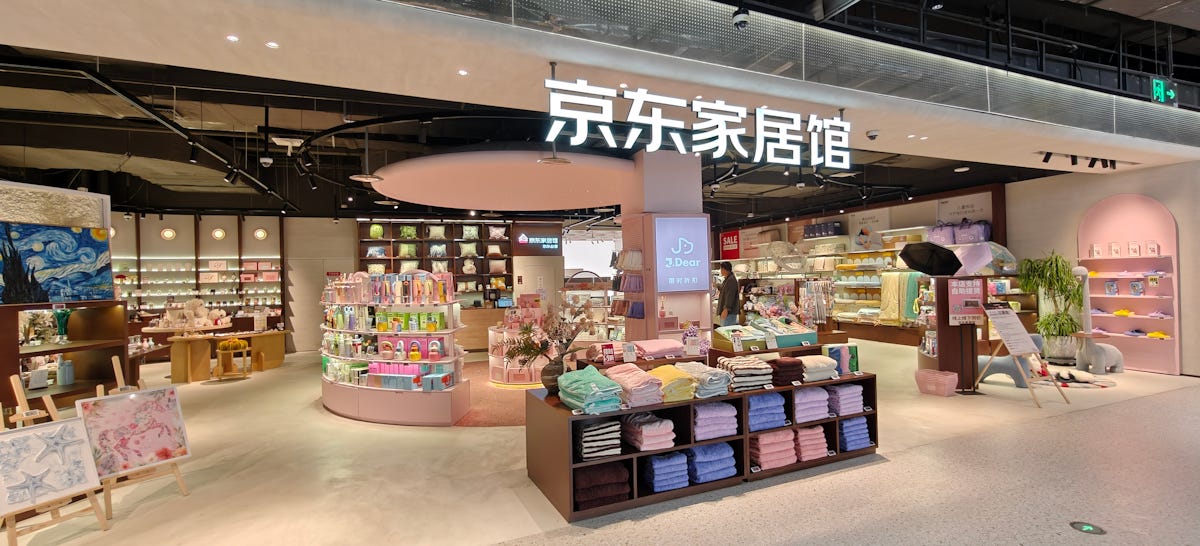
Jingdong Home Store.
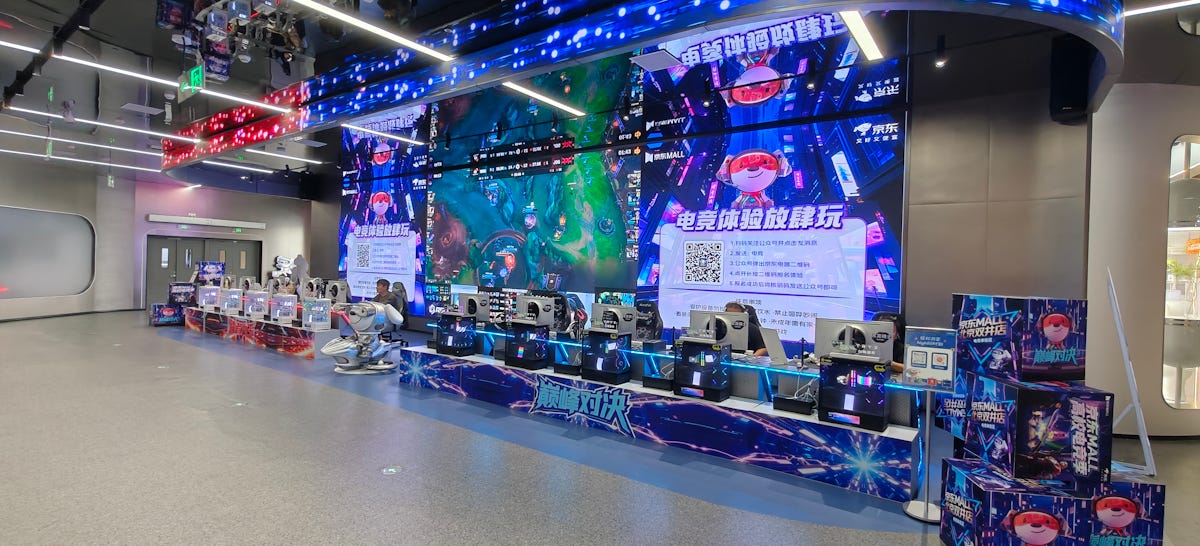
eSports.
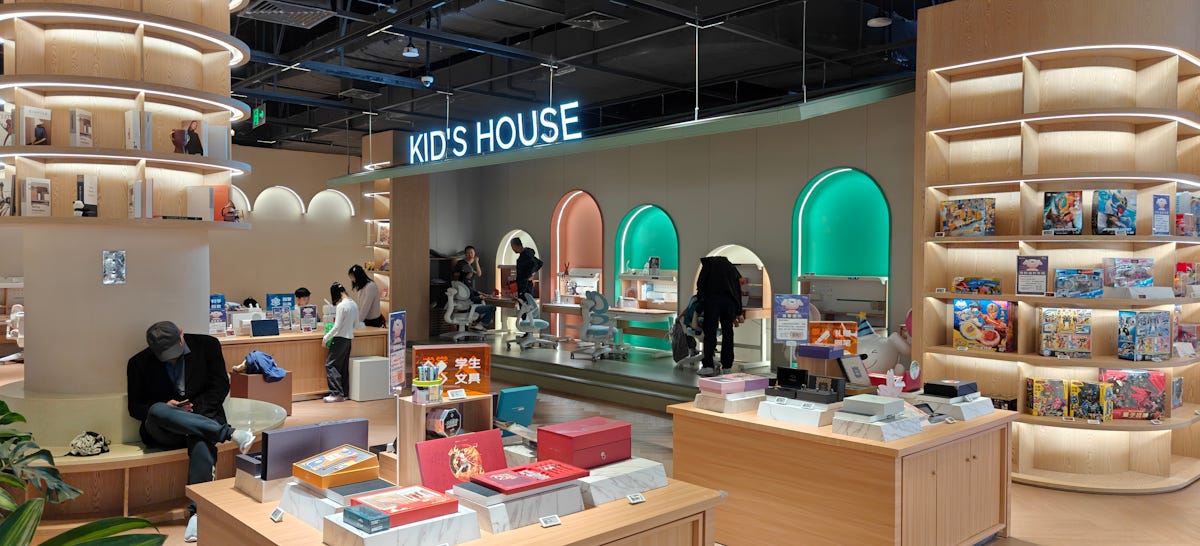
‘Kids house’.
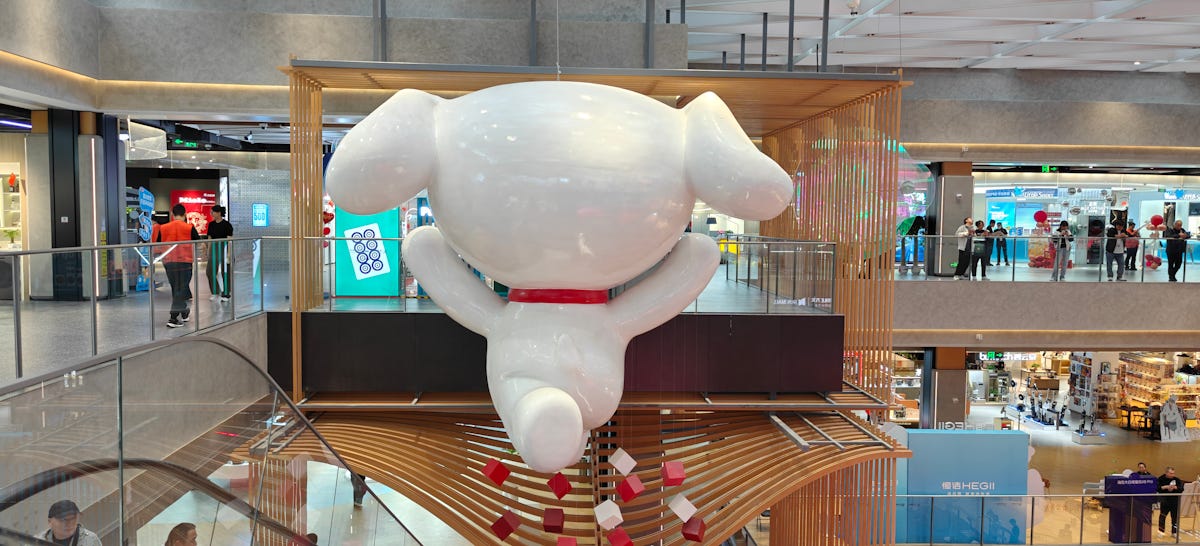
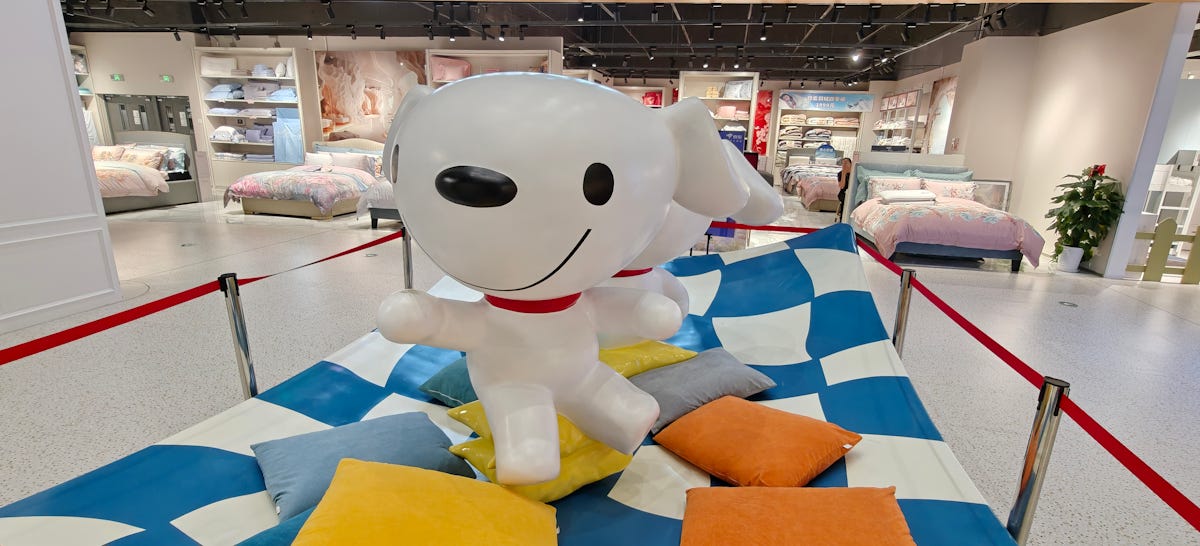
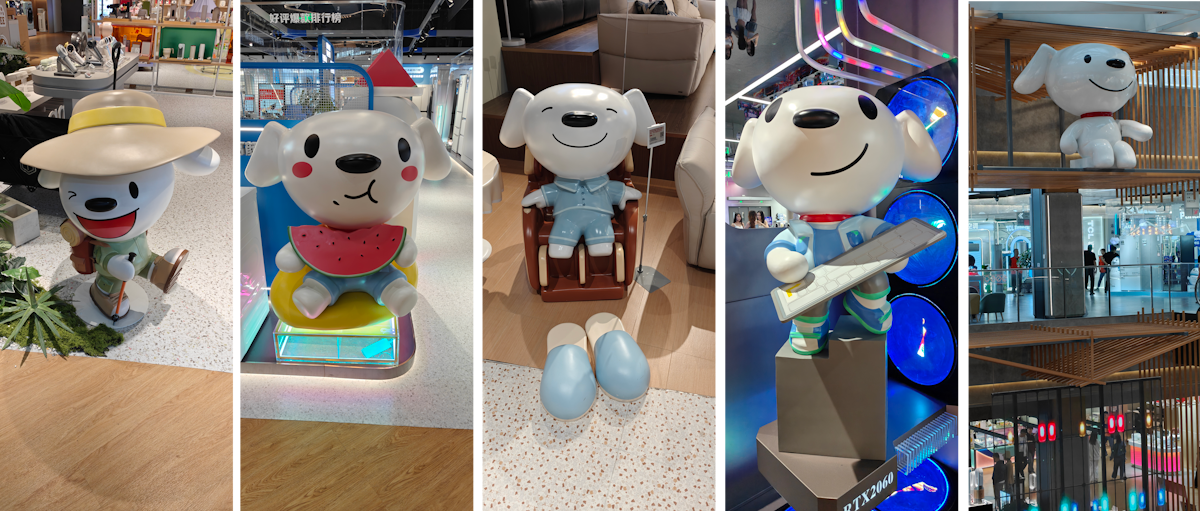
The ever-present Joy Dog.
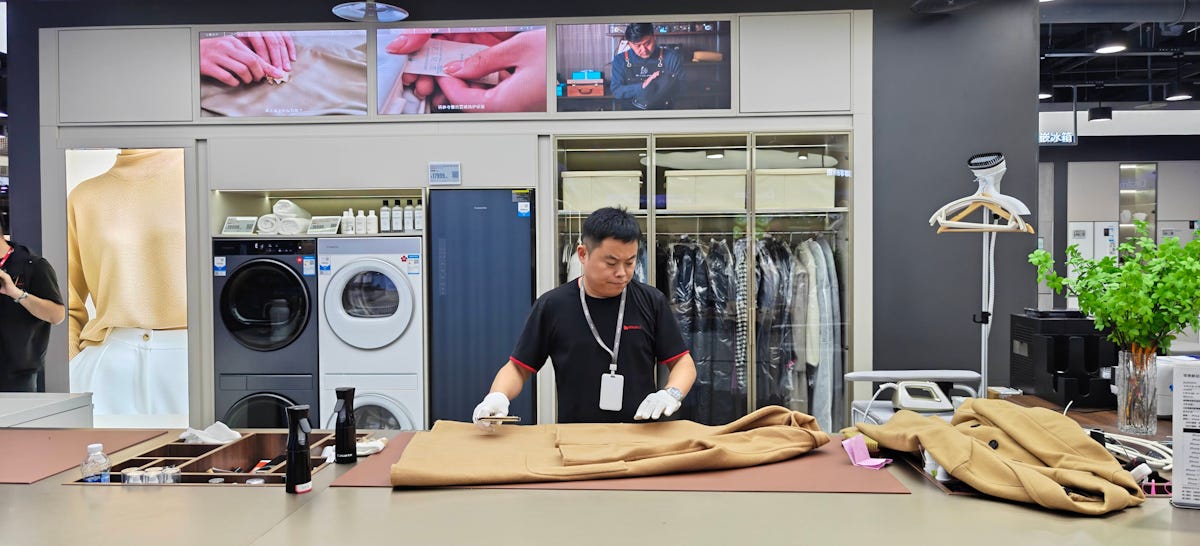
Dry-cleaning service.
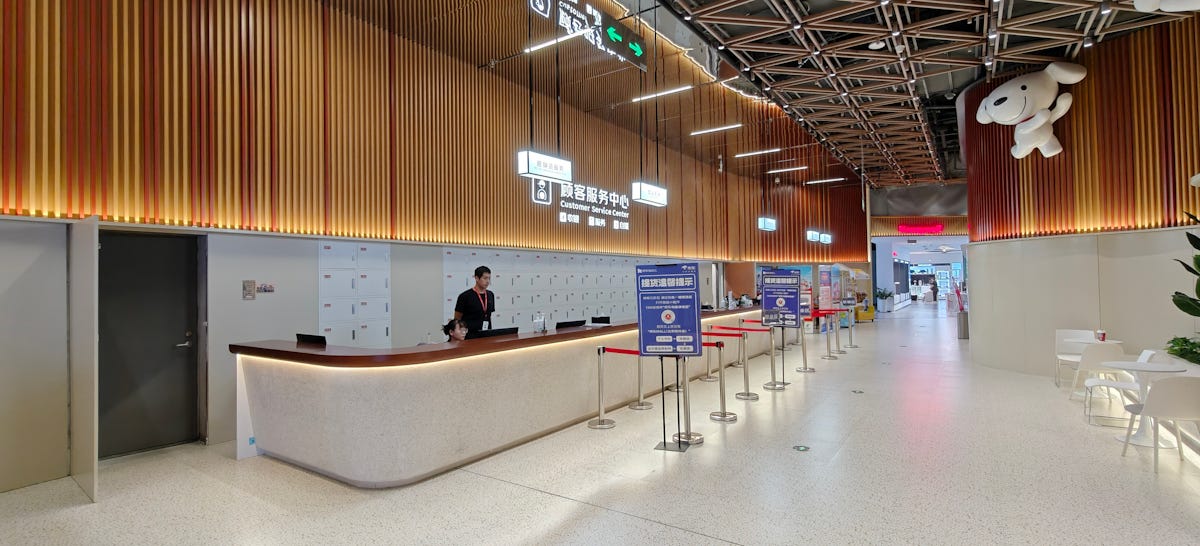
Customer service centre.
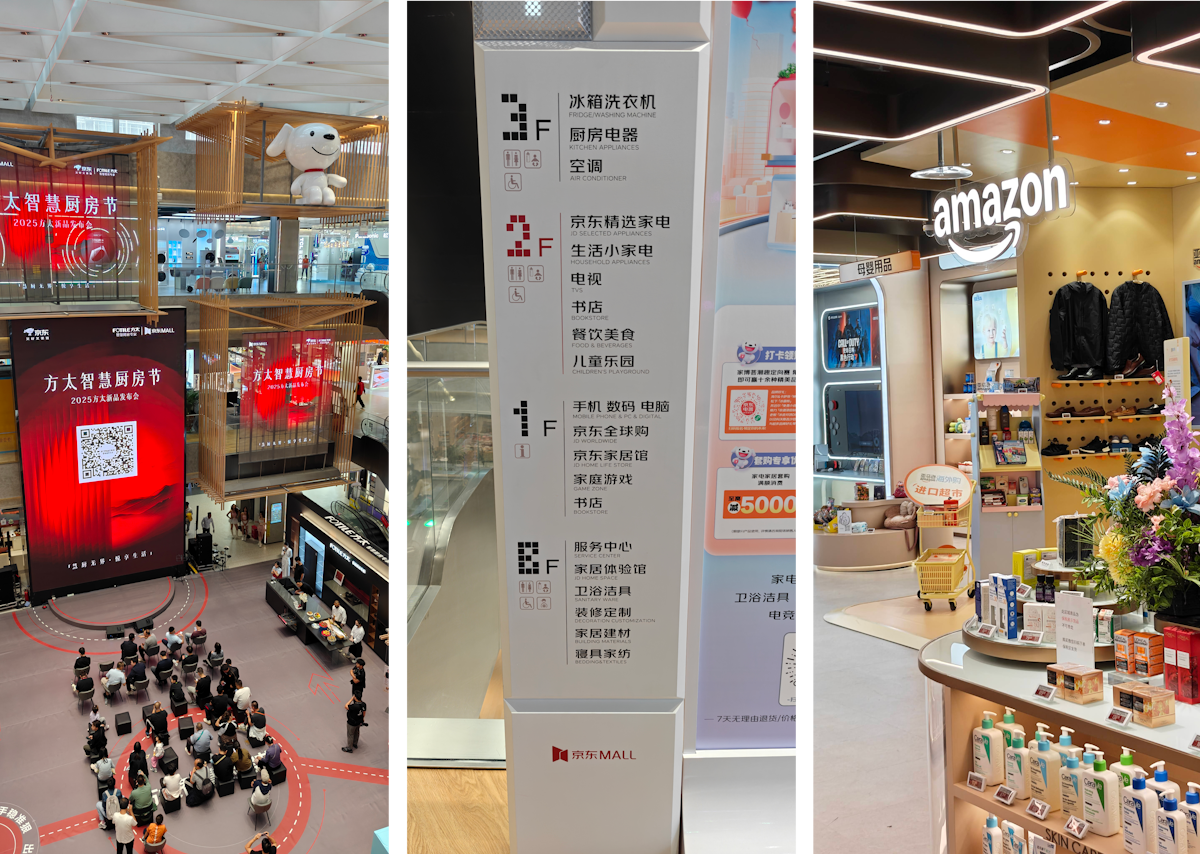
Four floors of shop-in-shops, even including Amazon (!).
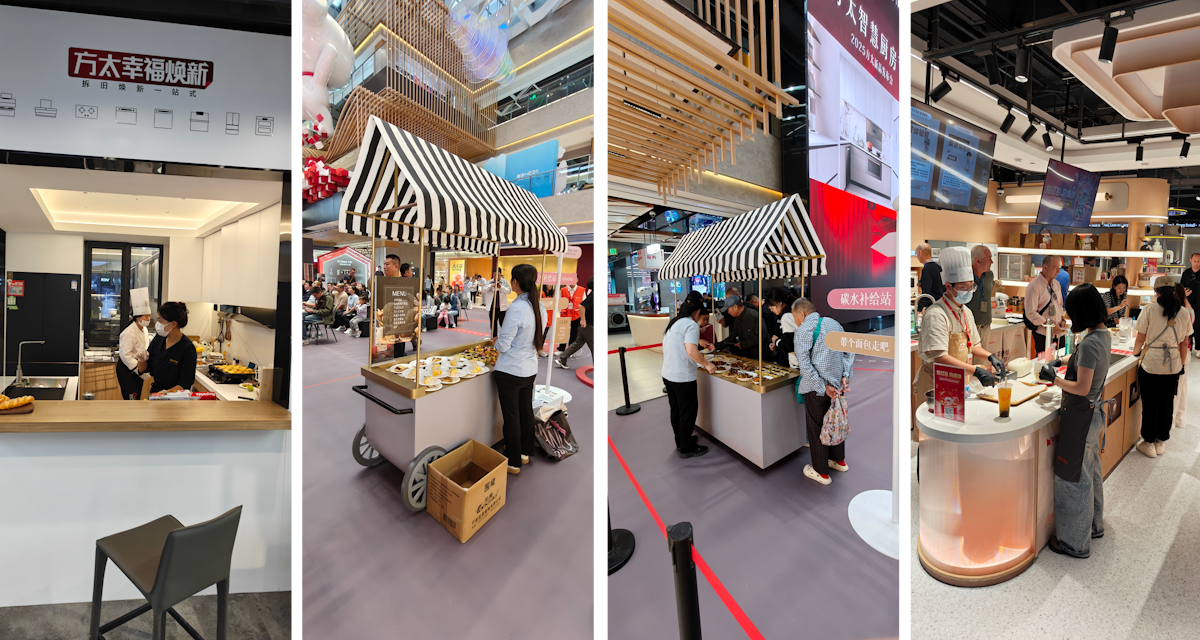
Lots of snacks to try out.
‘This will never make money!’
In October, we visited the JD Mall in Beijing as part of the ChinaTechTrip tour with K5 and were guided around by the store manager. The German and Polish participants were impressed and baffled at the same time.
One of the participants snubbed the concept and confidently claimed, ‘This will never make money!’ Participants referred to Amazon's attempts to do something similar, which had failed. But maybe they were unable to evaluate things within the Chinese context.
When asked about the ROI of the business model, the store manager added an interesting aspect that might feel counterintuitive but rings true for the Chinese market: customer acquisition costs. The Mall is basically an offline version of JD’s website, with dedicated brand stores. JD will generate revenue from rent and commissions on sales from these stores, but the primary role of JD Mall is to acquire customers.
In China, it has become costly to acquire customers online, so internet companies are increasingly using offline initiatives to recruit new customers. Once recruited, they are pulled into the ecosystem of these Chinese internet companies. For JD, affluent customers recruited through JD Mall can be offered a range of additional services via the JD app, including high-quality meal delivery with JD Takeaway and grocery delivery with 7Fresh. These services will appeal to the same customer profile that shops at JD Malls.
Indeed, as far as we can tell from available data (JD doesn’t publish its customer acquisition costs), JD’s CAC have been going through the roof in recent years.
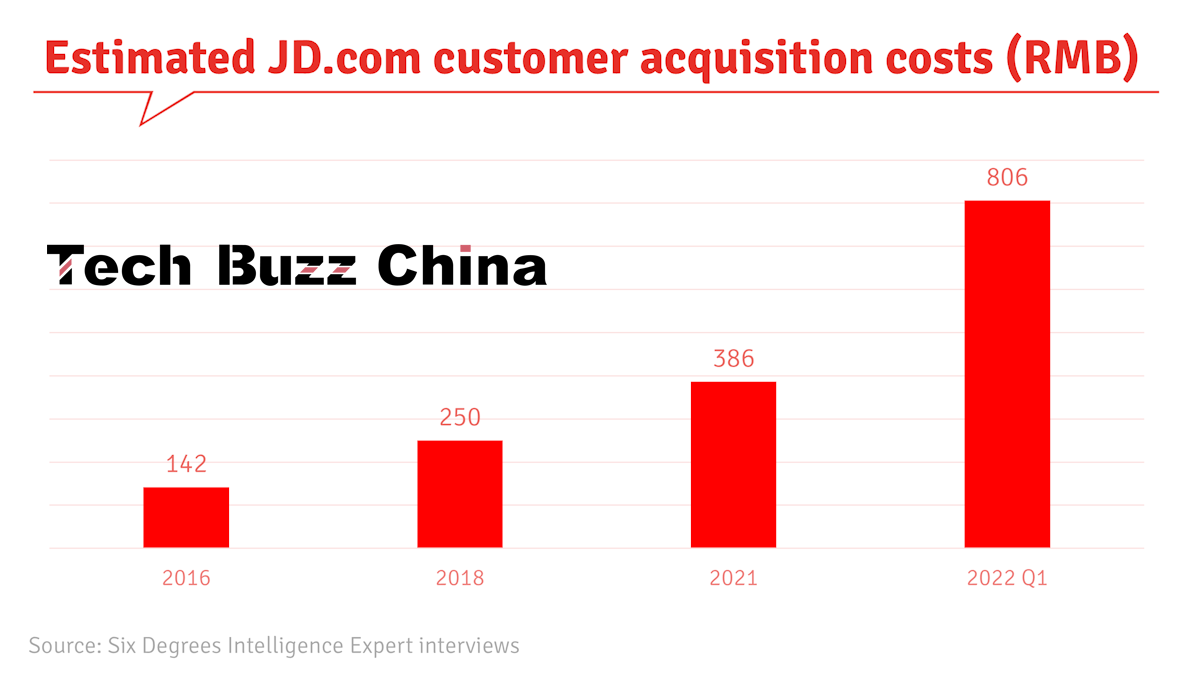
Acquiring customers through an offline store has, in some cases, become cheaper than through online channels. And this is not something new in China. In fact, rising online customer acquisition costs were one of the drivers of the New Retail movement in the second half of the last decade.
There are other initiatives that JD uses to gain new customers. When, during an earnings call, JD was questioned about the high investments in the launch of JD Takeaway’s food delivery business, JD responded that, while it might be loss-making at the moment, it helped them acquire customers at a lower cost than if it had bought and converted traffic from third-party channels like Douyin.
And there is one clear sign that this strategy seems to be working: the growing number of JD Malls launched and to be launched across China. It’s an incredibly high-value asset investment for JD. Throughout the years, I have seen JD experiment with various formats, including JD X unmanned stores and Jingxi offline stores. These have all disappeared, and I consider them careful experiments because the number of stores was always kept limited. With JD Mall, I see the opposite happening. They don’t disappear; instead, they continue to grow in number. The first stores must have validated the concept, which is now being rolled out. In fact, the company plans to open dozens more across China. [6]
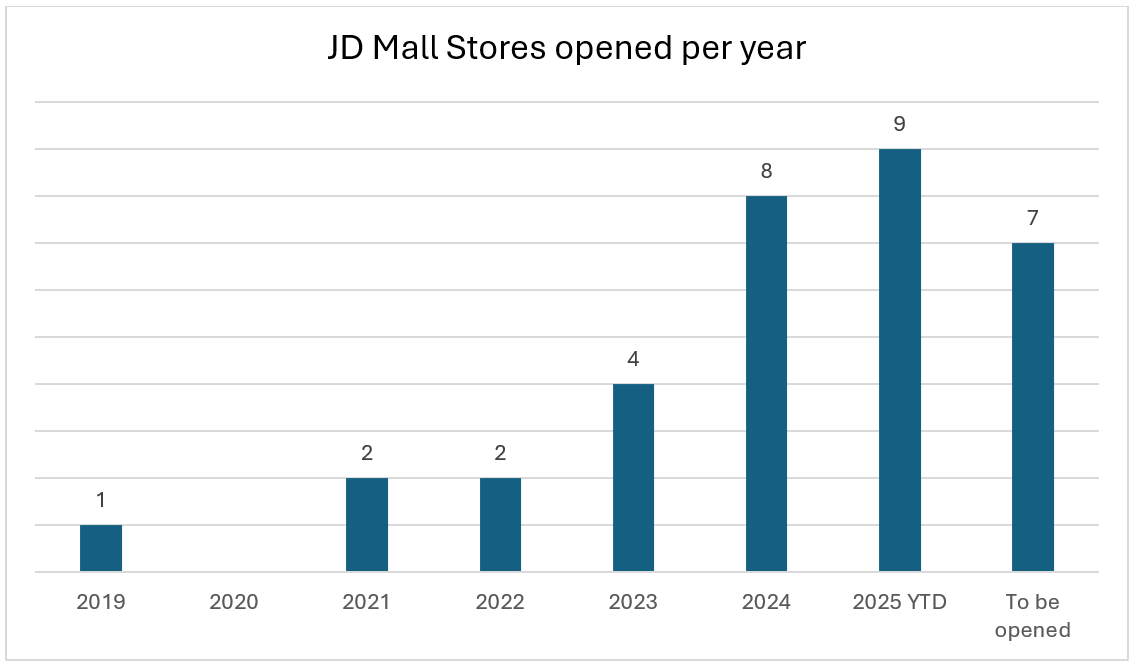
Note: The Xi’an, Chongqing, and Hefei stores originally started as e-Space stores. Their opening dates were used in this chart.
JD has had its fair share of offline retail failures. It meant to open 100 unmanned convenience stores in 2018. They were closed down after reaching roughly a dozen. [8]
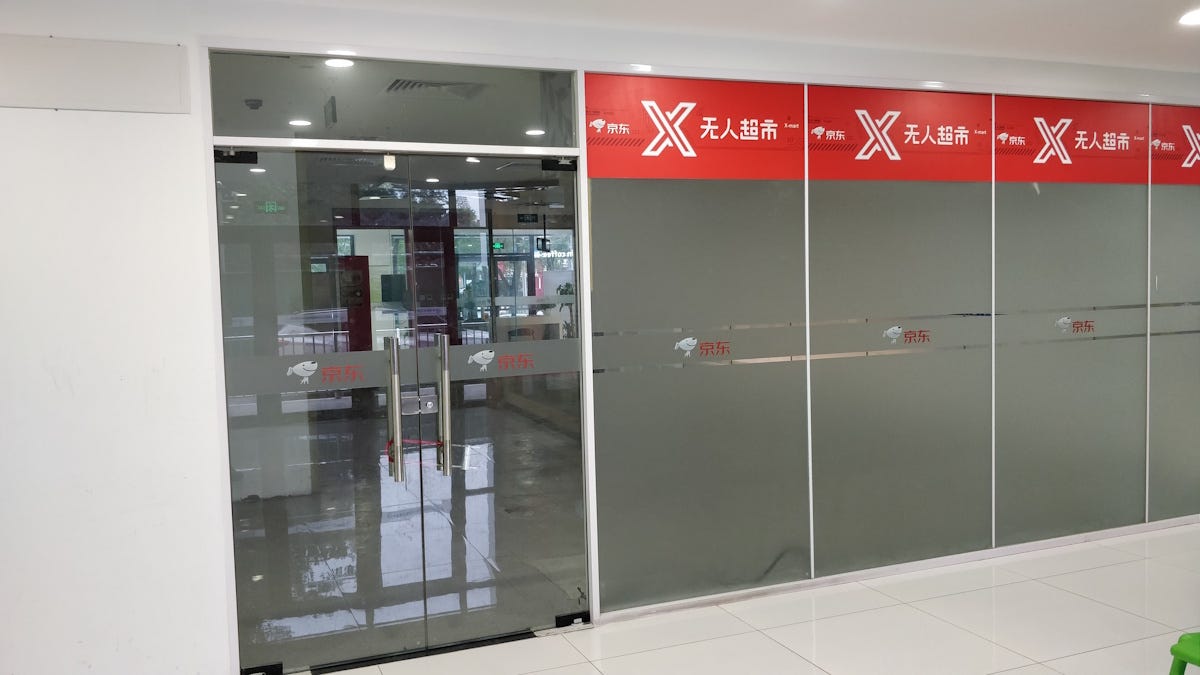
A closed-down JD unmanned store in Beijing, 2019.
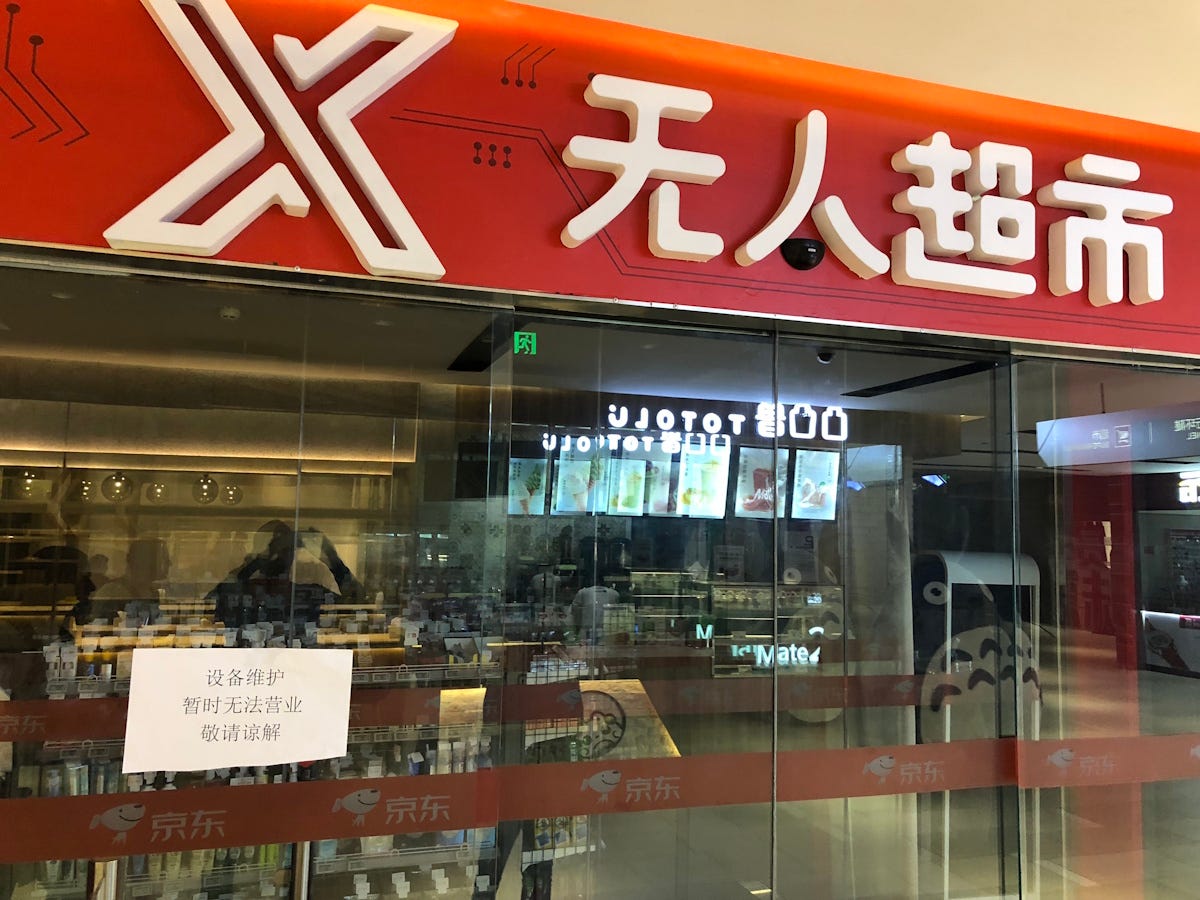
Another unmanned store closing down, Beijing 2018. The notice reads “Equipment maintenance. Temporarily unavailable for business. Thank you for your understanding.”
I have also tried to visit offline stores for Jingxi, JD’s answer to Pinduoduo, but found them deserted.
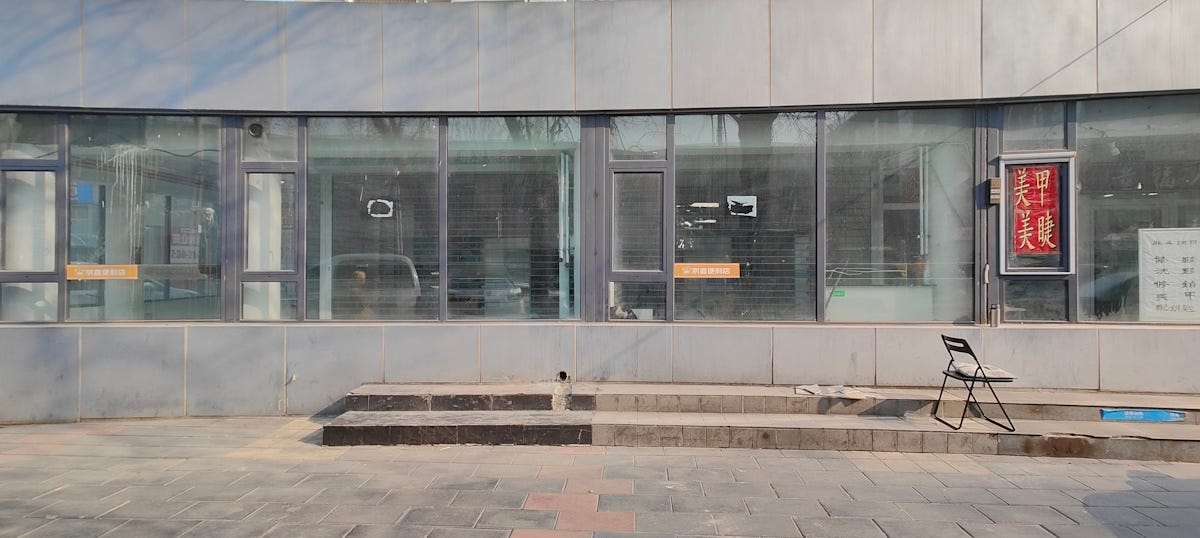
Deserted Jingxi store, Beijing 2024.
While JD obviously constantly experiments with offline retail formats, it just as easily shuts them down when they fail. The fact that it continues to expand an expensive format like JD Mall points to a certain level of success.
Of course, there is no guarantee that every JD Mall will be a success. JD has benefited strongly from the government’s consumer subsidies for consumer electronics in 2024 and 2025. It remains to be seen what will happen when those stop, since consumer confidence is still low. There are also signs that not every store is doing well. For instance, two dark upper floors at Chongqing’s Liangjiang Store suggest that business is not what it used to be.
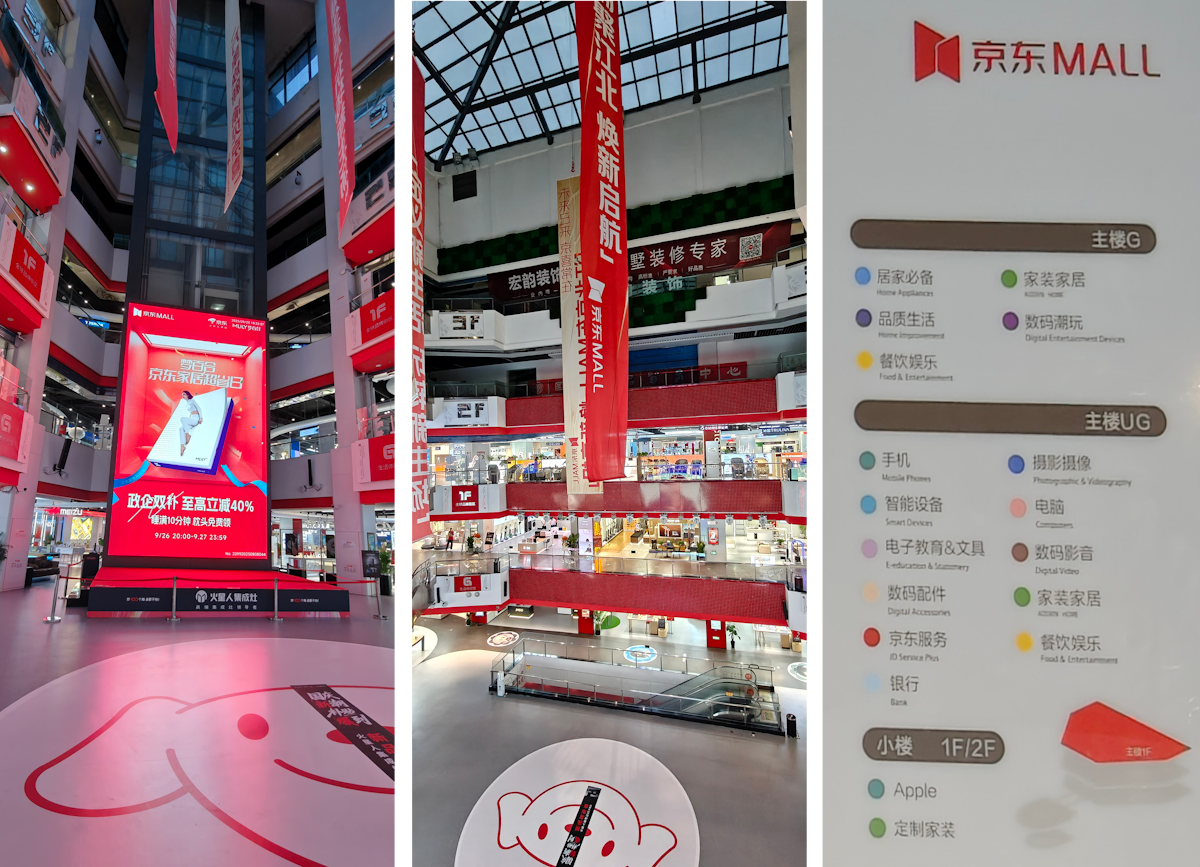
Empty floors at the Chongqing Liangjiang JD Mall.
Another sign of internet companies struggling with offline stores was the Tmall Premium Home Appliances & Furniture store I stumbled on in Hangzhou last April. The store was in a sorry state, with big banners trying to hide the empty spaces. More than half of the floors were desolate, and not a soul was in sight.
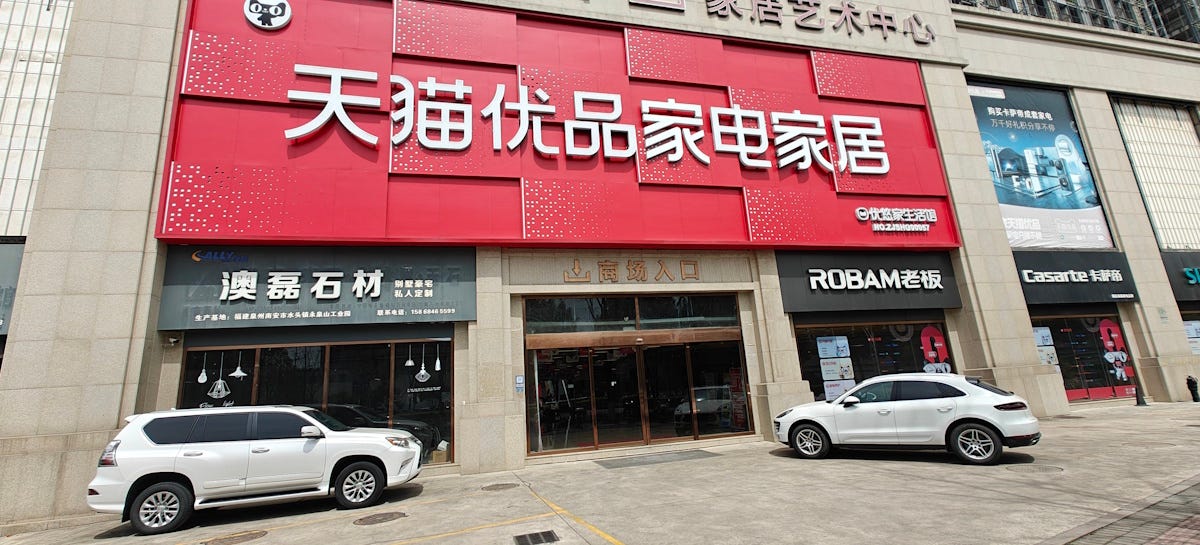
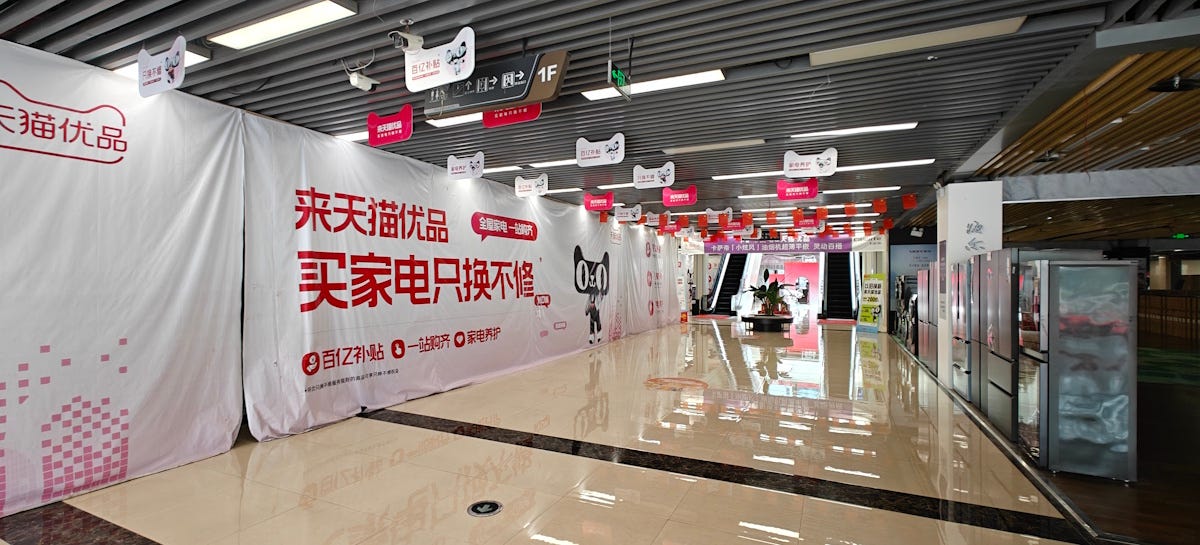
Last year, when I visited a large Red Star Macalline mall in Shanghai (a home-furniture mall chain that Alibaba once invested in), it was also deserted. One and a half years later, Sascha Tapken, who runs a media company for the interior design industry (Home & Living), visited the same location, and it was just as empty, even in the weekend. Of course, this was to be expected given China’s current real estate crisis. If nobody buys apartments, nobody fills them with furniture and kitchenware.
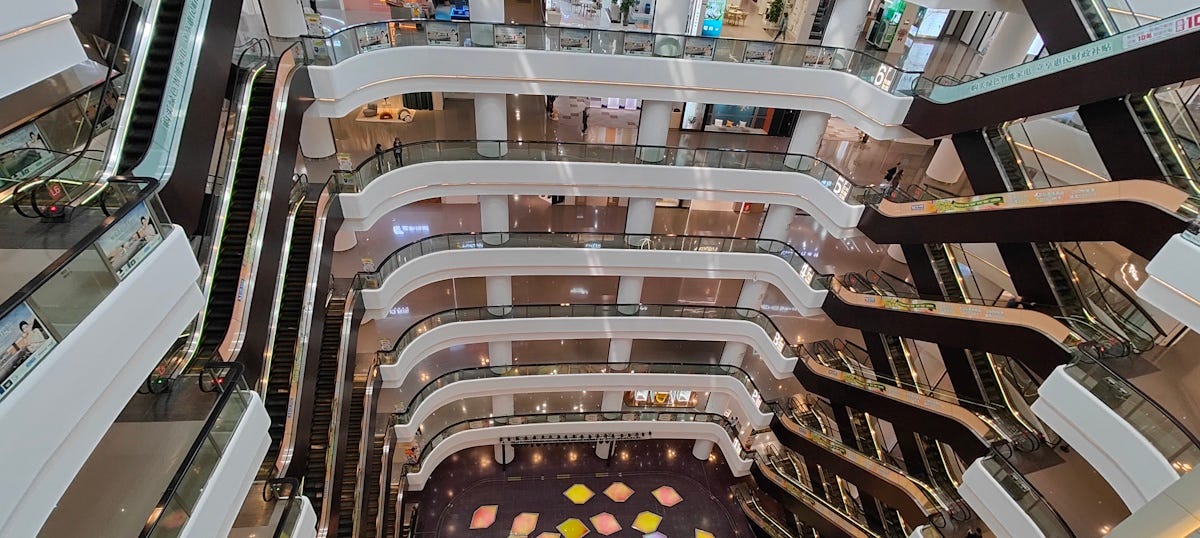
A deserted Red Star Macalline mall in Shanghai, October 2024.
At the JD Mall in Beijing, the floor with home furniture was also the quietest one. Still, JD Mall might have an advantage in offering a broader selection of still-popular 3C products.
And maybe Alibaba isn’t the best benchmark anyway. Except for Hema (Freshippo), Alibaba’s ventures into offline retail have never been very successful, as described in our report, The Collapse of Alibaba’s New Retail Part 1 and Part 2. A combination of factors, including a lack of experience in offline retail, underestimating the complexity of digitising offline retail, and betting on the wrong horse in the consumption upgrade, led Jack Ma to proclaim that Alibaba had to return to Taobao, the internet, and the customer. What followed was the sale of Intime department stores and Sun Art/RT Mart hypermarkets at a significant loss.
Perhaps that’s where the difference lies. As shown at the start of this article, JD has always had a much firmer foothold in the offline market, whether through self-operated small stores or franchises in convenience stores, liquor stores, and other business sectors. As such, where Alibaba failed, JD has much better credentials to make the JD Mall strategy a success.
And then there’s one more reason why a concept like JD Mall might have a higher chance of success in China than elsewhere: the lack of trust in online sellers. There are so many scams online and shoddy or counterfeit goods being sold on marketplaces that many Chinese are reluctant to buy. This will especially be true for big-ticket purchases.
I often use my own experience with buying a stroller for my brother-in-law when his wife had a baby to illustrate this lack of trust. I understood that my wife did not want to take the risk of buying a troller from some random seller on Taobao. However, despite JD.com's good reputation, she refused to buy a stroller on any Chinese website. ‘Can you imagine what could happen if it’s fake and falls apart on the street?!’
I tried to convince her that JD was selling authentic brands and could be trusted, but she would have none of it. She ended up buying a stroller of the same brand on a webshop in the Netherlands and shipping it to China, paying an additional 80 euros in shipping costs, VAT and import taxes.
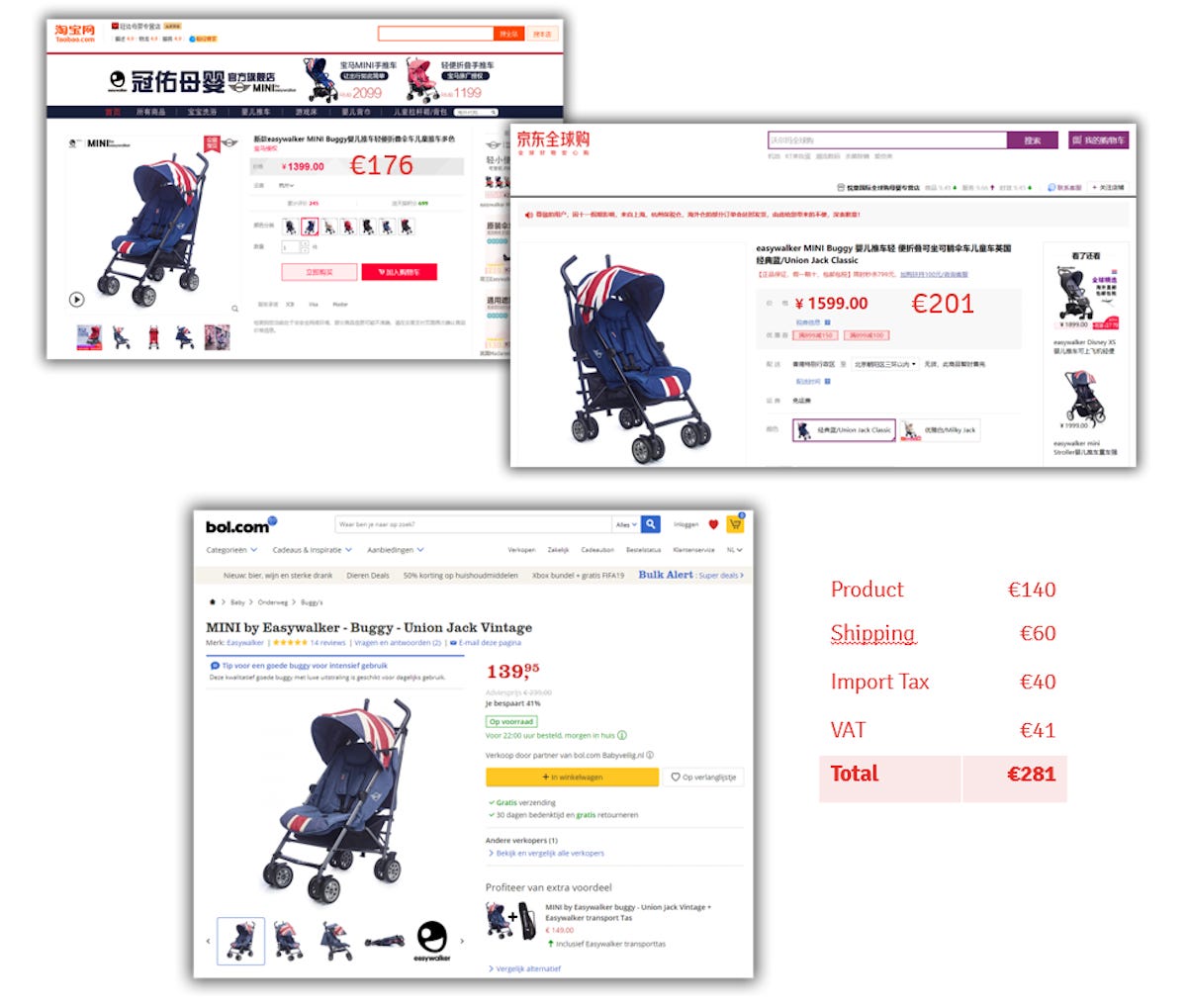
Maybe the investment in JD Mall is what is required in China to gain the consumer’s trust. The store manager in Xi’an explained, “Home appliances are low-frequency, high-value purchases. Customers feel that making a decision is quite costly. Everyone in the market has pretty much the same pre-sales service. What sets us apart is the experience. We give you more choices before you buy and allow you to truly experience the product.”
And maybe there is more to the business model than meets the eye…
The GM of a trading company from Suzhou shared: ‘JD.com Mall in Suzhou promised not to remit profits to its headquarters for three years. By operating at a loss and leveraging its strong market position, JD.com has attracted a large number of consumers and brands. Notably, JD.com can sell at a negative gross profit without informing brands and then demand subsidies from them afterwards, which brands usually have no choice but to accept.’
And while some of the German e-commerce leaders in our group seemed unconvinced and remained sceptical, our Chinese camera woman was a believer: ‘I want to go shopping here all the time!’
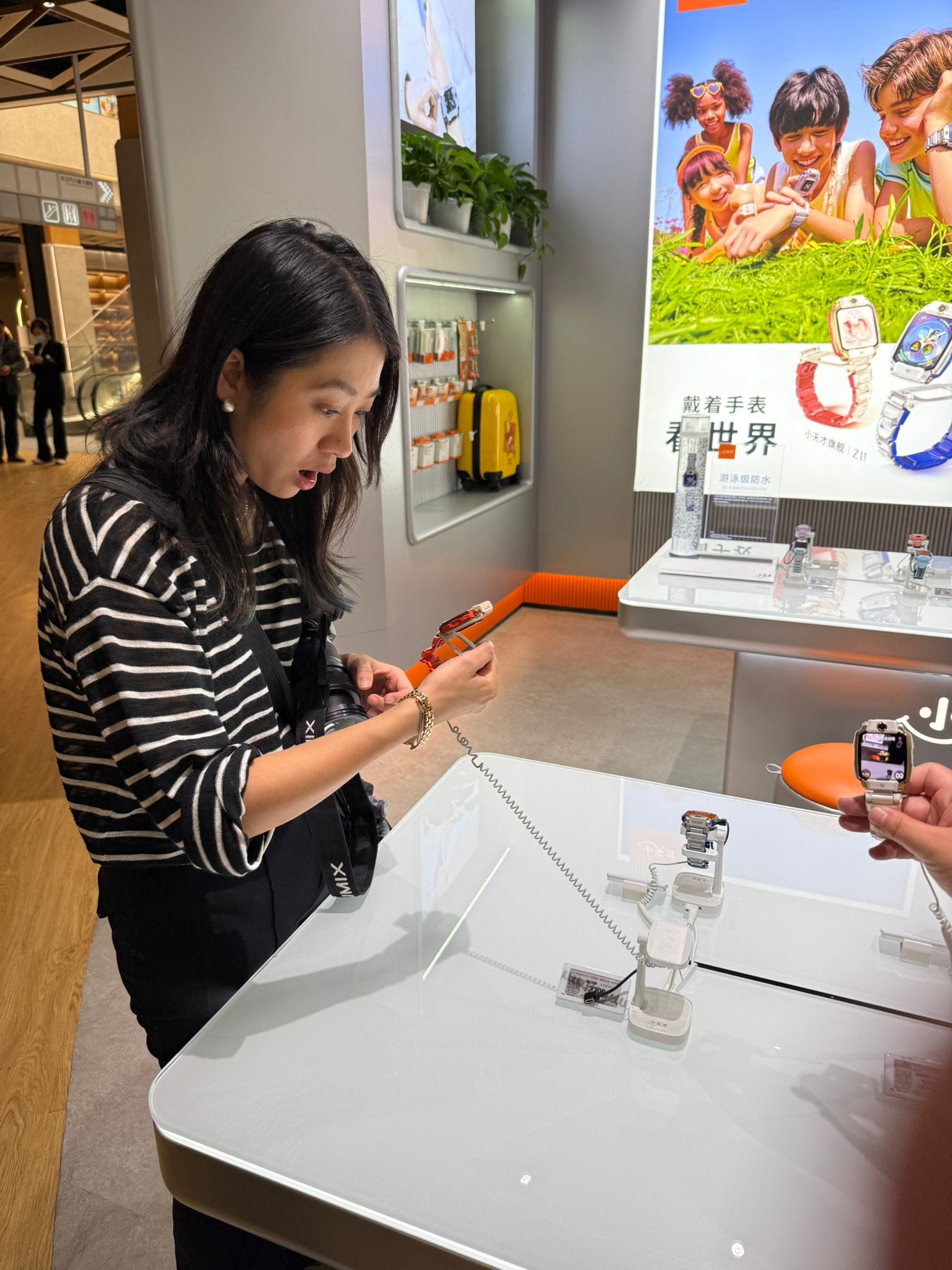
Camera woman Guligo Jia found her new heaven.
Epilogue: the Ceconomy acquisition
On September 1, 2025, JD.com officially announced its plan to acquire a majority stake in German e-tail giant Ceconomy, giving it 70.9% voting rights. The Ceconomy CEO stated: “Leveraging JD.com’s leading advantages in retail, logistics, and technology, we will accelerate our breakthrough growth.” Still, the plans sparked heated discussions in Europe, and while the German government has given its green light to the acquisition, at the time of writing, shareholders were still rejecting the offer. [9]
Ceconomy operates two established chain brands, MediaMarkt and Saturn, with stores in 12 European countries, including Germany, France, and Spain, and boasts over 1,000 physical stores across its network. Sales reached €22.4 billion in the 2023/2024 fiscal year, with online sales accounting for 24%. [10]
Public sentiment around the Ceconomy acquisition centres on several concerns: [10]
Job security: Concerns that JD.com’s e-commerce strategy could lead to offline store closures and layoffs.
Changes in brand identity: Fears that familiar local brands will be “sinicised,” altering the traditional experience.
Supplier competition: Concerns that JD.com might favour Chinese suppliers and products, putting local businesses at a disadvantage.
Ceconomy’s conditions for the acquisition were:
Maintain Ceconomy’s German headquarters and brand independence;
No layoffs for operational reasons within three years;
Compliance with existing labour agreements.
Meanwhile, UK retailer Sainsbury’s ended discussions about a takeover of non-food retail chain Argos with 664 stores by JD.com, within 24 hours after formally announcing the negotiations. The UK supermarket group stated that JD.com’s new terms were not in the best interests of its shareholders or stakeholders.
Both the Argos attempted acquisition and the Ceconomy planned acquisition demonstrate JD’s interest in acquiring access to the European/UK markets. It also sparked discussions about what JD would copy from its Chinese operations to Europe.
I find it unlikely that JD will blindly copy its JD Mall philosophy to Mediamarkt or Saturn stores. The JD Mall strategy is primarily aimed at building consumer trust before purchase, which is essential in a low-trust society with relatively underdeveloped consumer protection, like China. I personally think that JD’s interest in buying retail chains stems from the opportunity to acquire an existing distribution channel with a large customer base rather than having to build these from scratch.
Why would JD be interested in such a distribution channel? I think there are two things pointing to possible reasons. First, not so long ago, JD founder Richard Liu shared his vision of bringing 1,000 brands to foreign markets. Second, JD has been building its own private-label products, which are likely among the brands Liu wants to offer the world…
What’s also clear is that, like in China, JD is aiming for an omnichannel approach. Recently, it relaunched the Joybuy brand across several European markets and rebranded its earlier European e-commerce attempt, Ochama. Towards the future, there are two possible scenarios:
JD will operate the acquired offline stores separately from Joybuy, use the latter as a pure online store and operate a multibrand strategy.
JD will eventually integrate the two and potentially rebrand any acquired stores to Joybuy. For this to happen, Joybuy would first need to become a well-known, successful and respected brand. This will prove to be a tough task as it remains to be seen whether Joybuy can be more successful than JD has been with Ochama (you can read my personal reservations here).
For now, there has been no sign of Joy Dog on the Joybuy website (why not?), but who knows where it might appear online and offline in Europe in a few years…
Key Takeaways
Ambitious Offline Expansion: JD Mall represents JD.com’s most ambitious offline retail project to date, aiming to open dozens of malls.
Focus on Home Scenario: JD Malls offer a one-stop shopping experience centred on the “home scenario,” including electronics, home appliances, furniture, and smart healthcare.
Core Philosophy: Experience-Driven Sales: The fundamental strategy is to move beyond passive viewing to active participation, encouraging customers to interact with fully functional products (e.g., baking cookies, testing vacuum cleaners) in realistic settings before purchasing.
Community Integration Strategy: JD Mall implements a “5-Kilometre Penetration” strategy, aiming to become a neighbourhood hub and drawing repeat foot traffic through free value-added services such as professional-grade laundry and shoe-washing facilities.
Hybrid Store Layout: The physical space is divided into Brand Showrooms (managed by individual brands) and JD Self-Built Areas (curated sections managed by JD).
Unique Staffing Model: JD utilises “Experience Officers” in the Self-Built Areas who do not carry sales quotas; their role is solely to guide customers through product experiences and provide assistance.
Omnichannel Integration and Tracking: Electronic price tags ensure parity with the JD.com website and feature QR codes that attribute online sales to the physical store if the product was scanned in-store first, thereby tracking the offline influence on online purchases.
High Cost of Online Customer Acquisition: A major business driver for JD Mall is the need to acquire affluent customers offline, as online Customer Acquisition Costs (CAC) have become extremely high in China.
Building Consumer Trust: The physical mall model is crucial in China, where many consumers lack trust in online sellers for high-value, low-frequency purchases like home appliances.
Post-Sale Support: JD fosters long-term customer relationships through dedicated group chats with staff following a purchase, offering ongoing support, tutorials, recipes, and tips to maximise appliance use.
Commercialisation Initiatives: JD is exploring commercialising successful experience zones, such as turning the popular coffee-making area into a full-fledged coffee shop with its own sales revenue.
European Expansion Context: JD’s planned acquisition of Ceconomy (which operates MediaMarkt and Saturn) suggests interest in acquiring existing European distribution channels and a large customer base, likely to introduce its own private-label products or other Chinese brands abroad, rather than blindly copying the JD Mall trust-building philosophy to Europe.
The following video summary of this report was created with Google Notebook.
Sources
The information in this report is based on on-the-ground observations by Tech Buzz China’s Ed Sander, augmented with excerpts from exclusive expert interviews within the Six Degrees Intelligence network, guided tours at JD Mall in Xi’an and Beijing, JD company information and the articles below.
Images by Tech Buzz China’s Ed Sander, unless stated otherwise. These images may not be reproduced without Tech Buzz China’s prior consent.
[1] 2023-11-21 Lianshang [2] 2025-11-13 JD.com X account [3] 2021-09-15 JD Corporate Blog [4] 2020-08-12 JD Corporate Blog [5] 2024-11-13 JD Q3 2025 quarterly report [6] 2025-05-06 Jiemian [7] 2021-09-15 Pandaily [8] 2019-03-09 Technode [9] 2025-11-15 Exciting Commerce [10] 2025-09-16 老麦Michael [11] 2019-11-07 JD Corporate Blog