WeChat Channels - The Hope of Tencent
How Tencent stopped focussing on stand-alone short video apps and to build a successful alternative as part of the WeChat's ecosystem.
Before we get started, there is an offline event for Tech Buzz China subscribers! You can also nominate your friends.
Investor Dinner. Wednesday April 5, 2023 in Palo Alto with Rui and Six Degrees founder Jason and VP, North America Michael.
Preference is given to paid subscribers, e-mail rui@techbuzzchina.com for more info.
Things that caught our attention
Chapter 1: A short history of WeChat Channels
Chapter 2: Behind the scenes: details on WeChat Channels
Chapter 3: ‘The hope of the whole company’
Please note that chapters 2 and 3 are only available to paying subscribers.
Things that caught our attention
Two weeks ago we published an extensive article about Douyin’s local services initiatives. Last week 36Kr reported (link in Chinese) how Meituan’s Q4 report sheds some light on the impact. Merchants have been shifting advertising budgets from Meituan to Douyin. Meituan’s income from commissions increased by 13.7% YoY, but income from advertising dropped 4.8% YoY due to competition from Douyin. As a result, Meituan has been giving discounts on advertising prices. Meituan’s marketing expenses also increased 22.7% YoY, exceeding the growth rate of revenue (21.3% YoY).
Meituan is also introducing a new marketing tool, Shenqiangshou, that lets merchants launch limited-time deals. It is also testing live-streamed product introductions in Shenzhen, to be rolled out country-wide later. This is clearly a defense against Douyin's initiatives in local services in the past years.
Alibaba this week announced that it would split up into six different companies, some of which might see IPOs in the future. Alibaba will have a 1+6+N structure: 1 holding (Alibaba Group), 6 business units but also N separate businesses, including Ali Health, Hema, Sun Art, Intime, etc. We've made a little cheat sheet of the new holding structure for you. Download it here as a PDF.
Daniel Zhang will continue to head up both the cloud intelligence division and continue to run the parent company. If you are wondering why Zhang has recently been leading the cloud business, read our recent report on Alibaba Cloud.
Rui was recently interviewed by TBVS News about US-China Tech Decoupling. Is it really happening? Watch the video here.
Introduction
In this bi-weekly newsletter, we take a deep dive into Channels, the short video section of WeChat. Chapter 1 is a short background history of WeChat Channels and is available to all subscribers. Chapter 2 contains exclusive information we gathered from expert interviews in the Six Degrees Intelligence database. Chapter 3 summarizes relevant recent developments, mostly taken from Chinese language tech media. Chapters 2 and 3 are only available to paying subscribers.
Key Takeaways
After failing to get traction in daily active users on stand-alone apps like WeiShi, Tencent has been very successful in capturing part of the short video market by launching WeChat Channels.
Integration of Channels in the WeChat ecosystem has both been a key factor in its growth but is also limiting its further potential as it monetizes through e-commerce, advertising and creator tipping.
Channels has set itself apart from Kuaishou and Douyin by offering more knowledge and current affairs videos and targeting older 35+ users. Its live events also seem to focus on nostalgia among these users.
The average e-commerce revenue per user on WeChat Channels is significantly higher than on Douyin and Kuaishou.
Recognizing the importance of short video in the current day internet landscape, Tencent CEO Pony Ma has named Channels the ‘hope of the whole company’.
Chapter 1: A short history of WeChat Channels
To understand Tencent’s initiatives in short videos, we have to go 10 years back in time. In these days of fierce competition between Douyin, Kuaishou, and WeChat Channels it’s easy to forget that Tencent was actually one of the very first companies that offered a short video app.
Back in 2013, when WeChat was seeing explosive user growth from less than 200 million to 355 million, Douyin didn’t exist yet and Kuaishou had just transformed from a GIF-making app to short video, Tencent launched a stand-alone video app called Weishi (微视, ‘WeVideo’). At the time WeiShi was more like Vine, enabling users to create 15-second videos with added effects. Other early players in the market were apps like Miaopai and Meipai.
WeiShi’s user numbers peaked in early 2014, but its popularity quickly waned. In 2015 it was merged into the Tencent Video division. Tencent soon after abandoned the app, overlooking the potential of short videos, just a year before Bytedance launched Douyin.
Seeing the rise of Douyin, Tencent realized that growth in text and photos has stalled, and the future lies in micro-sized, digestible videos. [1] In 2017 it invested $350M in Kuaishou, and it revived WeiShi in April 2018. At the time, Tencent said it would reposition WeiShi to focus on film and TV content, helping distribute Tencent’s licensed content. [2]
True to its ‘horse racing’ approach whereby multiple teams work on the same objective and compete internally, Tencent released (according to some counts) up to 14 other short video apps in 2018, among which Yoo (later rebranded to Hotpot Video), Sukan, Yuguang, Yintu, Xifan, DOV, and Hapi, none of which made much of a splash. [3]
WeChat users would see promotional links to WeiShi when they posted videos on their Moments timeline. The look of this iteration of WeiShi was almost identical to Douyin, and the app had the same kinds of user ‘challenges.’ [4] Tencent also announced it would spend 3Bn yuan in subsidies for KOLs that made content on Weishi, but when rumors went around that Tencent was withholding these incentives, lots of KOLs turned their backs on the app. [5]
Around the same time, WeChat blocked sharing external links to videos from its competitors, resulting in a legal clash between Tencent and Bytedance. Initially, WeChat also blocked WeiShi content.
In 2018, WeiShi had 384 monthly active users [1], while Douyin had 500 million. But WeiShi’s daily active users were abysmal (having barely hit 5 million in June 2018, according to Questmobile [6]).
In June 2019, WeChat allowed users to post 30-second clips on their Moments timeline via Weishi, twice as long as regular videos uploaded to Moments from a phone’s gallery. This was a rare integration of another Tencent app into WeChat [7]. But while WeiShi users could log in with their WeChat and QQ accounts and the app was promoted in its bigger siblings, this was hardly the seamless integration that users had come to expect from WeChat and WeiShi remained a stand-alone app. It probably was precisely this weakness that led to the development of WeChat Channels.
Enter WeChat Channels
While WeChat continued to grow its user base, although at a much slower pace, it had been losing time spent on its app to Bytedance and Kuaishou. Bytedance had first taken time from WeChat Official Accounts with its Toutiao news aggregation app, followed by the onslaught of Douyin.
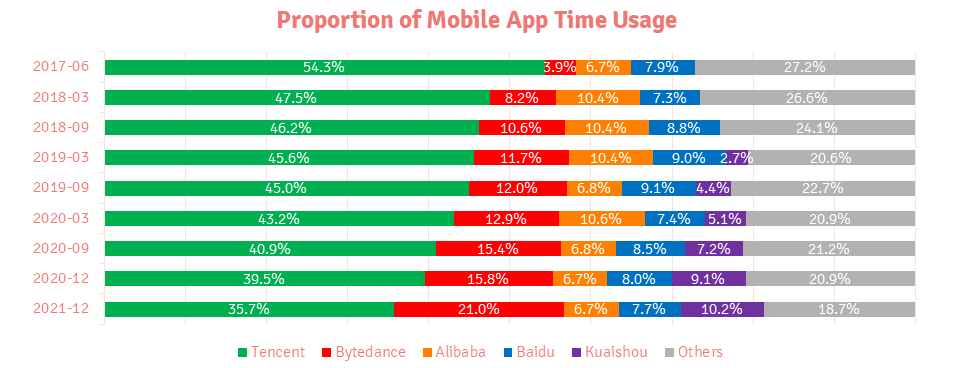
Source: Questmobile
In the race to develop a short video app to defend itself against these competitors, Tencent started testing a new short-video functionality called ‘Channels’ (视频号, Shipinhao) in its WeChat app in January 2020. WeChat’s creator Allen Zhang had also noticed a significant increase in the number of videos that users were sending in chats and posting on their Moments timeline. More users seemed to be interested in sharing content by video than laboriously writing blog posts for an Official Account.
On Channels, users could share one-minute videos to people that were not among their personal contacts, which was rather unique for the normally closed-network approach of WeChat. On the Moments timeline, for instance, it is only possible to share posts with actual contacts.
The first users that were allowed to test Channels had to provide ‘proof of influence’ (e.g. follower numbers on other social media). This showed that WeChat was trying to move popular KOLs (Key Opinion Leaders; influencers) to its new video platform.
The first incarnation of Channels left much to be desired. The demo below shows what happened after clicking on a video shared in the Moments timeline. WeChat Channels would open with the concerned video playing. Channels could also be accessed through WeChat’s Discover menu.
The following functionalities are demonstrated in the video.
Vertical scroll
Pause/view bullet comments
See other videos from the same location
Forward video to friends or share on Moments
Favourite a video
Liking a video
Viewing comments (like comments and leave your own comments on other people’s comments)
Seeing original music used
Seeing other videos by same user
The difference with Douyin was significant. Where Douyin used full-screen videos in a portrait layout, Channels used a more square-shaped landscape layout. On Douyin, you could move to the next video by swiping up, Channels required you to scroll. This pointed to an emphasis on consuming content on Douyin while Channels seemed to stimulate interaction.
Douyin is well-known for its strong recommendation engine based on a user’s personal preferences and on machine learning, making the app extremely addictive. During its testing phase, Channels seemed to be driven more by what contacts in your network had viewed and the location you were in than of complex algorithms. As such, the experience felt more like Kuaishou than Douyin.
As far as design is concerned, Channels soon changed to a format that is much more like Douyin’s and switched the scrolling for the more common and popular swiping navigation.
Later, Channels added three tabs to its main screen: Follow (accounts you are following), Friends (what friends are watching) and ‘Hot’ (Trending, content served by algorithms). Allen Zhang expected the distribution of time spent on these sections to follow a ratio of 1 : 2 : 10. His idea was that friends would be more reluctant than the algorithm to like (and thereby recommend) banal content. In reality, they found that people would spend more time on content their friends liked.
Source: iiMedia, January 2021 [8]
By June 2020, half a year after its launch, Channels had opened up to most WeChat users, 200 million of which were now using the video functionality in the app. By the end of 2020, Channels had 280 million daily active users (DAU) that, according to one research firm, spent 9.5 hours per month watching videos there [9]. This shows that it’s easier to convert WeChat users to new functionality in the app than to convince them to download an extra app like WeiShi (which had less than 50 million daily active users by the end of 2020).
WeChat also improved the integration of Channels with Official Accounts, Search, and Mini-Programs and started testing with live-streaming and 30-minute videos in October 2020. By September 2021, the maximum video length was further increased to one hour.
In January 2021, Tech Buzz China first discussed WeChat Channels on its first livecast with Dan Grover. At that time, WeChat had made it possible to view livestreams of people near you.
At a conference in January 2021, Allen Zhang, the director of WeChat, shared that he had realized that the kind of content people would see on WeChat would affect the quality of what people would produce [10]. This seemed to indicate a desire to offer higher quality content than Douyin. Zhang said that video would be the driver of social media in the coming decade, and Tencent would use all its available means to steer traffic to Channels.
Pig feed
In April 2021, Tencent would merge Tencent Video (long-form) and Weishi (short video) into a new video division under the Platform and Content Group (PCG). WeiShi had less than 50 million daily active users and 100 million monthly active users at the time (Douyin had 600 million and Kuaishou 520 million) [11a/12].
In June 2021, at an industry forum, Sun Zhonghua, the VP heading the new business unit, would call short video clips “increasingly low-intellect and vulgar”, comparing them to “pig feed.” and called people who watched them “like idiots”. He named the ways such apps use algorithms to recommend similar clips to viewers a style of “brainwashing” that was coming under pressure from industry regulators and auditors. It was no surprise that around the same time, Tencent once again announced it would reposition Weishi to focus on film and TV content, pivoting away from user-generated videos. [11]
In 2021 DAU of Channels further increased to 500 million. Note, though, that as Rui mentioned in her October 2021 update on Channels (read it here) that clicking on a single Channels video link shared in chat or Moments would make you a DAU. In that update, Rui also concluded that there were strong differences between Douyin and Channels.
The conclusion was that Channels, Douyin and Kuaishou were mainly competing for user time, not so much on content, although Channels and Kuaishou were closer together because of the focus on private traffic.
In December 2021, WeChat started showing Channel videos by accounts you followed in the Subscription section for official accounts.
Live Concerts: bringing out the has-beens
To further improve its popularity, WeChat started broadcasting live concerts of pop stars on Channels. In December 2021, WeChat Channels broadcasted a 2-hour livestream with Irish ‘boyband’ Westlife (yes, those of early 00s fame), which drew 28 million viewers. That number was not all that impressive compared to similar livestreams of its competitors, but it was the first in a series of live-streamed concerts of artists like Mandopop star Jay Chou, Canto-pop legend Leslie Cheung, Taiwanese singer Lo Ta-yu and The Backstreet Boys, the latter sponsored by luxury US carmaker Lincoln.
The choice of performers that were popular in the 1990s and 2000s shows that WeChat is aiming for a relatively older audience for Channels. A strategic choice since, like everybody else, these people are using WeChat and were underserved by other short video apps that focussed more on younger audiences.
Channels also started experimenting with paid live streams in 2022, with the National Basketball Association being the first to test out the function. [21]
Although the viewer numbers are impressive, such events are held more frequently on Douyin and Kuaishou, who also won the broadcasting rights to the Tokyo Olympics, the Winter Olympics and the Qatar World Cup, bringing massive viewership. [13]
WeChat Channels had now been connected to many other parts of the WeChat ecosystem, including mini-programs, Official Accounts, user profiles, and WeCom (the enterprise version of WeChat). As such, Channels is everywhere in WeChat and hard to avoid.
Still, by early 2022 not enough creators were making content for Channels. They were merely recycling content made for other platforms, and there were no breakout livestreamers.
In its Q1 2022 earnings report, Tencent claimed that the volume of videos and viewing time had seen ‘significant growth’ thanks to more entertainment programming and improved algorithms. During the Q2 2022 earnings call, the company said it would focus on improving efficiency and launching new revenue initiatives, including in-feed advertisements on Channels. The app also launched its own 618 shopping festival on Channels, handing out incentives for livestreamers to sell on Channels.
In July 2022, WeChat started adding video ads on Channels, allowing users to shop directly from an advert and share it with friends on WeChat. It also introduced an e-commerce tool to create online stores on Channels [14]. WeChat’s video unit also set up a live commerce team in July. Citic Securities estimated the advertising revenue from Channels would be 37Bn yuan in 2023 (Douyin’s revenue from advertising was believed to be more than 75Bn yuan in 2022).
In 2022 the number of short video users in China exceeded 1 billion for the first time, up 8.3% compared to 2021. This means that almost every Chinese internet user is watching short videos [9]. With Tencent’s disappointing revenue results in 2022, Channels had become the key focus for future growth.
Chapter 2: Behind the scenes: details on WeChat Channels
Despite its strategic importance, WeChat Channels is not broken out as a separate business, and details on its operations and performance are incomplete and scattered. Below we lay out a comprehensive look at its operational performance and business strategy based on proprietary sources.
Basic Overview
WeChat Channels demonstrated impressive growth in the second quarter of 2022, with an average of 452 million DAU, a 31% increase year-on-year. Moreover, the average user usage time increased 43% from 35 minutes in Q2 2021 to 50 minutes in Q2 2022. In March of 2022, WeChat Channels boasted a total of 38 billion video views (the number of times a video has been played), or something like 3 videos per active user per day.
As mentioned in Chapter 1, Channels is mainly divided into three tabs, namely Following, Friends and Hot, with the majority of views coming from Hot, making up 68%, followed by Friends at 15%, and Following at 6%. Shares, Searches, and Top Stories accounted for 5%, 4%, and 2%, respectively.
As of August of 2022, video views of PGC (Professional Generated Content) on WeChat Channels accounted for 51.1%, while PUGC (Professional User Generated Content) made up 30.4%. The remaining 13.5% consisted of UGC (User Generated Content).
WeChat Channels' demographic reach sets it apart from Douyin and Kuaishou. In August 2022, users over 36 made up 41.9% of WeChat Channels' user base, while Douyin and Kuaishou reported 39.5% and 34.8%, respectively.
Key Growth Catalysts
Catalyst 1: Getting on the Discover Page
In its early days, Channels users were still adjusting to the new feature, often preferring access through Moments, Official Accounts, and Mini Programs. It wasn't until 2021 that WeChat's Discover page introduced live streaming and Channels, a game-changer.
This addition to the Discover page sparked a shift in user behavior, encouraging active content searches and longer watch times. In contrast, users accessing Channels through social links were less engaged. It also helped that a large portion of Channels’ demographic, those over 35, spend more time consuming content through the Discover page. To capitalize on this, Channels focuses on guiding users to the Discover page, then utilizing algorithmic recommendations to drive more traffic to popular and original videos.
Over the years, enhancements like improved Discover page features and live streaming capabilities have emerged. Users now enter Channels and make reservations for live-streaming events such as the "618" e-commerce festival, Super Brand Night, and International Women's Day. A red dot added to Channels in early 2021, indicating live streaming, significantly boosted user engagement.
Catalyst 2: Official Account integration
In 2021, the platform integrated with the rest of the WeChat ecosystem, connecting with Official Accounts and Moments to expand content distribution. A key consequence of this is that unlike on other platforms, it is not necessary for livestreamers, video creators, and merchants to invest in advertising to jumpstart their Channels account. They can begin by leveraging the various video forwarding capabilities via Official Accounts (as well as Moments, and in-chat links), which are relatively friendly to mid-to-low-tier creators. Now, the 20 million or so WeChat Official Account authors can supplement articles with related video content from WeChat Channels. However, a downside was that this also made Channels more reliant on Moments and message forwarding for traffic. Although social recommendations drive short-term growth, Channels may encounter limitations with this approach in the long run.
Ongoing Improvement Opportunities
Opportunity 1: Creator recruitment
Initially, WeChat Channels didn't actively incentivize creators, leaning on MCN institutions for that purpose. But in 2022, the platform pivoted to tap into the creator ecosystems of popular social media platforms like Douyin, Kuaishou, Weibo, Bilibili, and Xiaohongshu, honing in on mid-tier creators.
Success in this endeavor is measured by two key performance indicators: the number of videos published and the number of creators recruited by MCN partners. To entice creators, WeChat Channels offered 100,000 visits to those with over a million followers and 50,000 visits for creators with 100,000 to one million followers. In total, WeChat Channels has invested 1 billion yuan in creator recruitment, incentives, and bonuses.
As of March 2022, WeChat Channels boasted 55 million creators, encompassing those from WeChat Official Accounts, Douyin, Kuaishou, and ordinary WeChat users. WeChat Official Accounts creators made up 18% of the total, followed by Douyin creators at 25%, Kuaishou at 20%, other WeChat users at 30%, and miscellaneous categories at 7%. Approximately 10-15% of creators, or 5.5 to 6 million, published videos on both Douyin and Kuaishou, illustrating the overlap between the two platforms.
Number of creators on WeChat Channels categorized by number of followers [March 2022]
Opportunity 2: Diversifying content
Channels serves up an impressive array of content across categories like lifestyle, education, current events, politics, entertainment, and more. But it is best known for knowledge and current affairs videos, consistently prioritizing the serious and informative. This current affairs focus aligns with the strengths of WeChat official accounts, which draw a diverse crowd keen on national and global news. Although Channels has made strides to diversify its content offerings, current events remain one of the largest categories.
However, crafting engaging current affairs video content that captivates viewers and extends their watch time is an ongoing challenge. Toutiao, a leading news aggregator employing top-tier current affairs and government affairs experts and professional journalists, enjoys a higher percentage of its content creators published on the written WeChat Official Accounts platform than on WeChat video Channels. Furthermore, users tend to pause only briefly to watch serious current affairs videos.
Opportunity 3: Live Events
In 2022, Channels offered an increasing number of live events (see Chapter 1), including an array of highly-anticipated concerts. These live shows drew in a significant number of online viewers, ranging from 30 million to 60 million viewers. Half of the concertgoers were drawn in by hosts on Channels, with the other half arriving via a range of social media promotion channels such as Moments, and Official Accounts. Similar to those who enter Channels via social links, however, viewers who access concerts via Channels tend to stick around for longer durations than those who come via social media promotions.
Monetization
The monetization of video content on WeChat Channels hinges on e-commerce, advertising, and live-streaming gratuities (tipping).
E-commerce
The GMV of e-commerce on WeChat Channels reached 58 billion yuan in 2021. Figures for each quarter were around 2 billion yuan, 8 billion yuan, 18 billion yuan, and 30 billion yuan, respectively. As for 2022, the GMV of Channels' e-commerce in January was 10 billion yuan (boosted by Chinese New Year’s), followed by 8 billion yuan in February, 7 billion yuan in March, and 8 billion yuan in April (the downward trend due to COVID restrictions).
In addition, Channels has a high repurchase rate of 60%, almost matching Kuaishou’s level of 75%. In January 2022, Channels saw a staggering 10 million unique buyers. However, in February, this number fell to 8.89 million and continued to decline in March to 8.75 million.
Despite a slightly lower average spending per order than Taobao, at 220 yuan, WeChat Channels, with an average revenue per user (ARPU) of 200 yuan, is still well ahead of Douyin (120 yuan) and Kuaishou (around 80-90 yuan) in this regard.
Merchants
The monthly average number of active selling merchants, which refers to a merchant who generated sales, in the first quarter of 2022 was 460,000. Merchants who bring in over 10,000 yuan in sales during a single livestreaming event are rewarded with a 10% boost in traffic. For merchants with their own private traffic, Channels goes even further, offering 10x in private traffic support to help drive sales. This effort to provide traffic assistance to merchants marks a departure from the previous practice of relying heavily on their own private traffic to generate revenue.
As a result, Channels has become an attractive platform for e-commerce businesses, with the number of e-commerce livestreamers reaching an impressive 2.3 million in the second quarter of 2022. In June 2022, 170,000 livestreamers were launching streaming events each day.
A key factor contributing to Channels' success is the abundance of brand merchants acquired from mini-programs, including names like KFC, McDonald's, and Three Squirrels. With over 10 million merchants on WeChat's mini-programs, Channels is positioned for significant growth potential.
However, it's important to note that 84% of all merchants on WeChat Channels come from small shops. The remaining merchants consist of brand merchants and those already selling on platforms like Pinduoduo and JD.com, with a focus on attracting small and medium-sized brand merchants. Unfortunately, for micro businesses, the support offered by Channels is relatively limited.
Service Providers
Instead of directly handling brand recruitment, WeChat Channels has strategically accumulated a range of service providers to manage the process. During the 2022 618 shopping festival, Weimob and Jinxiu Heshan, two of Tencent's e-commerce service providers, successfully brought in prominent livestreaming influencers and well-known brands to Channels. Currently, there is no specific brand support plan, as Channels' presence in the e-commerce sector is still in its infancy.
Having spent several years involved with Channels, service providers have amassed extensive knowledge in enhancing public domain traffic, which can help brands effectively monetize their traffic. Tencent envisions these service providers using their expertise to draw in more prominent brands, ideally international and top-tier domestic brands in categories like men's and women's fashion, food and beverages, and cosmetics.
Advertising
Tencent boasts a trio of advertising options: direct-response advertising, match-making advertising, and brand advertising. Direct-response advertising, which includes ad graphics & text links to stores, products, and distribution channels, is the simplest means of monetization.
Brand advertising is primarily tailored to popular influencers, with high-quality video creators being particularly sought after by advertisers. When it comes to recruiting creators, priority is given to Official Accounts authors, followed by top influencers from Douyin, Kuaishou, and Xiaohongshu. MCN companies are also tapped for recruitment, based on the number of followers they are able to attract.
Tencent announced the launch of its match-making advertising platform in June 2021. This platform, which bears similarities to Douyin's Xingtu and Kuaishou's Kuaijiedan, aims to facilitate the match-making process between advertisers and influencers. This platform generated 120 million yuan in revenue for Q2 of 2022 and has much room for growth.
In-feed Video Ads
In Q4 2022, Channels introduced in-feed video ads as a key growth driver, operating separately from the existing match-making advertising platform but sharing similarities with Douyin and Kuaishou's approaches.
With 600 million daily active users and 45 minutes of average daily usage time, combined with a 2.5 ads per minute frequency and a projected 5% ad load rate by 2023, the revenue potential is substantial. Currently, the CPM for advertising on WeChat Channels is 30 yuan, and in-feed ads are expected to become the primary source of advertising revenue. Tencent's vast advertising customer base will likely transition to Channels, with in-feed ads drawing advertisers from the WeChat ecosystem, especially mini-programs.
Despite its ambitious plans, Tencent currently lacks advertising scenarios and needs to launch related advertising tools to increase the value of its ads. However, the company's ads on Moments and Channels are expected to be integrated in the future, with advertisers able to place ads on both platforms simultaneously to increase exposure. As Tencent explores multi-channel advertising further, concerts have already emerged as a good use case. The total cost of organizing an online Jay Chou concert for Tencent, for example, is just several million yuan but brings in 200 million of official sponsorship and in-feed ads on WeChat moments from advertisers for a total of 50-60 million views.
Live-streaming Tipping
Apart from e-commerce and advertising, live-streaming tips is also a source of income for content creators. In comparison to Kuaishou's hefty 45% commission fee for tipping, Tencent's fee falls on the lower end of the industry standard at 35%, with the host and MCN agencies taking home the remaining 65%. Live-streaming tips on Tencent totaled 2.43 billion yuan for Q2 of 2022.
Addendum: A Threat to Kuaishou
The rise of WeChat Channels has certainly shaken things up for Kuaishou, which once relied heavily on traffic from WeChat, with up to 60-70% of its traffic coming from that source before 2021. However, 2022 saw a strategic shift for Kuaishou, as it diversified its traffic sources, with only 30% coming from WeChat. Kuaishou has now turned to other channels such as iQiyi, Sohu Video, Xiaohongshu, and Weibo to fill the gap.
Both Kuaishou and Douyin have carved out distinct strategies to differentiate themselves. Kuaishou has zeroed in on cultivating private domain traffic, while Douyin has placed its bets on public domain traffic to maximize efficiency. Not one to be left behind, Kuaishou ramped up content creation initiatives by forging a closer partnership with Midu Reader, a novel-reading platform. Meanwhile, Douyin sharpened its advertising and e-commerce prowess, cementing its position as a leader in those fields.
Channels, with its emphasis on social interaction, is tightly woven into WeChat's social fabric. This connection poses challenges for Channels in monetization and independent growth, as it needs to be seamlessly integrated with the broader WeChat ecosystem to function. While Channels is emerging as a solid competitor in the advertising realm with the potential to surpass Kuaishou, overtaking Kuaishou in the live-streaming e-commerce market may prove to be a steep climb.
Chapter 3: ‘The hope of the whole company’
Many would say that WeChat hasn’t really done anything incredibly innovative since launching WeChat mini-programs in 2017. Integrating video in WeChat was hardly something impressive following Douyin and Kuaishou. Still, Channels is all the more important to Tencent now that it has seen its first-ever year of declining revenue in 2022 (-1% compared to 2021). As with many other internet companies, Tencent had to revert to many cost- and job-cutting measures to maintain profitability in 2022.
In a meeting at Tencent on December 15th, 2022, Pony Ma told his staff in an uncharacteristically sharp tone that unprofitable business units could be shut down, hinting specifically at the PCG division (Tencent Platform and Content Business Group) that includes Tencent News. He added that he no longer believed in ‘buying volume’ since it wasn’t Tencent’s core competitiveness. He also said he was shocked by the level of corruption among mid-level managers that had come to light during cost-cutting investigations.
Ma said Tencent would focus on its core business, and emphasized that Channels was ‘the hope of the whole company’. In the past three years, short video had an enormous impact on the global internet, and it will continue to erode time spent on long-form video, games, and other products. Tencent would need to adjust its investment strategy for long-form videos. Ma announced that (more) e-commerce features would be added to Channels but stressed that this was relatively unfamiliar terrain for Tencent. [15]
While Channels has largely depended on organic growth and integration into the WeChat ecosystem since its inception, Tencent now needs to put more resources behind it.
Less than a week after Pony Ma’s speech, Tencent announced how Channels would start monetizing. From January 1st, merchants would have to pay technical service fees. Every time a product is sold, the merchant needs to pay a fee over the charged price, including shipping. New merchants that open a store on Channels enjoy a reduced technical service fee of 1% within a transaction amount of 1 million yuan in the first 30 days after signing a contract. [16] Kuaishou had started charging a service fee of 1-10% three years earlier in February 2020, some of which it has returned to merchants in the form of subsidies until 2023. [16]
Product categories have different fees, mostly between 2% and 5%. Among them, personal care, clothing and underwear, sports and outdoor, mother & baby, and kitchenware have the highest rate of 5%. The daily GMV of Channels reached 100 million yuan in September 2022, meaning that Tencent could earn 2 to 5 million yuan per day from Channels. By comparison, the advertising income from Channels was expected to be 1Bn yuan, or more than 11 million yuan per day, in Q4 2022. [16] In 2022, a former Tencent executive revealed that the live commerce GMV of Channels was 40-50Bn yuan, not 100Bn yuan as rumored. [16]
At its annual WeChat conference in January 2023, Tencent shared impressive growth figures for Channels in 2022: [17]
200% growth in video views
800% growth in GMV from livestreaming (not that difficult if you start from scratch)
Channel user time exceeds 80% of total WeChat Moments user time (which in 2019 was said to be stable at 30 minutes per day for several years)
Creators with more than 10,000 followers increased 308%
Average order value on live commerce exceeded 200 yuan
Livestream viewers increased 300%
Time spent watching livestreams increased 156%
In its annual results for 2022 Tencent would later claim that time spent in WeChat Channels had tripled in 2002.
More details were shared during the Weixin Open Class meeting in March: [20/21]
creators grew two times more active, while creators with more than 10,000 fans grew more than four times in 2022
Channels has become one of the main revenue drivers for Tencent’s advertising business, with the video section’s in-feed ads raking in 1 billion yuan (US$145 million) in sales during the December quarter last year.
In 2023, Tencent plans to give influencers and merchants more incentives for using Channels. It will support original content creators, especially in music and comedy, while also helping brands to have a presence on the video channel. [18] Allen Zhang, who has always fiercely resisted the excessive commercialization of WeChat, was not present at the annual conference.
On March 28th, WeChat announced that it would set up a paid subscription service where creators can set up a paid content section where subscribers pay a monthly fee. Creators will also be able to access Tencent’s advertising system so they can display content-related ads in the comment sections of their posts, in exchange for a cut of the ad revenue. Tencent sees helping creators monetize and increasing their earnings as the next step in the development of Channels. [20]
According to the China Internet Audio & Video Convention there were 1 billion Chinese, or 95% of the online population, watching an average of 168 minutes of short videos every day by the end of 2022. [22]
While it wouldn’t only concern Tencent, a potential threat on the horizon is that the National Radio and Television Administration is studying measures to curb addiction to short videos among youths. This brings the 2021 curbs on gameplay by teenagers to mind. The authorities are also said to be looking for improvements in content quality on short video apps [19]. Considering the difference in content style between Douyin and WeChat Channels we mentioned in Chapter 1, this might lead to a competitive advantage for Tencent if the government decides to enforce further content restrictions.
Sources for Chapter 1 and 3:
[1] Tech in Asia, June 12, 2018
[4] Radii, September 19th, 2018
[10] Tech Buzz China, January 2021
[13] TMTphantom, January 10th, 2023
[14] SCMP, July 24, 2022
[15] Jiemian, December 22nd, 2022
[16] Tech Planet, December 29th, 2022
[17] Technode, January 10th, 2023
[19] Bloomberg, February 27th, 2023


