
How Temu’s semi-managed model could change everything …
… and how it is just a stepping stone to something bigger


Image from a May 2024 Temu U.S. e-mailing.
Introduction
When we started writing about Temu one and a half years ago, few people were paying attention to the new Chinese webshop. How have times changed? In the past few months, we have been getting weekly interview requests about the topic. The world has woken up to Pinduoduo’s cross-border e-commerce platform.
Still, we notice that there is a lot of misunderstanding about Temu in the mainstream press, and many reporters are not well-informed about its parent company, Pinduoduo. And that’s where the danger lies because we see the same dismissal of Temu’s platform as when Pinduoduo launched in China. Eight years later, Pinduoduo, arguably China’s second-largest e-commerce company, has conquered significant market share from Alibaba. In recent years, Alibaba and JD have tried launching Pinduoduo clones like Taote and Jingxi with little success. In 2023, these giants started focusing on offering inexpensive goods on their main platforms. As they say in China: ‘First they laughed at Pinduoduo, then they studied Pinduoduo, now they want to be Pinduoduo’.
We decided to do another update about Temu since there have been many developments in recent months, especially around their implementation of the semi-managed model. What is it? How could it change things? And is it just a stepping stone to something bigger?
For this article, we've meticulously analysed over 20 expert interviews from our partner, Six Degrees Intelligence. The outcome is a comprehensive report, brimming with insider knowledge and depth, that you won’t easily find elsewhere. We trust you'll find it enlightening.
Note: to avoid repeating ourselves, this report picks up where our latest December report on Temu left off. Therefore, we assume you are familiar with our previous reports on Temu:
Temu - Pinduoduo's Cross-Border E-commerce Platform (December 2022)
Temu: from $0 to $3 billion in 10 months (June 2023)
What’s up with…? - Part 1: Temu (December 2023)
The first section, which delves into Temu’s current KPIs, is accessible to all subscribers. However, the remainder of the report, including the exploration of the merchant situation, the semi-managed model and Temu’s profitability, is a premium offering exclusively for our paid subscribers, emphasizing the value we place on your continued support and interest in our work.
Freya Zhang and Ed Sander, Research Editors
Rui Ma, Consulting Editor

(click on the images above for information on the Tech Buzz China team)
The current state of Temu
Let’s first have a look at Temu’s recent performance.
Customers
Temu has attracted many middle-class and low-income consumers in the US. Based on a survey of credit card data, Earnest found that about 18% of U.S. households have shopped with Temu since its launch. [1] American consumers account for about 40% of Temu’s global customer base.
Globally, Temu has 480-490 million users, and it aims to reach 600 million users this year.
The total number of Temu users in the U.S. is 150 -160 million, and it has about 80 million monthly active users, of which 50 million make monthly purchases.
In Europe, the monthly active users are 40 - 50 million.
The average usage time on Temu has reached 19 minutes (compared to 11 minutes on Amazon), showing the app's improved stickiness. The US usage time has reached 23 minutes (Amazon 18 minutes, Walmart 14 minutes). [2] In the UK, usage time reached 21 minutes versus 8 minutes on Amazon. [3]
The mobile app of Temu is mainly used by women between 18 and 28 years old, accounting for almost two-thirds of all users.
In the first half of 2023, 55% of all app users had annual incomes under $50,000. In the year's second half, 50% had annual incomes between $50,000 and $100,000. The income class of Temu app users is generally lower than that of Amazon.
While this profile might be true for app users, Temu’s most loyal U.S. shoppers have proven to be Baby Boomers and Generation X. Bloomberg reported: “Boomers 59 and older were the most loyal, placing about six orders over 12 months, twice as many as Gen Z shoppers aged 18 to 26, according to Attain, which mines credit card data from a panel of 6.5 million consumers.” [4]
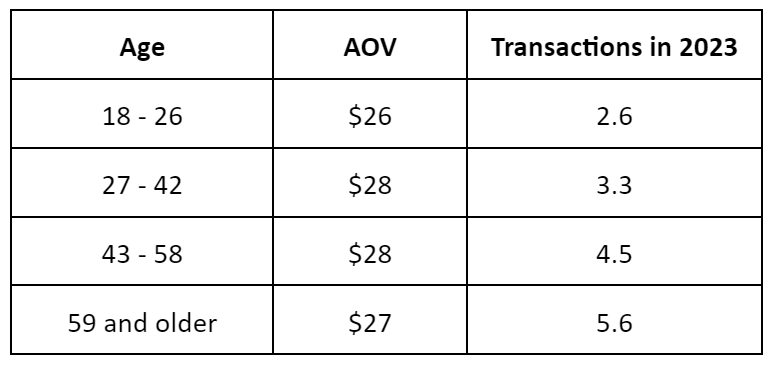
Source: Attain [4]

Decreasing the weight of the US Market, building the global market
Temu and SHEIN are estimated to account for 1% of the U.S. e-commerce market, while Amazon accounts for 38%. [5] Temu’s growth in the US has slowed down in 2024, though. This is a deliberate strategy since Pinduoduo expects policy headwinds (e.g. trade protection) and wants to reduce its reliance on that market. To improve profitability, the company has shifted to paying more attention to quality of growth than expanding scale.

Google Trends: U.S. searches for ‘Temu’ since its launch in September 2022.

Google Trends: Worldwide web searches for ‘Temu’ in the US since its launch in September 2022.
Temu intends to decrease the US market's share of total sales to approximately one-third. This share had already fallen to 57% in Q4 2023 and currently stands at about 40%. Temu is actively acquiring customers in other markets to expand its global influence. The share of sales in Europe was 35% last year but has fallen to 30% as new global regions have been added.
Although it is a highly competitive market, Temu hopes to increase Southeast Asia’s sales share to 20% by increasing marketing resources.

When it launched in 2022, Temu planned to open in 100 markets, but this was later adjusted to 50-60. At the end of 2023, Temu paused the expansion to new markets. There has been a long period of hesitation in opening new markets because of doubts that it would bring incremental growth or only be a burden. But recently, it accelerated again. At the time of publication, Temu was active in 65 countries.

When Temu opens a new market, it adjusts its business strategy according to opening-up conditions and product compliance requirements. In the US, it faces IP challenges, including counterfeits and infringing on brands. Temu has established dedicated legal, compliance, and intellectual property teams. Many lawsuits are filed in the US each month, but most remain unresolved.
In 2024, Temu plans to further develop in Asia and Africa but might also have to pull out of some markets. At the end of 2023, it launched in 8 African markets, but only Cameroon proved successful, and it had to close down in the other seven markets. In January, Temu launched in South Africa, but orders were expected to have long shipping times of up to 20 days. [6] Following a familiar pattern, only weeks after Temu launched, it became the most downloaded app. Buffalo International Logistics, which handles orders from Temu and SHEIN in South Africa, could not handle the tsunami of packages. It was reported that delivery was delayed for one week. [7]
The costs per region can differ significantly. In the U.S., Temu faces the highest costs for subsidies, advertising, and fulfilment, while in Europe, costs are relatively low. In Asia Pacific, especially Southeast Asia, they are even lower.
Other KPIs
Partially driven by Black Friday, Temu’s GMV reached $8 billion in Q4 2023, roughly the same as in the previous three quarters together. [8]
GMV reached $15-$16 billion in 2023 (although some estimates have it as high as $18 billion). Losses in 2023 ranged from $8 - $9 billion, higher than expected.
The effective order share is 65-70%, meaning Temu faces challenges with cancelled or returned orders.
In January 2024, daily GMV was $80 - $100 million. While the first quarter is usually a slow season for e-commerce, Temu is expected to maintain the level of GMV it had in Q4 2024 at $7-8 billion.
In March, Temu’s global daily GMV was nearly $100 million. Close to TikTok Shop but lower than SHEIN’s $120 million. [9]
The Average Order Value (AOV) across the whole platform was $26 - $28, while it reached $40 in the US (up from $30 at the start of 2023), $30 - $35 in Europe, and $20 - $25 in Southeast Asia, Japan, and South Korea. Temu implemented a ‘free shipping above $30’ policy for existing customers. This has increased their average order value as consumers add more items to avoid shipping fees.
The target for AOV in the U.S. is $50 (comparable to SHEIN’s current AOV), while subsidies will remain 30%, like in 2023.
Temu hopes to increase order frequency. In 2023, the average monthly order was less than 2 (only 1.1, according to one source). The goal is to increase this to 2.5 this year and reach an average of 30 orders per customer over the whole year.
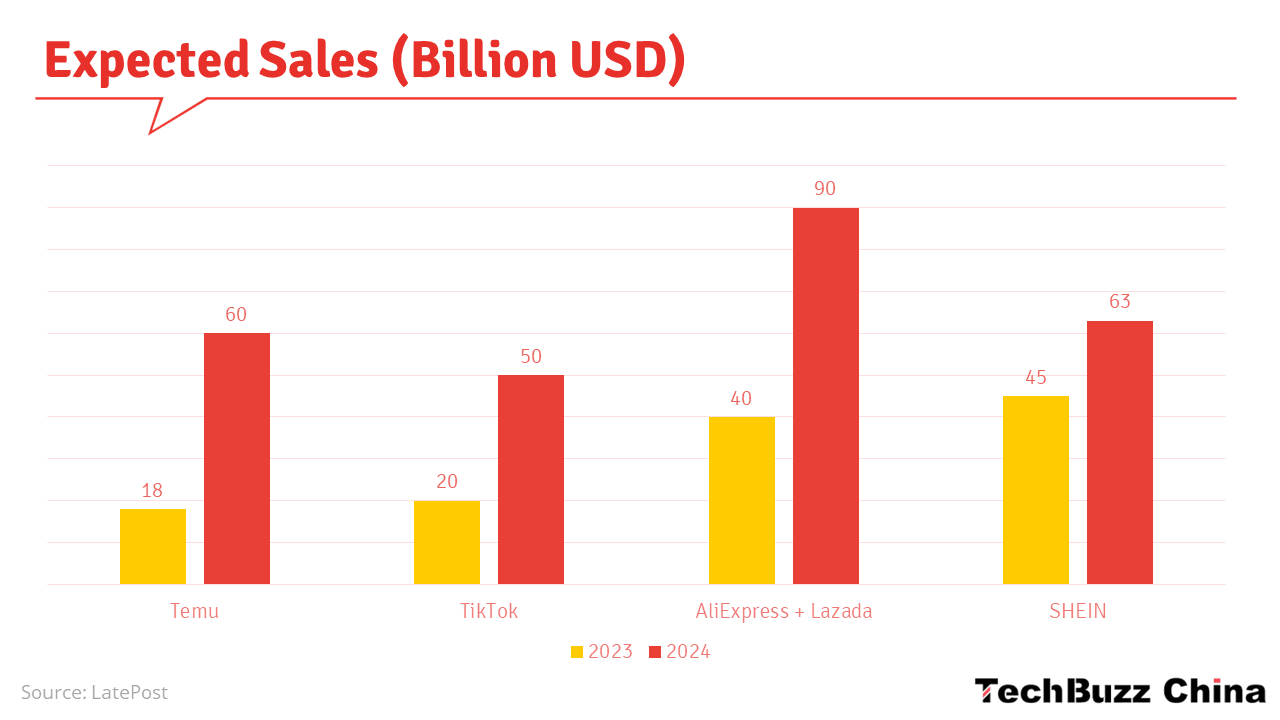
Some experts mentioned a 2024 GMV target of $30 - $36 billion in 2025. This is, however, considered a conservative goal, and based on the current momentum, 2024 could even reach $40. The company wants to reach $100 billion and be profitable by 2027.
Other recent sources claim Temu has a sales target as high as $60 for 2024 and $140 billion for 2027. [8]
Some of these GMV growth targets are conservative since Temu has faced fierce competition and policy uncertainties. Increases in investments have also yet to result in incremental growth.
In February 2024, Temu invested an estimated $21 million in five Super Bowl commercials (three during the games and two afterwards). This was Temu’s second appearance after the legendary 2023 Super Bowl adverts. It also invested $10 million worth of giveaways and $5 million in coupons and points. [10] Popularity and search volume rose after the commercials. However, it did not translate into significant numbers of new users or GMV. Downloads also did not reach the expected numbers and were down 13% compared to those after the 2023 Super Bowl ads [2].
In the first three days after the Super Bowl, downloads increased by more than 50%; in the following three days, they remained 20%—30% higher. Compared to January, February saw a 10%—15% increase in orders. However, the commercials did not result in long-term user engagement or revenue growth.
Globally and in Europe, Temu now only ranks second to Amazon as the competition is more scattered than in the US. Since Temu has the potential to become the second biggest player in some major markets, this will definitely impact other (cross-border) e-commerce platforms. Temu will strongly influence the order volume and growth potential of smaller players. The impact on Amazon will be more limited since its business structure and strategic layout enable it to remain more stable and less influenced by market fluctuations.

Still from the 2024 Super Bowl commercial.
Customer retention and repurchase
According to Earnest data, more than 28% of Temu’s early adopters were still buying on the platform 16 months after making their first purchase. That number is double the retention of Walmart and Target and about half that of Amazon. [1]
According to calculations by Lipsman, Temu’s ‘stickiness’ (the ratio of daily users divided by monthly users) rose from 9% in September 2022 to 20% in October 2023. [10] However, at the same time, Morgan Stanley claimed that the number of US households shopping on Temy declined 20% between September 2023 and January 2024. [12]
The 30-day retention rate in the US is 20% or more and remains relatively stable. However, changes in retention rates outside the US can be more significant.
In the past six months, the percentage of repeat customers has reached 45%. While this isn’t as high as Amazon’s 70%, it is gradually increasing. When Temu primarily focused on gaining new customers in the first half of 2023, the repurchase rate was only 30%.
While the repurchase rates for beauty care products are relatively high, the repurchase rates for large-ticket items and clothing are relatively low. Purchase frequency is also related to pricing, with lower-priced products being purchased more frequently. This is especially true for clothing; consumers buy these products weekly or monthly for different social occasions.
Repurchase rates in the US and Europe have been declining. The reasons are:
There has been increased competition with Amazon and SHEIN, which have reduced prices. Temu’s prices (after subsidies) are usually 40-50% lower than those on Amazon, and for clothing, 20-30% lower than on SHEIN.
Since September, Temu has cancelled ultra-low-priced items (products under $3 or even $1), which significantly affected repurchase rates. Temu also removed low-priced items, raised prices, and reduced subsidies, which impacted the repurchase rate of ‘hot-selling items’. These items had a short lifecycle and saw large sales changes within a month, making inventory control difficult.
Logistics
Temu has warehouses in Guangdong, Yiwu (where 50% of all orders ship from) and Hong Kong and ships from Guangzhou, Shenzhen, Hong Kong and Shanghai.
Every day, the number of outsourced packaging and sorting staff for Temu can reach 10,000 - 30,000. There are also more than 10,000 overseas customer service people.
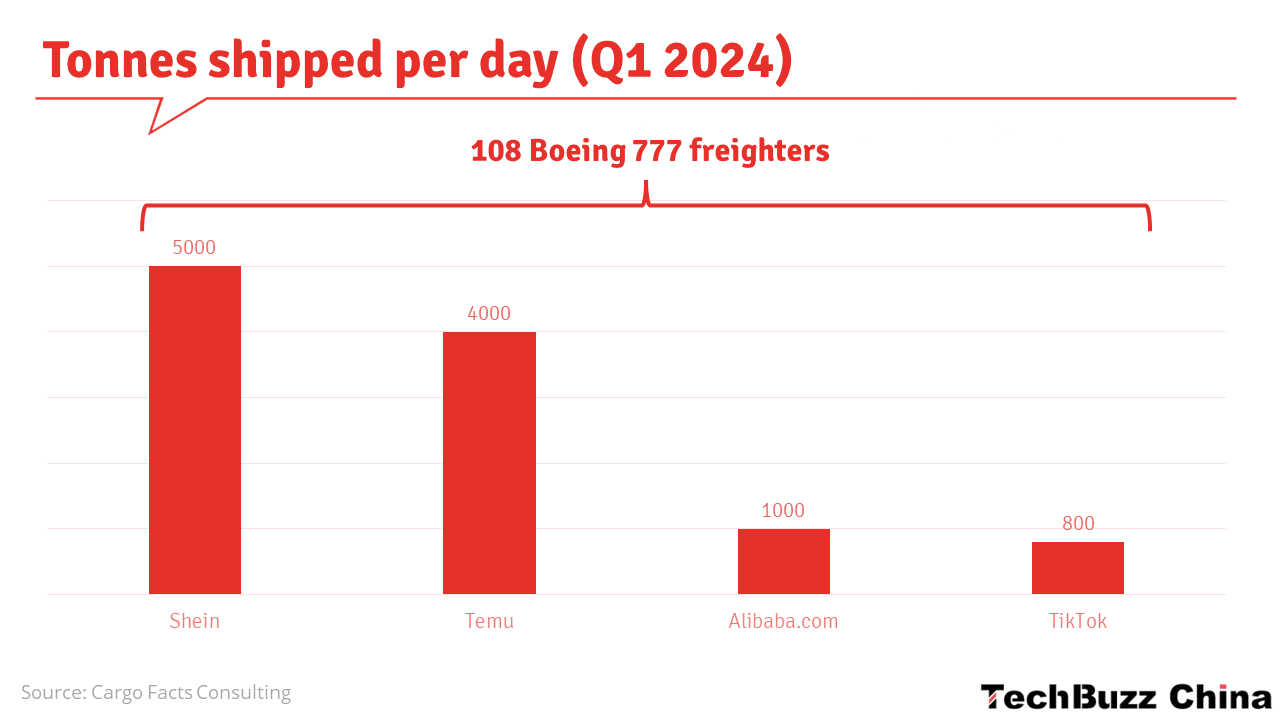
Temu and SHEIN have significantly impacted the air cargo market, boosting the prices for air freight from hubs like Guangzhou and Hong Kong.
Temu’s daily cargo volume has reached 4,000 tons, while SHEIN’s is even higher at about 5,000 tons. AliExpress’s daily cargo is 1,000 tons, and TikTok’s is approximately 800 tons. While Temu’s market share in the US has been stable, AliExpress and TikTok are growing rapidly.
At the end of 2023, Temu tried sea freight for two months but found that even express shipments still took 12 days to reach the US customer, compared to 8-11 days by air freight. Temu also tried to bring 30%-40% of its best-selling products to the US, but due to slow delivery and out-of-stock situations, this approach proved to be unsustainable. Moreover, rapid changes in the market bring great uncertainty to stocking goods overseas. Temu did, however, reduce air freight costs by using tail warehouses and signing contracts with three major airlines.
In January 2024, Temu and Jitu also changed their cooperation. Jitu no longer provides ‘end-to-end’ logistics but focuses on the last mile delivery, allowing Temu to find the most efficient service provider (minimising costs and maximising timeliness) for each leg of the transport. [11]
By sending small parcels, Temu can avoid 10%-20% import tariffs in the US because they stay under the $800 threshold of the de minimus rule. Considering the enormous volume of packages (one-third of all packages arrivingTherefore the rule has come under fire.
Ironically, the Obama administration introduced the policy in 2015 (raising the threshold from $200 to $800) to stimulate e-commerce and help customs focus its resources on bulk commodities. The de minimus rule especially helped Amazon because, at the time, the company was actively recruiting Chinese merchants on its platform. Ten years ago, there were 15,000 Chinese merchants on Amazon; now, there are 1 million. These merchants would post small packages from China directly to the consumer. Later, Amazon would shift course and promote Fulfilment by Amazon, enabling the merchants to put their goods in an Amazon warehouse in or near the destination country. [13]
When using FBA, merchants would ship in bulk, would exceed the de minimus threshold and would have to pay import tariffs. Meanwhile, Amazon could charge the merchants for logistics services. To encourage merchants to use FBA, Amazon gave products higher search rankings. 89% of merchants ended up adopting FBA. [13]
Policy changes like increased tariffs or longer customer clearance time, which could lead to a longer delivery time, will also force Temu to change its logistics strategy to maintain customer satisfaction. Although it considers the chances of the regulation being fully abolished small, Temu is anticipating a possible change to the threshold value of the de minimus rule. But even without the advantage of de minimus (which is being lobbied for a change), it would most likely still offer significantly lower prices.
Pricing
In Temu’s fully managed model (see our June article on Temu for an explanation of this model), the merchant's gross profit is normally about 20%, but the bidding system (more on this later) in which different merchants compete will reduce that margin. For categories with fierce competition, if a merchant's price is ‘not optimal’ compared to market prices, Temu's backend system will prompt merchants to reduce their prices.
Normally, such price reductions will be between 10% and 15%. So, if a product costs RMB 12, the system recommends adjusting it to RMB 10 instead of RMB 11. However, in some cases, the recommendation can be as high as 30%. If there are no adjustments, the product might be automatically removed from the platform. Preferential policies that were first given to developing categories will disappear, and gross margins will become smaller. At the end of the day, in the fully managed model, the gross margin of a merchant tends to be about 10%.
Temu does, however, give certain product categories that are short in supply, like plus-size women’s clothes, 20-25% gross margin to encourage merchants to list such products. Large factories may also be given greater pricing power or autonomy.
In the fully managed model, the sales price usually is about three times the manufacturer’s price. A product that costs RMB 10 is generally sold for RMB 25-26, giving Temu a gross margin of 60%. But despite this high margin, it will still face a loss because of advertising costs, logistics fees, and overhead. We will explore Temu’s profitability later in this article.
SHEIN is generally priced slightly higher than Temu, but the price difference is not very significant. On Amazon the net margin of a merchant will be higher (maybe 30%) but operating on Amazon requires operating skills and large advertising spending to attract traffic.
While supplier prices have decreased, consumer prices on Temu have been increasing. In the US, the selling price is now 1.5 times that in Q1 2023 and is expected to be three times as high by the end of 2024. Even when discounted, the price would be 2.4 times as high to ensure a gross profit margin of 60%.
Product range
Temu wants to increase the number of SKUs in the US from 2 to 4 million (while increasing the number of merchants to 300,000) and in other markets from 1 - 1.5 million to 2 million (while increasing merchants from 100,000 - 200,000 to 200,000 - 300,000). Since Q3 2023, Temu has been increasing the importance of its 3C small home appliances category, which will be the focus of its growth strategy.
Worldwide, Temu offers 10 million SKUs, which is still very limited to Amazon’s 850 million and AliExpress’ 100 million. [9]
Marketing
For customer acquisition, Temu relied on discounts, ‘red envelopes’ and coupons while increasing brand exposure and attracting potential customers through advertising on various platforms (Facebook, YouTube, Google, etc). In the future Temu plans to hand out more coupons to existing and new customers and reduce these once a shopping habit has been formed.
Of all traffic on Temu, 65% is organic, while 35% is paid. According to Meta’s CFO, Chinese advertisers like SHEIN and Temu contributed 10% of the firm's revenue in 2023. The market has been complaining about Temu driving up the costs of digital marketing. [5]
In 2023, Temu spent an estimated $1.2 billion on adverts on Meta’s network alone. It has also placed adverts in Google Shopping search results for white-label alternatives to well-known brands and has worked with 10,000 influencers. [10]
Temu plans to spend $4.3 billion on marketing in 2024. The increase from $3 billion can mainly be found in subsidies, less in advertising volume.
$3 billion of the total budget will be spent on purchasing traffic to gain more customers.
To enhance customer loyalty and market competitiveness, $1.3 billion will be invested in subsidies (discounts).
$3 will go to the US market. Up to a third of the budget might be allocated to shopping festivals like Black Friday.
Note: the rest of this article is available to paid subscribers only.
Merchants
Fully managed platforms like Temu typically use a low-price strategy, and merchants cannot determine their own sales prices. The platform is more suitable for products that do not focusing on long-term brand development. Merchants on Temu mainly deal in private labels and speciality products. They control costs and increase the value of their products through in-house R&D (e.g., mold-based manufacturing). Their products are not homogenous, so they have higher pricing power and margins.
One merchant shared how they usually test market response to new products on Amazon first because it has a broad user base and provides effective market feedback. Once the sales on Amazon are stable, he will introduce the product on other platforms to expand channels and reach more potential customers. He has seen good results and profitability with Temu’s semi-managed model (more on this later), although he fears that there will be fierce price competition on the platform in the long run.
The delicate price-quality balance
As discussed in an earlier article, merchants pay half of the domestic transport costs between (manufacturing) source and the Temu warehouses in Guangzhou. They also need to pay for any return costs from the warehouses. And as far as consumer returns are concerned, merchants on Temu need to bear the full return costs, increasing the operational pressure. For such returns, merchants can choose between secondary sales, discounted sales or destruction of goods.
Consumer complaints about Temu generally focus on four areas: [14]
The product quality is poor, and products break easily.
Customer service: difficulties finding someone and/or a solution when problems arise (refunds, returns).
The logistics are slow, and the arrival is often delayed or not received.
The marketing methods (e.g. ‘price cutting’ and ‘cash rewards’) are deceptive. After half a day of playing the gamifications, there is no reward or the reward cannot be claimed. (I wrote extensively about how this was already frustrating in Pinduoduo a few years ago)
This indicates that logistics and after-sales are not keeping up with the pace of growth, and Temu’s bidding system is causing quality problems.
Initially, Temu verifies a merchant’s prices against Alibaba’s 1688.com wholesale platform and the Yiwu wholesale market, adding a certain margin (according to some sources, around 20%). [11] However, once it detects a lower price, the merchant will be asked to reduce his price. Also, for popular products, Temu will search for alternative suppliers to deliver the same goods at lower prices. [14]
Temu aims for products that meet ‘export standards’, meaning the costs are low and they guarantee a basic quality. It has also taken advantage of access capacity in Chinese factories to reduce manufacturing prices. The bidding system that lets merchants/manufacturers bid on volume every week further reduces prices.
In Temu’s bidding system, only the product with the lowest price will be made available on the platform. Regardless of the order volume and how much of merchant A’s goods are stored in a Temu warehouse, if merchant B quotes a lower price, merchant A's sales will stop, and merchant B’s will start. This does not consider that merchant B might be dumping surplus inventory under cost price. If merchant A does not lower his price, he might eventually be asked to pay inventory fees. He might have to collect or even scrap his remaining inventory at Temu’s warehouses. To avoid these costs, merchant A can only lower his price.
But there’s more… If a merchant accepts a price reduction, it will be applied retroactively. For instance, if a merchant already sold 10,000 pieces of a specific product and later reduced the price by RMB 5, Temu will freeze RMB 50,000 in the merchant's account. Merchants have shared their negative experiences on platforms like Douyin and Xiaohongshu. Some claim that, due to these policies, they have lost serious amounts of money by trying to sell on Temu. [14]
In this race for the lowest price, some merchants will achieve this by making concessions to product quality. They will start using less or lower quality raw materials and cut back on process costs while trying to maintain the product's appearance. A manufacturer of winter jackets might start reducing the filling in the coats. [14]
To force merchants to maintain acceptable quality, Temu has strengthened quality inspections and is using a penalty system. In case of quality complaints, the merchant gets fined five times the consumer price of the item. Since the consumer gets his payment back, that leaves four times the sales price in Temu’s pockets. [11] In other words, the system not only penalises the merchant but is also a source of income for Temu. Meanwhile, the merchant sees its margins evaporate.
Despite complaints about after-sales service, Temu's refund and return policies are highly consumer-friendly. It has a 90-day no-reason return and exchange service. This has a significant impact on merchants that need to bear the risks. If there are quality complaints, merchants often dare not resell returned goods, and the goods may even be scrapped. Although consumers have to give a reason for their complaints and upload photos, Temu does not share detailed reasons when it gives merchants fines. They might relate to product non-compliance, consumer dissatisfaction, insufficient warehouse inventory or product quality issues. A lack of information could prevent a merchant from taking measures to solve problems.
I have experienced these problems myself. Out of 15 items I have bought on Temu, 4 or 5 had unacceptable quality. For instance, I bought a phone charging cable on Temu that was only able to charge my phone 20% in half a day. When I complained, I was told that, as an exception, I did not have to return the goods, and I was refunded in 24 hours.
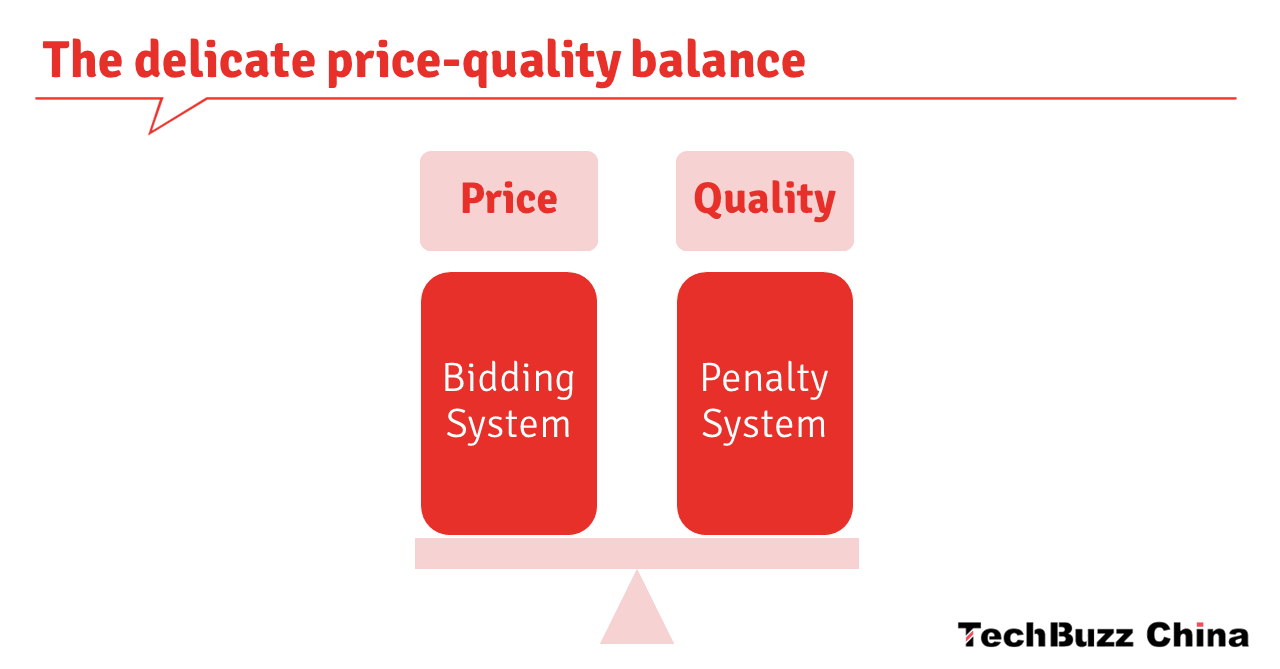
It’s a tricky game that Temu plays. On one hand, it forces merchants to lower prices while, on the other hand, heavily penalising them if the product quality becomes unacceptable.
Merchants facing low profits, high returns (with Temu mostly giving consumers the benefit of the doubt and granting refunds), and even fines often leave Temu and might return to Amazon.
The semi-managed model
In the fully managed model, merchants (mostly manufacturers) send their goods to a Temu warehouse, and Temu takes over the logistics of delivering them to the overseas consumer. This model, which we have discussed extensively in previous Temu articles, is perfect for manufacturers that do not have the skills or resources to do cross-border e-commerce themselves. Temu would take over all logistics, sales price-setting, marketing and after-sales, and the manufacturers could focus on what they are good at: designing and producing products.
On March 15 2024, Temu also launched a semi-managed model for merchants that already have the goods (or are willing to put goods) in a warehouse in a foreign country. Merchants must be able to handle distribution and logistics independently from there. In these cases, Temu gives higher supplier prices, making it possible for the merchants to gain higher margins. The semi-managed model also allows merchants located in the foreign market to sell through Temu, while it has only accepted domestic merchants on the fully managed model.
Temu is not the first to try this model; AliExpress has used a version of the semi-managed model since August 2023. The AliExpress model's core is that merchants can handle shipping and returns themselves. However, in Temu’s version of the semi-managed model, the platform retains the right to set product prices. The idea is that merchants can control fulfilment costs while the platforms can attract users through pricing power. This differs from Amazon’s approach, in which merchants manage pricing and marketing, and Amazon charges commissions.
The semi-managed model might not be feasible in countries with smaller market volumes but would work in markets like the US, Germany, Japan, the UK, France and Italy. After launching semi-managed in the US and Canada, Europe followed with a focus on the UK, France, Italy, Germany, Spain and Portugal. Other regions like Japan and South Korea are expected to follow.
In the fully managed model, the US accounts for nearly 50% of GMV, Europe for 30-35%, and Asia for about 10%. For the semi-managed business, GMV distribution is expected to be 70% in the US and 30% in Europe. By the end of 2024, the U.S. should have a 60% share, Europe 40%, and Asia and Latin America 10%.
Temu aims for product uniqueness and tries to avoid overlap in similar goods between the fully managed and semi-managed models. Currently, it can control the overlap to 5%.
The average order value in the semi-managed model currently is $37 - $38, while it is $40 in the fully managed model. Temu expects the AOV of orders in the semi-managed model to eventually be 30% higher than in the fully managed model, rising from $30 to $50 - $55.
In the fully managed model, the product audit process is quite strict, including checks of product quality, completeness of certificates, accuracy of graphic descriptions, and product prices. If specific categories or SKUs are already saturated on the platform or the price is not competitive, the product will not pass the audit. About half of the products are rejected unless the merchant has strong product selection capabilities. On the other hand, the audit for the semi-managed model is relatively loose. AI technology can be used for review, or merchants can be asked to provide videos so they can be audited online. This could potentially lead to issues with product quality.
SHEIN is launching a semi-managed model in the U.S. in May 2024. AliExpress recently also implemented an overseas hosting model. As with Temu, they are competing for Amazon merchants and independent merchants with warehouses overseas. [9]
An industry insider speculated that Temu might combine the fully and semi-managed models: merchants ship goods overseas, and Temu expects the goods and controls the final delivery to the consumer. [9]
Merchants of the semi-managed model
In April, there were 180,000 merchants active on Temu, only a few thousand of which were using the semi-managed model. The rest are all Chinese merchants using the fully managed model. Only 1% of all merchants have switched to the semi-managed model.
Merchants that use the semi-managed model can be divided into two categories:
Chinese sellers with cross-border e-commerce backgrounds who overlap significantly with other platforms like Amazon. Temu has set up a recruitment centre in Shenzhen that focuses on recruiting Amazon merchants.
Local American sellers, coming mainly from Amazon and Wish. They can’t match Chinese sellers’ prices but have an advantage in response speed. Compared to TikTok and SHEIN, the proportion of this category on Temu is small.
Some merchants might use the semi-managed model to deal with longtail goods and slow-moving products on other platforms. By selling unsalable products on Temu, merchants can avoid destroying inventory and having to pay scrapping costs in the foreign market. These merchants are unlikely to customise or distribute large quantities of products specifically for this model, though. In other words, they use it as a supplementary but not primary sales channel. When inventory is low, they might prioritise other platforms offering better margins.
For example, sometimes merchants move from Amazon to Temu to clear surplus inventory. While Amazon offers higher margins, the platform provides insufficient traffic. Moving some SKUs to Temu can also spread risk and take advantage of the high traffic on such new platforms. The traffic on Temu is substantial, and it has high stickiness, which benefits merchants.
The fully managed model is suitable for merchants that need a low threshold way to enter the market, have no foreign trade experience or operational capabilities and do not want to invest in stocking up or dealing with logistics in the US. The semi-managed model is more suitable for merchants that already sell on Amazon.
Competitive merchants that have made profits under the fully managed model are more willing to take the risk and try the semi-managed model.
In Shenzhen, where 90% of merchants used to mainly sell through Amazon, many have moved to Temu, where they see lots of sales potential.
While merchants on the fully managed model are usually manufacturers, those who use the semi-managed model tend to have physical wholesale or have operating experience on other e-commerce platforms. They have consumer-facing capabilities, enabling them to handle critical aspects like logistics, order execution, and after-sales service themselves.
When the semi-managed model was launched, Temu had 10,000 merchants using the model. 80% of the merchants were from China and the remaining 20% included brands from the US and Latin America. Chinese merchants mainly sell goods to clear inventory from Amazon or Walmart and they offer 300,000 SKUs (merchants that clear inventory through Temu generally have 10-15% less margin than on Amazon). About 10%-20% of merchants have switched from the fully managed model to the semi-managed model.
The current number of merchants and SKUs is insufficient and Temu is investing to expand the scale. Temu encourages merchants to add more SKUs to meet the needs of different consumers. It aims to recruit 50,000 - 100,000 merchants and offer 2 million SKUs and is adding about 10,000 merchants per month, most of which are small to medium-sized sellers in the US.
However, some merchants are dissatisfied with the prices under the semi-managed model because of the cost pressure of this model. Subsidies that Temu offers can not relieve this pressure. This could lead to the loss of merchants.
The semi-managed model is useful for heavy and/or large items that would normally be shipped by sea freight and for which air freight in the fully managed model would not be suitable. Initially, Temu mainly recruited merchants selling such large items for the semi-managed model, but soon they expanded to all categories. Compared with fully managed, the semi-managed model can cover a wider product range and allows for other categories to be added to Temu’s product selection, like bulky, lightweight items, food with limited shelf life and locally copyrighted books. [9]
Currently, few local US merchants participate in the semi-managed model. Those who do mainly sell large goods (heavier than 10 kg), high-value goods, and 3C electronic products. Temu hopes to increase the share of large goods in sales to 20% in the next five years.
The fully managed and semi-managed teams work independently. Some staff members of the full-managed model have now been assigned to the semi-managed model. Since the semi-managed model is a separate system, merchants need to open a new store even if they are already using the fully managed model. Temu plans to direct 30% of traffic to semi-managed merchants.
Logistics in the semi-managed model
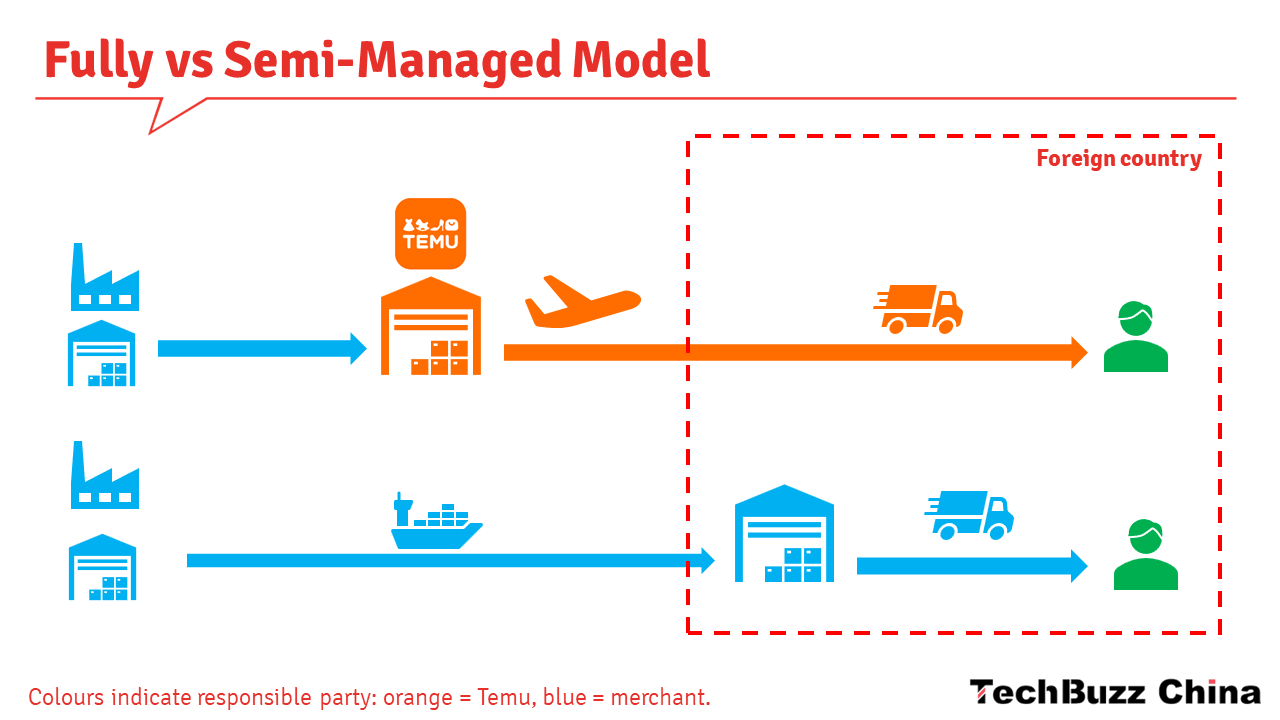
In the semi-managed model, the merchant has to take care of the entire logistics process: shipping goods (primarily by low-cost sea freight) to the country of destination, to the local warehouse and from the warehouse to the consumer. For the latter, the merchant can choose its own logistics provider as long as it is one on Temu’s whitelist.
Because of the lead time of sea freight from China to the destination country, there is a potential risk of goods being (temporarily) out of stock. As such, the semi-managed model comes with more ‘hassle,’ and merchants need to consider many aspects when deciding their sales strategies, including inventory control, product circulation speed, customer satisfaction, and cost-effectiveness.
For emerging companies, shipping from China when orders have been received is less risky than putting goods in overseas warehouses, and it helps manage inventory levels and related costs. However, as companies grow, setting up overseas warehouses becomes more attractive as it can reduce logistics expenses per product. For example, the price per 10 grams of air freight to Thailand is RMB 0.5, but only RMB 0.2 for sea freight. Providing a better customer experience through shorter delivery times potentially further improves profitability.
For cross-border merchants that ship directly to the consumer from China, the logistical costs are about 10% of total sales. In the case of overseas warehouses, they are about 5%. In both the fully managed and semi-managed model, Temu maintains the negotiated price advantages of shipment in a country through centralised procurement. Thanks to its high volumes, it can obtain lower prices. Although merchants choose a suitable service provider to deliver the goods in the semi-managed model, they do get penalised when they exceed delivery times.
Delivery fees in the fully managed model usually are $5.50 - $6. With Fulfillment by Amazon, the costs are about $6.50, while UPS would be $5. In the semi-managed model, the biggest savings are in the first leg of logistics: sea freight, which only costs about 30% of air freight.
A possible disadvantage of the semi-managed model could be higher logistical costs for delivery from the warehouse to the consumer compared to the costs of the same leg in the fully managed model. Merchants need to ship orders separately, while Temu has consolidated volumes for which it gets a lower price with local couriers in the fully managed model. In other words, the choice of fully or semi-managed must be carefully considered per product.
Temu currently has five warehouses in different regions in the US, including self-built and rented warehouses. Shipping from these warehouses can be done within 0-1 day, and they help improve delivery times to most places in the US to 2-3 days (although some areas can take up to 5 days). Merchants that use the semi-managed model can use these Temu warehouses, their own warehouse, or even Fulfillment by Amazon.
Temu has partnered with WINIT (万邑通) and Easy Export (出口易) to offer warehouse services in the U.S.. These firms have facilities in the U.S. and elsewhere and will effectively act as the Fulfilment by Amazon equivalent of Temu. [15]
The semi-managed model can result in serious extra costs for rent and staff when merchants need to operate their own warehouses. These costs are obviously much higher than in China. If, owing to fierce competition, sales are not as expected, this could lead to backlogs and severe inventory costs. Shipping goods back to China usually is prohibitively expensive.
Some merchants that use the semi-managed model use third-party warehouses in the US. These are experienced in handling returns, avoiding logistics chain problems affecting the merchant's operating experience. These warehouses provide various services, including warehousing, packaging, connecting to last-mile delivery and reverse logistics. However, the number of warehousing service providers that can handle large items is limited, while these types of products are also most suitable for the semi-managed model. This means that merchants of such products often have to set up their own overseas warehouses. This is a high threshold for many merchants.
Merchants can ship large quantities of products in advance to US warehouses by sea freight to reduce costs (compared to air freight) and out-of-stock risks. However, this can lead to high warehouse costs in the US. Merchants need to predict US consumers' demand to keep warehouse costs down and replenish inventories promptly.
The aforementioned de minimis rule allows consumer packages under $800 to be imported tax-free. However, merchants with businesses in the US need to declare and pay taxes on their imports. This also applies to the semi-managed model. Should the de minimis threshold be lowered, it will potentially impact the fully managed model but not the semi-managed one. Therefore, more manufacturers are expected to switch to the semi-managed model if such a policy change is made.
While merchants need to pay for logistics in the semi-managed model, they do not need to pay commissions or advertising fees like on Amazon. So, while a merchant’s margins on Amazon are higher, the costs are often higher as well.
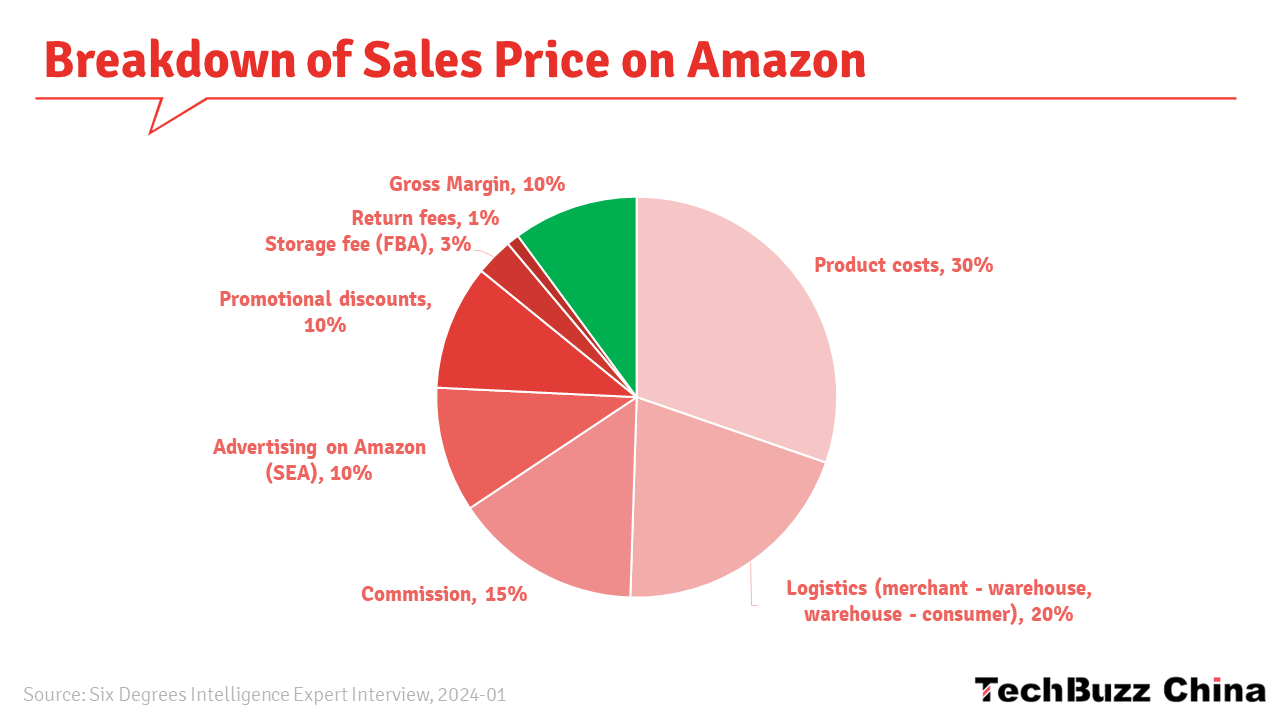
With the semi-managed model, Temu outperforms SHEIN and TikTok, which use variations on the fully managed model, in delivery speed. In the best case, consumers receive their Temu order on the 3rd day after placing it. If weekends are taken into account, the average will be 4-7 days, which is better than the 5-10 days of the fully managed model (only 10% of orders can be delivered in 5 days). While Temu has not yet reached Amazon’s 3-5 days speed, it is getting closer. If Temu can match Amazon in speed, it will significantly improve customer satisfaction, considering that Amazon Prime users must pay extra fees.
Pricing in the semi-managed model
As with the fully managed model, merchants cannot independently determine the prices of goods in the semi-managed model. Temu still controls this right. When setting the pricing for semi-managed merchants, Temu considers other platforms like Amazon, Walmart, SHEIN and AliExpress and applies a certain discount. In the US and Canada, a 5%-15% discount will be applied. In the UK, the discount will be relatively low because of VAT. If the order is below $30 and does not meet the criteria for free shipping, Temu will provide merchants with $2.99 shipping support.
In the semi-managed model, orders over $30 enjoy free shipping. In the fully managed model, the threshold is sometimes $39.
Goods in the semi-managed model usually are higher in price, which has increased Temu’s average order value (AOV) from $40 to $42 - $43 and is likely to grow further in the future. Some merchants have even moved the higher-priced items (outdoor and household items) to the semi-managed model because their size and weight are unsuitable for cross-border small package transportation through the fully managed model.
In the semi-managed model, the merchant’s margin usually is more than 20%, depending on the product's competitiveness in the market, while it is 10-20% in the fully managed model. Generally speaking, if a merchant has a 25% gross margin in the fully managed model, he needs a 55% margin in the semi-managed model to cover the additional costs. Net profit in the semi-managed model is about 2%-3% after deducting all related expenses. On other platforms like Amazon, sellers can achieve net margins of 20%.
As mentioned, in the fully managed model, the sales price usually is about 2.5 - 3 times the manufacturer’s price. A product a merchant sells for RMB 10 is generally sold to a consumer for RMB 25-26, giving Temu a gross margin of 60%. In the semi-managed model, Temu’s margins are lower: 20%—30%. This is lower than with the fully managed model, but Temu can save about 30% in logistics costs. Despite this, the semi-managed model has not yet become profitable because of promotion (advertising) and management costs.
The weight of subsidies is similar in both models. Temu will also provide price subsidies in the semi-managed model to enhance its competitiveness. In March, this was 30%-50%.
The same goods in this example typically sell on Amazon for RMB 40. The recommended selling price on Temu is 70% of Amazon’s price, or RMB 30. In the fully managed model, prices will generally be 40% to 50% cheaper than those on Amazon. In the semi-managed model, 20% - 30%.
Another example. Specific Bluetooth headsets sell for RMB 15.8 in Temu’s fully managed model, with RMB 2.5 gross profit and RMB 0.6 net profit. In the semi-managed model, they need to be RMB 26-27, giving RMB 7-8 gross profit and RMB 1 net profit.
Traffic distribution between the two is entirely isolated, so they don’t compete with each other. The platform can, however, steer consumers to semi-managed goods by offering subsidies and promotions. Starting in March, Temu did not ask merchants to lower prices but to participate in promotional activities instead.
As we have described, Temu is known for its pressure on merchants to lower prices. However, compared to Amazon, the competitive pressure for large ticket items that the semi-managed model is more suitable for is relatively limited. The reason is that there are not many merchants selling these items at the moment. After the launch of the semi-managed model, Temu has not required merchants to lower their prices, giving them some pricing freedom.
Payment cycles on Temu are now 30 days on average and as little as 20 days for popular items. On Amazon, it can last as long as 85 days. In the semi-managed model, payment can be settled in US dollars, giving potential exchange rate advantages, while the fully managed model is always in RMB.
The impact of the semi-managed model isn’t significant yet. Temu isn’t thoughtfully tilting traffic towards semi-managed yet. But that is expected to change.
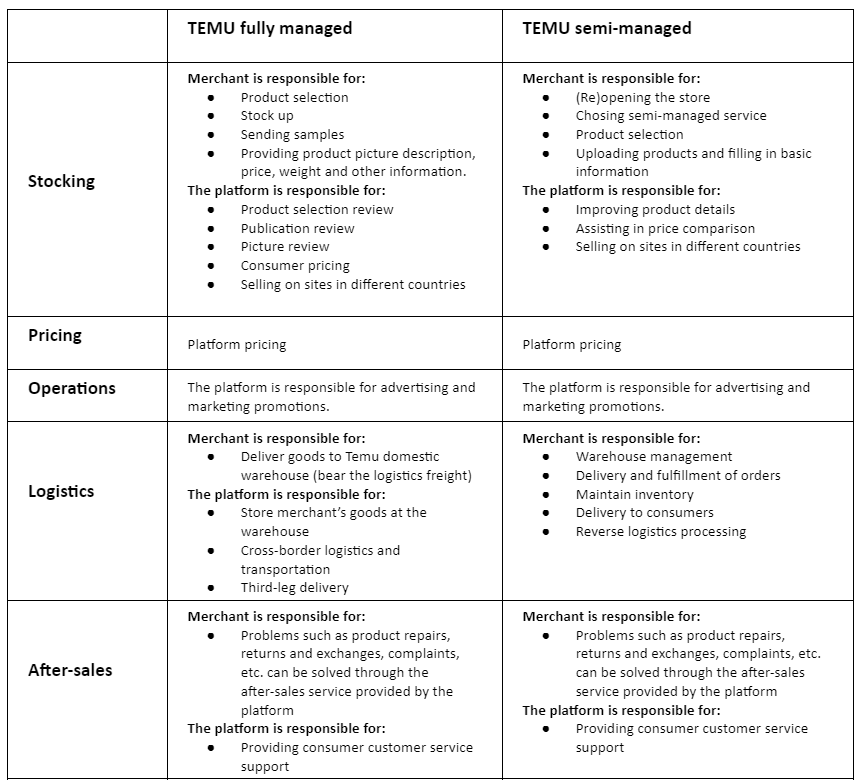
Source: 雨果网 [16]
Temu versus Amazon
Amazon remains the most important sales platform, with global influence and the largest market share. Despite the new competitors, Amazon’s GMV growth was 10% in 2023 and is expected to remain on that level this year. Amazon is not likely to interfere with retail prices because it thinks it should compete through better product selection and services. Still, in the clothing category, Amazon has lowered merchant commissions to deal with the competition by SHEIN and Temu.
Amazon hopes Chinese sellers can provide competitive prices to support the platform's growth and encourages them to advertise to increase its revenue. It has also tried to develop a supply chain in Vietnam, but this has not had the desired results.
Meanwhile, some products are moving to Temu’s semi-managed model, especially those of merchants with overseas warehouses or independent websites.
Products are generally 40%- 80% cheaper on Temu than on Amazon. This is partially due to Temu’s price subsidies, which are approximately 30% of the product price.
Temu’s AOV is $40, while Amazon’s is $60. It will be difficult for Temu to reach the same level as Amazon.
How do Temu and Amazon overlap?
At 5-10%, the overlap between merchants and Temu is relatively low. The total sales of Chinese merchants on Temu are only 10% of those on Amazon (in 2023, it was $10 billion versus Amazon’s $100 billion).
The product overlap between Temu and Amazon is estimated to be only 8%, while it is 5% with SHEIN.
The overlap in users between Temu and these two platforms is about 10%.
About 6% - 8% of Amazon users also buy on Temu.
Compared to Amazon, the overlap between Temu and other Chinese platforms is much more significant. AliExpress and Temu have a high degree in similar product categories, with the most popular being clothing accessories, household goods and 3C electronic accessories. TikTok Shop focuses more on beauty products, followed by women’s clothing & underwear, and food & beverages. It also has niche categories like Muslim clothing and men’s underwear. SHEIN mainly deals in its own brands of women’s clothing. It opened a marketplace, but its categories are still less diverse than Temu and AliExpress.
While Temu has been reported to have conquered 17% of the US dollar store market by November 2023, it claims the impact on Dollar Tree and Dollar General is relatively small because these stores sell a lot of fresh food (50% and 30-40% of sales respectively). The impact on Target and Five Below has been more significant, and Temu has penetrated a large share of their user bases.
When considering Temu’s semi-managed model or Amazon, both options have pros and cons. When a merchant lists products on Temu, it can enjoy fast listing and exposure. An advantage of Amazon is that through Fulfilment by Amazon, it can ship products within 48 hours. Temu's semi-managed prices usually are 30% lower than those of Amazon, attracting price-sensitive consumers, but it may hurt merchants’ Amazon sales and profit margins. What’s more, Temu offers new customers coupons and promotions, putting further pressure on merchants’ margins.
A stroller seller compared selling on Temu (semi-managed) and Amazon as follows. The product costs $25. On Amazon, it sells for $80, and the gross profit is 1.5 times the cost price. On Temu, it sells for $55, and the logistics costs are about $5, so the gross profit is one-time the cost price. Selling on Temu had little impact on their Amazon sales. This differentiated pricing could become a problem when consumers compare prices across platforms. In their pricing strategies, merchants must balance business objectives while maintaining consumer trust and satisfaction.
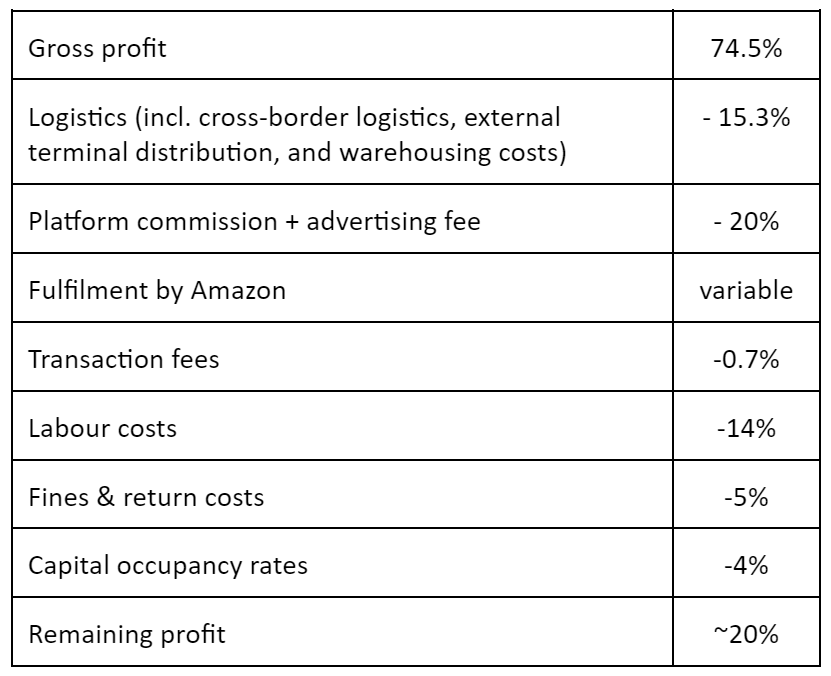
The future
Let’s look at the expectations for Temu in 2024 and beyond.
Temu’s GMV in Q1 2024 is expected to reach $10 billion, with the US market having a 35% share. The semi-managed model will only have a single-digit share in this.
At the beginning of April 2024, the US daily order volume of the semi-managed model was 150.000 orders, less than 10% of the total number of US orders. Still, Temu expects that the share of the semi-managed model will increase to 30% by the end of the year.
For 2024, Temu expects a GMV of $30 - 40 billion and a profit increase of the parent company of 30% - 40% YoY. However, other estimates in recent months have shared GMV targets as high as $45 billion and even $60 billion.
The US GMV of Temu is expected to grow to $18-$20 billion in 2024, and the semi-managed model will have a 30% share of that.
By the end of 2024, the average US order is expected to contain 4 - 6 items, and the AOV will be $50.
The current GMV of Temu is mainly composed of categories such as clothing, household products, 3C electronic accessories, pet products, and toys. These categories make up 60% of sales. When the semi-managed model drives sales of items like furniture, kitchen appliances, and office supplies, the share of the current main categories will decrease.
Temu has become the key driver of Pinduoduo’s growth. An HSBC report claimed that 23% (or RMB 57 billion) of PDD’s revenue in 2023 can be contributed to Temu. HSBC expects Temu’s contribution to revenue to increase to 43% in 2024 and more than 50% in 2025. In other words, Temu is Pinduoduo’s main growth business. [8]
Markets
The US market is crucial for Temu’s overall goals, but Temu is careful because of potential (tax) policy changes in the US that Europe may also follow. Temu would rather slow down growth and ensure compliance. If policy changes in the US lead to losses, they could balloon to 30%. However, considering Temu’s average order value of $40-$50, lowering the de minimis threshold from $800 to $500 or $600 will have limited impact. Temu does foresee a possible tariff increase of 10%. However, as the GMV decreases in the US, it will have a lower impact on global company results.
While it reduces its dependence on the U.S. market, Temu has asked merchants to prioritise stocking best-selling products in markets such as Europe, the Middle East, Japan, and South Korea. [17] In January 2024, the number of registered users in Japan reached 15.5 million and 5.7 million in South Korea. [18] [19]
Temu hopes to increase the number of users from 470 million at the start of 2024 to 700 million by the end of the year. It especially hopes to expand in Southeast Asia, Japan, South Korea, the Middle East and (southern) Africa. The platform is putting more emphasis on Japan than on South Korea because there is no strong competition from other Chinese cross-border e-commerce platforms in Japan, while in South-Korea there is.
In Southeast Asia, manufacturing costs are relatively low compared to those in China, making it difficult for Chinese merchants to be successful there. Therefore, the region has a low priority for Temu.
In Mexico, Temu has opened two warehouses to start a local merchant market. It is also considering shipping goods through Mexico to reduce tariffs and enjoy government subsidy policies. Temu also considered Trump's possible victory in this decision since Trump has several businesses in Mexico and might be reluctant to impose import tariffs.
Merchants and product selection
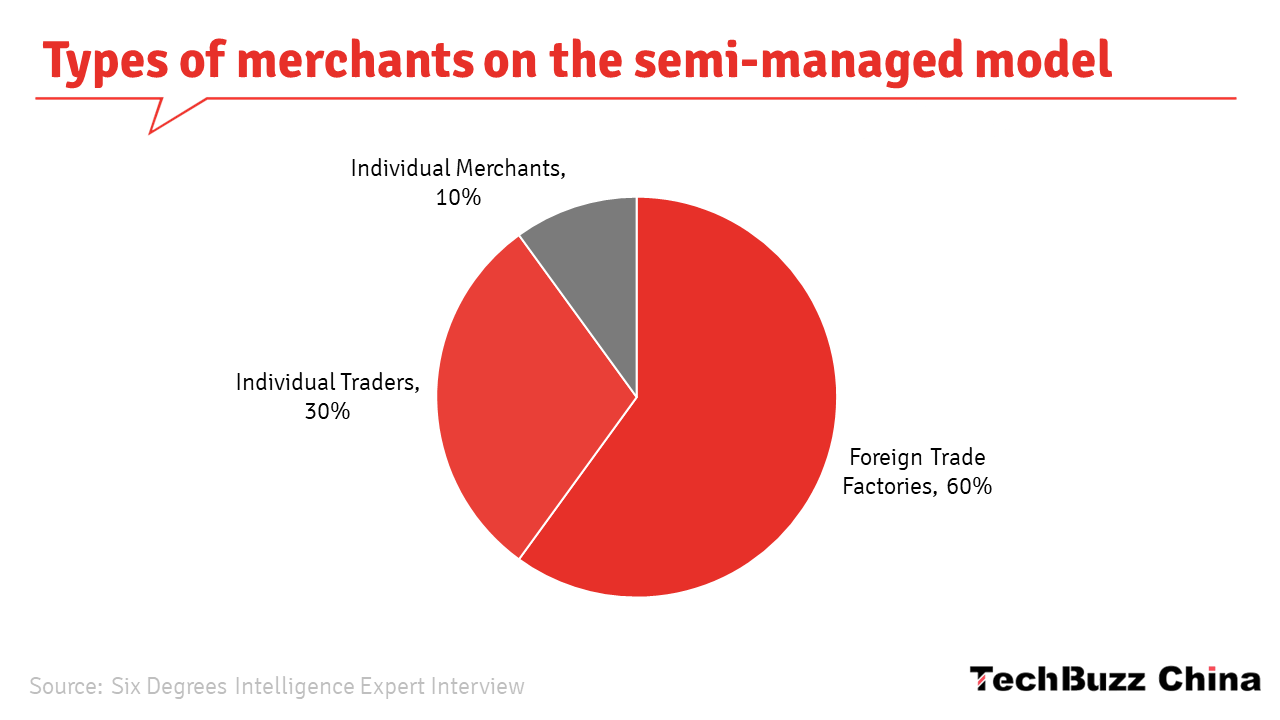
Currently, the proportion of factory-type merchants on Temu is 60%. Because these merchants have greater advantages in cost control (compared to traders), the platform hopes to increase this to 70%. The rest will be made up of traders (20%) and individual merchants without sources of supply (10%). Still, in September 2023, Temu lost several clothing factories because of the relatively small margins on the platform.
Recently, Temu launched an OBM (Original Brand Manufacturer, factories that design and produce their own brands) channel. It is aimed at domestic single-store brand merchants with at least RMB 1 million in sales. Currently, the following categories can be offered: men’s clothing, outdoor sports clothing for men, and maternity wear. Merchants must open a new store and release at least 50 SKUs, showing that Temu's strategy is to boost its apparel product selection. While the channel uses the fully managed model, it is said to be more flexible in quality inspection and pricing verification. [17]
Temu’s pursuit of low prices has led to cooperation with factories that do not meet ESG standards, which could lead to compliance issues. In the US, Temu had taken a strategy to wait for a reaction and then make adjustments as a reaction. At TikTok, which has been much slower rolling out cross-border e-commerce, they concluded that Temu was able to quickly open the country because they ‘get on the bus first, buy the tickets later’. ‘Getting on the bus’ refers to setting up logistics, payment and other partners before entering a country. ‘Buying the ticket later’ refers to solving compliance issues while expanding the market. [9]
In the US, Temu wants to increase the number of SKUs from 2.5 million to at least 4.5 million. The semi-managed model and opening to local niche merchants with low to medium prices should support this goal. However, Temu has not yet effectively attracted local merchants, especially compared to Amazon. Temu’s lack of popularity (compared to established platforms), merchants’ concern about lower profits (despite subsidies and traffic support) and general resistance against cross-border e-commerce have proven problematic. American merchants tend to be conservative and reluctant to try new channels, instead focussing on brand positioning and target groups.
Temu will also add more categories and merchants and gradually transition. In the mid to long term, after first moving to a semi-managed model, Temu wants to develop into a self-operated 3P model similar to Amazon. Merchants will be able to operate their stores independently.
Temu’s profitability
The question on everybody’s mind is how profitable Temu is now and will be in the future. We often find articles stressing how much money Temu is losing per order. Unfortunately, some publications fail to understand that temporary losses are part of Temu’s strategy and that they should be considered as just one of the factors (acquisition costs) determining customer lifetime value. It is normal for e-commerce platforms (or any start-up, for that matter) to run losses for extended periods. It took Amazon nine years to become profitable. So, instead of stressing the current lack of profitability, we should look at how Temu plans to become profitable.
In the process of international expansion and operations, Temu faces several financial challenges.
The gross profit margin for Temu is normally 50% - 60%.
The fulfilment costs are quite high, accounting for 25% - 30%, and there are differences per country. Logistics costs in the US market normally account for 30% (the global average is 27%). Temu took measures to reduce costs and increase efficiency, but these costs did not drop significantly.
Temu carried out large-scale advertising, accounting for another 30% of expenses.
Customer acquisition costs are about 20%, including subsidies, discounts, and promotions.
Domestic warehousing and distribution are 5% (1% for warehousing, 4% for sorting).
Other costs (management, labour and operating expenses) account for about 5%.
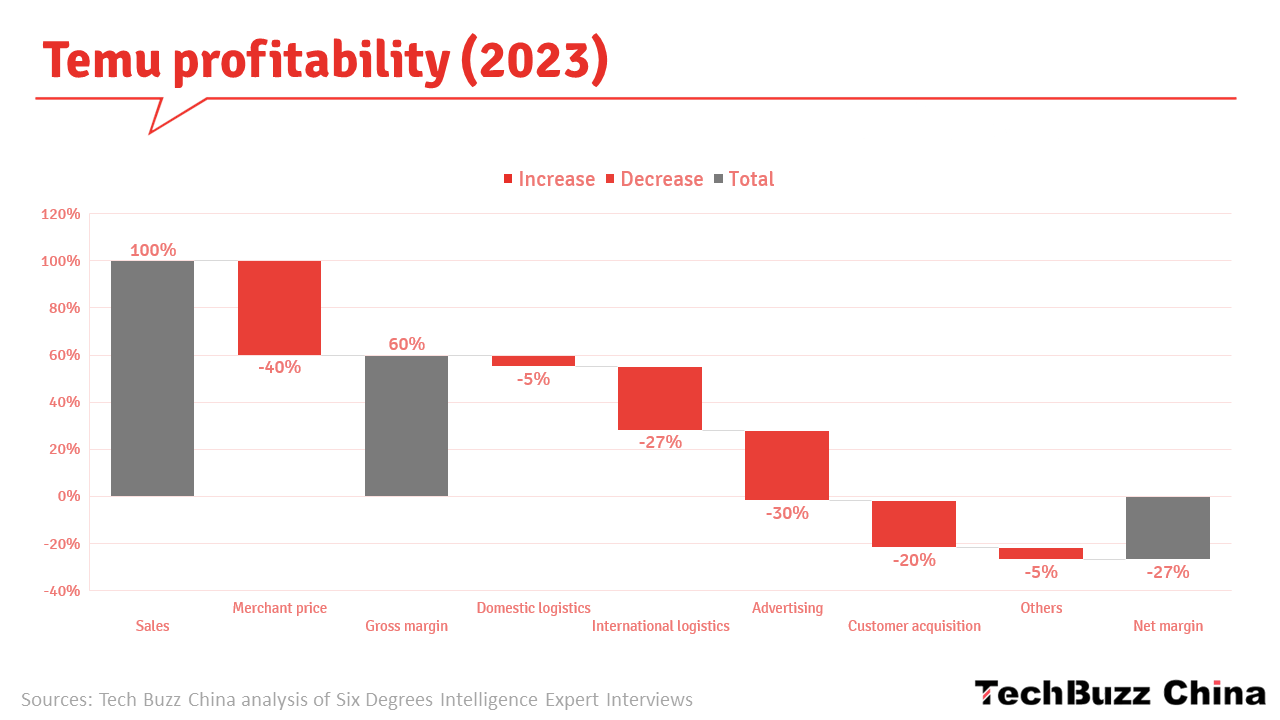
In 2023, Temu faced a 27% loss. Temu’s current losses are mainly the result of heavy investments in large volumes of traffic (advertising), which is part of the company’s strategic choices. After the user base has stabalised, it will decrease these investments and maintain stickiness to the platform through subsidies (discounts).
In Japan, Europe, and the Middle East, Temu faces the challenge of insufficient funds. Although they continue to gain customers there, the funds aren’t enough to support the high investments. Temu’s primary consideration is still the profit performance of the parent company.
Currently, Temu is still focusing on the fully managed model and is facing major cost pressure from storage and logistics. In the fully managed model, Temu has a 55% gross profit margin and a 10-15% net profit in the long term. The latter is higher than Pinduoduo’s net profit in the domestic market.
In 2024, Temu expects to reduce losses from 27% to 18%, break-even by the end of 2025 and be profitable in 2026.
Here are several ways Temu plans to achieve this:
Customer acquisition costs in the US are expected to decline by 2% - 3% in 2024.
Adopting multiple logistics models and achieving economies of scale should decrease logistics costs. Logistics costs are expected to drop from 27% to 18% globally.
Optimising the fully managed model and growing the semi-managed model. Temu plans to grow the fully managed model to $30 billion and the semi-managed model to $15 (adjusted downwards from an earlier goal of $18 billion).
Some experts believe the semi-managed model will have a 55% to 60% share of Temu’s sales by 2025. With the transfer of risk to the merchant, Temu’s profitability is expected to improve dramatically.
The mark-up of the semi-managed model is currently lower than that of the fully managed model, but it might increase in the future.
Eventually, Temu will implement platform service fees according to different product categories, e.g. 0.5% for the 3C category and 1% for clothing and daily necessities.
55% of merchants on Temu have migrated from the Pinduoduo platform. If goods are sold both on Pinduoduo and Temu, the volumes will be larger, thereby lowering supplier prices.
Temu expects to maintain low prices for the next 2 to 3 years. However, Temu may gradually increase commodity prices to reduce reliance on subsidies. If fulfilment costs can be controlled at 18%, then the costs of subsidies and fulfilment can be controlled at 40%. With the fixed warehousing and distribution costs of 5%, Temu should be able to keep costs below 50%. Maintaining a 50-60% gross margin is feasible for Temu, so it would break even.
In 2024, Temu hopes to reduce losses by reducing customer acquisition and fulfilment costs. The fulfilment costs can be broken down as follows:
‘First leg’ domestic logistics (from merchant to Temu warehouse, 50% of which is paid by the merchants): 15% of total logistics costs
‘Middle leg’ transport from China to foreign markets (mostly by air freight): 50% of total logistics costs
‘Overseas last leg’ (from receipt in foreign market to consumer): 35% of total logistics costs
There is little room for improvement in the first leg. However, there is strong bargaining space in the last leg. To reduce middle-leg costs, Temu is negotiating directly with airlines. For instance, by negotiating directly with China Eastern Airlines, it has been able to reduce middle-leg costs by 30%.
Currently, Temu’s organic traffic accounts for 60% of the total and paid traffic accounts for 40%. Temu has noticed a decline in organic traffic, so it invests more in paid traffic and encourages merchants to do their own marketing. As the number of users grows and reaches its peak, Temu will start to charge commissions, and merchants will also need to pay traffic advertising fees. It is also determined to break through the lower-class market and change the behaviour of the middle-class consumer, just like it has done with Pinduoduo in China.
As was seen with Pinduoduo in China, where 1st- and 2nd-tier citizens also started buying low-interest goods on Pinduoduo, the same is happening with middle-class consumers in the US.
Temu plans to use the same strategy that Pinduoduo used to get branded goods on the platform. In China, this ‘tens of billions of subsidies’ strategy compensated for the price difference for branded goods, resulting in different consumer profiles being attracted to the platform. While on Pinduoduo, the low prices of non-branded goods are its main competitive advantage, brand value and loyalty to branded goods can increase market share and conversion rates. In the domestic market, the ‘tens of billions of subsidies’ program helped bring the share of branded goods on Pinduoduo to 27% of GMV in 2023.
Pinduoduo has been guiding brands to provide a basic functional product and sell it at a 30% discount in the tens of billions of subsidies strategy. Although the products are not necessarily the same model, as long as the price is low, consumers are willing to place orders, showing that Pinduoduo has successfully attracted a wide range of price-sensitive consumers. Still, while Pinduoduo nowadays has many brands on its platform, few are top brands. Mid- and low-level brands do not have enough branding power to generate traffic alone. It remains to be seen how this would play out with Temu.
Temu does not yet have the conditions to work with domestic suppliers in the US. To attract local brands, it expects to need a user base equivalent to 80% of Amazon’s. If that’s true, it still has a long way to go.
AliExpress has not been very successful in convincing brands to join its platform, and it even had to create another platform (Miravia) in Spain to attract them. Will Temu, with its comparable image of ‘cheap stuff from China’, be more successful? Time will tell, and we’ll keep you posted.
Key Takeaways
Temu’s GMV in 2023 was $15-$18 billion and is expected to grow to $40 - $60 billion in 2024 (different sources have different estimations).
Temu had a 27% loss in 2023. They expect to reduce this to 18% in 2024, break even in 2025 and be profitable in 2026.
Because of fears of policy changes in import tariffs, Temu is reducing the weight of the US market in total GMV and putting more emphasis on Europe and Asia.
To reduce logistics costs, Temu has started a semi-managed model in which the merchant is responsible for the full operations of shipping goods to foreign warehouses and the consumer. Temu expects this will reduce logistics costs by 30%.
Other ways in which Temu is planning to improve profitability is reducing subsidies (increasing consumer prices), implementing platform fees, negotiating directly with airlines, combining sales volumes of Pinduoduo and Temu to further lower supplier prices, increasing AOV and repeat purchases, etc.
The semi-managed model is very suitable for goods that can not efficiently be shipped by plane, like large or heavy items. Temu is expected to expand its product selection in categories like furniture and home electronics through this model.
Temu has not been very successful yet in recruiting local sellers in foreign countries. It is planning to use Pinduoduo’s ‘tens of billions of subsidies’ strategy to convince (foreign) brands to sell on its platform.
Complaints about product quality have been rising and Temu is doing a dangerous balancing act in pushing merchants to lower prices while punishing them for shoddy quality.
In the long term, Temu wants to become a 3P platform like Amazon, where merchants are responsible for their own operations. Most likely Temu will continue to offer the fully and semi-managed models for merchants with specific needs or lack in cross-border e-commerce experience.
Sources
Six Degrees Intelligence, a leading global expert network/quantitative research firm that operates in China. Augmented with information from the articles below:
[1] 亿恩APP 2024-03-11 [2] NBC News 2024-02-13 [3] DW 2024-02-28 [4] Bloomberg 2024-01-23 [5] Economist 2024-02-15 [6] Technode 2024-01-18 [7] Daily Investor 2024-03-29 [8] 第三只眼看零售 2024-03-27 [9] Latepost 2024-04-28 [10] Modern Retail 2024-01-22 [11] Daily Dot 2024-02-06 [12] CNBC 2024-02-09 [13] 远川研究所 2024-03-04 [14] 白鲸出海 2024-03-01 [15] Marketplace Pulse 2024-04-15 [16] 雨果网 2024-01-24 [17] 36Kr 2024-04-03 [18] Pandaily 2024-02-21 [19] Pandaily 2024-02-22
Images by Tech Buzz China’s Ed Sander unless stated otherwise. These images may not be reproduced without prior consent by Tech Buzz China.