
The Hundred Shrimp War: OpenClaw and China’s AI Agent Explosion
While you could read this as China catching up to Silicon Valley on AI agents, what's actually happening is more structural — and more permanent — than that framing suggests.

Quick note before you dive in:
We were recently interviewed by the BBC for its piece How China fell for a lobster: What an AI assistant tells us about Beijing’s ambition, very relevant to today’s piece on OpenClaw.
You may also have noticed that we’ve published every week for the past three weeks. We are slowly moving toward a weekly cadence, simply because the news is coming too fast and too furiously, and two weeks is starting to feel like a long time between reads. We will likely make that full switch soon, though not immediately.
Separately, Youth Tech China Trek, a side project inspired by our investor trips for ages 10 to 18, is opening its second cohort for July 19-26 in Beijing after the first sold out. If you have kids who are deeply into, or simply very curious about, frontier STEM, you can learn more at techchinatrek.com. We’ve worked hard with our partners in China to curate the most interesting and immersive experience possible.
And as mentioned before, the Tech Buzz China content network is growing! If you want other informed and interesting China-based perspectives on AI, robotics, new energy, and semiconductors (which we don’t cover!) please subscribe to our partner Weijin Research at weijinresearch.substack.com. They write prolifically on these subjects.
Table of Contents
WHAT OPENCLAW IS AND HOW IT WORKS
THE ECONOMICS OF ALWAYS-ON AGENTS
THE SHOCK
Until early 2026, for most users, AI meant chatbots: you typed a question, you got an answer, the session ended. OpenClaw changed the category. Built by Austrian developer Peter Steinberger as a side project in late 2025, OpenClaw is an open-source framework that turns large language models into agents: software that does not just respond but acts. It reads files, controls browsers, sends messages, books travel, chains tasks together, and runs continuously without human intervention. Crucially, it connects to any AI model through a standard interface, letting users swap providers the way they switch mobile carriers. That model-agnostic design is the architectural choice that matters most.
What followed was the fastest open-source adoption wave since Bitcoin. In the last week of January 2026, OpenClaw accumulated 100,000 GitHub stars in roughly two days. React took eight years to reach the same number. Linux took twelve. By early April 2026, the repository stood at roughly 350,000 stars, and the project had survived an Anthropic trademark complaint, three name changes in seventy-two hours, and a cryptocurrency scam that briefly inflated a fake token to a $16 million market cap before collapsing to zero.
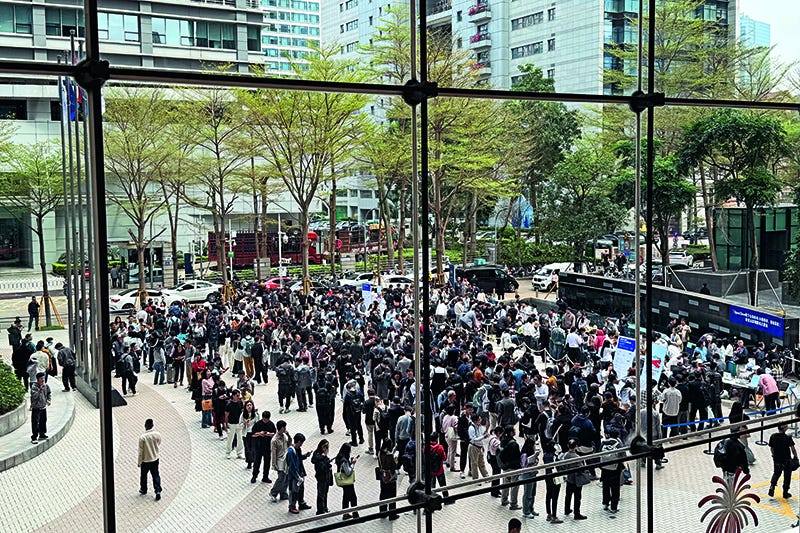
The adoption spilled into the physical world in ways AI products rarely do. Nearly a thousand people queued outside Tencent’s Shenzhen headquarters for free installation help. On Chinese e-commerce platforms, paid installation services appeared overnight, with some vendors charging ¥1,000 (~$140) per home visit. When people pay a stranger a day’s wage to install a free piece of software, the demand is clearly real. Small business owners configured agents to monitor supplier prices on 1688 overnight and update procurement orders in their ERP systems before the workday began — a workflow that previously required manual checking across multiple platforms. Developers set agents to review pull requests, run Claude Code, and submit commits autonomously while they went to the gym. Solo founders used agents to draft Xiaohongshu posts and compile daily AI newsletters without lifting a finger. These are ordinary white-collar tasks, now delegated to software running through the night.
The infrastructure impact was immediate. GPU rental prices for Nvidia’s H200 jumped 25–30% in a single month, with delivery times extending to mid-2027. Because OpenClaw agents check in every 30 minutes and chain tasks without stopping, they consume 10 to 50 times more compute than a standard chat session. GPU demand is no longer just a training story. Inference, driven by always-on agents, is now the growth vector.
The demand showed up in company financials, too. Zhipu (2513.HK, ~$40 billion market cap) and MiniMax (0100.HK, ~$40 billion market cap), the two leading Chinese pure-play AI model companies and the first globally to go public when both listed in Hong Kong in January 2026, both pointed in the same direction: API revenue and usage were accelerating sharply as OpenClaw-style agents took off. Stock prices moved before the earnings reports confirmed it. The rallies and Zhipu’s AutoClaw launch were not hype; they were a repricing of real demand.
But the real story is not OpenClaw itself. It is what OpenClaw revealed about the economics of AI agents: the framework layer is already free, the derivative layer is racing to free, and the money flows to whoever sells the compute and the tokens. In that race, Chinese providers are structurally ahead.
WHAT OPENCLAW IS AND HOW IT WORKS
Steinberger’s background matters for context: he previously built PSPDFKit, a PDF library running on over a billion devices, backed by a €100 million (~$116 million) Insight Partners investment. He is not an AI researcher. He is a product engineer who wanted to control his computer through WhatsApp, and what he built in roughly an hour became the framework at the center of China’s AI agent wave. One instruction that circulated widely in Chinese developer circles captures the gap between that modest origin and how users actually adopted it: “Here is $100. Help me double it.”
OpenClaw’s architecture has two layers that matter commercially: