
The Taobao Inside Qwen: Why Alibaba's AI Gambit Is About Re-Architecting the Internet
While you could dismiss this as yet another company slapping a chatbot onto its existing services, what's actually happening here is more interesting (and consequential) than that framing suggests.

A Note from Rui
With the rapid improvement of generative AI and translation tools, we’ve been rethinking what kind of analysis actually adds value for our readers. Frankly, there’s less and less reason to offer watered-down versions of what smart people inside China are already writing — especially when the original thinking is so much richer.
So we’re excited to announce our first content collaboration with Weijin Research (未尽研究), founded by Zhou Jiangong.
I was introduced to Mr. Zhou last year through a good friend who has done a lot of work in climate change. But once I became a subscriber to his research platform, I quickly realized he and his team write about far more than energy — they cover AI, semiconductors, crypto, industrial innovation, and much more. They’re prolific, and their perspective is genuinely valuable: China-centric, because they’re writing for a Chinese audience, but on topics that are fundamentally global at this point.
We’ll occasionally feature translated pieces from Weijin Research here, but they have a full pipeline of content — to get the complete picture, we’d encourage you to subscribe to their substack or X account directly. We’re helping to operate those and welcome your feedback.
We think English-language audiences would really benefit from reading their work, and we’re glad to help get it out there.
About Zhou Jiangong
Zhou Jiangong is the founder and CEO of Weijin Research, a Shanghai-based research firm covering technology, AI, and carbon neutrality.
He is one of China’s most experienced business media executives. He was a founding editor of Yicai Daily (First Financial Daily) in 2004, then served as Editor-in-Chief of Forbes China from 2009 to 2015. After Alibaba’s RMB 1.2 billion investment in Yicai, he became CEO of the entire Yicai Media Group, overseeing its TV, print, digital, and new ventures — including launching the English-language Yicai Global.
Before media, he was a research consultant at CSIS in Washington, D.C., working on China’s pension reform. He founded Weijin Research in 2023, and has since published widely on generative AI, the economics of large model training, and China’s role in the global energy transition. He authored Crossing the Unknown: From Infinite Labor to Infinite Computing and translated the Chinese edition of the Jensen Huang/Nvidia biography.
He holds master’s degrees from Johns Hopkins SAIS and Peking University.
Table of Contents
The Interface Is the New Infrastructure
From Search Box to Agent: The Great Unbundling of Intent
The Missing Piece for Global Competitors
Trust, Hallucinations, and the GEO Threat
Qwen in Context
Qwen (Tongyi Qianwen, 通义千问) is Alibaba Cloud’s family of large language models, launched in April 2023 during the post-ChatGPT scramble when every major Chinese tech company rushed to build its own foundation model. Baidu shipped Ernie Bot, Tencent launched Hunyuan, ByteDance built Doubao, and Alibaba released Qwen. All of them navigated Beijing’s stringent generative AI regulations, which require registration and content alignment with state guidelines.
But what makes Qwen different from the others is what Alibaba did with it after launch. The Qwen 2.5 series arrived in 2024 with notable improvements in reasoning, coding, and multilingual capabilities, and Qwen 2.5-Max showed competitive benchmark performance against global models. More importantly, through 2024 and 2025 Alibaba integrated Qwen across its entire ecosystem: Taobao for shopping, DingTalk for enterprise collaboration, AliExpress for cross-border commerce, turning the model from a standalone assistant into the backend engine for Alibaba’s core services. By early 2026, Qwen had gained widespread consumer adoption, driven by deep integration with Alibaba’s commerce and travel services. It wasn’t a chatbot anymore. It was the interface through which Alibaba was attempting to redefine how consumers interact with digital services, overseen by Alibaba Cloud (which also supplies the underlying compute), creating a rare vertical integration of AI model, cloud platform, and commerce rails under one corporate roof.
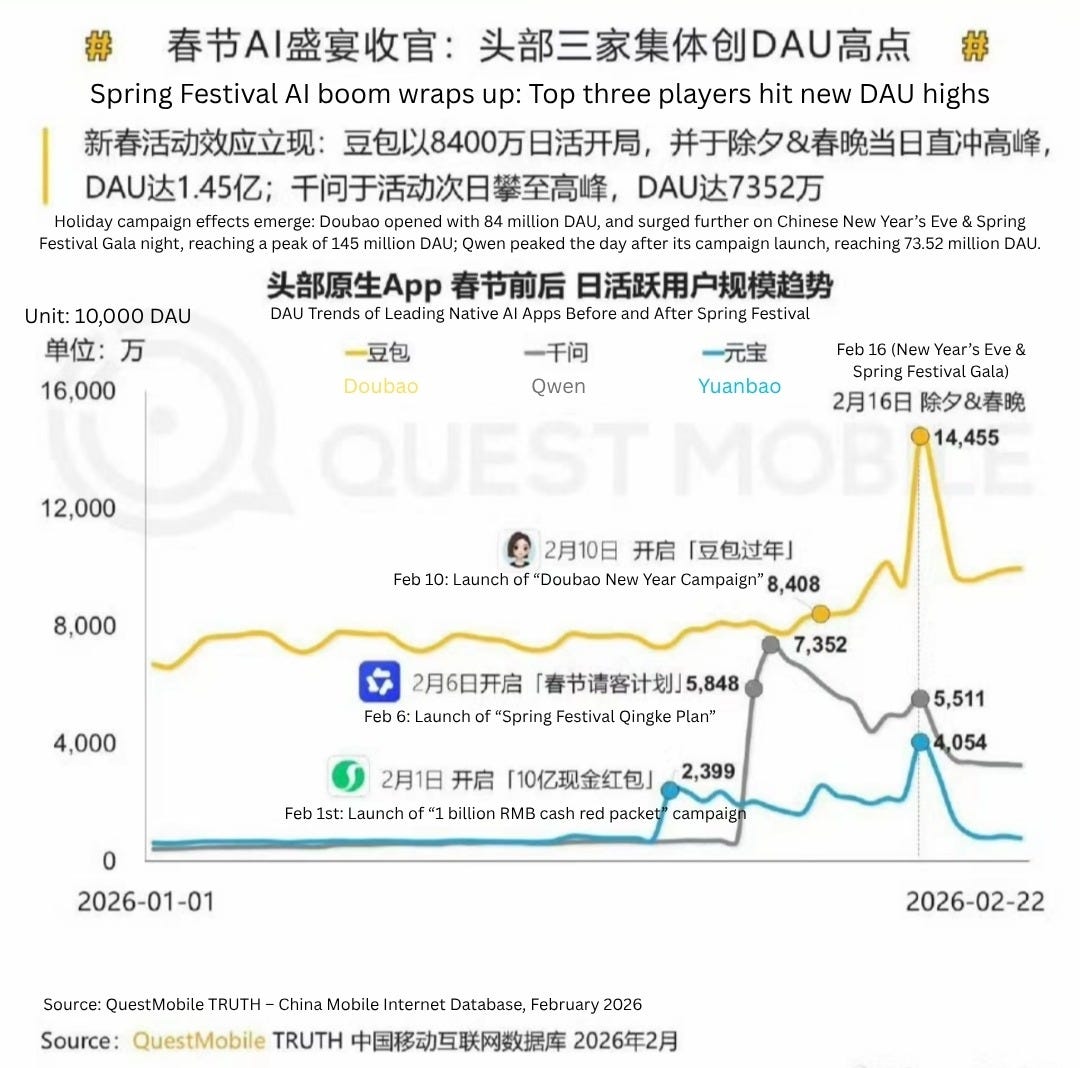
For investors trying to make sense of all this, the first two months of 2026 offered a useful signal. In late January, the explosion of OpenClaw, an open-source autonomous agent, sent speculative capital chasing anything connected to “agentic AI.” Yet by early March, a different signal emerged. During China’s Spring Festival, three AI apps hit daily active user peaks that would rank among the world’s largest consumer platforms: ByteDance’s Doubao at 145 million DAU, Qwen at 73.5 million (up 940 percent, the highest growth of the three), and Tencent’s Yuanbao at 40.5 million.
More telling than the raw numbers was the market’s response. On March 9, Morgan Stanley named Alibaba a “Top Pick,” replacing Tencent, and assigned a sum-of-the-parts valuation that allocated $19 per share to the Qwen division, with a high-end scenario of $345 per share for the parent company. The rationale was explicit: Alibaba’s advantage lies not in its language model but in its “full-stack AI” integration. As the analysts wrote, “Alibaba currently has a leading self-developed AI chip, is China’s largest and the world’s fourth-largest cloud infrastructure provider, and its Qwen model has significant influence in the global open-source field. Through integrating cloud capabilities with diverse business scenarios such as e-commerce and DingTalk, Alibaba can capture commercial value across the entire chain from basic computing power to end-user applications.”
What caught investor attention wasn’t a benchmark breakthrough, but something more mundane and more consequential: the integration of AI into the everyday commerce of 1.4 billion people.
The Spring Festival Bet
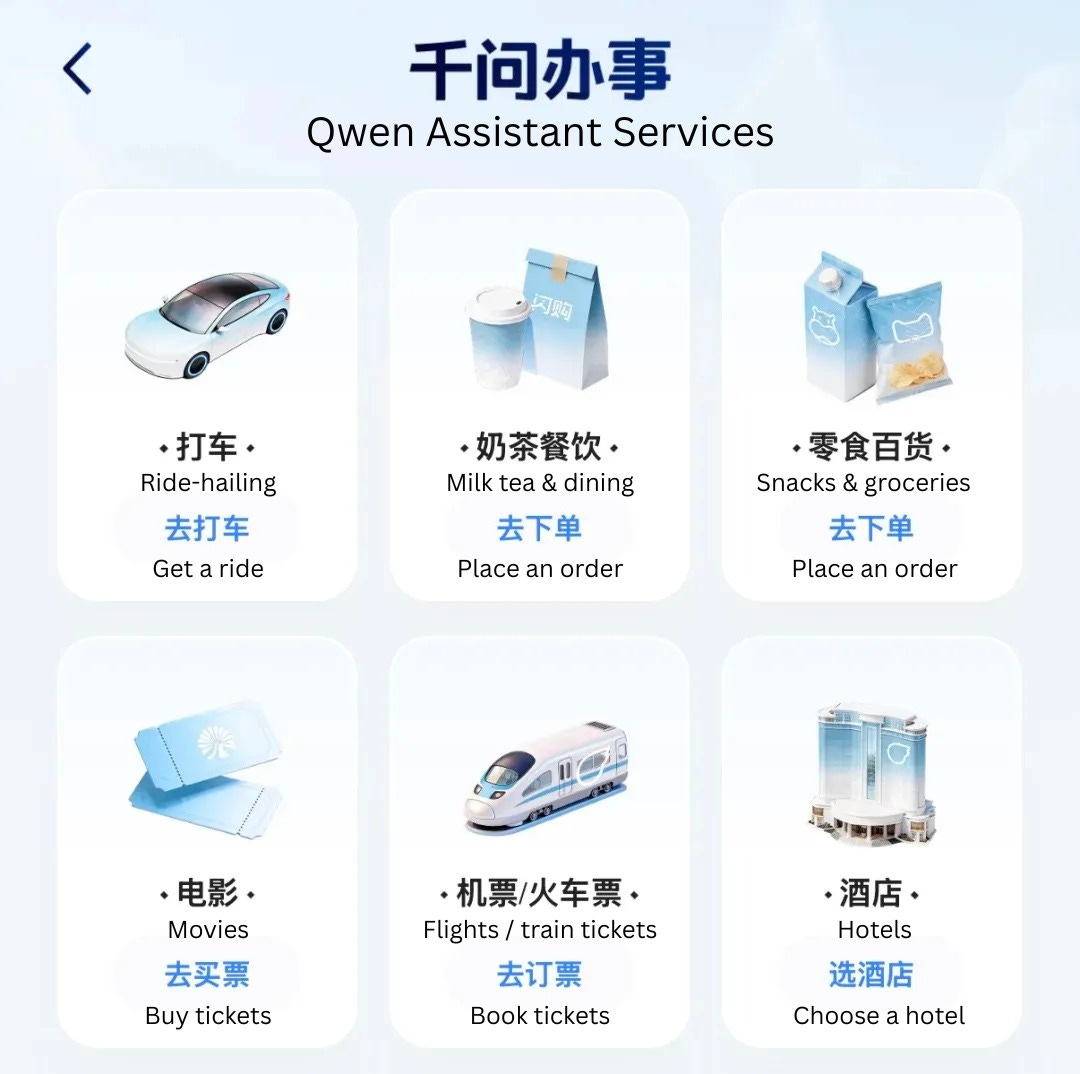
During the holiday, Alibaba deployed 3 billion yuan (roughly $415 million) in subsidies through its “Qingke Plan” to boost adoption of Qwen’s “one-sentence ordering” capability. For context, this was the largest Spring Festival campaign in Alibaba’s history and the highest amount in this year’s AI promotional race among Chinese tech giants, significantly outstripping Tencent’s 1 billion yuan Yuanbao campaign and Baidu’s 500 million yuan Ernie Bot effort. The feature let users speak or type requests like “order me milk tea,” “book a flight to Beijing,” or “buy tickets for the new movie,” and Qwen would handle the entire transaction through Alibaba’s services: Taobao for shopping, Alipay for payments, Fliggy for travel, Amap for navigation.
The results were striking. Over 200 million “one-sentence” transactions during the holiday period. In a single nine-hour span, 10 million milk tea orders. The phrase “Qwen, help me...” entered common usage not as a tech demo but as a practical tool for millions of users, many of them in lower-tier cities and rural areas where multi-app navigation is a genuine barrier to online commerce.
Industry analysts viewed the spend not as traditional marketing but as what Wang Peng, a researcher at the Beijing Academy of Social Sciences, called a strategic “behavioral experiment” aimed at “lowering the cost of trials to near zero and habituating users to use AI for decision-making and transactions.” The expected ROI wasn’t measured in immediate sales but in capturing what analysts describe as “the most expensive commercial real estate in the AI era: the first touchpoint for user intent.” If successful, the investment would shift purchasing decisions from manual app navigation to AI commands, a migration that holds vastly greater long-term value than traditional customer acquisition costs (which typically average around $100 per user for e-commerce platforms). Though as Pan Helin, an expert committee member from the Ministry of Industry and Information Technology, cautioned, heavy subsidies don’t guarantee lasting behavioral change, noting that “the real test comes after the incentives fade.”
Alibaba was not alone in this push. ByteDance, as the exclusive AI cloud partner for the Spring Festival Gala (still the world’s most-watched television event), used Doubao to drive 1.9 billion interactions on New Year’s Eve alone, generating over 50 million AI-powered profile pictures and 100 million personalized greeting messages. Tencent’s Yuanbao invested 1 billion yuan combining cash red packets with social sharing, drawing 49 percent of its participating users from outside major metropolitan areas.
But the strategies were structurally different. ByteDance focused on engagement and content creation. Tencent focused on social virality. Alibaba focused on transaction completion. Its AI was spending people’s money, booking their travel, and ordering their food. The distinction points to fundamentally different theories of where AI creates value.
For investors, it comes down to monetization clarity. ByteDance’s engagement model generates massive interactions but converting attention to revenue requires additional steps: advertising placements, influencer marketing, steering users to Douyin’s e-commerce tab. Tencent’s social approach builds rapid adoption, yet transactions still occur across fragmented mini-programs, diluting the agent’s role. Alibaba’s transaction-first model captures revenue at the moment of execution. Every “one-sentence” order flows through Alipay’s payment rails, Taobao’s merchant network, and Cainiao’s logistics, creating a closed loop where the AI is a direct extension of the core commerce engine, not a cost center.
The strategic timeline makes Alibaba’s intent clear. On January 15, 2026, Qwen announced full integration with Taobao, Alipay, Fliggy, Amap, and other ecosystem services, opening public testing for “one-sentence ordering.” During the Spring Festival campaign in January and February, over 200 million transactions followed. On March 8, with the launch of the Qwen AI Glasses G1, the function extended to hardware: users could say “I want to buy Qwen glasses” and complete the purchase in a single conversational turn. And on March 23, Qwen added AI-powered ride-hailing. Users say “Get me to Chaoyang Park for under 20 yuan, no ride-sharing, a clean car,” and Qwen handles the rest. This is not just a convenience upgrade. It represents a shift from AI as an information tool to AI as a reliable executor in the physical world.
The Interface Is the New Infrastructure
On a Sunday morning in early March 2026, a user in Beijing opened the Qwen app and typed “I want to drink coffee.” Within seconds, the AI identified nearby cafes, ranked by rating and delivery time. The user refined: “Coconut latte, iced, no extra sugar.” Qwen matched the spec, found a store, and offered one-click checkout, all without opening a delivery app or navigating a single menu.
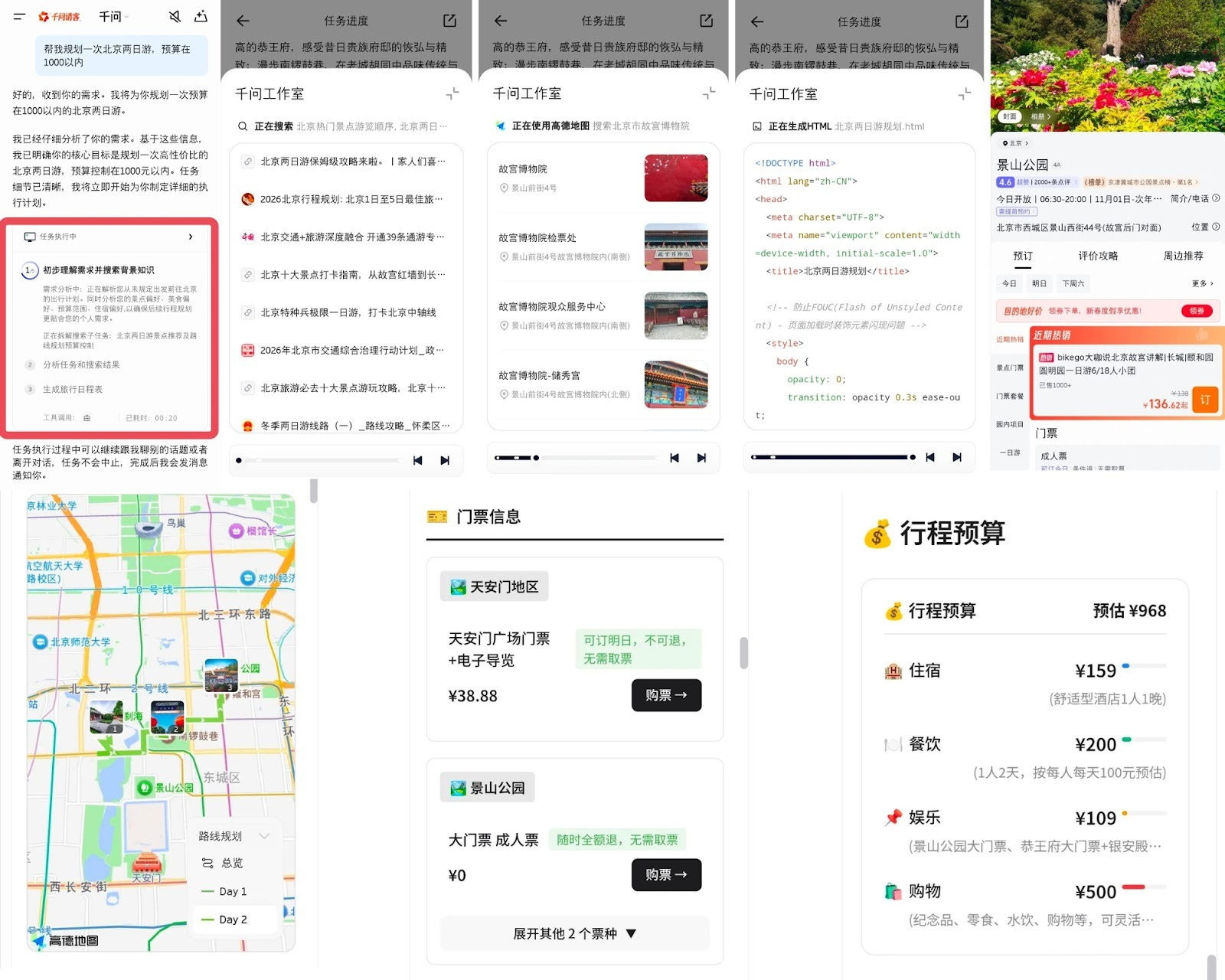
Another user typed: “Help me plan a two-day trip to Beijing on a 1,000-yuan budget.” Rather than generating a list of attractions, Qwen decomposed the request into subtasks, calling Amap for routes, querying Fliggy for hotel prices, checking ticket systems for pricing, and assembling everything into a dynamic webpage with a map, booking buttons, and full budget breakdown. Vague intent to executable plan, single conversation thread.
Now, the tech press will frame this as another LLM advancement, but that misses what’s actually happening. Alibaba is building a new way to interact with the internet: