This week’s piece will be out on time this Friday. We’ve been doing a lot of interviews on AI safety in China, and we’ll examine what those concerns mean for the AI trade: where investors have reason to worry and where they may not.
Things you might have missed
Developments since our September 4 issue.
From our recent coverage
DeepSeek’s gigawatt data-center plan has run into grid reality. A proposed Inner Mongolia site would use 160,000 Huawei Ascend chips and draw as much power as 750,000 households. Its biggest obstacle is connecting that load to the grid. Read more →
Moonshot AI is weighing a Hong Kong IPO of as much as US$5 billion. The Kimi developer has reportedly hired Bank of America as global coordinator. An IPO of that size would test public-market appetite for China’s model companies. Read more →
China’s August car sales fell 23.6% year on year while new-energy penetration reached a record 65.2%. Exports are driving growth: new-energy-vehicle exports rose 154.7%. Read more →
Anthropic alleges that seven China-based AI labs distilled Claude at scale. Its 154-page report says an Alibaba-linked campaign peaked at nearly three million exchanges a day using more than 3,500 fraudulent accounts. It also names DeepSeek, Moonshot, Zhipu, Xiaomi and MiniMax. China’s Commerce Ministry called the allegations groundless. Read the report →
From our research partners
What do China’s 500 trillion daily tokens actually measure? Weijin Research, a TBC partner whose work we help publish, examines the counting behind the headline number, why comparisons with US usage are difficult, and why more tokens do not necessarily mean more revenue. Read the September 11 article →
Where we have been featured
We joined CNN Newsroom on September 14 to discuss China’s approach to AI safety. The conversation covered the risks Beijing identifies, the US lead in frontier models, and prospects for AI talks at the September 24 Trump–Xi summit. Read the transcript → More of our media appearances →
Why ByteDance Broke Up a Growing Feishu (Lark)
At 9:30 a.m. on July 30, Feishu employees had just arrived at work when an all-hands email split the business they had built. ByteDance’s Microsoft 365-like workplace suite, branded Lark overseas, would lose its independence. Chinese Entrepreneur reported that its product team would move under the group behind Doubao, ByteDance’s ChatGPT-like assistant. Marketing, sales and customer service would join Volcano Engine, ByteDance’s AWS/Azure-like cloud business.
The split came as sales were growing. Separate Chinese media reports put Feishu’s 2025 revenue above RMB3 billion (US$443 million) and said second-quarter revenue had doubled year on year.
Four months earlier, Feishu had been at the center of China’s OpenClaw craze. OpenClaw, the open-source agent we covered in April in “The Hundred Shrimp War”, runs through messaging apps. Its claw logo inspired Chinese users to call setting one up “raising a lobster.” Feishu offered one-click setup and free tokens. By July, despite the business’s recent growth, its product and customer teams were being sent in different directions.
Feishu may be more useful to ByteDance as a way to sell AI than as a standalone software business. It holds employee identities, documents, meeting records and approval flows, together with the rules governing who can use them. Doubao Work, ByteDance’s workplace agent, can draw on those records and permissions. Volcano Engine can supply the computing power and engineering needed to run it.
The document store, messaging system and access controls would remain. An agent could become employees’ first stop for work, giving its supplier a way to sell more model usage, cloud computing and support. A company adopting the agent could also pay that supplier to connect it to internal systems and help run it. Tencent and Alibaba are competing for that spending too.
Why selling AI to Chinese companies is hard
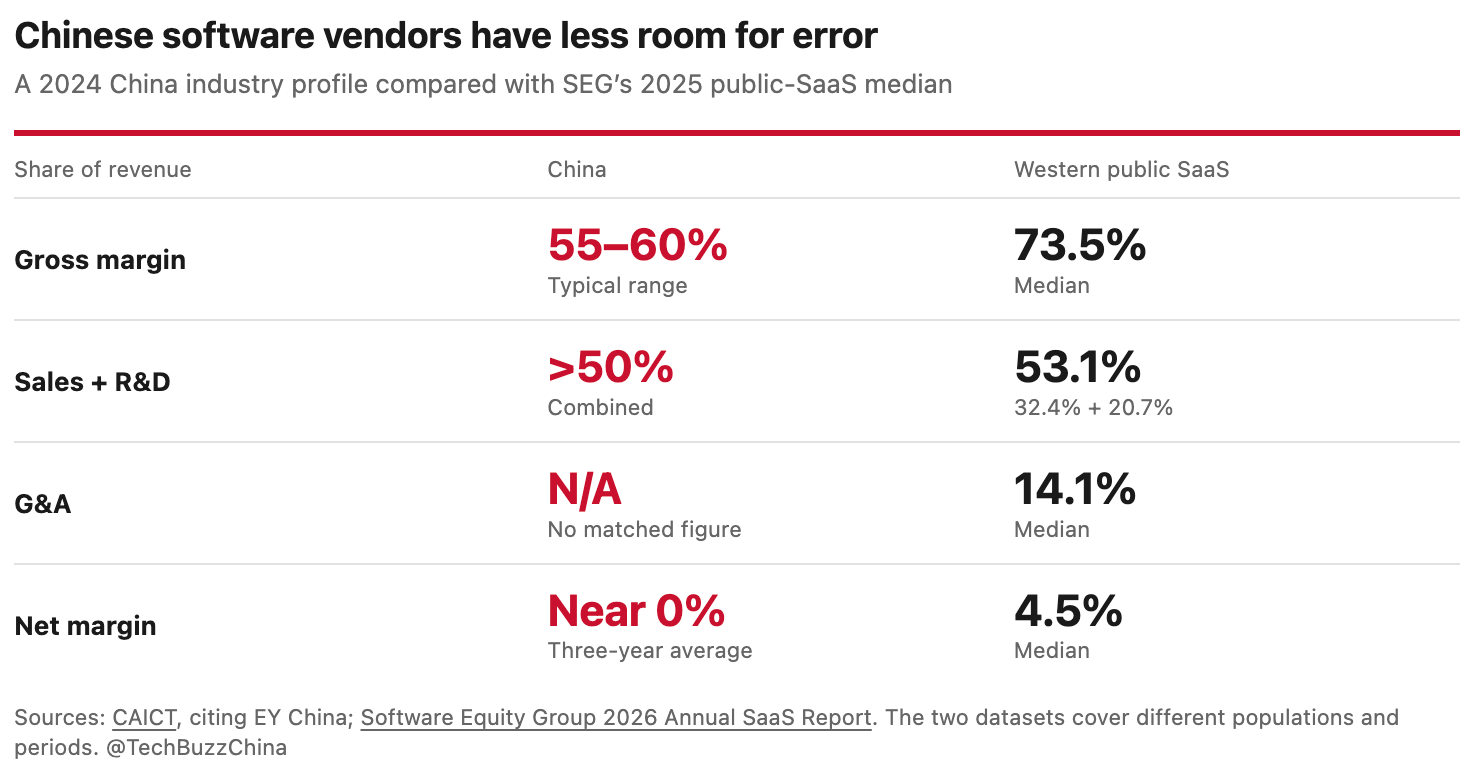
Large Chinese companies often buy software with a substantial service job attached. They buy through formal tenders, install it on their own servers or a mix of private and public cloud, and hire outside firms to tailor and maintain it. The China Academy of Information and Communications Technology’s 2024 enterprise SaaS report describes gross margins commonly around 55% to 60%, sales and research spending above 50% of revenue, and average net margins close to zero.
By comparison, Software Equity Group’s 2025 public-SaaS index recorded a 73.5% median gross margin. The samples cover different populations and periods, but the Chinese profile leaves less gross profit to pay for sales and research. Office agents bring another bill: computing, plus engineers’ time spent setting access rules and checking results.
Company information may be scattered across WeChat groups, spreadsheets, local drives and industry software. Preparing it for an agent can require connecting each system, cleaning data and deciding which actions still need human approval. On 乱翻书, a Chinese technology podcast, participants likened this work to that of forward-deployed engineers, or FDEs: technical teams that adapt a general product to a customer’s systems. When each installation requires that help, each new customer brings a substantial labor bill.
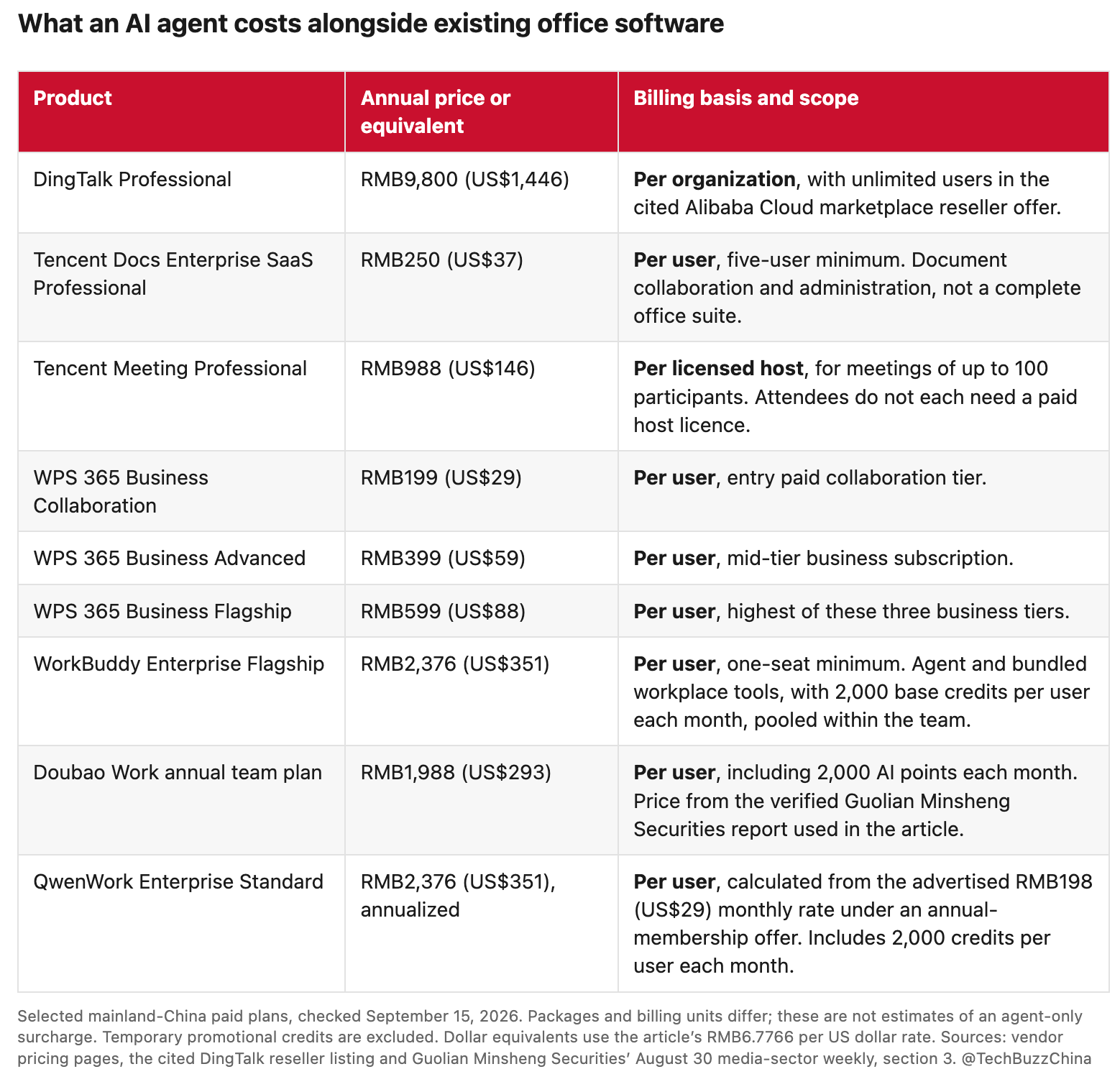
Adding an agent to an existing subscription can therefore leave the vendor paying for more computing and engineering while collecting little extra revenue. Selling model usage, cloud computing or services alongside it could help cover those costs.
The work is heaviest for large private companies, state-owned enterprises and regulated customers. Small businesses face fewer approvals, and companies can buy model access through developer tools without signing a company-wide software deal.
For Tencent, ByteDance and Alibaba, a workplace agent could lead to purchases well beyond an employee subscription. All three already sell businesses some of the computing, engineering and continuing support these deployments require. But the sale need not begin with procurement. An employee can try an agent before the employer commits to a larger purchase. Tencent is trying to reach that purchasing discussion with employees already using its product.
Tencent: win the employee first
WorkBuddy, Tencent’s desktop agent, lets employees get started without adopting an entire workplace suite or waiting for a company-wide purchase. They can work across local and cloud files, connected applications and different AI models. Its open platform lets developers connect applications and authorize local or cloud tasks. Tencent can reach individual users before IT and procurement consider buying the product for the company (a sort of PLG aka product-led-growth strategy). Access to company information still depends on the employee’s permissions and approvals from the separate systems.
Eric, a former Feishu product employee in the podcast discussion, encountered that obstacle when he tried to get WorkBuddy to use information stored in Feishu. He described creating a company app, obtaining administrator approval and authorizing access again while the task was running, all before the agent could proceed.
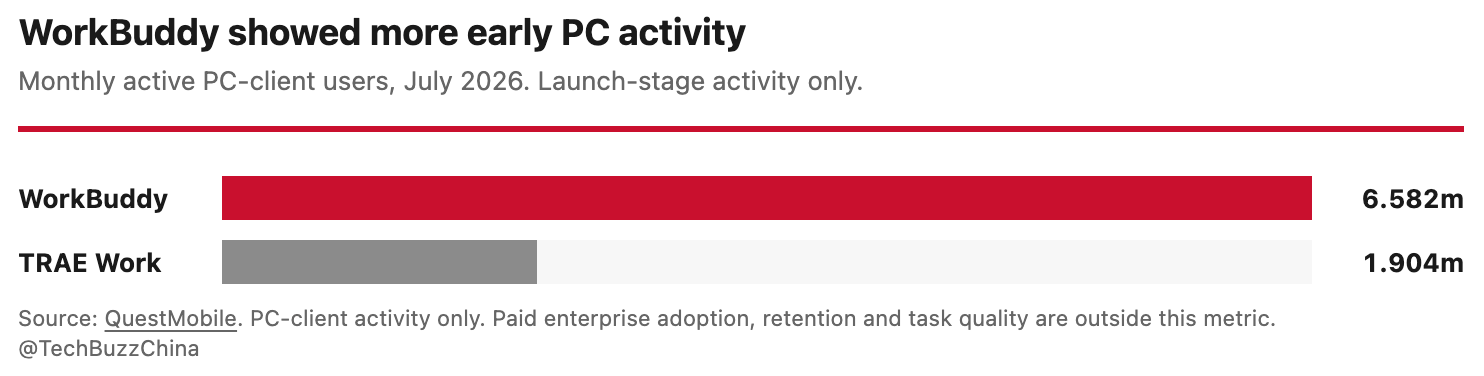
In July 2026, QuestMobile measured 6.582 million monthly active users for WorkBuddy’s PC client, against 1.904 million for TRAE Work, ByteDance’s earlier work-agent client. The figures predate Doubao Work and QwenWork, and TRAE Work’s workplace capabilities were later folded into Doubao Work. It is also important to remember that Tencent’s PC users may also come from a broader population than the large-company buyers targeted by Feishu and Volcano Engine.
Tencent is the only one of the three to give a gross-margin comparison for paying users. On its second-quarter earnings call, management said gross margin from paying WorkBuddy users was comparable to Tencent Cloud overall. Blended margin was lower because free usage remained subsidized.
Employees who already rely on WorkBuddy can bring that experience into a company’s purchasing discussion, potentially making the sale easier for Tencent. Renewals and purchases of extra credits would turn the first deal into repeat revenue. ByteDance starts with Feishu already inside companies and a different difficulty: bringing workplace software and AI into the same purchase.
ByteDance: sell one system
As we noted in the opening of this piece, ByteDance moved Feishu’s product team under the Doubao group and placed its sales and customer teams alongside Volcano Engine in July. Doubao Work, its workplace agent, can draw on Feishu’s company records, while Volcano Engine can sell the computing and engineering alongside the software. A customer could receive one combined offer for work previously divided between separate sales teams.
Before July, buying Feishu workplace software meant dealing with one team. Buying models, cloud services or AI computing meant dealing with another team at Volcano Engine. The teams could pass each other leads, but they sold different products and were rewarded differently. A TMTPost analysis described separate product plans and sales targets, repeated calls on the same companies and added cost. An office agent can need computing, access to business systems and engineers for a single deployment.
Feishu has already organized company information around employee identities. When the relevant systems are opened to it, Doubao Work can use a Feishu login to draw on documents, meetings, messages, the organization chart, knowledge base and access rules. A standalone agent has to obtain much of that access through connectors and permissions. Those connections still need to work reliably and meet security and compliance requirements.
Mark, a former TikTok product employee in the same podcast discussion, described the launch as “organization integration ahead of product integration.” Participants judged WorkBuddy to be a superior product, ahead in finding tools, moving through connectors and coordinating several agents.
ByteDance still has to decide who handles each customer, earns sales credit and receives commissions. Staff rewarded for separate products or types of usage may keep selling them separately. It’s the same problem Alibaba encountered in its earlier effort to sell cloud computing alongside workplace software.
Alibaba: earn beyond the agent
QwenWork, Alibaba’s workplace agent, combines DingTalk, its Teams / Slack-like workplace app, with Qwen models and Alibaba Cloud. DingTalk supplies employee identities, approval flows and company information. Alibaba can charge for the agent and the computing or technical support its use generates. A customer doing more work with AI could spend more with Alibaba without buying another employee subscription.
Under its earlier “cloud-DingTalk integration,” Alibaba reported that the number of DingTalk organizations with more than 1,000 employees tripled over two years. Customers paying for both Alibaba Cloud and DingTalk grew 30% year on year in one quarter.
When DingTalk separated from Alibaba Cloud in 2023, Southern Metropolis Daily reported, citing industry sources, that the sales operations had never truly merged. Cloud representatives could sell DingTalk, but a large cloud-computing contract was worth far more than a SaaS subscription. That gave salespeople reason to concentrate on the larger deal. Alibaba owned both products, while the teams selling them still had different priorities.
QwenWork need not become the dominant office agent for Alibaba to benefit from additional model or cloud sales. Alibaba’s existing computing business is substantial. For the quarter ended June 30, its segment reporting recorded AI Cloud and Compute Services revenue of RMB48.437 billion (US$7.15 billion), up 45%, including RMB12.376 billion (US$1.83 billion) from AI-related products. Those figures cover the broader computing business.
Who can win the business?