


Things you might have missed
From our recent coverage
Our coverage on X: @TechBuzzChina.
ByteDance Brings AI Generation Into Its Video Editor — We examine how integrated editing, distribution and commercial assignments affect independent video tools.
Luxeed Seeks Its Own Manufacturing License — We distinguish a proposed transfer of an existing Chery factory from an expansion of vehicle production.
From Weijin Research
Have China’s Open-Source Models Been Brought Back Down to Earth? — Weijin Research, a TBC partner whose work we help publish, examines how changes to benchmark weighting and research-workflow tests alter the assessment of Chinese open models.
Silicon Valley’s AI Giants Need Drug Discovery to Prove Themselves — Weijin analyzes AI companies’ investment in automated wet labs and the implications for China’s drug-research contractors.
The Global Agent Race Meets China’s Super Apps
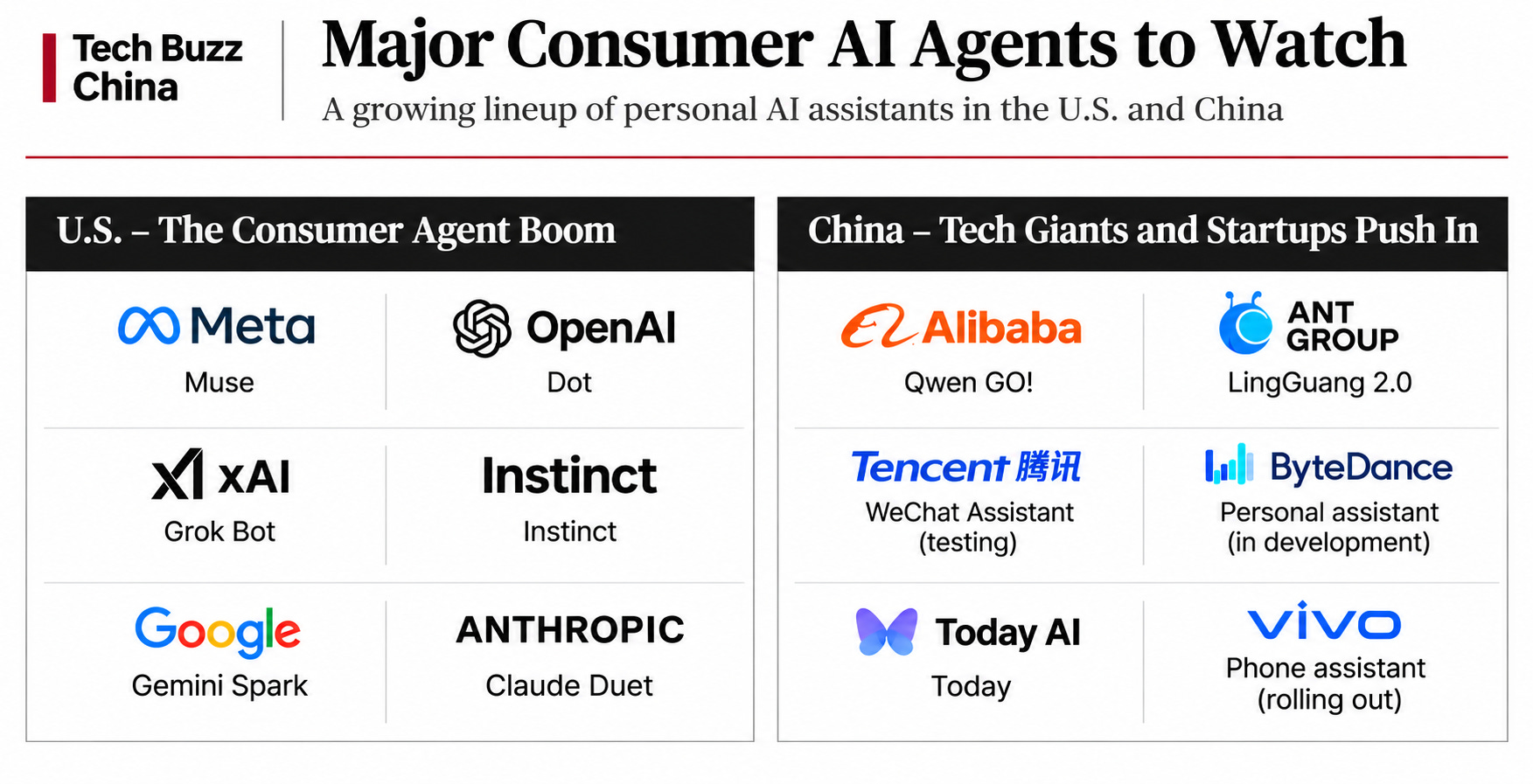
Silicon Valley has found its latest consumer AI obsession: personal agents. In just six weeks, more than 10 million people in the US and Canada had set up Meta’s Muse, with roughly a quarter using it on any given day, according to Meta’s October 21 earnings call. Investors are equally enthusiastic: Instinct recently raised $1 billion at a reported $10 billion valuation. Meanwhile, OpenAI’s Dot and xAI’s Grok Bot are competing to make AI assistants part of everyday life. The ambition goes well beyond chatbots that answer questions. These agents promise to remember personal information, operate software and complete tasks on behalf of their users, potentially becoming the primary interface through which consumers interact with digital services.
So where are China’s consumer AI agents? Alibaba, Tencent, ByteDance and other Chinese tech giants have been investing heavily in AI, yet their consumer-facing products have largely remained chatbots rather than agents capable of completing tasks on users’ behalf. Recent launches suggest the market may be entering a new phase. Alibaba opened applications for Qwen GO!’s waiting list on October 13, while Ant, a separate company from Alibaba, released LingGuang 2.0 on October 27. Tencent’s native WeChat assistant remains in limited testing, and September reporting described ByteDance’s internal experiments. Smartphone manufacturers and independent startups are also entering the race.
The difference begins with how consumers use the internet. In the US, everyday digital activities are scattered across websites, applications, accounts and payment systems, creating opportunities for AI agents to coordinate work that would otherwise require moving between services. In China, WeChat, Alipay, Meituan and Taobao already bring together messaging, shopping, payments and everyday services. As Jiazi Guangnian argued in October, there may be less friction for an agent to remove in the first place. And while China’s super apps could give their owners a powerful advantage in developing agents, they also control much of the information and infrastructure that independent assistants would need to access.
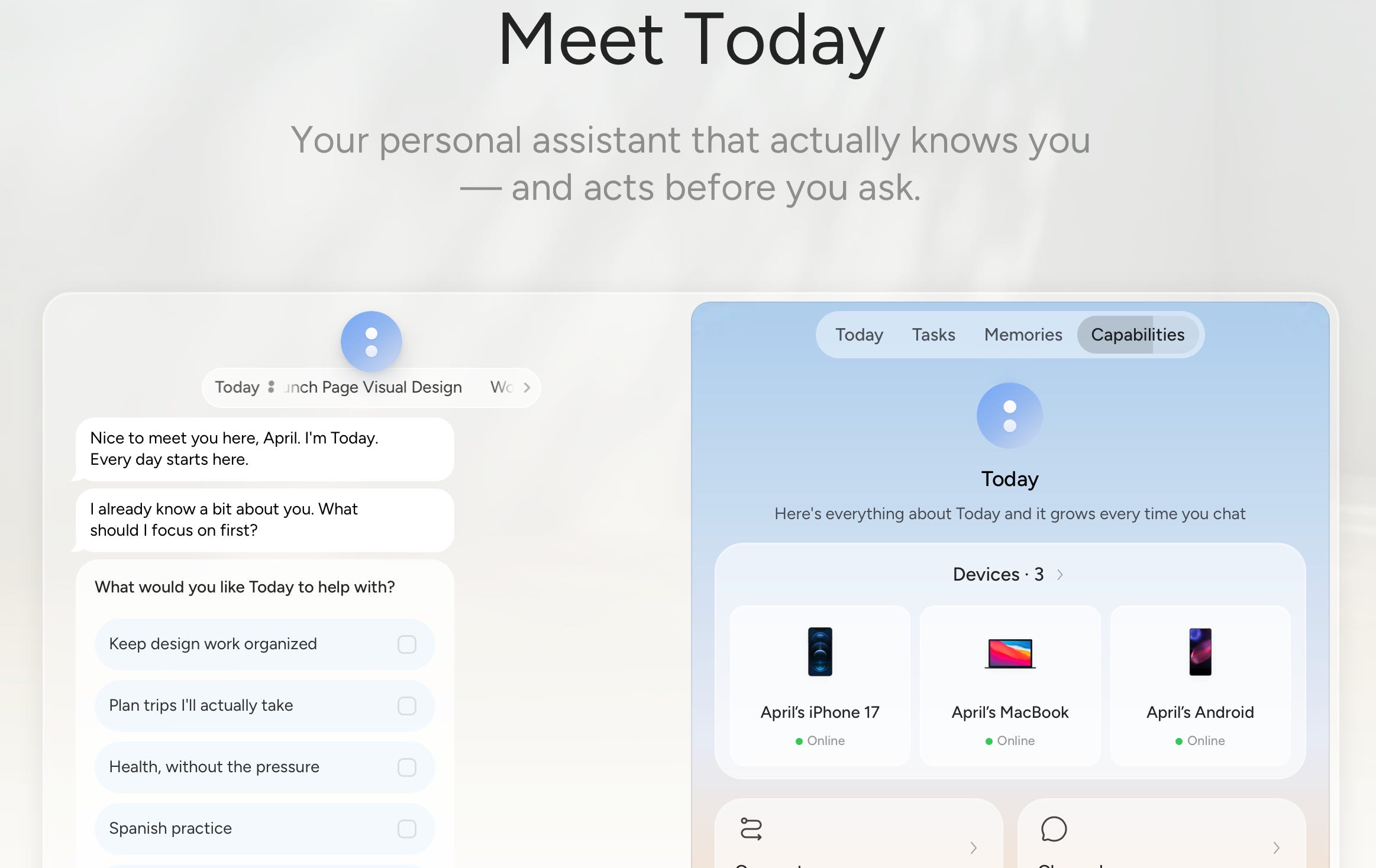
Consider the experience of small-business owner Pan Yuefei, who tested Today, an assistant developed by Chinese startup Today AI. The assistant discovered an overdue RMB100,000 (about $15,000) project payment in his recordings and reminded him to follow up. It was precisely the kind of useful, proactive assistance that could make these products valuable, even though Pan still had to collect the money himself. Yet Pan estimated that roughly 70% of his valuable private information was stored in WeChat, according to Economic Observer’s October 26 report. Today couldn’t access that information, limiting its ability to provide more useful, personalized assistance. It’s a major obstacle for independent agents trying to compete with China’s dominant internet platforms.
The resulting competition is about much more than building a better chatbot. China’s internet giants already have the users, information and commercial relationships needed to turn AI assistance into a feature of their existing services. Independent developers are pursuing a different opportunity: becoming the assistant consumers rely on across multiple platforms, even when those platforms continue to handle transactions and fulfillment. Whether that position can become a viable business is one of the central questions facing China’s emerging consumer-agent market.
Three Routes to the Personal Agent
China’s internet giants enter the consumer-agent race with substantial advantages in distribution, user information and access to services. Alibaba can build on Taobao’s commerce infrastructure through Qwen, while Ant can connect LingGuang to Alipay’s payments and financial services. Tencent has WeChat, whose extensive network of mini-programs allows users to shop, order food, book transportation and access countless other services without leaving the app. Its Yuanbao chatbot is a separate product from the native WeChat assistant currently in testing. For these companies, the opportunity lies in turning existing consumer relationships into agent-driven services, drawing on the accounts, transaction systems and merchant networks they have spent years building.
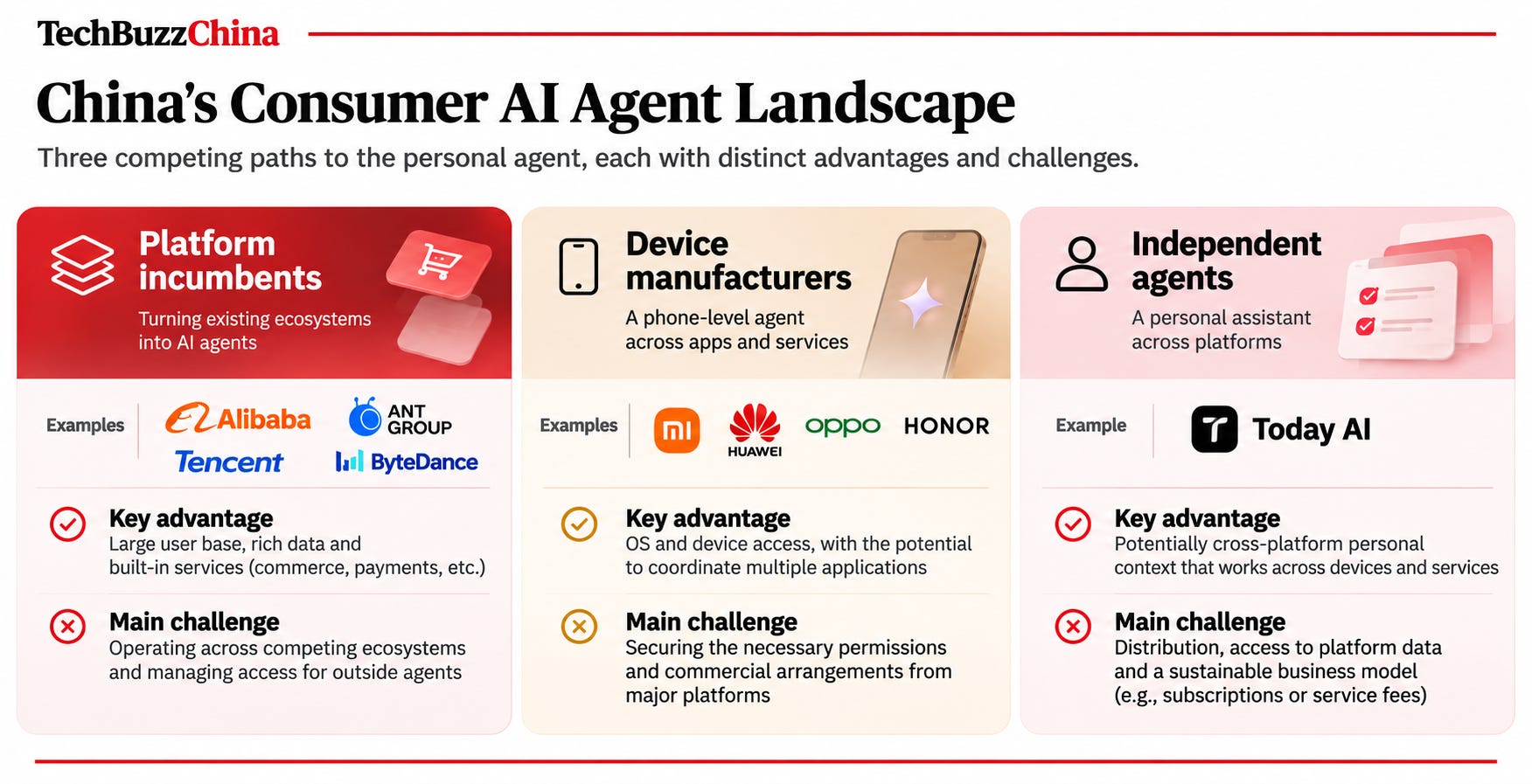
Smartphone manufacturers occupy an unusual position in this competition. Xiaomi, Huawei, OPPO and Honor already control the devices through which consumers access competing internet platforms, giving their assistants a potential role that no individual app can easily replicate. A phone-level agent could receive a request before the consumer has decided which service to use, then coordinate the applications needed to complete it. As industry analyst Evin argued in October, the commercial significance lies in controlling where consumer demand originates, rather than simply supplying the AI models that process it. How much of that opportunity device makers can capture will depend on the permissions and commercial arrangements they secure with the services operating on their phones.
Independent developers are pursuing a more ambitious position, seeking to become the assistant consumers turn to regardless of which applications or devices they use. One of the most prominent examples is the aforementioned Today, founded by Qi Junyuan, who previously created the collaboration platform Teambition and served as an executive at ByteDance. The company has reportedly raised more than $200 million, with Tencent and Ant among its investors, and is developing an assistant designed to remember personal information, track commitments and manage tasks over time. Its strategy rests on building a continuing relationship with the user, accumulating context that makes the assistant increasingly useful across different activities. Access to the information and services needed to deliver that experience will depend on agreements with the platforms where much of the user’s digital life already resides.
These approaches are likely to overlap, with platforms, device makers and independent developers drawing on one another’s capabilities. As 新立场Pro argued in October, the competition is ultimately about which company becomes the consumer’s habitual starting point for getting things done. For incumbent platforms, that could mean extending their existing relationships into AI assistance; for device makers, it offers a way to coordinate activities across applications; and for independent developers, the opportunity lies in maintaining a relationship that follows users across services. The competitive positions are different, but all three depend on gaining influence over how consumers initiate and delegate work.
The Super Apps Still Hold the Keys
When ByteDance introduced an experimental smartphone powered by its Doubao AI assistant in December 2025, it offered a glimpse of what consumer agents might eventually do. Instead of opening applications and navigating their menus, users could ask the assistant to carry out tasks across different apps. The experiment quickly ran into trouble with WeChat, whose login problems prompted ByteDance to disable Doubao’s ability to operate the app. As we reported in our earlier Tencent coverage, even ByteDance’s enormous consumer reach offered little leverage over WeChat’s access rules. The episode exposed a constraint that better AI models alone could not resolve.
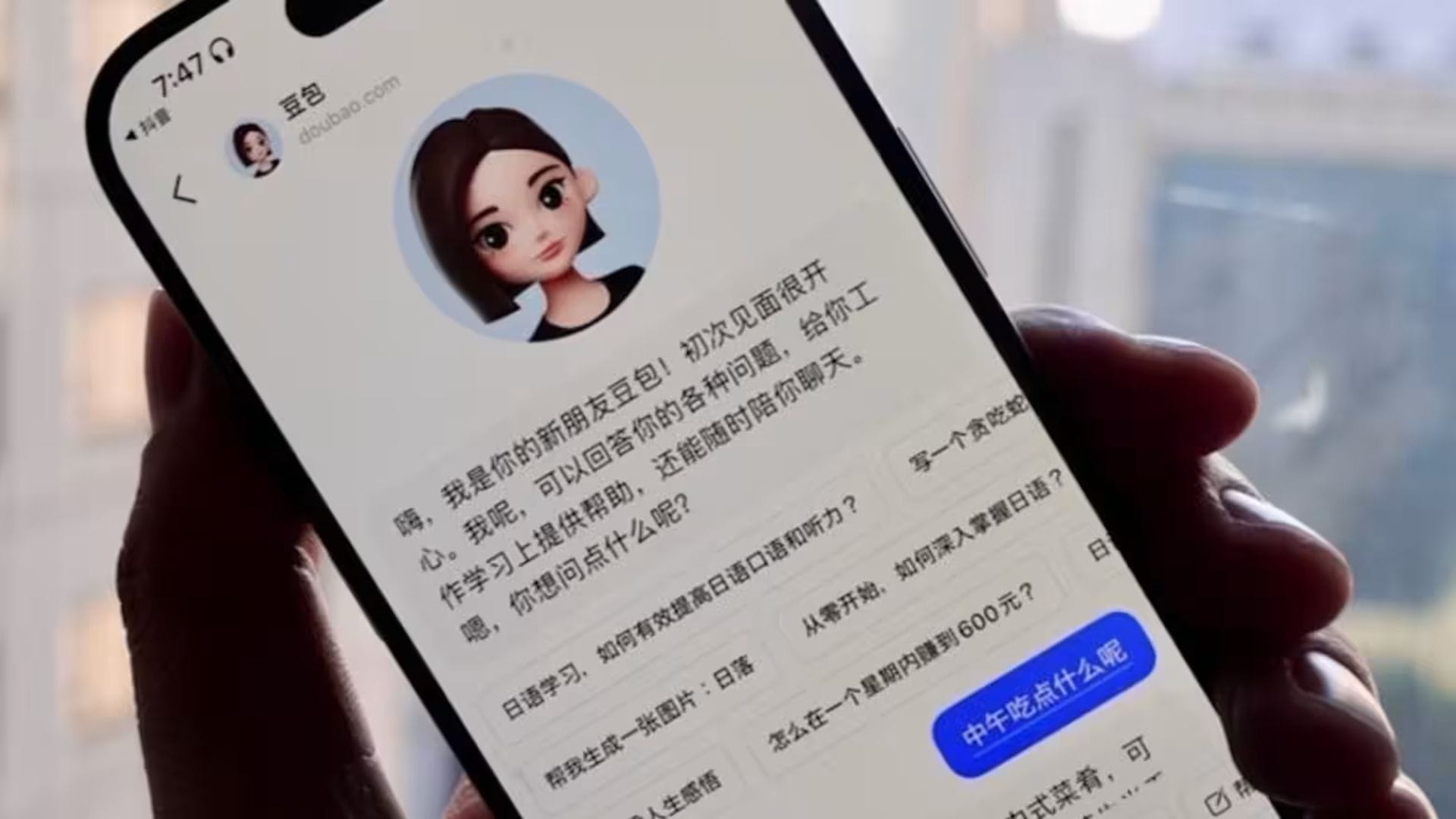
The response has been a shift toward negotiated access. September reporting described Doubao’s shift toward supported interfaces, with screen automation used more selectively and users brought back into the process when an operation is refused. Under its screen-operation protocol, applications can specify which automated interactions they permit, while the developer policy updated October 28 continues to list WeChat, Taobao and Alipay among services refusing screen automation. Financial transactions face additional restrictions. These boundaries reflect commercial concerns alongside legitimate questions about privacy, fraud and liability. As industry experts Liu Xingliang and Wang Pengbo explained in October interviews with Zhongxin Jingwei, banks have particular reasons to be cautious about giving third-party assistants access to sensitive accounts. An agent’s ability to operate software is only one part of gaining permission to conduct business through it.
Ant is testing a model in which the assistant receiving a consumer’s request and the platform fulfilling it can be different companies. Through its AHA framework, outside assistants can hand requests to services operating within Alipay, allowing each company to retain a distinct role in the transaction. In an example Ant described in August, a consumer asks an OPPO phone assistant to buy movie tickets. Rather than attempting to navigate Alipay’s interface itself, the phone assistant hands the request to Ah Bao, Alipay’s own assistant, which processes the order and returns it for the consumer’s confirmation. Under the described arrangement, Alipay retains the merchant relationships, customer accounts and payment infrastructure. OPPO can offer a more capable assistant while Alipay receives the transaction, giving both companies a commercial reason to cooperate.
Ant is also demonstrating what deeper, authorized access to personal information might make possible. In an October 29 trial by Beijing News, a journalist asked LingGuang to examine six months of Alipay transactions and subscriptions. After receiving permission, the assistant produced an analysis in just over 30 seconds. Extending that capability to information held in other services, such as WeChat conversations, workplace documents and shopping histories, could allow agents to identify overlooked obligations, track commitments and coordinate activities that currently require users to piece together information themselves. For an independent assistant such as Today, the ability to connect information across ecosystems could be particularly valuable, although the LingGuang demonstration involved only one authorized account.
Tencent, meanwhile, is experimenting with ways to bring AI assistance into WeChat while determining which functions to make available to outsiders. Its native assistant Xiaowei, still in limited testing, has demonstrated ordering through mini-programs with manual payment confirmation. A July report on Xiaomi’s XiaoAI described a more limited arrangement for authorized WeChat messaging and calls. Tencent has also explored exposing selected developer services to agents through CloudBase, while LightVela allows users to communicate with a hosted agent through WeChat messages. These arrangements offer different degrees of functionality, with Tencent retaining considerable discretion over what outside assistants can access. None of the latter three mechanisms establishes general access to a user’s private WeChat history.
Taken together, these experiments suggest that cross-platform agents may develop through a series of negotiated connections rather than unrestricted access to other companies’ applications. That could support useful services and create new channels for customer acquisition, particularly when platforms benefit from additional transactions. The more consequential question is how much freedom agents will have to compare and choose among competing providers. An assistant restricted to a platform’s preferred merchants would have a very different commercial role from one able to search across services and recommend the best option for its user. The terms of those agreements will help determine whether independent agents become meaningful intermediaries in China’s consumer internet or primarily serve as additional distribution channels for the incumbents.
What Work Is Worth Delegating?
Even if China’s platforms eventually open more of their services to AI agents, there remains a more fundamental question: What would consumers actually gain by using them? Consider ordering milk tea. As K2Lab founder Wang Ming observed in an October discussion reported by Jiazi Guangnian, asking Qwen to place an order offered little improvement over opening Taobao’s instant-retail service and doing it yourself. China’s consumer apps have spent years eliminating unnecessary steps from everyday transactions, leaving relatively little room for an AI assistant to make an already convenient purchase meaningfully easier.
Agents may prove more useful when they uncover work consumers didn’t realize needed doing. In one case reported by Economic Observer, Qwen GO! discovered that a shopper was entitled to a price adjustment on a frying pan, located the relevant purchase in their Taobao history and recovered RMB52 (about $8). The amount was modest, but the shopper hadn’t known the refund was available. Like the overdue RMB100,000 payment that Today identified in our opening example, the value came from recognizing an opportunity that might otherwise have been missed. For consumers, that could prove more compelling than delegating purchases they already know how to make.