
SHEIN Needs a Second Business to Earn the Valuation It Wants
Slower retail growth means the valuation increasingly rests on marketplace and supply-chain services.


Things you might have missed
Before we get to SHEIN, four developments from the past week are worth keeping on your radar.
FROM TECH BUZZ CHINA
CATL is moving well beyond battery supply on China’s new Pinglu Canal. Its agreement covers marine power systems and battery rental, with plans for wind and solar generation, storage and microgrids along the 134-kilometer waterway. Read our take →
DeepSeek’s V4-Flash API has joined China’s National Supercomputing Internet. The state-backed platform hosts more than 1,700 open-source models and recently formed a 100,000-card pooled computing resource, giving DeepSeek another low-friction route to domestic developers. Read our take →
MiniMax open-sourced a video model built for revision, not only first drafts. H3 can alter backgrounds, objects, clothing and camera angles while preserving the original motion, letting production teams host the model inside their own workflows. Read our take →
FROM WEIJIN RESEARCH
Kimi K3 has exposed the competing interests behind Washington’s debate over Chinese open models. Weijin maps the divide among frontier labs, cloud platforms, chipmakers, startups and national-security officials. Read the analysis →
Four years ago, investors valued SHEIN at $98.2 billion, making it one of the world’s most valuable private companies. The company was marked down to $64 billion in its last funding round and is now seeking a Hong Kong valuation of $40 billion to $50 billion, according to Reuters, although some investors argue that something closer to $30 billion would be more defensible.
Tariffs and regulatory scrutiny explain part of that reset, but the larger problem is that SHEIN’s original growth engine is maturing. First-quarter revenue increased just 1.1%, product revenue was essentially flat, US revenue fell 14.3% and marketing expense climbed 31.4%. The company still generated $258 million of operating profit, but it no longer resembles the hypergrowth retailer investors once valued at nearly $100 billion.
SHEIN has been preparing for this transition for years. Its marketplace and brand partnerships add commissions, fulfillment fees and marketing services to product sales. Those businesses are already changing the accounts; the valuation depends on whether they can also change the profit trajectory.
Built Backwards
In SHEIN’s early years, the team worked out of a rented villa on the outskirts of Nanjing. The first floor served as the office, the second as living quarters and the third as a warehouse. Chinese reporting describes founders Sky Xu, Molly Miao, Maggie Gu and Tony Ren, together with technology chief Basten Xu, working through hot summers with little more than electric fans. They packed orders, uploaded products to the website, optimized search traffic and answered customer messages themselves. It looked less like the beginning of a global fashion company than a small export business.
None of the founders came from the fashion industry. According to the prospectus, they had previously worked together at a search-engine marketing company serving Chinese exporters. Xu had studied international trade, while the others came from management and related fields. SHEIN dates the current company’s founding to 2012, though Xu had already experimented with cross-border e-commerce, moving from search marketing into wedding dresses and women’s apparel.
The founders began with the problem of finding overseas demand online and worked backwards into product selection and supply. Traditional apparel retailers built design organizations, store networks and seasonal buying calendars. SHEIN watched search behavior and conversion data, launched small production runs and expanded only the styles that sold. Fashion became less about predicting demand than measuring it.
Xu is an unusual figure to have built a consumer brand of this scale. He rarely gives interviews or appears in public, and many employees reportedly would not recognize him. People who have worked with him consistently describe him as patient, pragmatic and deeply involved in day-to-day operations. In 2015, he renamed the company from SheInside to SHEIN, adopting the shorter brand that would accompany its global expansion.
The other founders built the capabilities the original search business lacked. Miao led marketing and localization, helping expand SHEIN into roughly 160 markets. People who worked with her describe someone who moved quickly once she had the information she needed. During a reported 2018 meeting with TikTok’s advertising team, she asked detailed questions, revealed little about SHEIN’s plans and approved an initial partnership before the meeting ended. Gu, reportedly a former English teacher, moved from customer service into product management and now oversees product selection and regional adaptation. Ren learned the apparel supply chain by visiting companies including Anta and Li Ning before building SHEIN’s supplier and logistics network, later moving into public affairs and corporate responsibility.
Large-scale Automated Test and Reorder (LATR)
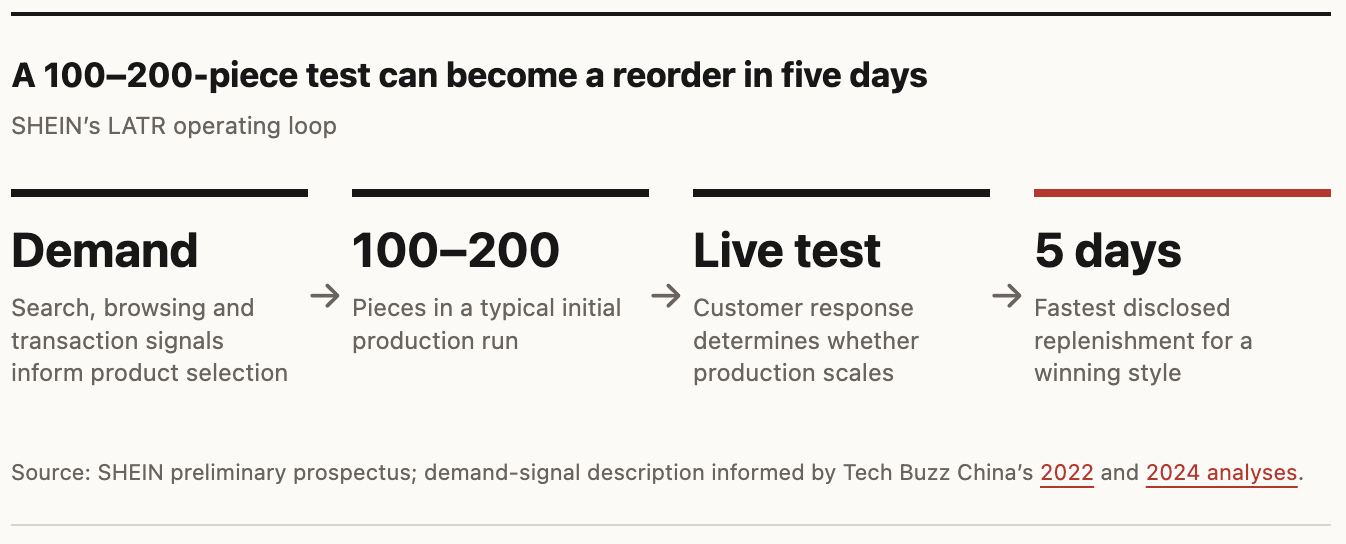
SHEIN’s most important innovation is the operating system behind its growth, which the prospectus calls Large-scale Automated Test and Reorder (LATR). The principle is simple: delay the expensive decision. Rather than committing to large production runs upfront, SHEIN starts with roughly 100 to 200 pieces and scales production only after customers begin buying. Successful designs can be replenished in as little as five days.
The model only works because of the network behind it. More than 7,500 contract manufacturers connect to SHEIN’s systems for ordering, production, quality control and logistics. By the end of 2025, that network supported more than 2 million apparel styles, inventory turned every 36 days, and more than 95% of inventory at the end of March was less than a year old.
Long before the prospectus gave the system a name, we had reconstructed much of it through suppliers and former employees in our May 2022 analysis, November follow-up and 2024 two-part analysis. Factories described applying to join the network, completing trial orders and being continuously evaluated on capacity, quality, delivery and responsiveness, while headquarters allocated orders across the system. A former SHEIN marketing director also told our expert network partner that the design-to-review cycle typically only took three days. The end result is that software coordinates thousands of independent workshops as one production system without SHEIN owning any factories of its own.
Part of LATR’s advantage comes from who pays when an experiment fails. As we wrote in our May 2022 analysis, suppliers often earned little or nothing on the first production run. They accepted those economics because SHEIN paid reliably and a successful trial could lead to much larger repeat orders. SHEIN limited its exposure to unproven styles while suppliers absorbed much of the cost of failed experiments.
Centralized warehouses in China completed the model. More than 90% of 2025 revenue came from products stored there, allowing low-value parcels to be shipped directly to overseas consumers. Suppliers lowered the cost of testing new products; low-value import exemptions lowered the cost of delivering successful ones.
SHEIN began evolving this model before trade policy forced the issue. It launched its third-party marketplace in 2023, allowing outside merchants to sell through the platform while expanding local inventory and fulfillment. As we argued in our 2024 marketplace analysis, “marketplace” understates what SHEIN has built. The company now combines self-operated retail with fully managed, semi-managed and independent third-party models, each giving it a different degree of control over inventory, pricing and fulfillment. The prospectus groups these businesses into just two line items—product revenue and service revenue.
A Growth Engine Losing Efficiency
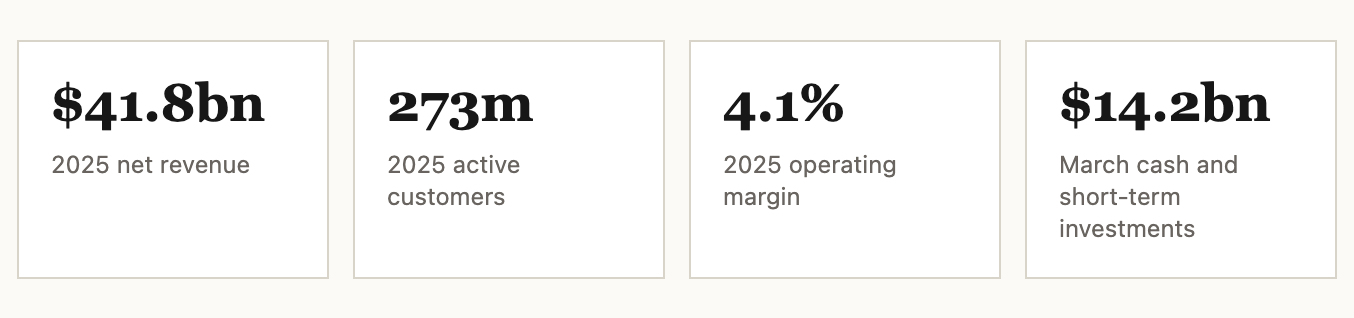
Revenue growth slowed from 41.1% in 2023 to 20.7% in 2024, 8.0% in 2025 and just 1.1% in the first quarter of 2026. Product revenue, still 85.7% of total revenue, was essentially flat, declining by $8 million. Overall growth came almost entirely from service revenue, which rose 9.1% to $1.30 billion.
One assumption behind our 2024 analysis turned out to be wrong. Based on expert interviews, we expected marketing expense to fall toward 4% of revenue as repeat purchases and organic traffic replaced paid acquisition. Instead, marketing expense remained at 10.7% of revenue in 2023 and 10.8% in 2024 before jumping to 14.8% in 2025.
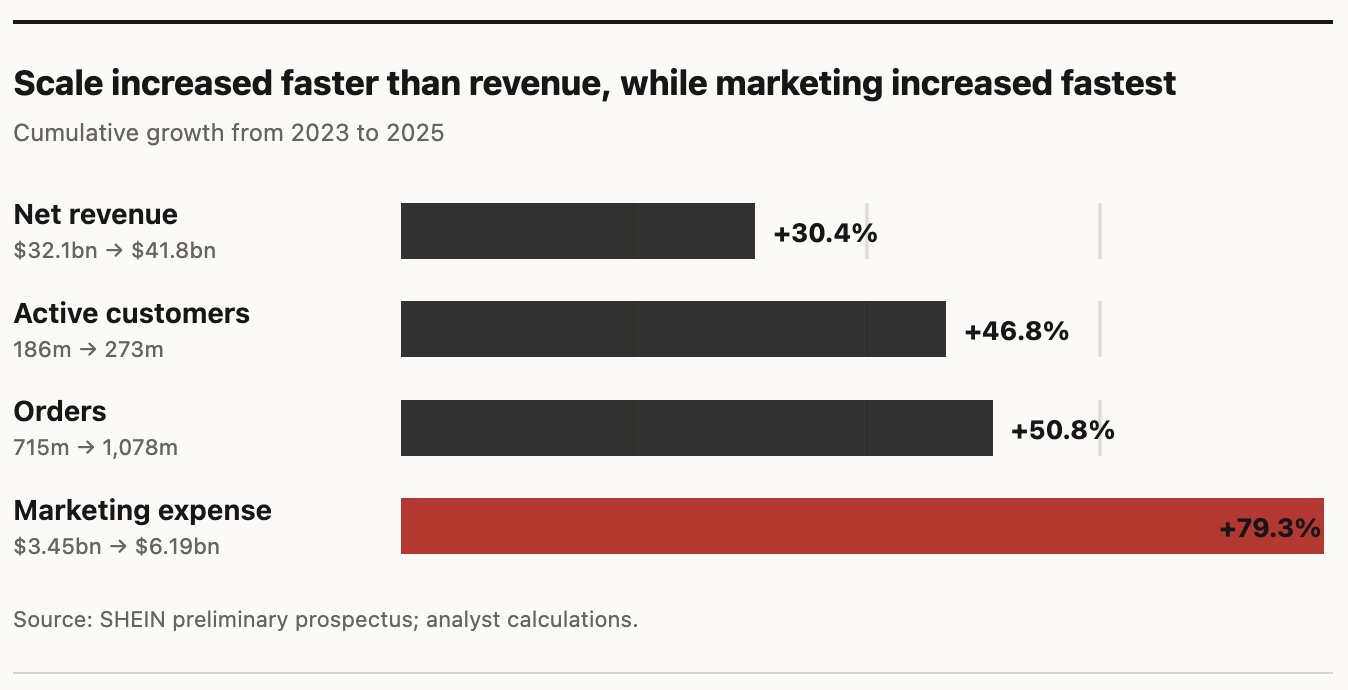
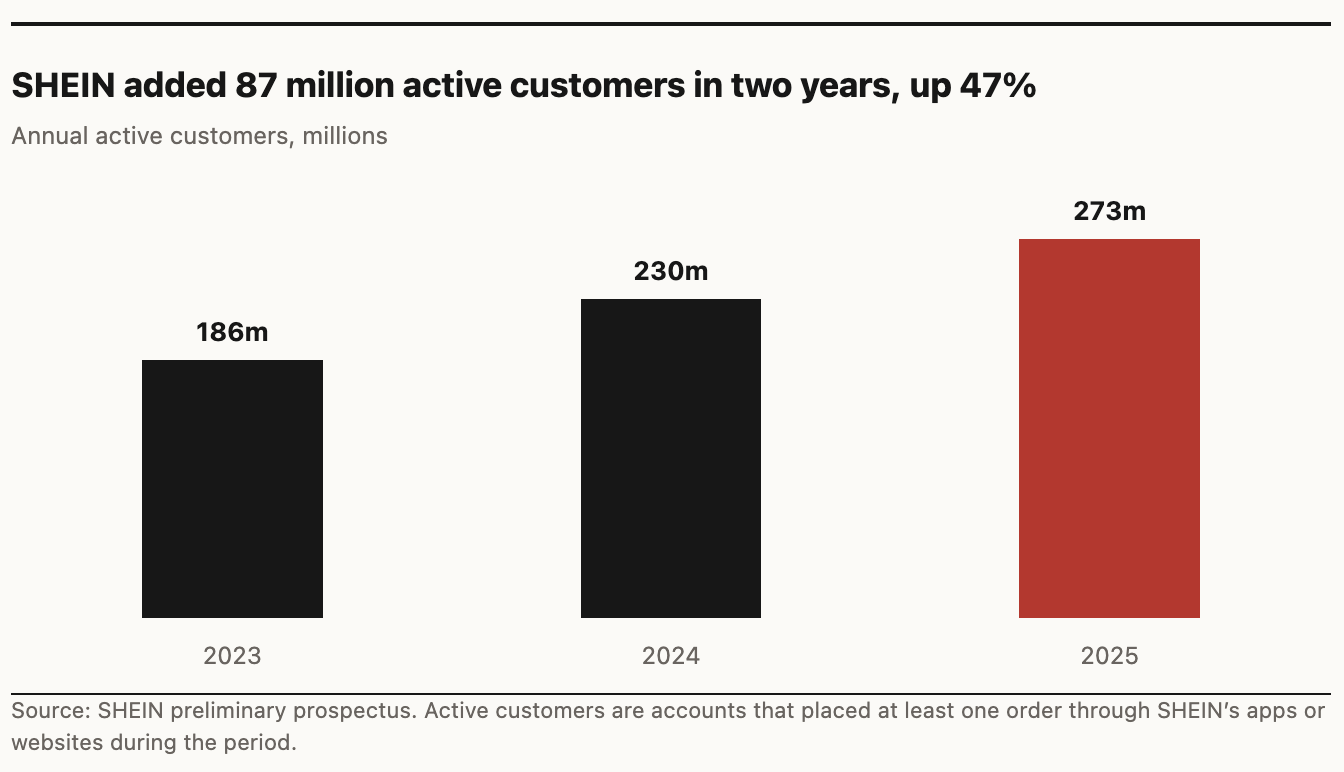
SHEIN was paying much more for roughly the same incremental growth. Active customers increased by 43 million, nearly matching 2024, and reported orders rose 17.3% to 1.08 billion. Marketing expense, meanwhile, climbed 48.9% to $6.19 billion, lifting marketing cost per reported order from $4.53 to $5.74.
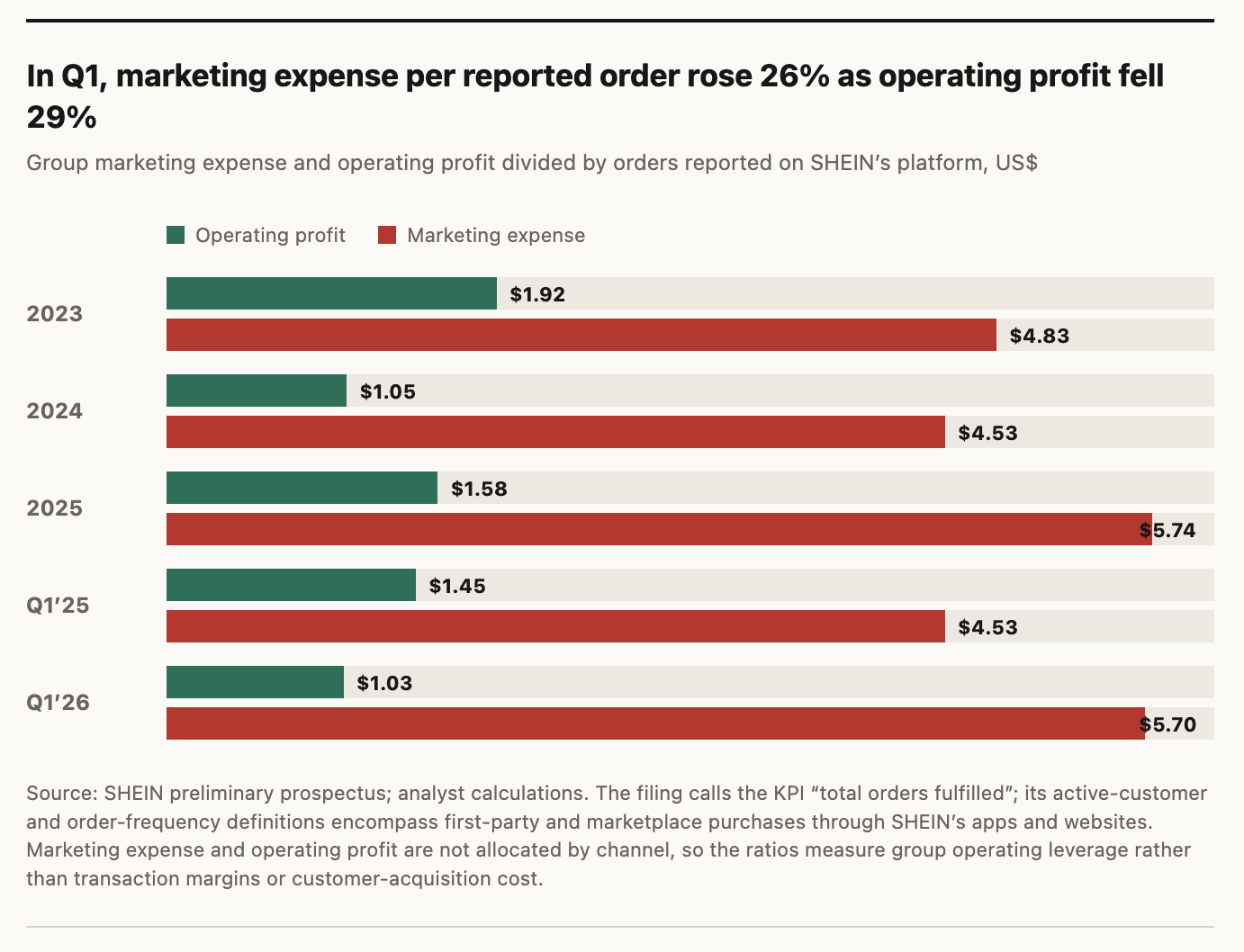
One important caveat: this is not a customer-acquisition-cost metric. It measures marketing expense and operating profit relative to reported orders across SHEIN’s platform. Marketplace orders are included in the denominator, while marketing also supports businesses such as Xcelerator (more on that below). It is best read as a measure of operating leverage.
Fulfillment did not deteriorate in the same way. While fulfillment expense rose from 42.1% of revenue in 2023 to 45.6%in 2025 and 47.7% in the first quarter of 2026, fulfillment expense per reported order fell from $18.90 to $17.70 before edging up to $17.90 for the twelve months to March 2026. The metric also includes merchant-fulfilled marketplace orders, but it does not point to the same loss of efficiency.
The timeline also argues against a tariffs-only explanation. SHEIN’s operating margin had already fallen from 4.3% in 2023 to 2.5% in 2024, before the US ended duty-free treatment for low-value Chinese parcels. Competition from Temu and other platforms for customers, advertising, air freight and fulfillment was already squeezing margins before tariffs hit.
LATR As-A-Service
SHEIN no longer monetizes its operating system solely by selling its own inventory. In first-party retail, it buys merchandise and records the full selling price as product revenue. Marketplace merchants sell on SHEIN, while the company records commissions and related service fees. Xcelerator extends the model further: some brands sell through SHEIN, while others purchase manufacturing, fulfillment or marketing services but continue selling through their own websites or other channels.
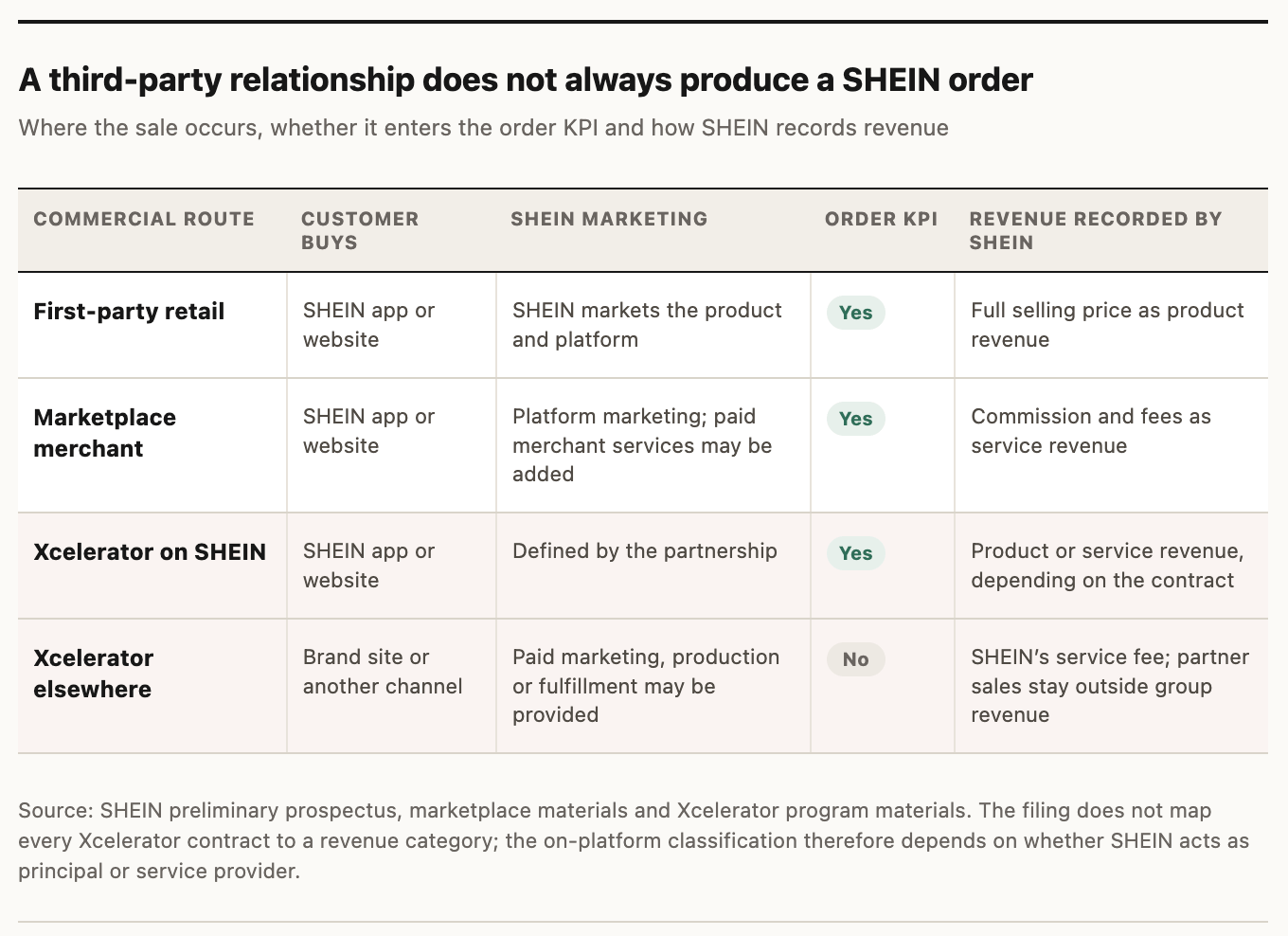
Not every partnership generates a SHEIN order. Marketplace sales enter SHEIN’s order count; purchases made on a partner’s own website do not. Marketing expense therefore no longer lines up perfectly with reported orders, although Xcelerator remained less than 1% of revenue in 2025.
The accounting changes too. SHEIN records first-party sales gross but generally books only commissions and fees on marketplace transactions. As service revenue rose from 2.7% to 14.3% of revenue, product revenue became a smaller share of the business.
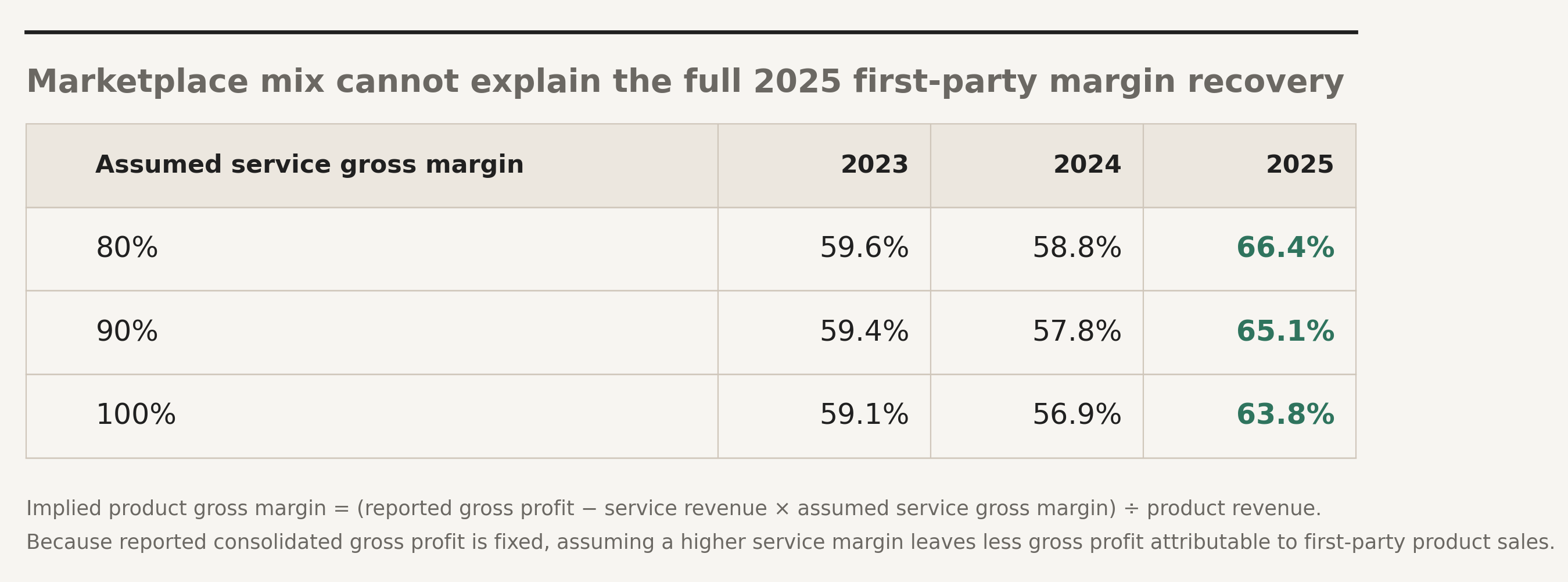
That mix shift mechanically lifts SHEIN’s reported gross margin because marketplace revenue carries little or no associated cost of goods sold. But it cannot explain the full improvement. SHEIN’s consolidated gross margin rose from 57.1% in 2024 to 61.2% in 2025. To isolate the first-party business, we backed out service gross profit under several assumptions. Because total reported gross profit is fixed, the higher the margin we assume for services, the less gross profit remains attributable to product sales. Even assuming services earn a 100% gross margin, implied product gross margin still rises from 56.9% in 2024 to 63.8% in 2025. In other words, the recovery was not simply an artifact of marketplace mix.
That improvement did not translate into comparable operating leverage. Much of the gross-margin gain was absorbed by higher marketing spending, leaving operating margin at just 4.1% in 2025, well below H&M’s 8.1% and Inditex’s 20.1%.