
China's Humanoid Robots Aren’t Ready. The Real Story Is the System Being Built.
The humanoids remain limited in capability, but many parts of the industrial system are being pulled into the experiment at once.

Things We Noticed:
We were just on the BBC Asia Specific podcast about the Manus-Meta deal.
We also spoke to Analytics India magazine about it last week.
China just released new guidelines to regulate AI agents.
What follows reflects observations from two just-completed Tech Buzz China trips in April 2026. (We will follow with a selection of a few companies we found interesting behind the paywall.) Across the two groups, we brought roughly 30 investors, founders, and operators from more than 10 countries to visit companies across EVs, AI, and robotics in Shanghai, Liuzhou, Guangzhou, and Shenzhen. Much of what was shared was explicitly confidential, so I cannot quote or reproduce it directly.
However, I’m here to give you my impressions and most important takeaways. We spent about half of our time on robotics, and specifically humanoid robots. The highest density learning environment for me personally was the FAIRPlus conference hosted by the Shenzhen Robotics Association, which featured nearly 400 companies across the robotics supply chain, almost 200 of them working on humanoids. In an upcoming piece, we will list a handful of companies we think are worth tracking closely at this still-early stage.
The short version is this: I came away less convinced that humanoids are close to becoming household helpers, but more convinced that China’s advantage in robotics is not any single robot. It is the closed loop around the robot: capital, factories, data, supply chains, customers, and local governments all pushing in the same direction.
There is plenty of waste and hype. But actual deployment creates its own learning: how customers use the robots, how the public reacts, what supporting jobs and services appear, which suppliers get pulled in, and where the business model starts to work. That is what makes this feel different from many other policy-driven tech booms. Humanoids are limited, but they are already being sold, rented, staffed around, and put into commercial settings.
— Rui
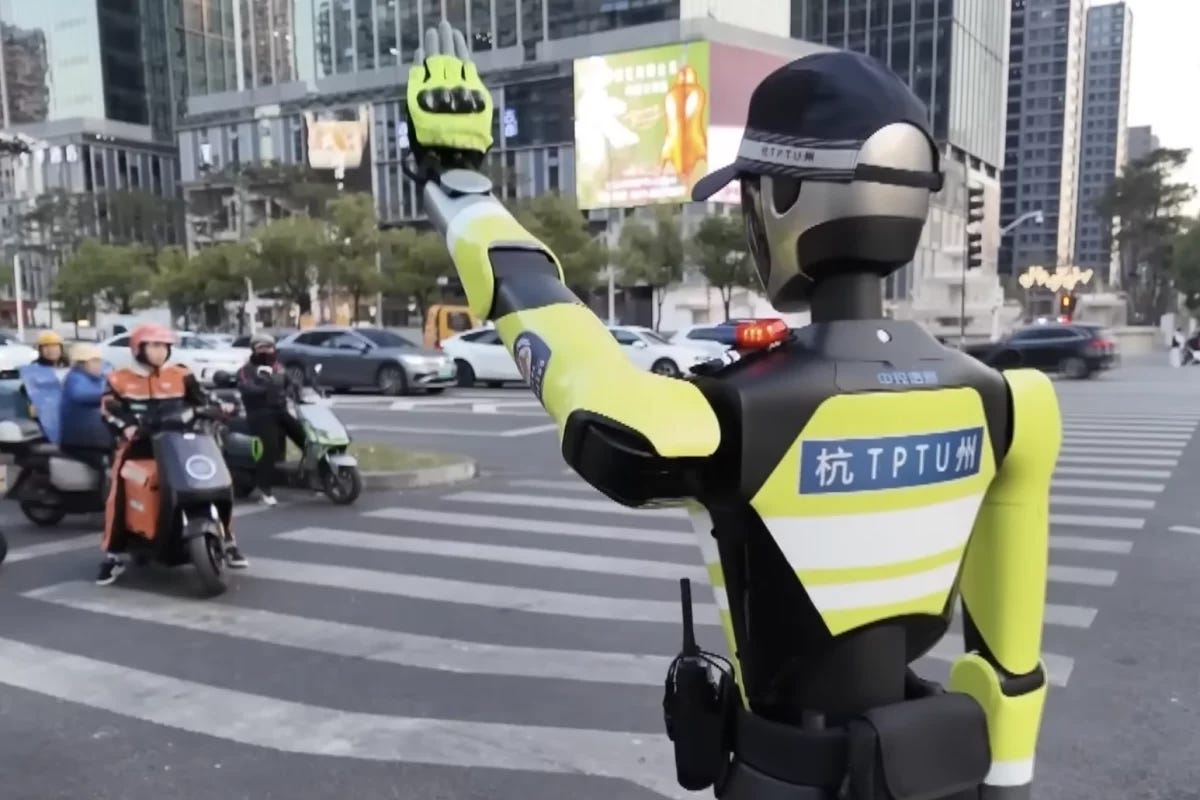
1. The hype is loud, but the activity underneath it is real.
We visited robotics companies during our Deep Tech Trip in September 2025 and again during our New Energy Trip in January 2026. Even compared with then, the level of activity in April 2026 felt like it had jumped by an order of magnitude.
It was almost impossible to lock down meetings. Everyone was either closing a round, launching a product, or, in many cases, genuinely on the road meeting investors, often local governments trying to woo them with promises of complete supply chains and ready-made industrial support. At one particularly well-known robotics company, we were passed between three different departments before the head of Government Affairs finally hosted us. The Investments and then Strategy people who had originally agreed to meet had all gone off to visit local governments.
Exhibition halls were being built, newly launched, or packed shoulder-to-shoulder with visitors like a weekend at Disneyland.
A note on these halls: many readers who have visited Chinese companies know how elaborate the corporate history and product displays have become. I learned on this trip that the format is largely borrowed from Japan. American startups, generally speaking, do not build museums to their own achievements. But in China, where local governments, major customers, investors, and other visitors are constantly coming through, the investment makes sense.
The bigger shift is that these halls are no longer just for business visitors. They are becoming tourist attractions. Some remain open only to groups or educational nonprofits, but a growing number of individual companies, along with organizations such as the Shanghai municipal government, are packaging them as tourist experiences available for purchase.
This sounds slightly absurd until you see it.
We were given a preview of one exhibition hall that has not yet opened to the public, with the understanding that it will soon be accessible for a small fee. Others, such as the groundbreaking SAIC-GM-Wuling EV plant we visited in Liuzhou, are already well known tourism sites. The plant produces China’s best-selling EV, crossed one million units in 2025, and is staffed to receive busloads of visitors every 30 minutes. (By the way, we would recommend it, but it is a bit out of the way.)

For the companies, the logic goes beyond incremental revenue or marketing exposure, although both are real benefits, especially for younger firms. These exhibition halls and factory visits make China’s manufacturing capacity and latest high-tech products accessible to the public. They work as marketing, education, and CSR, especially given how many parents bring their children, but the larger effect is social and political: getting people comfortable with the technology, curious about it, and proud of the industrial base behind it. This matters even more when so much public capital is being directed into these industries, future jobs are expected to come from them, and fewer people experience manufacturing directly as more labor shifts into services. Technological progress inevitably leaves some people behind; helping the public see it, understand it, and feel some ownership over it is not a tangential issue, but a main part of the work.
As a side note, we will be open-sourcing some of these resources, including details on factory and company tours that are sometimes, though not always, open to foreign passport holders. We plan to publish how-to guides on our website in the near future. Factory tours generally make up half a day to a full day of our current five-day trips.
2. Local governments are the major ecosystem builders.
State-led capitalism is in full bloom in robotics, though not necessarily for the reasons most outside observers assume.
The most familiar layer is manufacturing. Humanoid robotics draws heavily on a supply chain that overlaps with EVs, given the shared dependence on batteries, autonomous systems, motors, sensors, and advanced manufacturing. Following Tesla’s lead, many major Chinese EV makers, including NIO, Xpeng, and Xiaomi, have announced or released some humanoid initiatives.
As a result, cities that built themselves up as EV manufacturing hubs are now aggressively recruiting humanoid robotics firms.
Liuzhou, in farflung Guangxi province, is a useful example. By conventional ranking, it is a third-tier city. But it is also one of China’s most important automotive bases, anchored by the SAIC-GM-Wuling joint venture mentioned above. It has already attracted UBTech, the first listed robotics company to push humanoids toward mass production, with over 1,000 units sold last year and humanoid revenue up roughly 23-fold.
We visited a UBTech data collection center funded by the Liuzhou government (Chinese announcement here), which is also on the company’s cap table through government-linked funds. (There is definitely some round-tripping here, not so different from the web of entanglements in US AI investing.) We also visited a local automotive factory where UBTech humanoids were being trained directly on the workshop floor through a collaboration agreement.
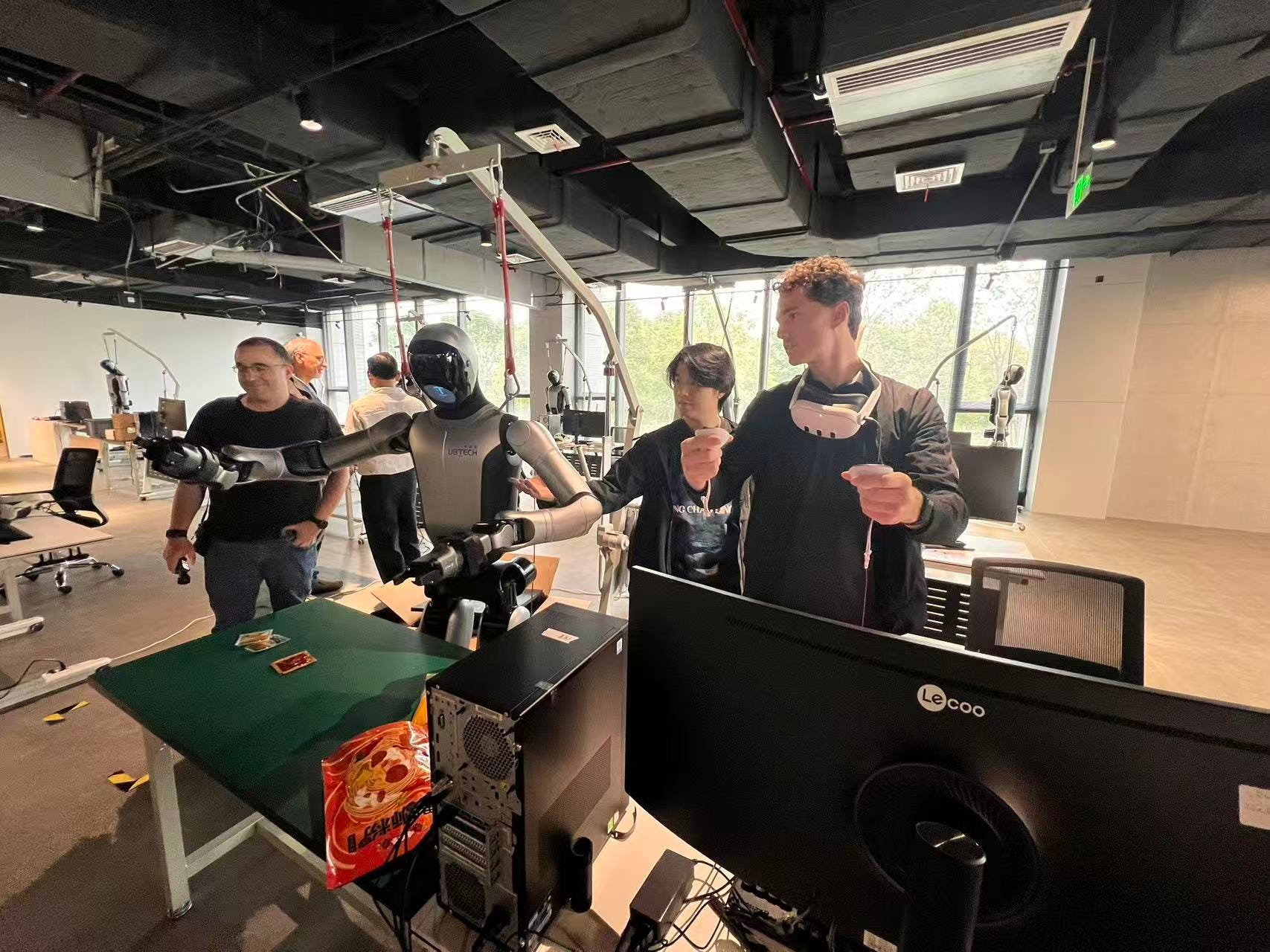
The government’s interest in operating its own training center runs along two tracks.
The obvious one is employment, though it may be transitory. Each task requires roughly 200 to 300 hours of human-led demonstration, and many movements are ultimately unusable. We tried it ourselves, and the manipulation work was much harder than it looks. The machine does not magically “learn factory work.” A human has to repeat the motion again and again, often awkwardly, until enough usable data is collected. In other words, before robots replace labor, they need a lot of labor to train them.* (See my conclusion for what happens if this assumption collapses more quickly than expected.)
The second, and more strategically interesting, is data ownership. The local government plans to resell the collected data to other robotics companies. The logic is that if it has invested heavily in the local manufacturing base, then data generated inside that environment should also become a local asset, something it can sell, use to attract more robotics companies, and eventually convert into demand for more robots … ideally locally. This is a core part of the recruiting pitch: the city is not just a node in the supply chain, but potentially a node in distribution too. Local governments can offer factories, capital, trial settings, and training data, making for a multi-pronged offering which makes it much more compelling for robotics companies to build there.
When I asked whether data collected on one company’s robots would transfer cleanly to other models, that did not seem to be the main concern. The attitude was more: that can be solved later.
3. Less subsidy theater means more direct investment, but comes with it more pressure to commercialize.
This is not the old local government subsidy playbook, or at least not entirely.
Under China’s new anti-involution policies, which are meant to curb destructive overcompetition and wasteful local subsidy races, local governments have fewer easy tools to attract companies than they used to. Selective tax rebates, fiscal subsidies, and land-related concessions are now harder to offer openly without legal authorization or higher-level approval. So the old model of winning projects by throwing land, tax benefits, and side payments at companies is being narrowed, even if it has not disappeared.
That matters because it changes how cities compete. Lower-tier cities still have fewer resources than Beijing, Shanghai, Shenzhen, or Hangzhou, but the gap narrows somewhat if everyone is more constrained in how freely they can use land and tax benefits. Investment is still very much on the table, and local guidance funds are actively backing robotics companies, often leaving firms with one government investor or even several. But this money is being deployed more as equity capital, which means it comes with the expectation that public funds will be preserved, not simply spent in pursuit of growth at any cost.
Capital preservation is a very real concern. One of the biggest things people miss about China’s innovation system is how much financial discipline shapes the direction of technology. It is generally not acceptable to lose the people’s capital, meaning public endowments, state-linked funds, and local government money. That is why profitability is prized, often at the expense of growth.
Many US tech investors would tolerate years of losses if the growth story were compelling enough. Chinese companies, especially listed companies or even private ones with public funds on the cap table, face much more pressure to reach profitability quickly because domestic institutional investors are heavily disincentivized from losing public money. A lot of the capital ultimately comes from state or quasi-state funds, and that changes what “good performance” means.
By the way, that pressure can be even stronger for larger companies. In the US, we are used to very large, very unprofitable tech companies, sometimes with what look like accelerating losses. In China, size often forces more discipline, not less, because state-linked funds may hold passive or index-mandated stakes and still exert pressure for steadily improving cash flow.
The result is a strange combination. It can curb the appetite for wild experimentation, because losing the public’s money is not treated casually. But it also pushes the whole sector toward commercialization, sometimes before the technology is fully ready, as I would argue we are seeing today in humanoids. You get a system that is less tolerant of long, uncertain moonshots, but very good at forcing companies to find customers, revenue, and practical deployment paths quickly. Interim revenue matters. Transitional markets are fine. What is not fine is having only a story, with no sales or profit on the horizon. Here, the micro mirrors the macro strategy of “crossing the river by feeling the stones.” The underlying belief is that each deployment creates more learning, and that enough incremental progress eventually produces a clearer sense of direction.
4. Humanoids are still far from human.
Now for the reality check: the demos are much more available than they are convincing.
That accessibility is actually useful. In China, you do not have to rely only on polished videos circulating on X. The robots are increasingly in exhibition halls, retail stores, rental platforms, data collection centers, and factory pilots, which means you can see more clearly what works and what does not. And what works, for now, is mostly movement.
There has been real improvement in locomotion. The top models now balance well and recover well if you push or pull them. In terms of movement, EngineAI was the standout from our visits. I personally found its range of motion much more entertaining and impressive than Unitree, which we saw at multiple labs, and Agibot. My simple heuristic is to evaluate demos across three axes: body control, autonomy, and physical interaction with the environment. Right now, the best models are much stronger on the first than on the other two.
This new cartwheel movement by the EngineAI PM-01 took only watching videos and less than 10 hours of compute time to train.
A backflip, for example, is impressive and ridiculously entertaining to see live, but it does not require much interaction with the outside world. The precision is mostly internal to the robot’s own body: joints, balance, movement control. That is very different from manipulating objects in a cluttered home, working safely next to people on a factory floor, or figuring out what to do without a preprogrammed sequence.
Humanoids have definitely improved, even compared with just a few months ago. But they still did not show enough intelligence to make me believe they are becoming productive household helpers anytime soon. A robot that can move impressively is not the same thing as a robot that can work usefully across a large, dynamic, messy environment.
5. Robots enable flexibility. The hand may get deployed first.
The factory demos were not the most dazzling demos we saw, but talking to folks in manufacturing helped clarify the real near-term opportunity: flexibility.
A lot of superficial humanoid discourse jumps straight to household help, eldercare, and domestic labor because that is the emotionally compelling version. But homes are terrible deployment environments: messy, low-margin, full of edge cases, and hard to measure ROI against.
Factories are not easy either, but the problem is more contained. The buyer has a budget, the environment can be modified, and the value of even partial automation is easier to calculate. But the most important reason factories matter for humanoids is that manufacturers increasingly want automation that can handle greater variation flexibly.
One long-time contract manufacturer we met with put it well: outsiders are often dazzled by giant, fancy industrial robots, but those robots are also quite inflexible. They have a role, especially in high-volume, stable production. But for manufacturers dealing with changing orders and shorter runs, the ideal floor is not just a row of enormous machines doing the same task forever. It is one where machines can be redeployed more easily, adapt to different tasks and tools, and support just-in-time production with less inventory. In his experience, the most profitable or favored factories are not always the most automated ones.
That also matches what we have seen before in “overflow” workshops, even at top companies such as CATL. It’s called “flexible manufacturing”: where the same line could handle a variety of products. But the flexibility was often achieved through labor, not automation, which is exactly the gap the current crop of humanoid robotics companies have a shot at trying to address.
This is also why robotic hands were so interesting and very much dominated the conversation this year. Companies like LinkerBot, which had its lead algorithm engineer do Q&A with us, are focused only on hands but can still command valuations comparable to full humanoid companies. (The company is reportedly going for a $6Bn valuation.)
I saw the 38 degrees of freedom hand from Yue Quan Bionics that sells for $85K USD in action.
The reason is that these hands are not necessarily going on humanoids. For the most part, they are being attached directly to factory arms. If a better hand can make an existing industrial arm more adaptable, that may matter much more in the near term than whether a full humanoid can walk around convincingly.
The humanoid body gets the attention. The hand may get deployed first.
There is also a labor argument, but it fits into the same flexibility story. Manufacturing labor in China is not infinitely abundant, and more importantly, it is not evenly available. Demand comes in surges, seasonal peaks, and just-in-time production cycles, so factories need the right workers, with the right skills, in the right place, often on short notice. This is why local governments trying to attract supply chains will emphasize their ability to quickly staff up from one shift to three, for example. Robots are not only a wage-cost story. They are also a way to reduce the operational pain of labor volatility.
So the serious near-term question is not whether humanoids can replace people wholesale. They cannot. It is whether robotics can make factories more flexible, less dependent on perfectly timed labor, and better able to handle variation.
6. Not every Chinese AI company is racing towards the conventional definition of “AGI.”
A shorter AI note, since this trip was more robotics-heavy: China’s AI companies are not all trying to build the next Anthropic, even if all of them respect the company tremendously and many continue to release large-parameter models because that remains a core part of the marketing and fundraising game.
The more useful way to understand the market is that companies are choosing different layers of development and deployment. Some labs have moved toward vertical applications, such as Baichuan, whose founders came from Sogou. Others, like Kaifu Lee’s 01, moved into services and researchers have been absorbed into other labs. Some companies are prioritizing mid-sized and small models because those are better suited for edge devices, smart hardware, simple agentic workflows, and in-car intelligence. For example StepFun, one of the labs we visited, just raised $2.5Bn to try to dominate this latter strategy. And let’s not forget about all the companies working around China’s scarce compute environment: optimizing chip usage, managing heterogeneous clusters, and using virtual machines to squeeze more out of available hardware. This is less glamorous than building the biggest, most capable model, but it is a very real part of the market.
But will vehicle makers be content to rely on third parties for intelligence? For smart cockpit, at least for now, the answer appears to be yes. ByteDance’s Doubao, for example, is now integrated into roughly 50 brands, and StepFun works with Geely and others.
An aside here that autonomous driving looks different though. For L2++ systems, roughly analogous to Tesla FSD, there are still partnerships aplenty, of course, and Huawei continues to supply its “brain” to many models. But companies like Xpeng are increasingly building their own solutions because they see autonomous driving as brand-defining, not just another feature to outsource.
The Chinese AI market is not one race. It is spreading across frontier labs, vertical applications, edge models, compute optimization, services, and product-specific intelligence for cars, robots, and devices. For robotics, that obviously matters because embodied AI will most likely not be won simply by whoever has the biggest model. It will be won, or at least commercialized first, by whoever can put the right model, at the right cost, into the right machine, and still control enough of the product experience to make the economics work.
7. The real overcapacity is talent.
It has been my conclusion for several years now that the real “overcapacity” in China is talent. China’s advantage is not just that it has a lot of engineers, but that many of them have spent years, sometimes decades, working on narrow, difficult technical problems.
This is easy to miss from the outside because people tend to look for Silicon Valley equivalents: which startup is funded by a recognizable fund, which founder went to MIT or Stanford or at least speaks good English / presents well to a Western audience, who overlaps with circles we already know. But a lot of the underlying work is happening in provincial universities, Chinese Academy of Sciences institutes, and specialized labs that most people do not track closely. This was obvious at the robotics conference, where many companies came from CAS or affiliated labs. China is science-maxxing, and not just in computer science.
An award-winning angel investor in new energy materials put it simply: many of these labs already have 10-plus years of experience in extremely niche research areas. When we focus too much on LLMs, we miss how much of China’s entrepreneurial ecosystem is built around other forms of technical depth: materials, batteries, robotics, sensors, manufacturing processes, and all the unglamorous scientific work that has to accumulate for years before it becomes a company.
8. There is AI anxiety, but not much AI anger.
There is AI anxiety in China, but not much yet AI anger, at least not in the way it often appears in the US.
People are worried, of course. They worry about jobs, about whether their children are studying the right things, about whether their own skills will still matter. But the anxiety did not usually come wrapped in the same moral language you often hear in the US: that AI is theft, or existentially evil, or an environmental crime. And you already know from what we’ve shared before that there is no power crisis to agitate people further.
The sharper question is labor replacement, and here the reaction depends very much on which labor we are talking about.
Repetitive factory work is not generally seen as a job many people aspire to keep forever, especially younger workers, and China’s labor force has been shifting toward services. That makes factory automation politically different from replacing service or gig work (240 million people by some estimates), which also functions as a much broader employment backstop. For robotaxis especially, the social risk is much more obvious. Driving may not be glamorous work, but it is an important employment backstop, and there are simply a lot of people who depend on it.
So I do not think China will slow-walk AI adoption in the broad sense. But I do think the politics of diffusion will differ sharply by sector, and you can already see signs of this caution, including a recent court case ruling that companies cannot simply dismiss employees due to cost cutting from AI. The government is not anti-automation. But it is very aware that some forms of automation are socially easier to absorb than others.
9. The US still wins in risk capital. But physical AI may be a different game.
When I spoke recently on an AmCham HK panel about US-China technology competition, I said the place where the US still clearly wins is risk capital.
There is still not enough truly risk-taking capital in China. People often ask me why ChatGPT did not come out of China, and my answer is that I do not think it could have, at least not in that first phase. The issue was not talent. It was that the original OpenAI-style bet was too undefined. It did not begin with a clear product, a clear customer, a clear revenue path, or even a clear metric of success. It was a long, expensive research effort where people did not yet know exactly what they were looking for, only that something important might be there. That is very hard for China’s capital system to fund for years.
And this is where I think the usual “China is not innovative” explanation is both lazy and wrong. The issue is not some cultural deficiency around creativity or invention. It is incentives. China is very good at pushing companies toward shorter-term commercial results, because the capital markets and investors demand it. It is also very good at extremely long-term state-led projects, the kind that require policy support and capital commitment over decades, like nuclear energy or major infrastructure.
The weak spot is the messy middle: work that is too uncertain for near-term commercialization, too open-ended for its private investors, and too market-driven to fit neatly into a long-term state plan. That is where the US has a real advantage.
But physical AI is a different kind of problem from the original OpenAI-style bet. It is still hard, and the timeline is still uncertain, but the goal is much easier to understand: build machines that can operate in the physical world, improve manufacturing, ease labor bottlenecks, and eventually handle more complex real-world tasks. You can argue about how soon any of this happens, and I would argue it is still not soon, but the direction is not mysterious.
That makes it a better fit for the Chinese system. Robotics needs capital, suppliers, factories, customers, cost pressure, hardware talent, software talent, and enough real-world testing to force iteration. It also helps that this is now clearly a national priority, so local governments have every incentive to pull these pieces together. This is why China remains one of the most important places to watch in robotics: not because the robots are ready, but because the loop around them is unusually complete.
PS … the technical path is shifting quickly, but the ecosystem is likely to adapt.
One final note: I strongly recommend watching NVIDIA robotics research scientist Jim Fan’s recent talk on physical AI and robotics training. His view is basically “RIP” to teleoperated data collection: simulation, video, generated data, and other more scalable approaches are already emerging and look far more effective.
I agree with him. The painful-looking teleoperation centers we saw are probably not what gets us to physical AGI, not even with Chinese levels of efficiency, grind and hustle. Some of these facilities may end up being transitional or wasteful, and the technical path is clearly shifting quickly.
But that does not undermine the broader point. China’s tech ecosystem, especially with state support behind it, is more flexible than people often assume. It is not wedded to a specific method so much as to whatever produces results. And because local governments, investors, suppliers, and companies all fear missing the next EV-scale industry, they have both the incentive and the machinery to redirect capital, policy support, supply chains, talent, and testing toward whichever path begins to work.
The bigger open question remains compute. The US still has a clear semiconductor advantage, but the next six to 12 months should show whether that gap, spearheaded by Huawei’s efforts, is widening, narrowing, or becoming more uneven across the stack.
A quick note from us: we are putting open-enrollment trips on hold for the remainder of the year, but we welcome groups to reach out about bespoke trips. We are especially interested in bringing a group of founders to China to meet physical AI companies and founders on the ground so reach out if that sounds like you. We have a slew of new projects around Physical AI that we are launching soon, stay tuned!