


Things you might have missed
A few developments since our August 30 issue are worth keeping on your radar.
From our recent coverage
Meituan’s second-quarter revenue reached RMB104.6 billion (US$14.4 billion), up 14.4% year over year, while AI research and development spending rose 22.5% to RMB7.7 billion (US$1.1 billion). CEO Wang Xing said the company’s models will serve its core businesses rather than operate as a standalone “token factory.” Read more →
Tencent open-sourced Hy4 Preview, a 770-billion-parameter model with a one-million-token context window. Its cached-input price exactly matches DeepSeek V4 Pro, although early testing found that repeated self-verification can consume time and tokens. Read more →
Horizon Robotics reported RMB3.78 billion (US$520 million) in first-half net profit on RMB2.06 billion (US$280 million) in revenue. Licensing and services grew 52.7% to RMB1.13 billion (US$150 million), giving a clearer view of how the autonomous-driving chipmaker is shifting its revenue mix. Read more →
From Weijin Research
Why Chinese AI Models Are Raising Prices as US Models Get Cheaper examines why Chinese providers are trying to charge more even as model prices fall elsewhere—and what that says about the value of tokens, product differentiation and inference economics.
Where we have been featured
Reuters followed the growing stream of investors and executives visiting China’s technology companies, including participants in our April robotics and emerging-tech tour. Rui explained why seeing Chinese companies firsthand has become useful due diligence even for people who do not invest in China. Read the article →
What Happens When an MSG Company Buys 4,000 AI Chips?
Lotus Holdings made its name selling MSG and chicken bouillon. By 2025, China’s “King of MSG” was also renting out AI compute, and business appeared to be booming: the company reported utilization near 90%. So in December it agreed to spend RMB200 million (US$29.5 million) on another 4,000 AI accelerator cards and related services. The chips arrived. The customers did not. By July, all 4,000 cards were still unassembled, with no buyer or computing-service customer.
The problem was not that China lacked demand for AI compute. At the same time, China Mobile was signing customers against capacity that had yet to be built. Its intelligent-computing revenue reached RMB5.3 billion (US$781 million) in the first half of 2026, up 130.1%, while management reported 7 gigawatts of cumulative contracted AIDC capacity, including 5 gigawatts signed during the half. The measures are not directly comparable, but the contrast is hard to miss: China’s MSG king had 4,000 AI chips looking for a customer; China Mobile had customers attached to data centers that did not yet exist.
That mismatch captures the next challenge for China’s AI infrastructure boom. China has shown it can finance and build enormous amounts of compute. The harder task is bringing hardware, software and paying workloads together before the equipment depreciates or becomes obsolete.
That matters beyond individual data-center returns. Idle hardware produces depreciation; hardware running real workloads exposes failures that Chinese chip, networking and software companies can fix in the next deployment. Even infrastructure that produces poor returns for some owners could therefore strengthen China’s broader AI stack, provided enough of it actually gets used.
1. China Has Plenty of Compute — On Paper
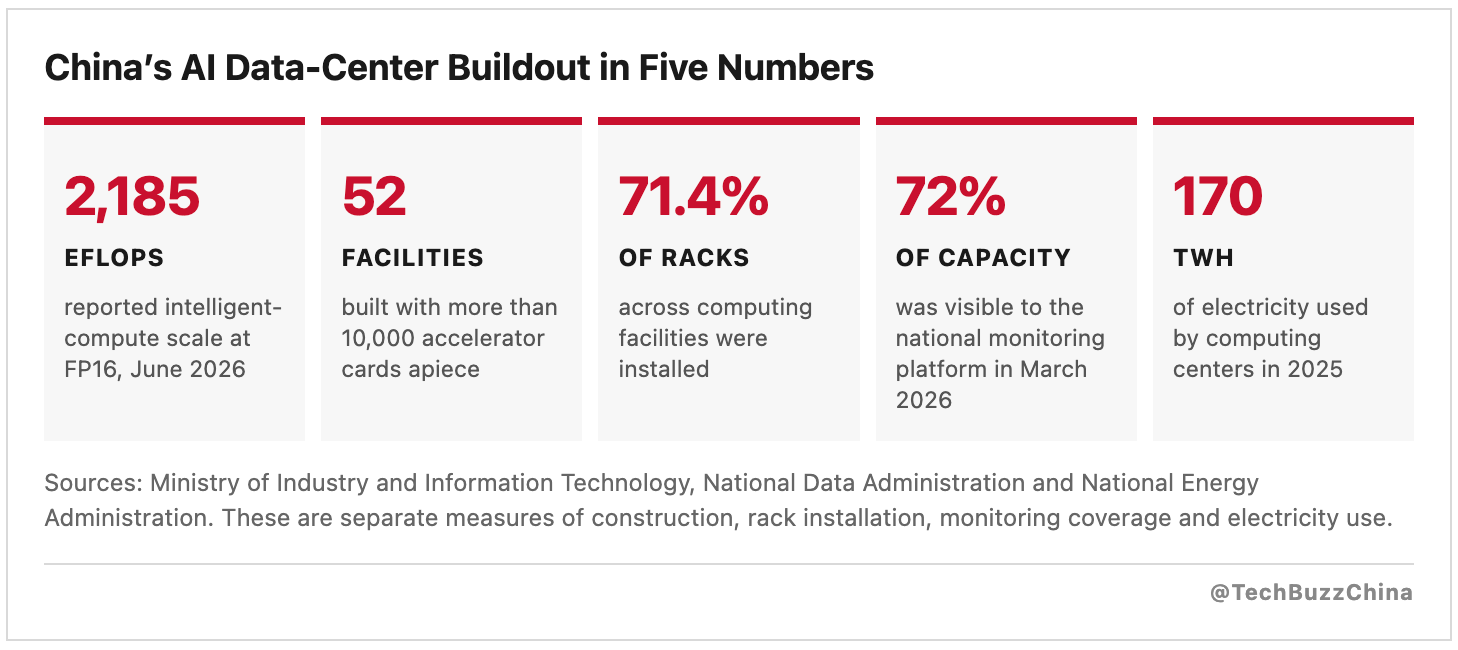
China’s AI infrastructure looks enormous in official statistics. By June 2026, the Ministry of Industry and Information Technology put the country’s intelligent-compute capacity at 2,185 EFLOPS, up 177% in a year, and counted 52 facilities containing more than 10,000 accelerator cards each. Across computing facilities nationally, 71.4% of racks had equipment installed.
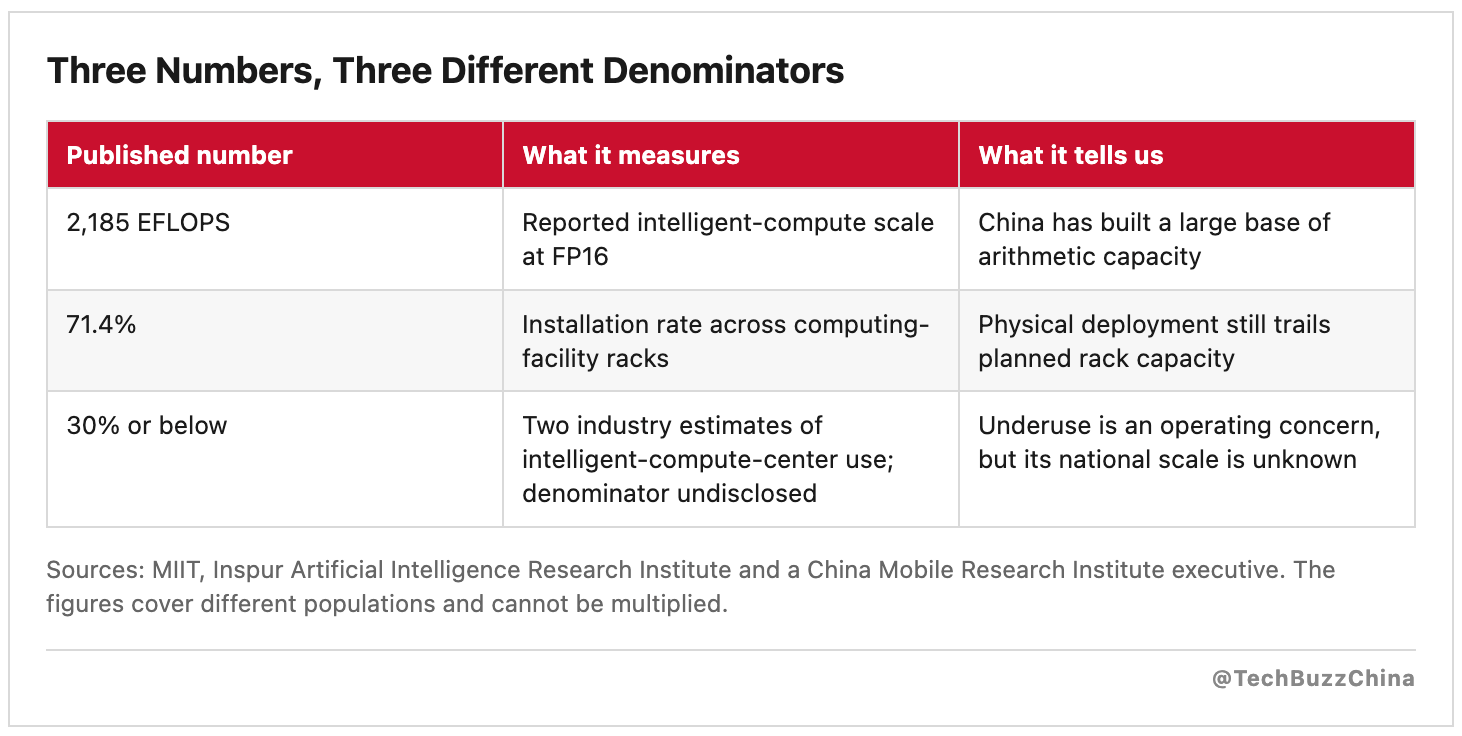
The trouble starts when we ask how much AI those numbers actually produce. The 2,185 EFLOPS measures what the processors could theoretically calculate if they were running flat out, not what they actually accomplish for customers. And the 71.4% figure tells us whether equipment has been installed in a rack, not whether anyone is using it. China does not publish a national figure for how much of this capacity is doing paid work.
The estimates we do have suggest a substantial gap. One industry estimate put average utilization at intelligent-compute centers at about 30% in 2025. An executive at the China Mobile Research Institute separately put it below 30%, pointing to immature software, incompatible hardware and the difficulty of getting large numbers of processors to work reliably together. The problem is that nobody seems to be measuring utilization the same way. The two industry estimates don’t publish their denominator, while individual operators use their own definitions. So 30% is best understood as evidence that utilization is low, not as a precise national average.
But the precise percentage matters less than the measurement problem it exposes. China can tell us how much theoretical computing power it has built and how many racks contain equipment. It cannot yet tell us how much of that equipment is continuously producing AI that somebody is paying for.
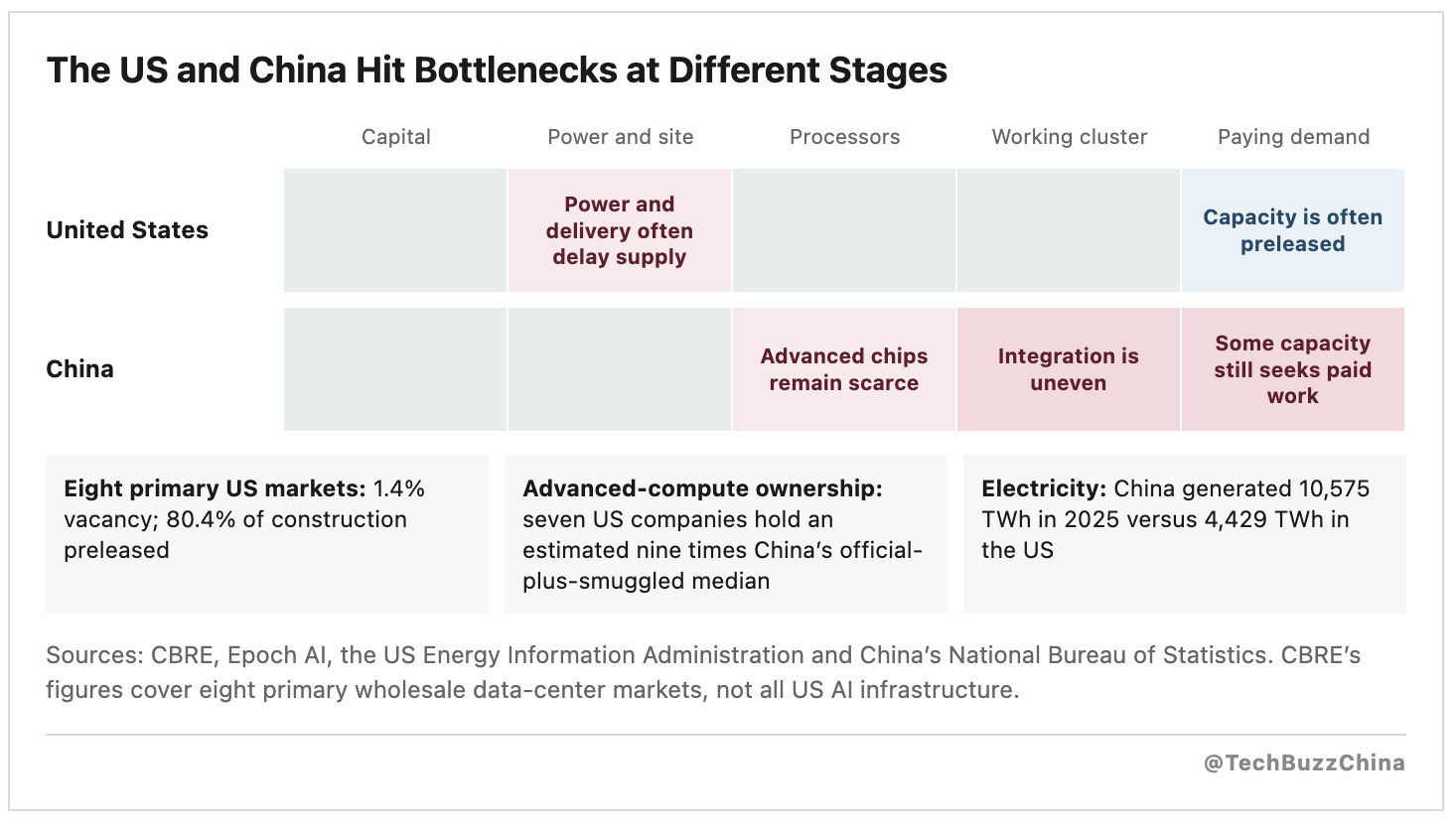
That distinction also helps explain why the US-China data-center debate can be so confusing. In major US markets, customers are often waiting for new data centers to get power and come online. In parts of China, the sequence can run the other way: the building is powered and the equipment is installed, but the operator is still waiting for the right chips, software or customer workload.
2. Who Can Turn Fragmented Compute Into a Service?
First: the chips
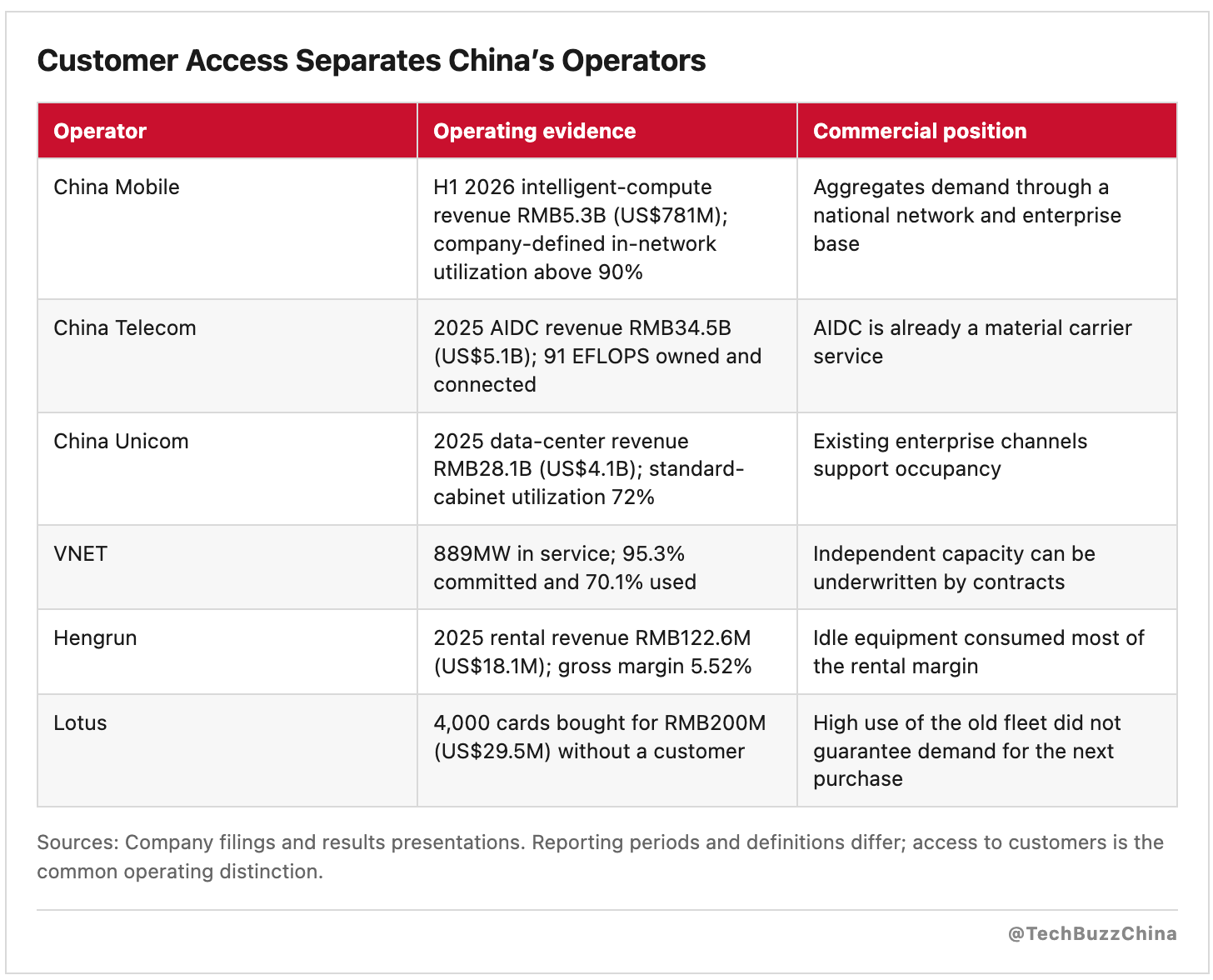
China Mobile’s advantage is not simply that it owns a lot of compute. It already has enterprise customers, national networks and cloud services, so it can sell computing without requiring customers to find and manage the underlying machines themselves. Its intelligent-computing services generated RMB5.3 billion (US$781 million) in the first half of 2026, part of a much larger RMB52.9 billion computing-services business. China Telecom and China Unicom have similar distribution reach.
That matters because China’s AI hardware is unusually fragmented. Nvidia remains in the installed base alongside Huawei and other domestic accelerators, which use different software environments and have different performance characteristics. A model optimized for one chip may need to be adapted for another, and large training jobs add the challenge of getting thousands of processors to communicate reliably.
This is a difficult problem, but Chinese companies are already building software to address it. Phancy, formerly Fourth Paradigm, has developed software for scheduling different kinds of accelerators and supporting multiple domestic chip platforms. SenseTime’s SenseCore similarly manages multiple types of AI hardware through a common computing layer.
That potentially gives carriers and large cloud providers an important role. They can combine customer demand and national networks with software that routes work onto whatever compatible hardware is available. The customer buys a computing service; the operator deals with the chips and software underneath.
Nor does the operator have to be a state carrier. VNET ended 2025 with 889 megawatts of wholesale capacity in service, 95.3% committed and 70.1% actually in use.
Then: the geography
Hardware is only one source of fragmentation. China also has a lot of computing capacity in places where its customers are not.
Most technology companies and enterprise demand are concentrated in eastern China, while western and northern provinces offer cheaper land, cooler climates and abundant energy. East Data, West Computing, with eight national hubs and ten clusters, is designed around that mismatch.
The growing importance of inference may make that geography easier to exploit. Inference accounted for slightly more than half of China’s reported AI data volume in 2025, 101.34 exabytes out of 199.48, while the National Data Administration separately estimated about 21.1 quadrillion token calls during the year. Neither figure measures revenue, but inference produces many smaller jobs that operators can potentially distribute across customers and locations.
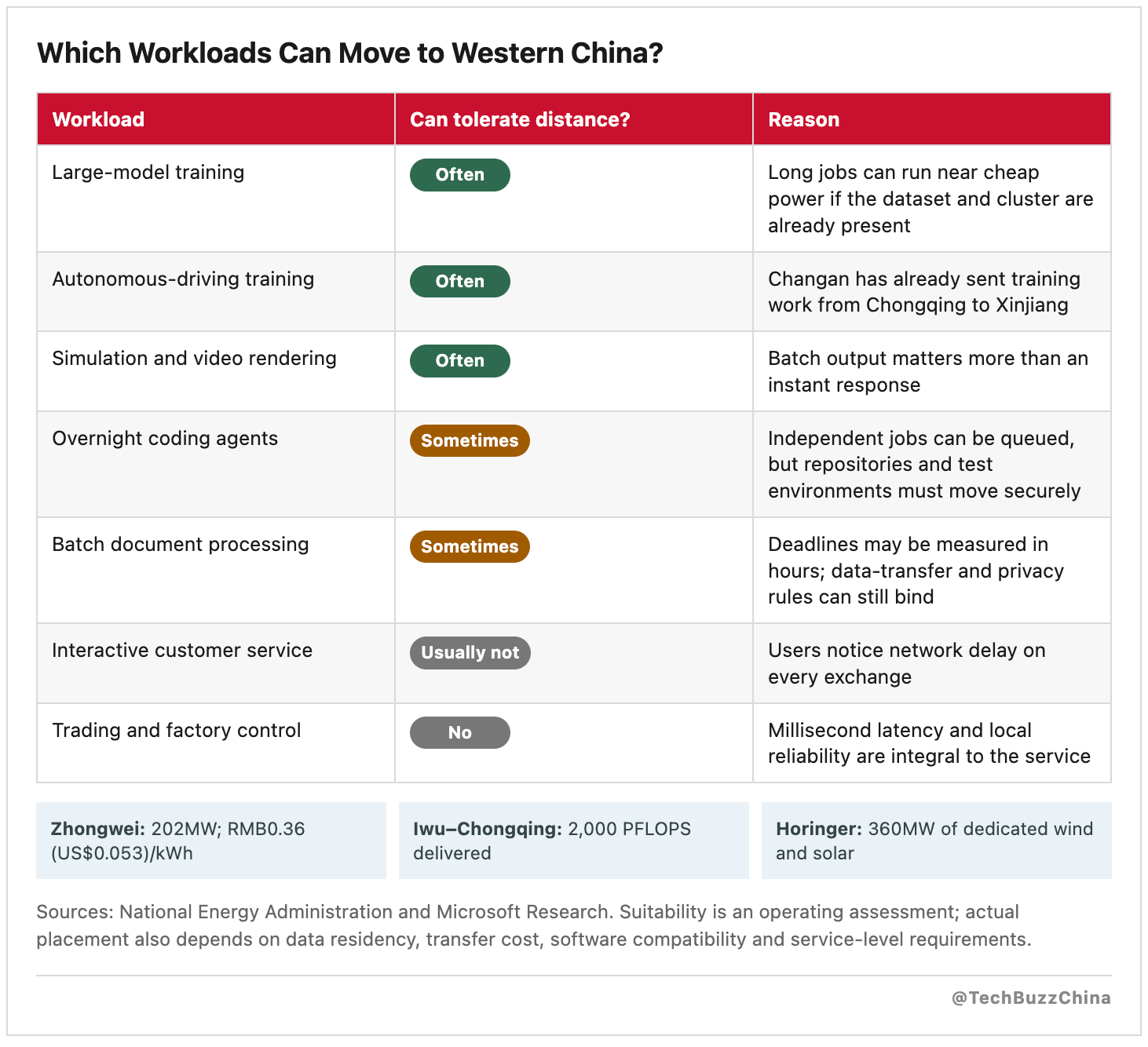
China Mobile’s newly operational B Park in Zhongwei, Ningxia, shows why they would want to. The campus has 202 megawatts of IT power, uses direct solar, storage and a self-built distribution network, and retains the public grid as backup. More than 80% of its electricity is green, with a comprehensive power cost of RMB0.36 (US$0.053) per kilowatt-hour. That is about 38% below the 2025 US average industrial retail price, although the two are not directly comparable tariffs.
The harder question is what work can actually move there. Xinjiang’s Iwu county has already supplied 2,000 PFLOPS of rated green computing capacity to Changan Automobile in Chongqing for autonomous-driving model training. The computation ran near the western power source and returned its results east.
Agentic software could enlarge that category. Interactive services still need to respond quickly, but thousands of unrelated coding, research or document-processing jobs can be queued and sent wherever compatible capacity is available. Microsoft researchers have found a similar opportunity in mixed inference, where delay-tolerant requests can be routed separately from interactive ones to use processors that might otherwise sit idle.
3. Who Pays When China Builds Ahead of Demand?
The downside of getting demand wrong is already showing up among China’s smaller compute lessors. Jiangsu-based Hengrun, a listed manufacturer that expanded into AI compute rentals, generated RMB122.6 million (US$18.1 million) from the business in 2025 but earned a gross margin of just 5.52%. The biggest problem was hardware sitting idle: RMB34.5 million (US$5.1 million) of depreciation was charged against unused equipment. Hengrun calculated that without that charge, gross margin would have been 33.60%.
Lotus, the “King of MSG” we met earlier, faced a different version of the same problem. It disclosed RMB1.228 billion (US$181.0 million) of compute contracts terminated during 2025. Most of its rental contracts run for just one year, and the longest for about 4.4 years, while its servers depreciate over eight. Customers can disappear much faster than the hardware does. Its compute subsidiary lost RMB28.6 million (US$4.2 million) in 2025.
Yet losses like these do not necessarily stop the next data center from being built, because China has several ways to finance capacity before commercial demand is proven.
The largest technology companies and carriers can do it themselves. Alibaba has committed at least RMB380 billion (US$56.0 billion) to cloud and AI infrastructure over three years, while China Mobile plans RMB37.8 billion (US$5.6 billion) of computing-network investment in 2026. Both already have cloud or AI products and enterprise customers, allowing them to invest across the stack rather than depend on a single compute-rental contract.
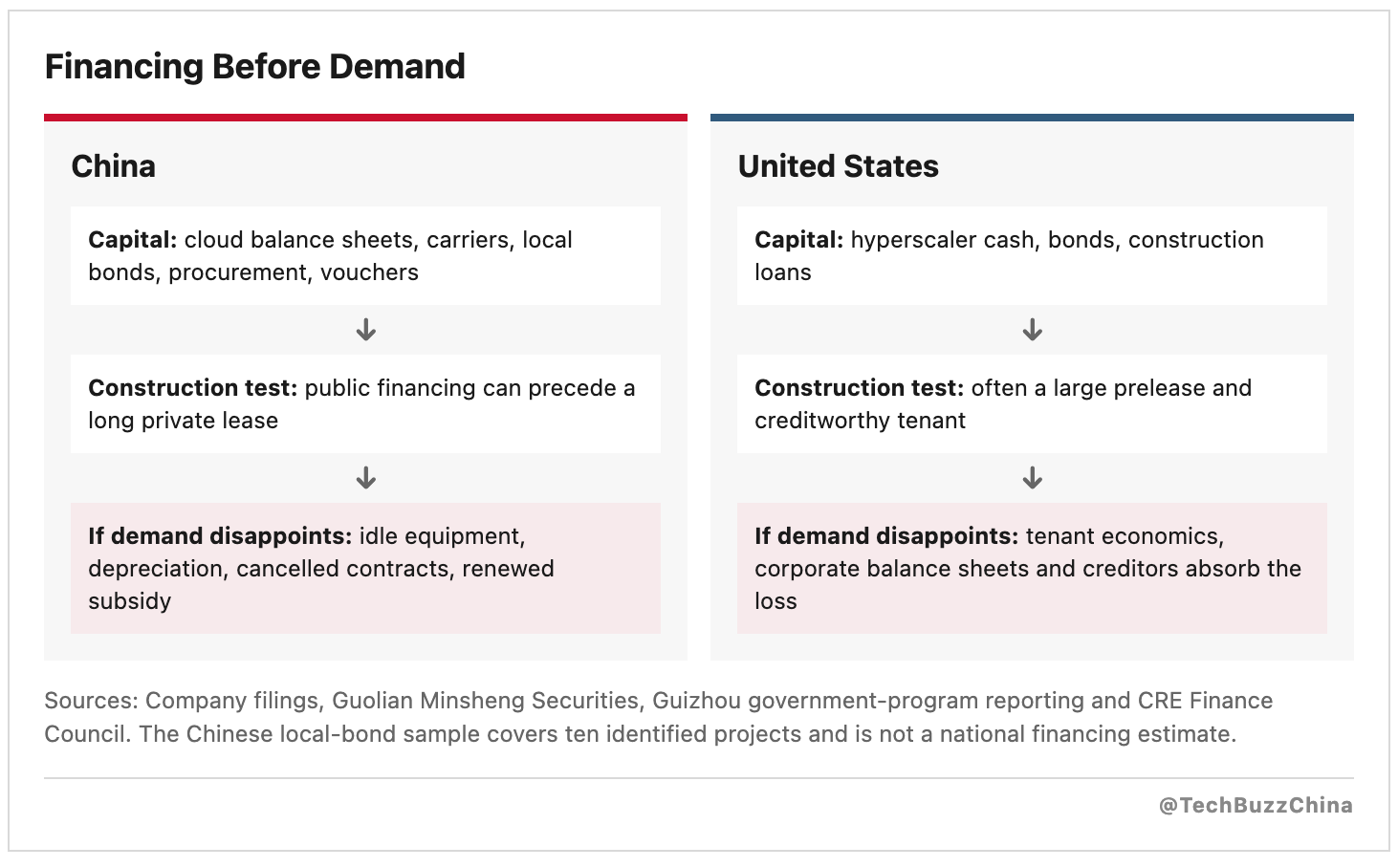
Local governments provide another route. In a ten-project sample compiled by Guolian Minsheng Securities, special-purpose local-government bonds were expected to fund RMB3.36 billion (US$495 million), or 54%, of total investment. RMB1.58 billion had been issued by Aug. 21. The sample is small, but it shows how a project can secure substantial financing without first finding a hyperscaler willing to lease the entire facility.
Government support can bring demand forward too. Guizhou budgeted RMB140 million (US$20.6 million) for computing vouchers in 2026, generally covering 30% of eligible spending. By midyear, more than RMB130 million had been redeemed by over 260 recipients, more than 90% of them from outside the province. The subsidy can persuade a customer to try Guizhou compute; whether that customer comes back at full price is the real commercial test.
Beijing is already putting limits on the weakest projects. Under a 2024 four-agency plan, cities where data centers have been operating for more than a year but still have equipment installed in fewer than half their racks should generally stop planning new clusters and large or ultra-large centers.
The US also finances infrastructure before anyone knows whether the AI running inside it will ultimately make money, but the risk is usually moved somewhere else before construction begins. A 2026 CRE Finance Council market primer put senior construction loans at 55% to 65% of development costs and said lenders typically require about 60% of a project to be preleased. The developer has a creditworthy customer committed to paying for the building; whether that customer’s AI business earns an adequate return is another question.
The difference is not that China takes demand risk and America does not. It is when the market has to prove itself, and who is left holding the risk if it doesn’t. Parts of China’s financing system allow the building and hardware to come first and the customer later. When that bet fails, the evidence can be unusually visible: idle machines, depreciation, cancelled contracts and another round of subsidies.
4. Can China Turn Overbuilding Into a Learning Curve?
China’s hardware disadvantage is still enormous. Our aggregation of Epoch AI’s May 2026 model puts seven US-headquartered companies at about 16.6 million H100-equivalents, versus roughly 1.82 million attributed to Chinese owners including its median estimate of smuggled chips, a gap of about nine to one. Cheap electricity and clever engineering cannot make millions of missing accelerators disappear.