


Building hardware with China? Tech Buzz China is starting an experimental English-language WeChat group for hardware founders and operators learning from or sourcing through China’s supply chain. Apply here
Things you might have missed
From our recent coverage
Tencent’s Bond Sale and AI Spending — Our post examines Tencent’s bond sale and the financing of its AI infrastructure spending.
DeepSeek’s Proposed Robotics Investment — Our post covers DeepSeek’s proposed investment in Winverse AI and the cost of developing robotics models.
Huawei’s Gains in a Shrinking Smartphone Market — Our coverage distinguishes Huawei’s growth from a recovery in overall smartphone demand.
From Weijin Research
AI’s Self-Improvement Loop Still Runs on Capital — Weijin Research, a TBC partner whose work we help publish, examines the capital and real-world constraints on recursive AI self-improvement.
Where we have been featured
The Information · October 9 — We comment on competition in China’s increasingly crowded AI model market.
CNA Correspondent · October 7 — We appear in CNA’s episode on women leading China’s technology companies.
South China Morning Post · October 6 — We discuss model fatigue as China’s AI industry releases more models.
Note: We use AI extensively to research, translate, draft, and edit our articles, drawing heavily on Chinese-language sources and contributions from non-native English speakers. Our team oversees the research, fact-checking, and editorial decisions.
Carmakers Want Independence. Buyers Still Want CATL.
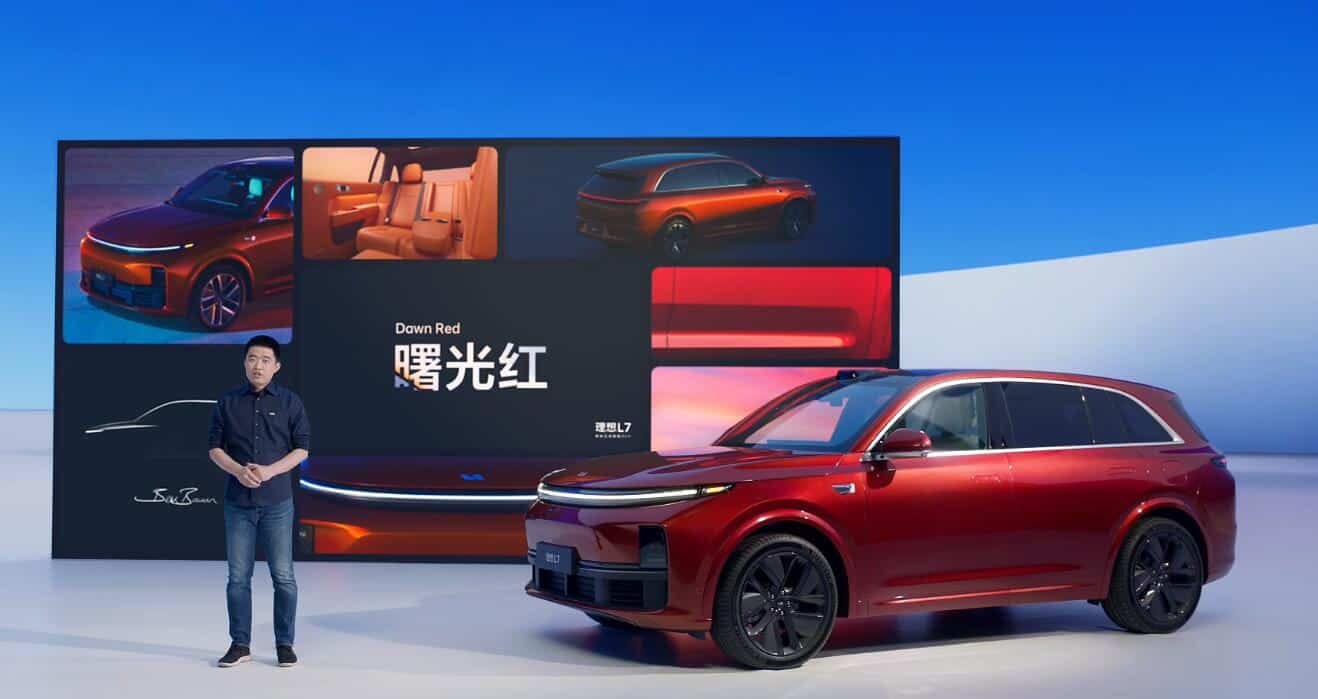
During China’s National Day holiday, a salesperson at Li Auto kept hearing the same question from prospective buyers: would the new model still come with a CATL battery? The answer was no. Li Auto had already dropped CATL from the new model’s announced supply arrangements, replacing it with batteries developed in-house and manufactured by Chinese suppliers Sunwoda and CALB. By then, CATL-equipped versions of the outgoing i6 were largely sold out, according to an October 12 report by TechPlanet. Yet customers were still asking for CATL, illustrating the tension between automakers seeking greater control over their most expensive component and buyers who continued to trust the established battery supplier.
Li Auto is hardly alone in seeking greater control over its batteries. At the September launch of its Longjia battery, Xiaomi, the consumer-electronics giant turned automaker, outlined a similar approach: it would define the product, participate in cell development, lead battery-pack development and oversee production quality, while leaving cell manufacturing to Chinese suppliers Sunwoda and CALB, according to Xinhua. The emerging division of labor allows automakers to take greater control of battery design and performance without investing in their own cell factories, while giving them more freedom to choose which manufacturers receive their orders.
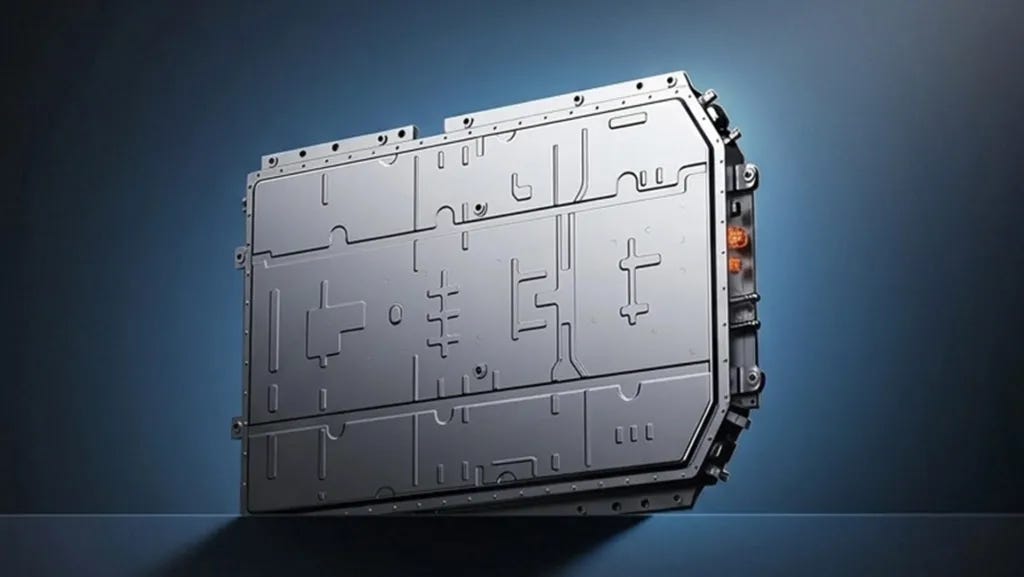
For CATL, these developments come at an uncomfortable moment. Its mainland-listed shares had fallen 20.7% over the three months through October 9, according to Goldman Sachs, as investors reassessed the outlook for the world’s largest battery manufacturer. The growing independence of its automotive customers raises questions about how much of their business CATL can retain, and whether it will have to accept less favorable terms to keep it.
Yet CATL’s operating performance tells a very different story. According to SNE Research, CATL supplied 333.0 gigawatt-hours (GWh) of batteries installed in electric, plug-in hybrid and hybrid vehicles registered worldwide during the first eight months of 2026, up 25.2% from a year earlier. Its global market share climbed from 37.7% to 39.4%, figures that do not even include its growing energy-storage business. CATL is gaining ground even as its customers seek alternatives, and that contradiction lies at the heart of the company’s challenge: automakers want greater control over their batteries, but CATL remains extraordinarily difficult to replace.
More Batteries, Less Profit Per Unit
CATL’s growing market share has not prevented analysts from lowering their earnings forecasts. The concern is not that the company is running out of customers, but that its extraordinary manufacturing scale may no longer translate into the same earnings growth investors have come to expect. As battery production expands, CATL faces a more complicated set of pressures involving costs, the profitability of different products and, increasingly, how much bargaining power it retains over the automakers that buy its batteries.
Both Morgan Stanley and Goldman Sachs have lowered their earnings expectations for CATL, even as they anticipate continued growth. Morgan Stanley cut its 2027 earnings-per-share forecast by 7.9%, while still expecting earnings to grow 18.3% that year. Goldman Sachs similarly expects battery sales to grow 58% year on year in the third quarter, but net profit to rise by a slower 30%. The concern is profitability, not demand: CATL may continue selling more batteries while earning less on each unit, as taxes, export rebates and changes in its product mix put pressure on margins. For a company whose dominance has been built on manufacturing scale, the question is increasingly whether that scale can continue delivering the same economic rewards.
Not all of these pressures come from automakers demanding better terms. CATL earns higher margins on complete battery systems and overseas energy-storage projects than on standalone cells, meaning that delays in recognizing revenue from those projects can weigh on quarterly profitability even when demand remains strong. The company also faces potential inventory losses if raw-material prices decline, along with uncertainty over taxes and export rebates. These risks have prompted Goldman Sachs to lower its earnings forecasts for 2026 through 2028 despite raising its sales-volume projections. What CATL sells and how much profit it retains are becoming just as important as how many batteries it produces.
These financial pressures help explain why CATL’s growing sales have not translated into equally strong investor confidence. But they tell us relatively little about the potential threat from automakers developing their own batteries. The real question is what “self-developed” actually means: whether carmakers are simply taking greater control of battery design or moving manufacturing orders away from CATL altogether.
What Carmakers Are Actually Taking From CATL
Automakers developing their own batteries are not necessarily preparing to manufacture them. Most are taking greater control over design and engineering while leaving production to established suppliers, although who makes the cellsultimately determines whether CATL keeps the manufacturing orders.
Leapmotor, for example, plans to use CATL cells in its D-series vehicles while developing the battery pack, battery-management software and integration with the vehicle itself, according to Automotive Pixel. The company is separately pursuing its own cell-manufacturing program, which could eventually reduce its reliance on outside suppliers. For now, however, CATL retains the cell business even as Leapmotor takes responsibility for more of the finished battery system.
Li Auto has gone further into cell development, although it still relies on outside manufacturers. The company began its battery program in 2020 and now designs the chemistry and structure of its cells while developing and manufacturing the packs installed in its vehicles. Its president and chief engineer, Ma Donghui, acknowledged in September that developing batteries internally was not necessarily cheaper once annual research and development spending was included, according to National Business Daily. The investment is instead giving Li greater control over battery performance, production specifications and the relationship between the battery and the vehicle.
A battery cell is the individual unit that stores energy, while the pack combines cells with the cooling systems, structural components and electronic controls needed to operate inside a vehicle. By designing the cells and producing the packs itself, Li can determine how those components work together without operating its own cell factories. Li executive Liu Liguo has also pointed to gaps between manufacturing records and the charging and service data collected once vehicles are on the road. Better access to that information could help Li diagnose faults, make repair decisions and improve subsequent designs, particularly when customers hold the automaker responsible for problems regardless of who manufactured the battery.
Li’s program is already reaching production vehicles. Its self-developed batteries appeared in the L8 in June, followed by the L6 and i8, according to Caixin. Initial batches of the updated MEGA and i9 continued using CATL batteries, with transitions planned as alternative supply expanded. The shift is proceeding across individual models rather than through an immediate replacement of CATL throughout Li’s lineup.
Xiaomi is taking an equally hands-on approach to its manufacturing partners. According to Caijing, Xiaomi’s quality teams stationed at supplier factories can inspect production data and halt manufacturing lines, while changes to materials, equipment suppliers or production parameters require its approval. Xiaomi is asserting control over factory decisions without taking on the cost and complexity of manufacturing cells itself.
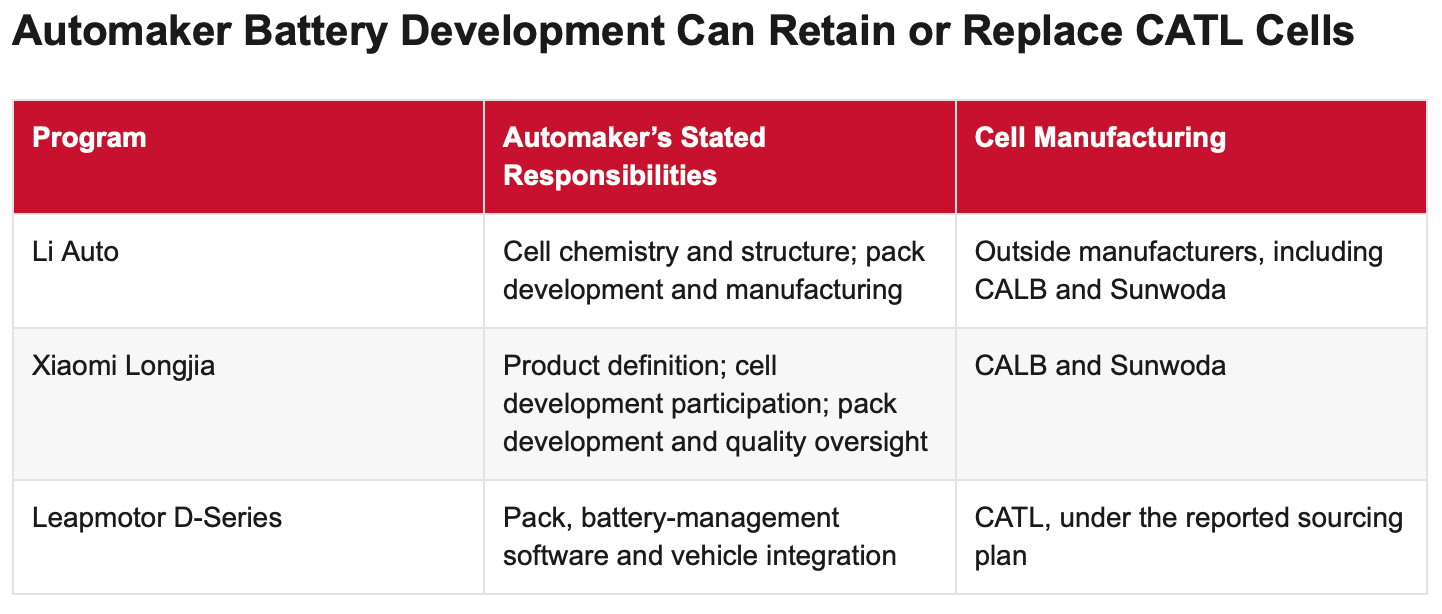
For CATL, the implications are quite different depending on how far each automaker goes. Designing battery packs in-house may reduce the engineering work CATL performs, but the company can still supply the cells. When those orders move to Sunwoda, CALB or another manufacturer, CATL loses the business regardless of who designed the battery. The bigger threat is the emergence of credible alternative suppliers, which could give automakers more leverage over prices and contract terms even when they continue buying from CATL.
Designing a Battery Is Much Easier Than Making Millions of Them
Automakers may be gaining control over battery design, but CATL argues that its greatest advantage lies in something considerably harder to replicate: manufacturing enormous quantities of batteries with consistent quality. At a September 3 industry event, chairman Zeng Yuqun emphasized that making a battery was relatively straightforward compared with producing billions of cells to the same standard, according to CATL’s published speech. Manufacturing consistency at scale is central to CATL’s case for why customers should continue relying on specialist suppliers, even after developing their own battery technology.
During CATL’s September Global Open Month, chief manufacturing officer Ni Jun made a similar point: knowing how to manufacture cars does not necessarily mean knowing how to manufacture batteries, according to Yicai. Battery manufacturing requires its own expertise, from controlling production processes to maintaining quality across millions of cells, and the ability to design a product does not guarantee the ability to manufacture it economically.
Greater customization can also make switching suppliers more difficult. A battery designed around a particular chemistry, shape or production process may require specialized equipment, production adjustments and extensive testing before another factory can manufacture it reliably. Owning the design does not necessarily mean owning the supply chain, particularly when moving production to another manufacturer involves additional investment, time or compromises on cost and quality. Automakers gain meaningful negotiating leverage only when alternative suppliers can deliver the same specifications at an acceptable price and on a workable schedule.
Li Auto’s relationship with Sunwoda shows how much investment that can require. According to a September 5 filing, Li proposed investing RMB2.65 billion ($394 million) in Sunwoda Power, the vehicle-battery subsidiary of Chinese manufacturer Sunwoda. The proposed investment would give Li a financial stake in one of the manufacturers supporting its battery strategy, strengthening cooperation while also exposing it to the supplier’s financial performance. Building an alternative supply chain can require substantial capital, not simply engineering expertise or a decision to redirect orders.
Sunwoda Power’s financial results illustrate the challenge. According to its parent’s interim report, the subsidiary nearly doubled its revenue in the first half of 2026 and narrowed its losses, but its operating cash outflow increased. Rapid growth was still consuming cash, reflecting the financial demands of expanding battery manufacturing even as sales improved. Building a credible alternative to CATL requires financing production capacity as well as developing competitive technology.
For automakers, greater control over battery design can improve vehicle performance, quality and supplier selection, but replacing CATL’s manufacturing role requires another company capable of producing those batteries reliably and at scale. CATL’s advantage lies in the manufacturing infrastructure and expertise it has already built, while its competitors must continue investing to close the gap. How much pricing power that advantage provides will depend on how quickly alternative suppliers improve and how much automakers are prepared to spend supporting them.
Not Everyone Is Moving Away From CATL
But perhaps the headlines about automakers breaking free of CATL are getting ahead of the reality. While some Chinese carmakers are working to reduce their dependence on the battery giant, others are deepening their relationships with it. On October 10, CATL announced a long-term agreement with SERES, the Chinese automaker behind the AITO brand, to continue supplying batteries across AITO’s vehicle lineup. The two companies also plan to expand their co-located manufacturing arrangement, adding a second phase with annual capacity of 10–12 gigawatt-hours (GWh). Rather than developing alternative suppliers, SERES is moving battery production closer to its vehicle assembly operations, potentially improving coordination and lowering costs while relying on CATL’s manufacturing expertise. The additional capacity is still in the planning phase, but the agreement offers a striking contrast to the moves by Li Auto and Xiaomi.
CATL is also making its engineering capabilities more attractive to manufacturers that might otherwise develop their own battery systems. Its TECTRANS II platform, introduced in September for commercial vehicles, standardizes battery-pack dimensions, electrical connections and communication systems, allowing manufacturers to adopt future battery technologies without repeatedly redesigning their vehicles. For makers of trucks and other commercial vehicles, lower development costs and easier upgrades could be powerful incentives to stay with CATL, particularly when vehicle purchases are driven by operating economics rather than consumer preferences.
CATL’s influence also extends to the people buying the vehicles. During its September Global Open Month, announced in chairman Zeng Yuqun’s September 3 presentation, the company opened its manufacturing operations to visitors, showcasing the production processes and quality controls behind its batteries. That effort builds on the consumer recognition already evident in Li Auto’s dealerships, where buyers continued asking for CATL even after the automaker had announced alternative suppliers. CATL has become a brand in its own right, potentially giving automakers a reason to retain it beyond the usual calculations of price and performance.